
Composting toilets have become essential fixtures in off-grid cabins, tiny homes, RVs, and boats where traditional plumbing isn’t practical. Understanding the individual parts that make up these systems helps you maintain, repair, and optimize your setup for years of reliable use.
This guide is for DIY builders, off-grid homeowners, RV and boat owners, and anyone interested in understanding or maintaining composting toilets. Knowing each part helps you choose, maintain, and troubleshoot your composting toilet for optimal performance.
Key components of a composting toilet include a urine separator, solids container, ventilation fan, and cover material. Composting toilets are complemented by a comprehensive selection of parts and accessories that ensure a seamless waste separation process. These are the components users are likely searching for when looking to build, upgrade, or maintain their composting toilet system.
This guide breaks down every component you’ll encounter, from structural elements to accessories that enhance daily comfort.
- Quick overview: main composting toilet parts
- Core structural components of a composting toilet
- Urine diverter and waste separation parts
- Solids container and lining parts
- Liquids container, drain and hose components
- Ventilation and exhaust system parts
- Comfort, hygiene and accessory parts
- Installation materials and mounting hardware
- Spare parts, lifespan and maintenance
- Matching parts to your specific composting toilet system
Quick overview: main composting toilet parts
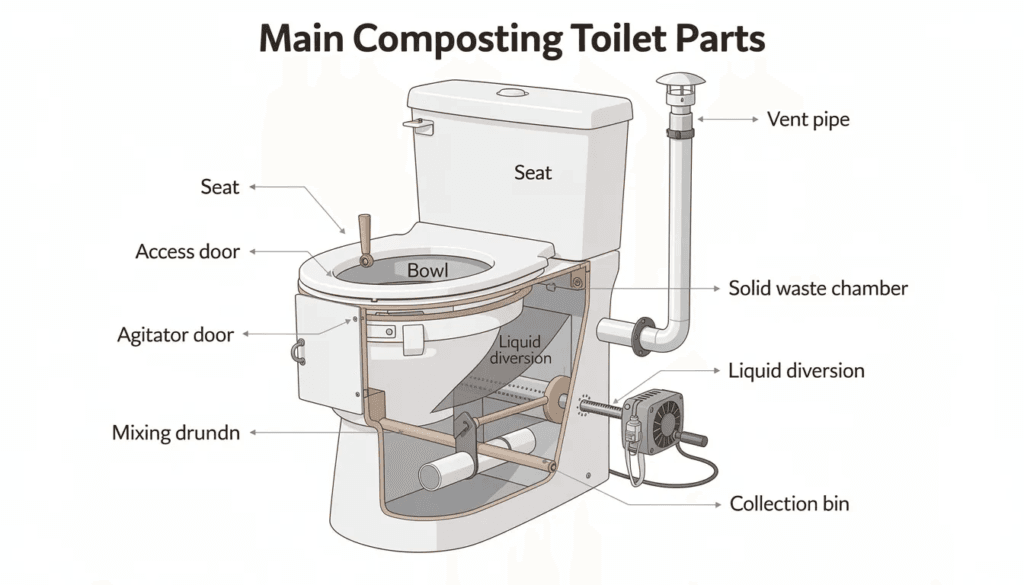
Before diving into the details, here’s a quick snapshot of the core parts you’ll find in a typical composting toilet system. These components work together to create an efficient, odor-free sanitation solution.
The essential parts include:
- Toilet body/box – The outer cabinet housing all internal components
- Urine diverter – Separates liquids from solids at the source
- Solids container – Holds dry waste and cover material
- Liquids container or drain – Collects or routes urine away
- Toilet seat – The user interface mounted on top
- Vent/exhaust system – Removes moisture and odors
- Access hatch or lid – Provides entry for emptying and maintenance
These parts are common across setups in off-grid cabins, RVs, tiny house builds, boats, and backyard composting installations. If you’re planning a compact home, it also helps to understand tiny house septic options for sustainable living. Later sections will cover each component in depth, plus replacement parts, toilet accessories, and installation materials needed for a complete system.
Definitions of Key Composting Toilet Components:
- Urine diverter: A urine diverter separates liquids from solids, which is critical for odor control and effective composting.
- Solids container: The solids container holds dry waste and cover material, providing a space for decomposition to begin.
- Liquids container: The liquids container collects urine, keeping it separate from solids to manage moisture and prevent odors.
- Ventilation system: The ventilation system removes moisture and odors, supporting aerobic microbial activity and maintaining a fresh environment.
- Cover material: Cover material, such as sawdust, peat moss, or coconut coir, is added after each use to balance moisture, support decomposition, and control odors.
These components work together to manage moisture, airflow, and microbial activity, ensuring a hygienic and efficient composting process.
Core structural components of a composting toilet
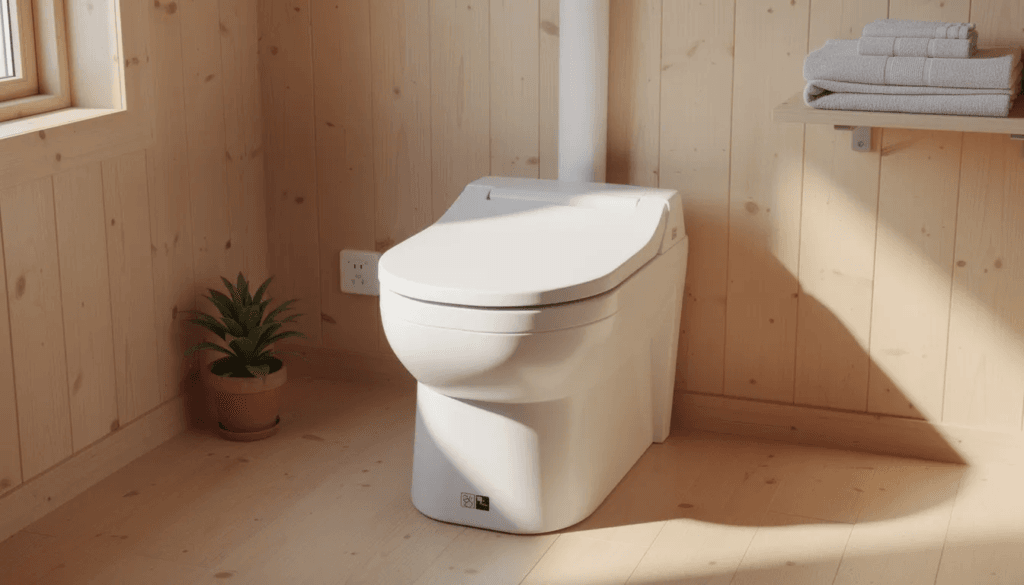
Structural parts form the “shell” of your composting toilet. They must be strong enough to support regular use, easy to clean, and sized correctly for your available space.
The toilet body typically consists of a rectangular cabinet design with a hinged top and front access panel. Inside, internal dividers or frames keep solids and liquids containers secure during use and transport—especially important for mobile applications like RVs and boats.
Common materials include:
Material | Best For | Notes |
|---|---|---|
18mm birch plywood | Cabins, tiny homes | Durable, easy to customize |
Marine-grade coatings | Boats, coastal areas | Moisture resistant |
Stainless steel hardware | All environments | Prevents corrosion |
Compact laminate | High-moisture spaces | Wipeable, hygienic |
Design considerations include footprint dimensions (typically 40–50cm width for small spaces), comfortable sitting height (roughly 42–47cm), and sufficient load capacity for all users. |
The toilet body
The toilet body is the visible furniture piece that houses all other components. Think of it as the foundation that everything else connects to.
A standard body uses 6-panel construction: four sides, a top, and a bottom. Each panel includes clearly labeled cut-outs for the diverter, seat mounting, and exhaust pipe. This modular approach makes it easy to customize height and depth for different users and spaces—whether you’re fitting a tiny house bathroom or a spacious cabin.
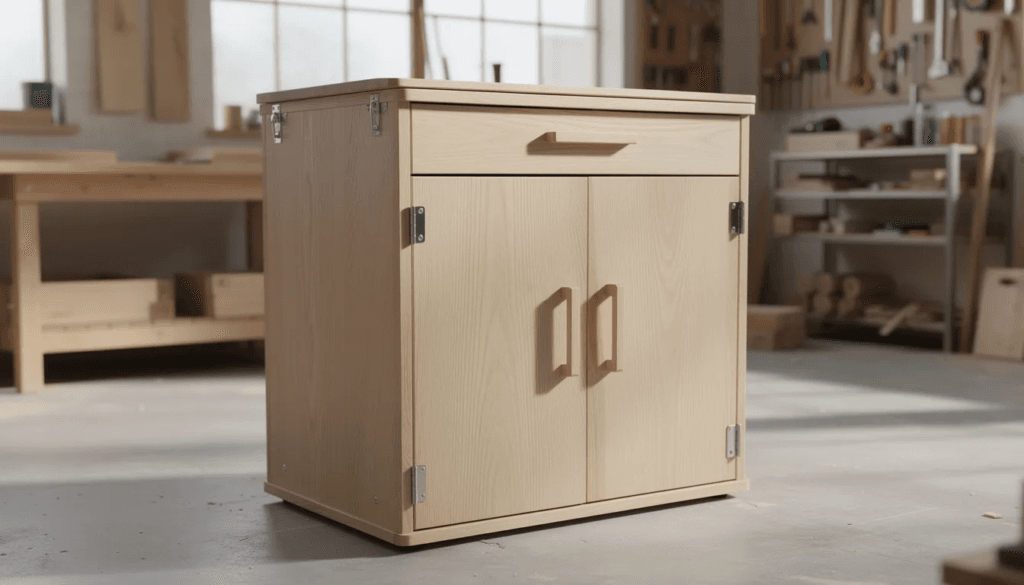
Finishing options matter for both appearance and hygiene:
- Clear varnish for natural wood look
- White paint for modern aesthetics
- Laminate fronts for maximum durability
Smooth, wipeable surfaces are important because they simplify cleaning and prevent moisture damage. For access, look for designs with a removable front panel or lift-up top—this makes container removal and maintenance fast and convenient.
Access lids and hatches
Lids and hatches give you access to solids and liquids containers without dismantling the whole toilet. Getting this right makes a lot of difference in daily usability.
The main types include:
- Top-hinged lid with gas struts – Stays open hands-free during emptying
- Removable seat ring panel – Lifts off completely for deep cleaning
- Front service hatch – Allows container swap-out without disturbing the seat
Small parts like hinges, magnetic latches, and rubber seals significantly affect how the toilet performs day-to-date. Quality hardware prevents rattling, ensures a tight seal, and extends the life of the unit.
For RVs and boats, child-safe or travel-safe closures are worth considering. These prevent accidental opening during movement and keep everything secure on the road or water.
Urine diverter and waste separation parts
Separation of liquids and solids is the heart of modern composting toilets. This simple principle dramatically improves odor control and makes handling waste much easier.
The urine diverter is a shaped plastic or composite bowl that directs urine forward into a separate container while solids drop straight down. This keeps the solids container drier, which supports better composting and prevents the anaerobic conditions that create unpleasant smells.
Typical diverter specifications:
- Materials: Injection-molded ABS or polypropylene
- Outlet sizes: 32mm or 40mm diameter
- Compatibility: Standard toilet seat bolt patterns
Additional parts usually needed include gaskets, hose connectors, and adapters that link the diverter to your liquids container or external drain. Quality diverters reduce splashing, prevent cross-contamination, and support odorless operation even in full-time use scenarios.
Choosing a urine diverter
When selecting a diverter as a spare part or for DIY builds, several criteria determine success or failure of your system.
Key factors to evaluate:
- Slope and contour – Ensures reliable flow without pooling
- Surface smoothness – Easier to clean, less odor retention
- Outlet size – Match to your hose and container inlets (32mm vs 40mm)
- Seat compatibility – Must fit your chosen toilet seat footprint
Homemade diverters can create problems. They’re usually less effective at directing flow and can lead to odors or leaks compared to purpose-built parts. The small investment in a quality diverter pays off in everyday convenience and system performance.
Match your diverter outlet size to hose and container inlets from the start. Extra adapters introduce potential leak points and add unnecessary complexity to your setup.
Solids container and lining parts
The solids container holds dry waste and cover material. It needs to be easy to carry when full and simple to empty without mess.
Common container sizes:
Use Case | Recommended Size |
|---|---|
Weekend cabin | 15–25 liters |
Full-time use | 30–35 liters |
RV/van life | 20–25 liters |
Shapes vary between rectangular bins and round buckets. Heavy-duty HDPE plastic is standard because smooth inner walls simplify cleaning and prevent waste from sticking. | |
Liners and consumables count as “parts” too: |
- Compostable bags sized to fit your specific container
- Optional absorbent pads for extra moisture control
- Cover material storage containers
Design details like integrated handles, transport lids, and secure positioning tabs inside the toilet body make the difference between a system that’s easy to maintain and one that becomes a chore.
Solids container accessories
Small parts on the solids side make daily use more convenient and less hands-on.
Key accessories include:
- Replacement lids – Snap-on caps for transport and storage
- Clamping rings – Keep liners securely in place during use
- Built-in frames – Hold bags open for easy change-over
Odor-control accessories attach near the solids area to enhance performance. Charcoal filters and dispensers for cover material (sawdust, coconut coir) keep things fresh between emptying cycles.
Liquids container, drain and hose components
The liquids side can use either an internal urine canister or a fixed drain line to an external tank. Your choice depends on your setup and how often you want to empty containers.
Internal urine containers range from 5–10 liter canisters for vans to 15–20 liter versions with secure screw caps for cabins. Spout styles vary—angled necks prevent splashing during emptying, while quick-release couplings allow fast removal without tools.
Drain and hose parts for external routing include:
- Flexible PVC tubing (typically 32mm diameter)
- Barbed fittings and elbows
- Wall bulkhead fittings
- Hose clamps
Route hoses with enough slope to avoid standing liquid. Even small pooling areas can create odor backflow into your living space.
Internal urine canisters
Dedicated urine canisters are common spare parts that need periodic replacement due to staining or wear.
Transparent canisters let you see fill level at a glance, while opaque versions offer a cleaner look. Fill level markings help prevent overflow—a common issue when multiple variants of container sizes are available.
Compatibility matters:
- Match canister inlet to your diverter outlet size
- Ensure leak-proof screw or bayonet caps
- Check that carrying handles are sturdy
Compact dimensions suit under-seat spaces in tiny houses and RVs where every centimeter counts.
External drainage and tanks
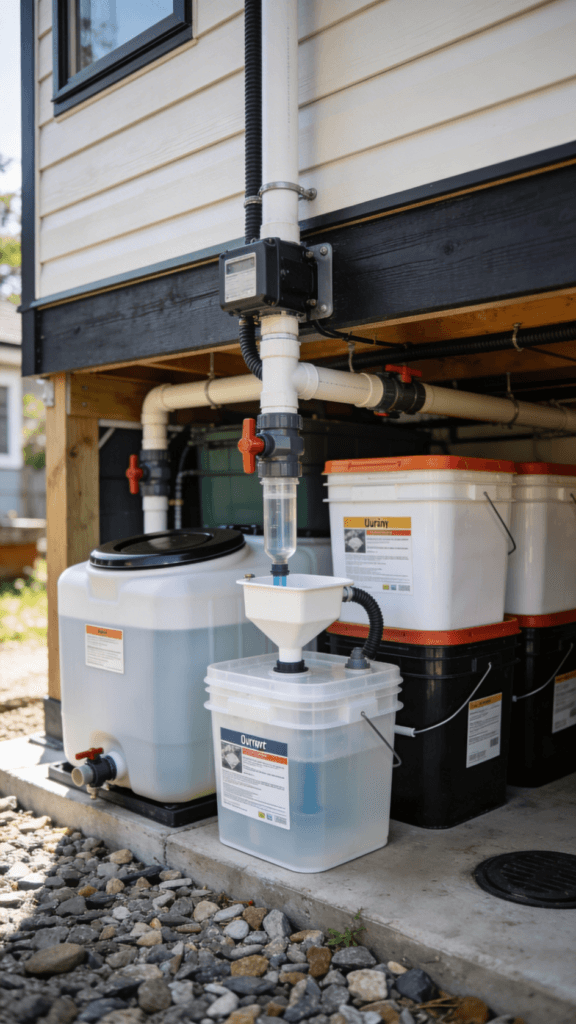
External drainage works well for longer stays, larger households, and mobile homes with existing grey-water tanks.
Key parts for external systems:
- Hose adapters at the diverter outlet
- Shut-off valves for maintenance
- Y-connectors for multiple drain points
- Connections to grey-water tanks on motorhomes or boats
Include odor traps in your design—either a U-bend or waterless trap valve—and ensure proper venting of external tanks. A fan-assisted exhaust is highly recommended when urine drains externally to prevent smells from entering living spaces through the drain line.
Ventilation and exhaust system parts
Ventilation is crucial for odor control and moisture removal. Without adequate airflow, even well-designed composting toilets can develop problems.
Basic exhaust components include:
- Fan unit (12V DC or 230V AC)
- Vent pipe (typically 50–75mm diameter)
- Exterior wall or roof cap
- Insect screens
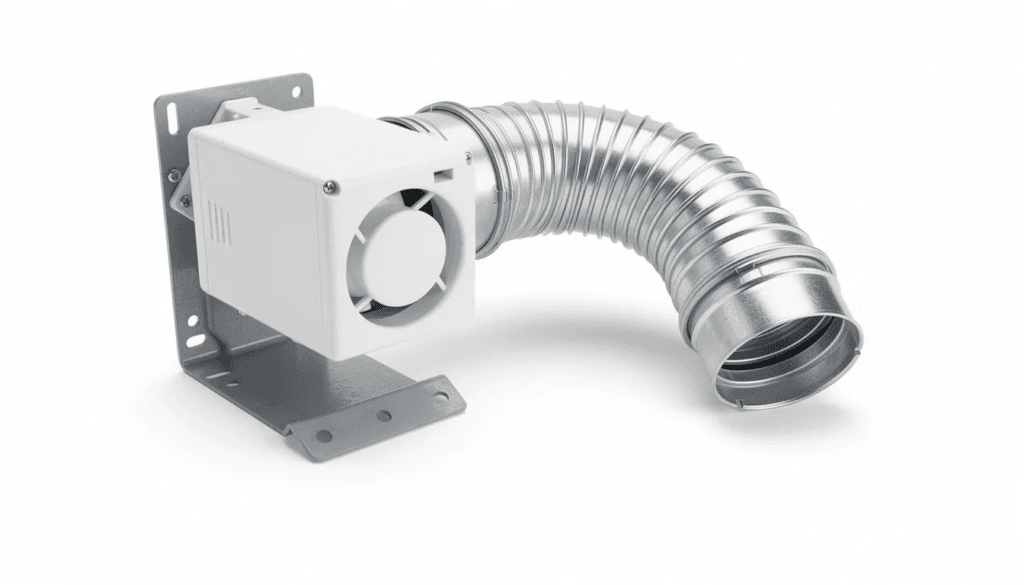
Non-electric natural vent systems rely on chimney effect with vertical pipes, but they’re less reliable in variable weather conditions. Seals and collars around pipes where they pass through the toilet body and building envelope prevent air leaks and maintain negative pressure.
Fans and filters are the most common replacement parts over the life of your toilet. Plan for easy access to these components.
Electric fan units
Electric exhaust fans are a popular upgrade or replacement part that significantly improves system performance.
Typical specifications:
Feature | 12V DC Version | 230V AC Version |
|---|---|---|
Best for | Off-grid solar | Grid-connected cabins |
Power draw | 1–5 watts | 3–8 watts |
Noise level | Low (under 25dB) | Low to moderate |
Look for weather-resistant housings and replaceable fan cartridges. Wiring considerations include inline switches, fuses, and waterproof connectors as part of the complete system. |
Vent pipes and terminations
Vent pipes carry moist air outside and must be correctly sized and routed for optimal performance.
Common specifications:
- Pipe diameter: 50–75mm (larger is better for natural draft)
- Materials: PVC or ABS plastic
- Length: As short as practical with minimal bends
External terminations include wall vents with backdraft flaps, roof cowls, and bird/insect screens. Weatherproof seals and secure brackets at roof or wall penetration points ensure your system stays functional through all seasons.
Comfort, hygiene and accessory parts
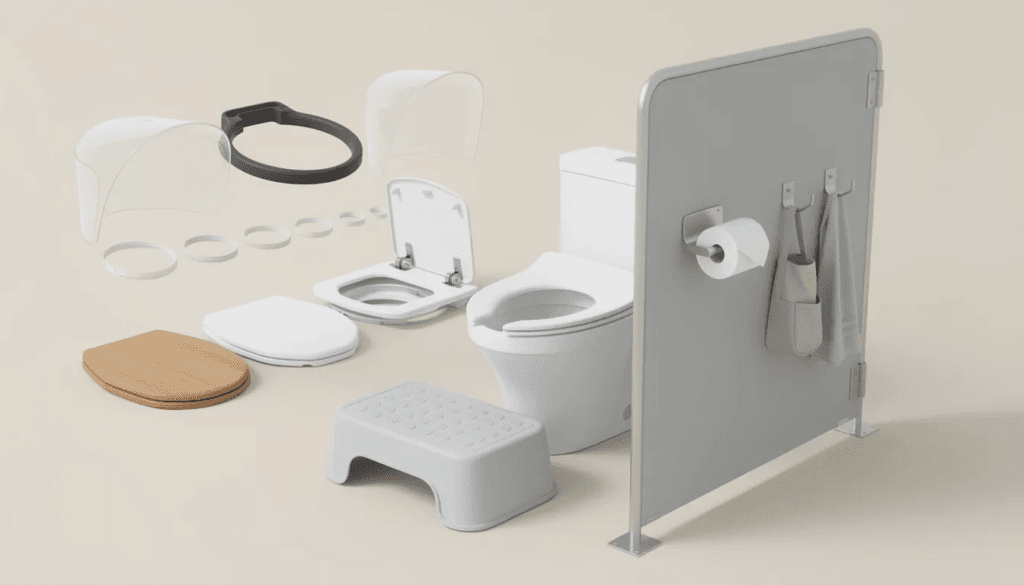
Beyond core components, accessories enhance comfort, cleanliness, and overall user experience. These are easy upgrades that make composting toilets more pleasant for everyone.
Common comfort accessories:
- Toilet seat options (wooden, plastic, soft-close hinges, family seats with child inserts)
- Splash guards and rubber edge trims
- Sealing rings to prevent leaks around the seat area
- Step platforms for shorter users
- Privacy panels, paper holders, and hooks
These accessories are straightforward to install and represent common add-ons when configuring a new composting toilet or upgrading an existing system.
Toilet seats and mounting hardware
The toilet seat is the most “felt” part of the system—it’s what users interact with directly. Getting this right affects daily comfort significantly.
Compatibility factors to check:
- Seat footprint matching diverter opening and body top panel
- Bolt spacing (standard is 150mm center-to-center)
- Hinge style (top-fix vs bottom-fix)
Replacement seat hinges, mounting bolts, and decorative caps are small but important spare parts. Both standard-size and compact seats are available for very small toilet bodies common in van conversions.
Cleaning and bio products
Eco-friendly cleaning products protect your investment and maintain system performance over time.
Recommended product types:
- Biological drain cleaners for urine lines
- Enzyme sprays for solids containers
- Mild surface cleaners safe for plastic and wood
Avoid harsh chemicals like bleach and strong acids—they can damage plastic parts, strip finishes from wood, and disrupt the beneficial microbes that make composting work. Many brands offer specialized bio-cleaners formulated specifically for composting toilet systems.
Installation materials and mounting hardware
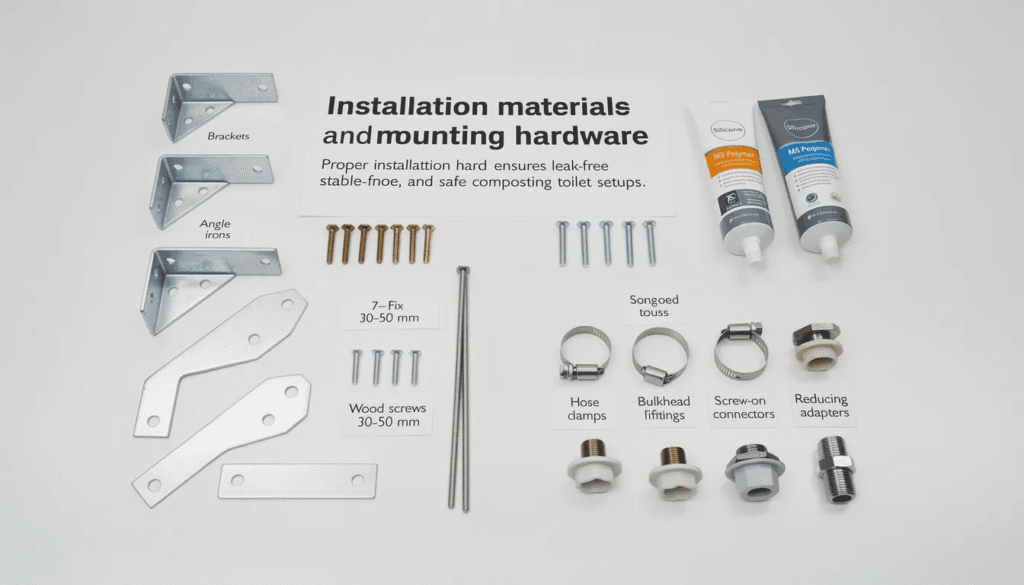
Proper installation hardware ensures leak-free, stable, and safe composting toilet setups. Cutting corners here leads to problems down the road.
Typical mounting parts include:
- Brackets to fix toilet body to floor or wall
- Angle irons and corner braces
- Wood screws of appropriate length (typically 30–50mm)
- Sealants (silicone or MS polymer) for vent pipes and hose pass-throughs
Plumbing-style parts you’ll need:
- Hose clamps
- Bulkhead fittings
- Screw-on connectors
- Reducing adapters
Consider purchasing an installation kit that bundles all small parts needed for first-time install. This saves time and ensures you have everything on hand when your project begins.
Planning for DIY installs
Building or installing your own system using individual parts requires careful preparation.
Essential planning steps:
- Create a detailed cut list for panels
- Prepare a drilling template for the diverter opening
- Map out clear routing plans for hoses and vents
- Measure your space multiple times before cutting
Basic tools required: saw, drill, hole saws (sizes matching your diverter and vent pipe), screwdriver, sealant gun, and measuring tape.
Leave access space around containers and connections. Future maintenance and part replacement becomes much easier when you’ve planned for serviceability from the start.
Spare parts, lifespan and maintenance
Composting toilets are long-term systems that rely on periodic replacement of selected parts. Knowing what to stock and when to replace keeps your system running smoothly.
Common spare parts and typical replacement intervals:
Part | Replacement Frequency | Signs of Wear |
|---|---|---|
Exhaust fans | Every 3–5 years | Increased noise, reduced airflow |
Urine hoses | Every 2–4 years | Discoloration, stiffness, odor retention |
Seals and gaskets | Every 2–3 years | Cracking, air leaks |
Containers | Every 5–10 years | Staining, brittleness |
Seat hinges | As needed | Looseness, breakage |
A simple routine inspection checklist: check for cracks in containers, leaks at connections, brittle hoses, worn seals, and noisy fans. Address issues promptly before they become bigger problems. | ||
If you’re living off-grid or traveling, keep a small stock of critical spares: extra hose sections, clamps, a backup fan, and replacement caps. Using original or high-quality compatible parts extends overall lifespan and reduces odor or failure risks. |
Eco-friendly and material choices
Part selection ties directly to environmental impact and long-term sustainability of your composting toilet system.
Sustainable choices to consider:
- Durable, repairable components over disposable alternatives
- Robust containers that last decades rather than years
- Replaceable fan modules instead of sealed units
- Recycled plastics for containers and fittings
- FSC-certified wood for toilet bodies
- Low-VOC finishes that are safe indoors
Dispose of worn parts responsibly—most plastic components can be recycled. Prioritize bio-compatible cleaners and additives that support rather than disrupt the composting process.
Matching parts to your specific composting toilet system
Not all composting toilet systems are identical. Parts must be matched to your exact model and usage scenario for everything to work correctly.
Dimensions, outlet sizes, and mounting patterns vary between manufacturers and between tiny house, RV, boat, and cabin setups. A diverter that fits perfectly in one brand may not work with another.
Before ordering, always:
- Measure carefully and document existing part dimensions
- Check manufacturer part diagrams or compatibility charts
- Verify outlet and inlet sizes match across connected components
- Confirm bolt patterns for seats and mounting hardware
Think through your daily use requirements: number of users, climate conditions, mobility needs, and desired emptying intervals. These factors determine optimal container size and ventilation strength for your situation.
The right combination of parts, spares, and accessories keeps a composting toilet efficient, odor-free, and comfortable for many years. Start by understanding what you have, plan for what you need, and don’t hesitate to contact manufacturers with questions about compatibility. A well-chosen set of components makes all the difference between a system you tolerate and one you genuinely find worth using every day.