
The housing landscape is shifting. Rising land costs, labor shortages, and growing demand for sustainable alternatives have pushed prefabricated solutions into the spotlight. Among them, the capsule house stands out as a design-forward option that delivers both form and function in a compact footprint.
This guide breaks down everything you need to know about capsule homes in 2025—from construction features and real-world applications to costs, installation, and how to choose the right supplier.
- Quick Answer: What Is a Capsule House and Why It Matters in 2025?
- What Exactly Is a Capsule House?
- Key Design and Construction Features of Modern Capsule Houses
- Capsule House vs Tiny House: What’s the Real Difference?
- Popular Capsule House Types and Model Ideas
- Where Capsule Houses Are Used: Real-World Scenarios
- Advantages of Capsule Houses
- Challenges and Things to Consider Before Buying a Capsule House
- Installation Process: From Factory to Foundation
- Costs, Pricing Models, and Value for Money
- How to Choose the Right Capsule House and Supplier
- Future Outlook: Capsule Houses and the Next Decade of Housing
Quick Answer: What Is a Capsule House and Why It Matters in 2025?
A capsule house is a prefabricated, modular micro-home typically ranging from 150 to 450 square feet, featuring a distinctive curved or faceted shell inspired by space capsule aesthetics and equipped with full residential amenities including a bedroom, bathroom, and kitchenette.
Unlike Japanese capsule hotel pods—those compact sleeping quarters under 100 square feet without private bathrooms or cooking facilities—capsule homes are self-contained dwelling units designed for permanent or semi-permanent living. They arrive from the factory with integrated utilities, smart systems, and finished interiors ready for immediate occupancy.
The 2025 context makes capsule houses particularly relevant. Urban land prices continue climbing in major markets across Europe, North America, and Asia. ADU-friendly regulations are expanding in states like California and Oregon. Eco-tourism resorts need rapid deployment solutions with minimal environmental impact. And remote workers want comfortable, functional retreats they can install on rural properties without lengthy construction timelines.
Three core benefits drive capsule house adoption:
- Fast installation: Weeks instead of months, with onsite placement typically completed in 1-3 days
- High design impact: Panoramic glass panels, LED ambient lighting, and distinctive shells that photograph well for rentals
- Engineered durability: Steel and aluminum structures rated for 150 mph winds and 50+ psf snow loads
What Exactly Is a Capsule House?
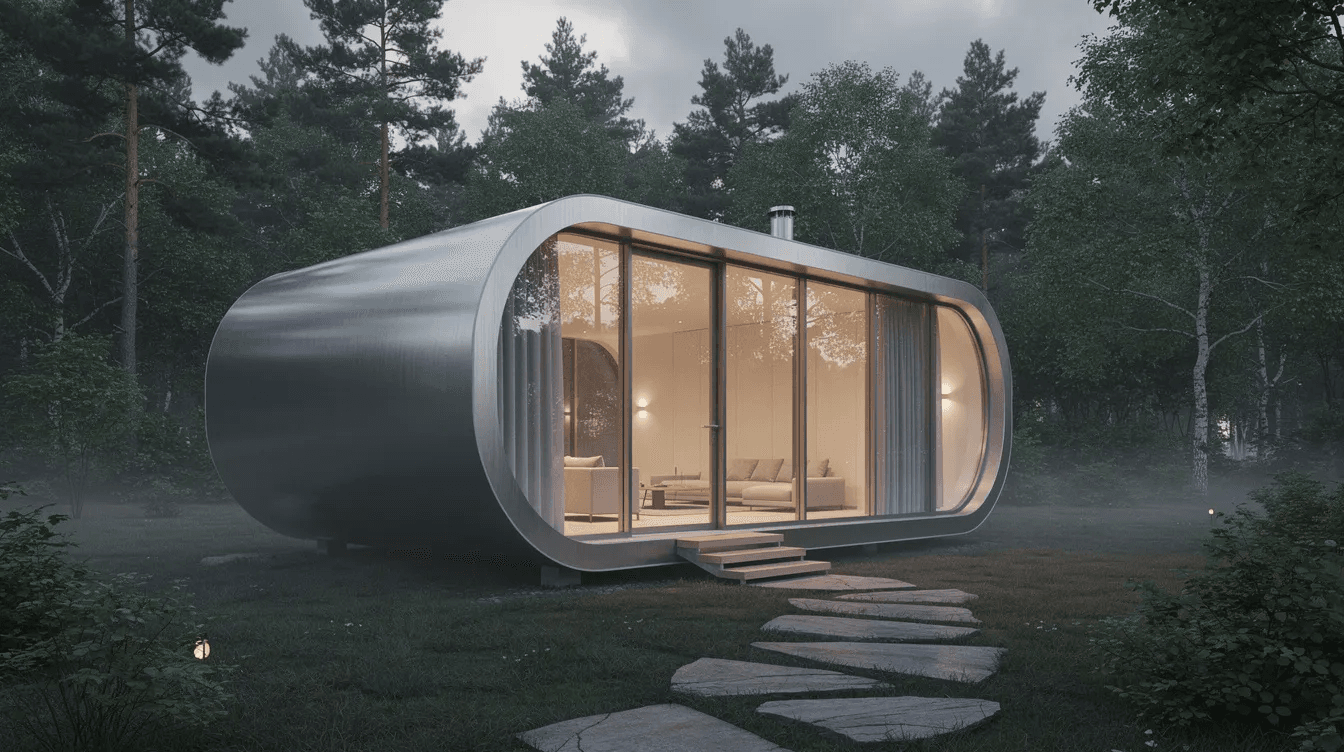
A capsule house is a compact, factory-built dwelling with a rigid structural frame, delivered almost fully finished and craned into place on a prepared foundation. Unlike site-built construction, these units leave the production line with electrical wiring, plumbing, HVAC, and interior finishes already installed.
Typical dimensions range from 18 to 40 feet in length and 9 to 11 feet in width, yielding usable areas between 200 and 420 square feet. Single-deck studio models occupy the smaller end of this range, while double-deck configurations with upstairs bedrooms push toward the larger end. Some manufacturers offer modular expansion options, allowing buyers to connect multiple units for additional space.
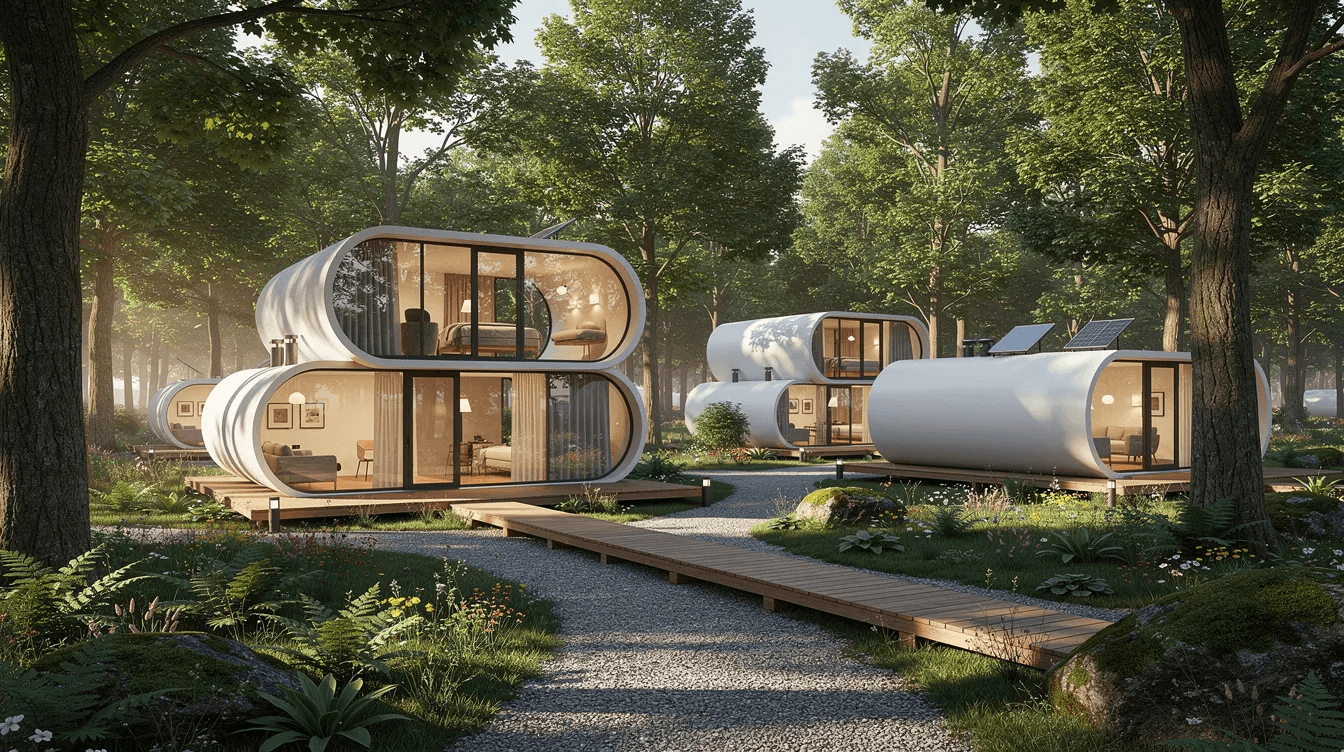
Common architectural features include rounded or faceted exterior shells clad in aluminum or composite materials, large glass surfaces covering two or three sides for natural light and views, built-in furniture like murphy beds and folding desks, hidden storage integrated into walls and floors, and smart home systems for climate control and security.
The conceptual lineage traces back to Kisho Kurokawa’s Nakagin Capsule Tower in Tokyo, completed in 1972. That metabolist experiment stacked 140 detachable capsule units on a central core, each around 100 square feet. While the building faced demolition debates by the 2010s due to maintenance challenges, it established the visual and philosophical foundation. Modern capsule houses from 2018 onward leverage advances in prefabrication technology, computer-aided design, and composite materials to transform that experimental concept into practical, durable dwellings deployable anywhere in the world.
Intended uses span permanent micro-homes for solo dwellers and couples, eco-resort units generating rental income, high-end glamping pods in scenic locations, backyard guest houses and home offices, and small rental cabins in tourism destinations that often draw inspiration from cute tiny house designs for dream homes.
Key Design and Construction Features of Modern Capsule Houses
Understanding how capsule houses are built helps buyers evaluate quality differences between manufacturers and make informed decisions about specifications.
The structural core typically consists of a galvanized steel main frame providing load-bearing capacity and rigidity. This frame supports an exterior shell of aviation-grade aluminum or composite panels finished with anti-corrosion coatings and UV-resistant treatments. Quality manufacturers engineer their designs to meet specific performance thresholds—wind ratings up to 150 mph for coastal installations and snow load capacities exceeding 50 psf for mountain sites. These aren’t marketing claims; they’re testable specifications that should appear in manufacturer documentation.
The building envelope incorporates triple-pane low-E glass with thermal breaks for superior insulation values. Premium models feature panoramic windows offering up to 270-degree views, balancing aesthetic impact with energy performance. Argon-filled glazing units reduce heat transfer by approximately 40% compared to standard double-pane alternatives. Combined with airtight construction achieving blower-door test results under 0.6 ACH50, these specifications approach Passive House standards.
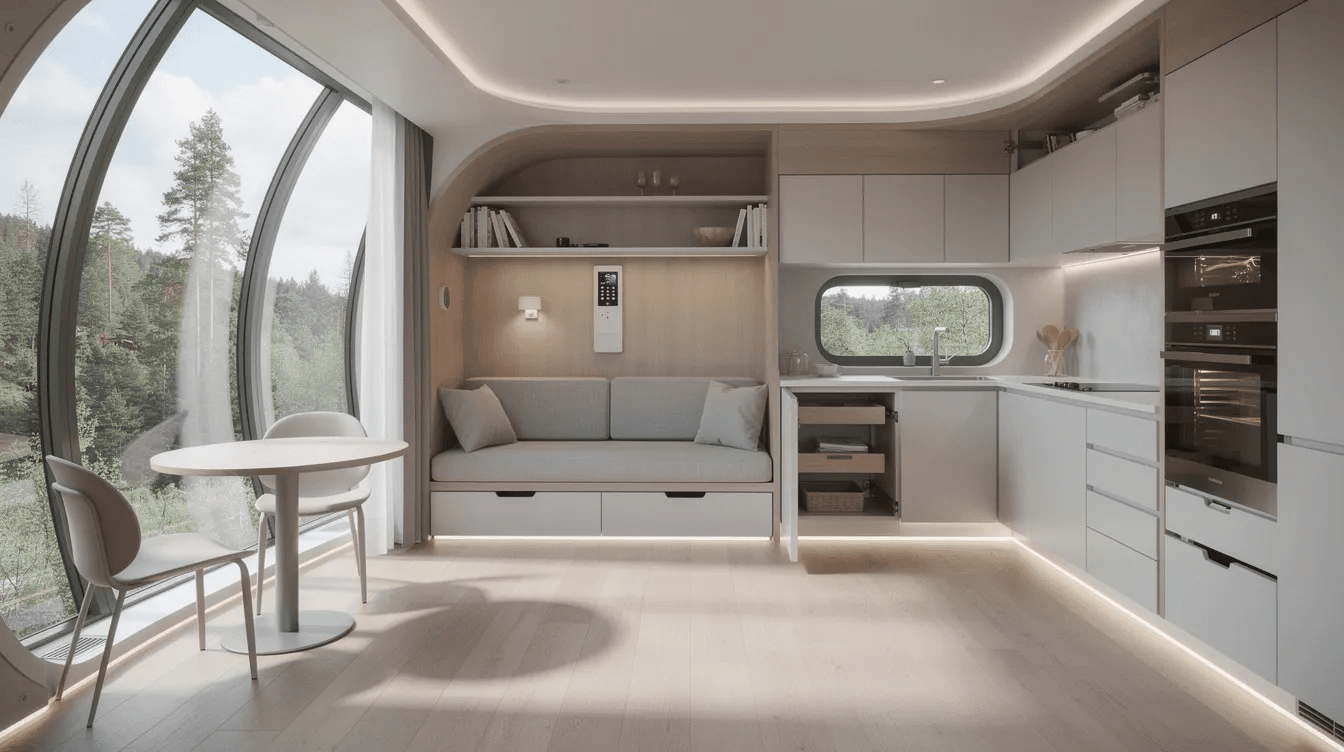
Interior layouts optimize limited square footage through open-plan designs. The typical configuration places a bed zone with either a fixed queen-sized bed or a smart folding system, a compact kitchen under 20 square feet with integrated induction cooktop, mini-fridge, and sink unit, and a full or three-quarter bathroom with shower, cassette toilet, and vanity. Built-in furniture and tiny house interior strategies that maximize every square foot eliminate the need for separate purchases and ensure every element fits the space precisely.
Utilities arrive pre-installed from the factory: 200-amp electrical wiring, PEX plumbing runs, and mini-split HVAC units with SEER ratings exceeding 25. Options include radiant floor heating and mechanical ventilation with heat recovery systems capable of recapturing up to 90% of exhaust heat—particularly valuable in cold climates where energy efficient operation becomes critical.
Smart home integrations come standard in premium models. Keyless biometric entry, app-controlled thermostats maintaining precise temperature ranges, dimmable LED strips mimicking natural light cycles, and IoT sensors for remote monitoring of humidity, air quality, and security appeal particularly to resort operators managing multiple units across a property.
Production timelines reflect industrial efficiency. From design confirmation to factory completion, expect 8-12 weeks using automated welding lines and panelizing systems. Quality checks verify waterproofing membranes and electrical systems before shipping. Modules travel via 40-foot containers or flatbed trucks, with onsite craning and hookup completed in 1-3 days.
Capsule House vs Tiny House: What’s the Real Difference?
Many people confuse capsule houses with tiny houses, but they represent fundamentally different approaches to compact living. Exploring modern tiny house designs for compact living alongside this guide helps clarify how aesthetics, mobility, and construction methods differ, and understanding these distinctions helps buyers identify which solution matches their goals.
Size and layout differences begin with exterior profiles. Tiny houses on wheels typically range from 100 to 400 square feet with conventional rectangular timber-framed shapes designed for road transport. Capsule houses commonly occupy 200 to 420 square feet with distinctive curved or faceted shells that prioritize aesthetics and structural performance over mobility.
Mobility represents the sharpest divide. Tiny homes are designed for movement—built on trailers, road-legal, and towable by standard vehicles for nomadic lifestyles. Capsule houses are manufactured as modules requiring flatbed transport and crane installation onto fixed foundations like concrete piers or slabs. Once placed, they’re not intended for regular relocation.
Construction methods differ fundamentally. Tiny houses rely on onsite or small-shop timber framing, often with significant variability and weather disruptions during builds. Capsule houses employ steel or aluminum frames with composite panels produced on automated lines, yielding precision tolerances under 1/8 inch and factory-controlled quality that minimizes defects. This industrialized approach enables consistent output at scale.
Intended use highlights philosophical differences. Tiny houses champion DIY minimalism, composting toilets, and solar setups for full-time off-grid adherents pursuing alternative lifestyles, with some elegant tiny homes that redefine modern living through design. Capsule houses target design-led applications—tech-integrated resorts, rapidly deployable micro-communities, and investment properties where aesthetics drive rental premiums.
Cost and lifecycle economics favor different choices depending on priorities. DIY tiny homes can cost less upfront, but capsule houses typically deliver 40-50 year lifespans compared to 20-30 years for wood-framed alternatives, with lower maintenance requirements due to corrosion-resistant shells and durable materials.
Key differences at a glance:
- Construction: Prefabricated steel/aluminum (capsule) vs. timber framing (tiny house)
- Transport: Flatbed + crane onto fixed site vs. trailer-towable
- Aesthetics: Futuristic curved shells vs. conventional rectangular profiles
- Production: Factory automation vs. custom small-shop builds
Popular Capsule House Types and Model Ideas
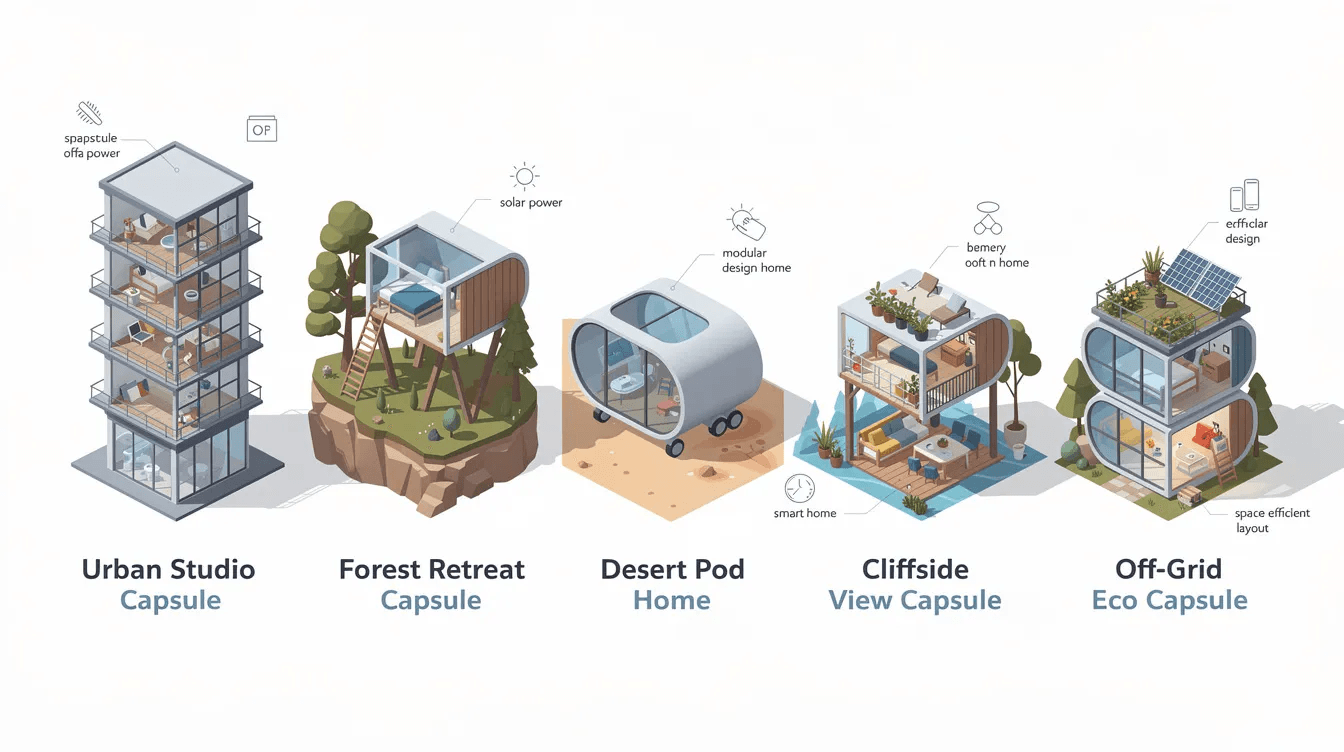
This section provides concrete examples of configurations that buyers and project developers consider in 2025, helping you visualize options before contacting suppliers.
Single-deck studio capsules occupy approximately 220 to 260 square feet with one open living-sleeping zone. A murphy bed or convertible sofa-bed, a 10-square-foot kitchenette, and a full wet-room bathroom fit within the compact footprint. These models suit solo urbanites, backyard offices, or micro-stays where multifunctional furniture like wall-mounted desks maximizes functionality in little space.
One-bedroom panoramic capsules expand to 300 to 340 square feet with a dedicated 80-square-foot bedroom separated by sliding partitions. Large glass walls comprising up to 40% of the facade flood interiors with natural light, while optional 50-square-foot balconies extend usable outdoor space. These configurations suit couples or premium Airbnb rentals, commanding 20-30% higher nightly rates due to the view-centric design appeal.
Double-deck star-view capsules reach 380 to 420 square feet across two levels. An upstairs 100-square-foot bedroom positioned beneath a transparent skylight enables stargazing from bed. The downstairs level houses a lounge, kitchen, and bathroom combination. This layout optimizes for glamping resorts and boutique hotels where elevated positioning minimizes site disturbance while maximizing the connection to nature.
Family-oriented variants cluster 350 to 400 square feet into two compact bedrooms sharing a 120-square-foot living area. These incorporate kid-safe rounded edges, loft bunks, and abundant storage drawers built into every available surface, much like well-optimized tiny house floor plans that maximize usability.
Specialized climate versions adapt standard designs for challenging environments. Winterized capsules add 4-inch rigid foam insulation boosting R-values to 30, sloped roofs designed for 100 psf snow loads, and heated floors. Tropical editions feature deep eaves providing 50% solar shading, ventilated facades, and corrosion-proof marine-grade aluminum suitable for humidity exceeding 80%.
Where Capsule Houses Are Used: Real-World Scenarios
Capsule houses are already in active use across tourism, residential, and commercial projects spanning multiple countries and climates.
Eco-tourism and glamping resorts represent the most visible application. Operators in New Zealand’s forests, Costa Rica’s beaches, and European mountain regions install clusters of 20 to 50 capsules elevated on piers to preserve soil and minimize environmental disturbance, creating experiences similar to tiny house nature retreats that immerse guests in the outdoors. These units deliver glamping experiences at $200-400 per night with 70% occupancy rates yielding attractive ROIs within 5-7 years.
Backyard ADUs and guest suites are gaining traction as municipalities liberalize accessory dwelling unit regulations. Homeowners in California, Oregon, and Washington add 250-square-foot capsules as in-law suites, home offices, or rental units, similar in function to accessory dwelling units designed to add flexible housing and rental income. Connected to existing home utilities, total project costs often land under $150,000 including permits—significantly below conventional construction for similar space.
Remote worker retreats position standalone 300-square-foot units on rural properties in Colorado, Wales, and similar locations with strong Starlink connectivity and solar arrays generating 5-10 kWh daily, mirroring many features found in self-contained tiny homes for modern off-grid living. Operating costs of $50-100 monthly enable productive getaways without ongoing infrastructure expenses.
Student and worker housing applications emerge near European university campuses and Chinese manufacturing zones, forming micro-communities of 100+ units with shared amenities like laundry facilities and common lounges. These address housing shortages in high-demand locations where traditional construction timelines can’t keep pace.
Emergency and temporary housing deployments demonstrate the flexibility of crane-ready installations. Post-disaster responses in Turkey’s 2023 earthquake zones and Ukraine aid efforts deployed capsule clusters within 48 hours for temporary shelter lasting years—far more comfortable than tents while remaining relocatable when permanent solutions become available, similar in spirit to how shipping container tiny house designs provide durable, rapid-deploy housing.
Advantages of Capsule Houses
Beyond the distinctive aesthetics, practical advantages explain why developers and individuals choose capsule houses over conventional construction.
Speed stands as the primary benefit. Factory prefabrication compresses what would be 6-12 months of site-built construction into weeks of manufacturing plus days of installation. Seasonal resorts can order in winter, receive delivery in spring, and open for summer bookings—timing impossible with stick-built alternatives.
Predictable quality results from controlled factory processes, standardized modules, and computer-aided manufacturing. Industry benchmarks suggest factory production reduces construction errors by approximately 80% compared to onsite building, where weather disruptions, variable labor quality, and coordination challenges introduce defects.
Durability and low maintenance stem from materials designed for longevity. Galvanized steel resists corrosion for decades. Multi-layer glazing with argon fills maintains performance without degradation. UV-resistant coatings on exterior shells prevent fading and eliminate repainting cycles that plague wooden structures.
Energy efficiency achieves 50-70% utility savings compared to code-minimum construction through R-30 walls, airtight envelopes, and efficient mini-splits consuming 30% less power than standard units. Optional 400W solar panels paired with 10 kWh batteries enable net-zero operation where local conditions permit.
Design impact drives 25% premium pricing in rental markets. The Instagram-worthy shells with panoramic glass attract bookings that generic cabins cannot match, making capsule investments cost effective over time despite higher upfront expenditure.
Scalability allows phased development. Start with a single capsule for proof-of-concept, then expand to villages sharing amenities like saunas, coworking spaces, and EV charging as demand validates the business model.
Challenges and Things to Consider Before Buying a Capsule House
Capsule houses aren’t a universal solution. Informed buyers should evaluate several constraints before committing.
Regulations and permits vary dramatically by jurisdiction. U.S. states like California require IBC compliance for foundations and seismic anchors, with permits taking 3-6 months and requirements differing by municipality. Some localities cap ADU square footage at 1,000 feet or mandate specific setbacks. International buyers face additional complexity with customs, duties running 5-15%, and local building code recognition of factory-manufactured housing.
Transport and access create logistical challenges for remote sites. Modules typically arrive 12 feet wide, requiring wide-access roads, clearance under bridges, and crane access with 20-ton lift capacity. Properties with narrow driveways, overhead obstacles, or steep grades may need significant site prep before delivery becomes feasible.
Upfront costs run higher per square foot than DIY alternatives. Expect $250-400 per square foot for delivered capsules compared to $150 or less for basic timber cabins or tiny houses available for purchase for budget-conscious buyers. However, total lifecycle economics often favor capsules when maintenance, lifespan, and operating costs enter calculations—making them affordable over 40-50 year horizons.
Customization limits lock in once production begins. Structural changes after design approval are difficult or impossible. Finish-level modifications like flooring materials, fixture selections, and color choices typically carry 5-8% premiums but remain available. Buyers must finalize layouts early and accept that factory efficiency requires standardization.
Resale and financing present obstacles in some markets. Banks undervalue prefab homes in regions without established valuation methods. 2025 sees emerging loan products treating capsules as manufactured housing, but buyers should verify financing availability before committing. Resale depends heavily on local acceptance of prefabricated construction.
Installation Process: From Factory to Foundation
Understanding the typical project timeline helps first-time buyers set realistic expectations and coordinate with suppliers effectively.
Pre-project steps begin 3-6 months before delivery. Site selection should consider solar orientation, views, utility access, and drainage. Geotechnical soil tests confirm bearing capacities above 2,000 psf for foundation design. Permit applications detail wind loads, snow loads, and compliance with local codes. Foundation prep—whether helical piers spaced 8-10 feet or slabs poured to 4-inch thickness—proceeds while manufacturing occurs.
Manufacturing stage runs 8-12 weeks from design approval. CAD models receive final sign-off. Materials including 2mm-thick steel, glazing units, and finish components are sourced. Assembly proceeds on automated lines with IP67-rated waterproofing and UL-listed electrical systems. Quality checks verify every system before shipping authorization.
Shipping and delivery varies by destination. Units receive weatherproof wrapping and load into 40-foot containers for ocean freight or onto flatbed trucks for overland transport. Common trade terms include CIF (seller handles shipping and insurance to destination port) or DAP (delivered to site with buyer handling final customs clearance).
Onsite installation proceeds rapidly once the module arrives. Cranes lift via integral lugs engineered into the frame, aligning the unit on pre-set foundation bolts. Weathertight seals form immediately upon placement, protecting interiors regardless of weather conditions during hookup.
Utilities hookup connects 1-inch water lines, 200A electrical service panels, and septic risers or sewer connections. Optional solar inverters, battery storage, and greywater systems install according to local regulations and buyer specifications.
Commissioning and handover includes 24-hour testing of all systems, documentation of warranties (typically 10-30 years structural, 5 years waterproofing), and establishment of maintenance logs. Certified installers provide training on smart systems and routine maintenance procedures.
Costs, Pricing Models, and Value for Money
Understanding how capsule house pricing works helps buyers compare quotes accurately and budget for complete projects.
Base unit prices from manufacturers cover the fully finished module: structure, interior finishes, bathroom fixtures, and basic appliances. This figure excludes land, site work, and logistics—meaning the quoted price is only part of your total investment.
Additional project costs add substantially to the base figure:
Cost Category | Typical Range |
|---|---|
Site preparation | $5,000-15,000 |
Foundation (piers or slab) | $10,000-20,000 |
Utility connections | $10,000-25,000 |
Crane hire | $3,000-8,000 |
Shipping (international) | $8,000-20,000 |
Customs duties | 5-15% of unit cost |
Furniture and finishing | $5,000-15,000 |
Pricing terms shift responsibility between buyer and seller. EXW (Ex Works) means the buyer handles all logistics from factory pickup. FOB (Free On Board) includes loading at the port. CIF (Cost, Insurance, Freight) covers shipping and insurance to destination port. DAP (Delivered At Place) brings the unit to your site with buyer handling only final customs and unloading. |
Value comparison should examine total installed cost per usable square foot alongside expected lifespan and maintenance. A capsule at $300-500 per square foot installed with 50-year durability may outperform conventional construction at $400+ per square foot requiring more frequent maintenance and shorter structural lifespan.
Financing and ROI calculations vary by use case. Cash purchases avoid interest but tie up capital. Business loans may treat capsules as equipment or real estate depending on foundation type. Resort operators project payback by multiplying expected nightly rates by occupancy—a $100,000 capsule generating $200/night at 65% occupancy produces approximately $47,000 annual revenue before operating costs.
How to Choose the Right Capsule House and Supplier
This buyer’s checklist helps evaluate different models and manufacturers before committing to a purchase.
Clarify your primary goal. Full-time residence requires maximum functionality and comfort. Rental investment prioritizes durability and design impact. Eco-resort units need consistent quality across multiple installations. Backyard offices may sacrifice kitchen facilities for workspace. Each use case drives different specifications for size, layout, and finish level.
Assess site conditions thoroughly. Climate determines insulation requirements, roof pitch for snow, and corrosion resistance for coastal humidity. Access constraints for trucks and cranes affect which suppliers can actually deliver to your property. Local code requirements for structural loads, fire safety, and foundation types may eliminate certain manufacturers from consideration.
Evaluate build quality through documentation. Request structural certifications, insulation R-values, glazing U-values (target under 0.15 W/m²K), and documented design lifespans. ISO 9001 certification indicates quality management systems. Manufacturers claiming 50-year design lives should provide testing data supporting that figure.
Check production capacity and lead times. Suppliers with automated production lines outputting 50+ units monthly—like established manufacturers in China—deliver on schedule. Smaller operations may struggle with timeline commitments, particularly for multi-unit orders. Verify realistic delivery dates before signing contracts with fixed completion requirements.
Review service and warranty terms. Multi-year structural warranties (10+ years) and waterproofing coverage (5+ years) indicate manufacturer confidence. After-sales support accessibility matters when components need service. Spare part availability ensures long-term maintainability. Global support becomes essential for international purchases.
Confirm customization options and design support. Prefer suppliers who adapt layouts, finishes, and climate packages for specific requirements while maintaining factory efficiencies. The 5-8% premium for customization typically delivers value when modifications improve functionality or regulatory compliance for your specific site.
Future Outlook: Capsule Houses and the Next Decade of Housing
Capsule houses align with broader 2025-2035 trends reshaping how the world approaches shelter. Modular construction is projected to reach 10% of global builds by 2030 according to McKinsey analyses. Climate adaptation demands resilient, relocatable structures. Experiential tourism continues favoring unique accommodations over generic hotels.
Technology integration will accelerate. AI-powered energy management systems will optimize heating, cooling, and battery storage for 20% additional savings beyond current efficiencies. Advanced composites 30% lighter than current materials will simplify transport logistics. Off-grid solar-storage systems approaching 15 kWh/m² efficiency will make remote installations increasingly practical.
Policy and planning shifts favor factory-built housing recognition in building codes. EU directives and U.S. state regulations increasingly acknowledge prefabricated construction methods, streamlining approval processes that historically complicated capsule projects. This regulatory evolution reduces barriers for both individual buyers and commercial developers.
Capsule communities represent an emerging model combining private units with shared amenities. Villages of 50+ capsules surrounding common spaces—coworking facilities, saunas, EV charging stations, community kitchens—offer social connection without sacrificing personal space. Biophilic design principles integrating natural materials like wood alongside metal and glass create environments that satisfy both aesthetic and wellness objectives.
Capsule houses won’t replace all traditional housing. Large families, those requiring extensive customization, and buyers in regions with cheap land and labor may find conventional construction more appropriate. But for flexibility-focused individuals, investment-minded developers, sustainability-conscious buyers, and anyone prioritizing speed, design, and durability, capsule homes represent an increasingly viable option.
The future of housing includes factory-built, technology-integrated, design-forward solutions delivered in weeks rather than months. Capsule houses occupy a meaningful position in that future—not as novelty items but as practical tools for modern living in an increasingly complex world.
Ready to explore capsule housing for your project? Start by researching local ADU regulations, connecting with established manufacturers through their website and email, and if possible, visiting completed installations. The best way to discover whether capsule living fits your needs is to experience the space, quality, and functionality firsthand.