

Choosing the right rv size is one of the most consequential decisions you’ll make as an RV buyer. Get it wrong, and you’re stuck with a rig that won’t fit in your favorite campgrounds, strains your tow vehicle, or leaves your family cramped on long trips. Get it right, and you unlock years of comfortable adventures.
Key factors to consider when selecting an RV include the number of travelers, intended destinations, budget, driving comfort, fuel efficiency, storage, and ease of parking.
This guide walks you through exactly how to match rv types, lengths, and classes to your specific situation—whether you’re a couple eyeing weekend getaways or a family planning full time living on the road.
Quick Answer: Best RV Sizes by Traveler Type
So what size rv do you actually need? Here’s a straightforward breakdown by traveler type and length range:
- Solo traveler or couple: 17–24 ft (class b or small class c / compact trailer)
- Family of 4–5: 26–34 ft (mid-size class c rv, class a under 36 ft, or 28–34 ft travel trailer)
- Large families / full time living: 34–40+ ft (larger class a motorhomes, fifth wheel, or 32–40 ft travel trailer)
For most new RV owners, the 28–32 ft range hits the sweet spot. You get enough sleeping space and living space for a family without the major maneuvering headaches that come with larger units.
Here’s something many first-time buyers don’t realize: campsite length limits at popular destinations are often stricter than expected. Many U.S. national park campgrounds were built before 1980 and cap rv length at roughly 30–35 ft. If Yellowstone, Yosemite, or Great Smoky Mountains are on your bucket list, that 40 ft Class A might lock you out of the best spots.
The sections below explain how to balance your tow vehicle limits, camping style, and interior layout with overall length—so you can find the perfect rv for your adventures.
- Why RV Size Matters More Than You Think
- How to Choose the Right RV Size: Step-by-Step
- Step 1: Match RV Size to Your Vehicle and Towing Capacity
- Step 2: Understand RV Classes and Typical Sizes
- Step 3: Choose RV Length by Travel Style and Group Size
- Step 4: How RV Size Affects Where You Can Camp
- Step 5: Interior Layout vs. Overall Length
- Step 6: Legal, Safety, and Seating Considerations by RV Size
- Step 7: Storage, Parking, and Ownership Costs by Size
- Example Size Scenarios: Matching Real People to Real RVs
- How to Narrow Down Your Final RV Size
- What Size RV Do I Need? (Complete RV Size Guide)
- Quick Answer: Best RV Sizes by Traveler Type
- Why RV Size Matters More Than You Think
- How to Choose the Right RV Size: Step-by-Step
- Step 1: Match RV Size to Your Vehicle and Towing Capacity
- Step 2: Understand RV Classes and Typical Sizes
- Step 3: Choose RV Length by Travel Style and Group Size
- Step 4: How RV Size Affects Where You Can Camp
- Step 5: Interior Layout vs. Overall Length
- Step 6: Legal, Safety, and Seating Considerations by RV Size
- Step 7: Storage, Parking, and Ownership Costs by Size
- Example Size Scenarios: Matching Real People to Real RVs
- How to Narrow Down Your Final RV Size
Why RV Size Matters More Than You Think
RV size isn’t just about how many beds you get. It directly impacts your safety, comfort, fuel efficiency, and where you can actually camp.
Driving ease changes dramatically with length. Threading a 32 ft rig through two-lane mountain roads in Colorado demands more skill and attention than cruising in a 19 ft camper van. Class a motorhomes and large trailers require wider turns, longer stopping distances, and more careful lane positioning.
Parking options shrink as size grows. Older national park campgrounds are most friendly to RVs 30 ft and under. A compact class b rvs can access roughly 90% more campsites than a 40 ft class a—that’s not a small difference when you’re trying to book a spot at a popular park during summer.
Fuel use scales directly with weight and frontal area. Heavier, taller RVs burn significantly more fuel on major corridors like I-40 and I-95. Expect 6–8 mpg in a large diesel pusher versus 15–20 mpg in smaller rigs.
Oversizing can also strain your tow vehicle in dangerous ways. Towing a 9,000 lb trailer with a 2020 half ton truck rated for 7,500 lb isn’t just uncomfortable—it’s unsafe and potentially illegal in some states.
On the flip side, undersizing can ruin the experience. If there aren’t enough seat belts or sleeping areas for your family, those 2024 travel conditions (devices, work gear, kids’ stuff) will make every trip feel overwhelming.
Once you pick an rv length, you’re also locking in:
- Which parks and campgrounds you can book
- Where you can store it at home or in paid storage
- What kind of maintenance costs and insurance premiums to expect
How to Choose the Right RV Size: Step-by-Step
Step 1: Match RV Size to Your Vehicle and Towing Capacity
Before dreaming about floorplans or bunk beds, confirm what your current vehicle (or planned purchase) can safely handle. Your towing capacity is the non-negotiable starting point.
Here’s how typical vehicles break down:
- Midsize SUV (e.g., 2023 Toyota Highlander): tow capacity around 3,500–5,000 lb. Usually limited to 14–22 ft lightweight trailers, teardrop trailers, or pop up campers.
- Half-ton pickup (e.g., 2022 Ford F-150 with max tow package): tow capacity 10,000–13,000 lb. Can handle many 25–32 ft travel trailers or smaller fifth wheels.
- Three-quarter-ton truck (e.g., 2021 Ram 2500): appropriate for large fifth wheels in the 14,000 lb range and heavy duty truck campers.
- One-ton truck (e.g., Ford F-350): required for the heaviest fifth wheels and multiple slide outs configurations exceeding 16,000 lb.
To find your specific numbers, check two places:
- Door jamb sticker on your tow vehicle—lists GVWR (Gross Vehicle Weight Rating) and often payload capacity
- Owner’s manual—contains GCWR (Gross Combined Weight Rating) and tongue weight limits
For travel trailers, tongue weight typically runs 10–15% of the trailer’s total weight. For a fifth wheel, expect 15–25% of trailer weight transferred to the truck bed.
A critical warning: the “dry weight” on RV brochures is misleading. That number excludes water, propane, food, bikes, and all your gear. Always use the trailer’s GVWR when estimating real-world towing needs.
If you want a big 35–40 ft fifth wheel, budget for at least a 3/4-ton or 1-ton heavy duty truck—not a midsize pickup. Matching your separate vehicle to your towable rv is essential for safe travels.
Step 2: Understand RV Classes and Typical Sizes
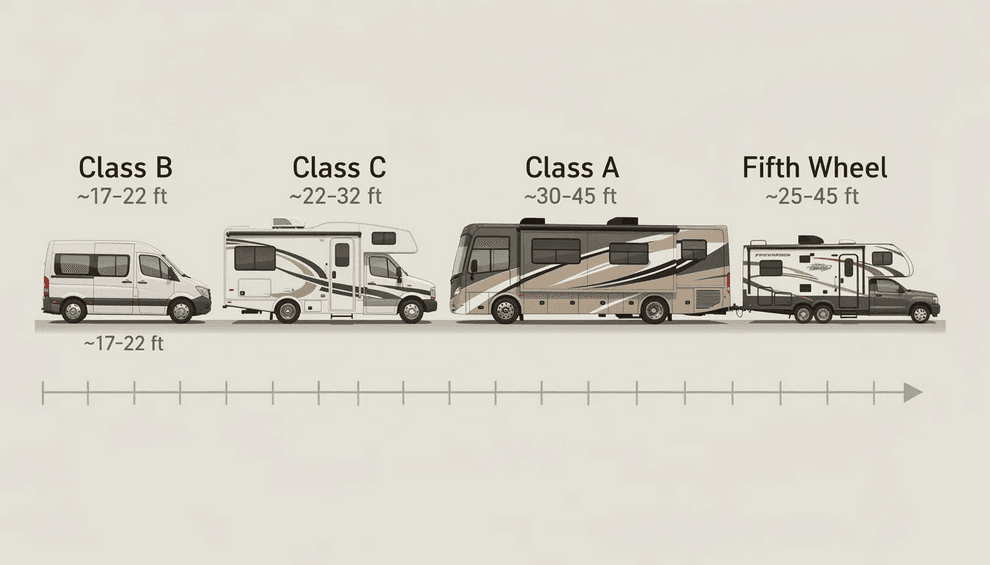
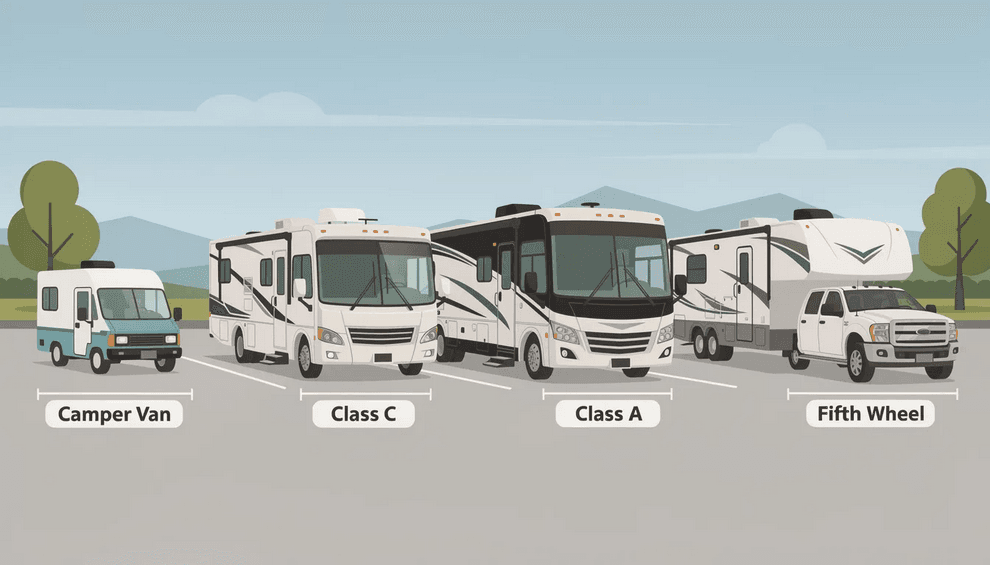
RVs come in a variety of sizes and styles, including Class A, Class B, Class C, travel trailers, fifth wheels, pop-up campers, and teardrop trailers. The size of different types of RVs are indicated by class, from Class A to C.
The question “what size rv” is partly about length and partly about class. Motorized and towable RVs have distinct characteristics, and understanding them helps narrow your options fast.
Motorized RVs
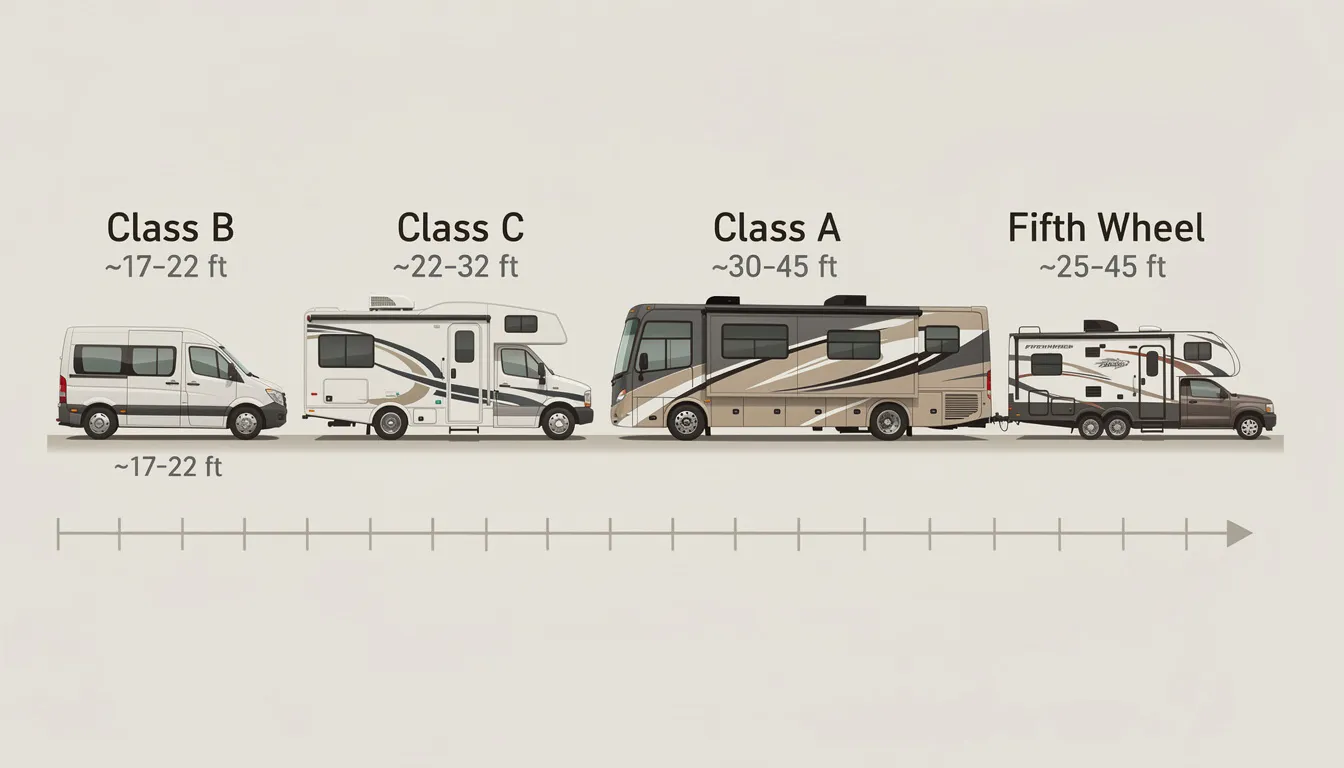
Class A motorhomes represent the largest motorized category, typically measuring 26–45 ft in length. Mainstream family rigs in 2024 often run 32–38 ft, featuring multiple slide outs and at least one full bathroom. These diesel or gas-powered coaches offer house-like amenities—king beds, washer-dryers, and full kitchens—but demand advanced driving skills and larger parking spaces.
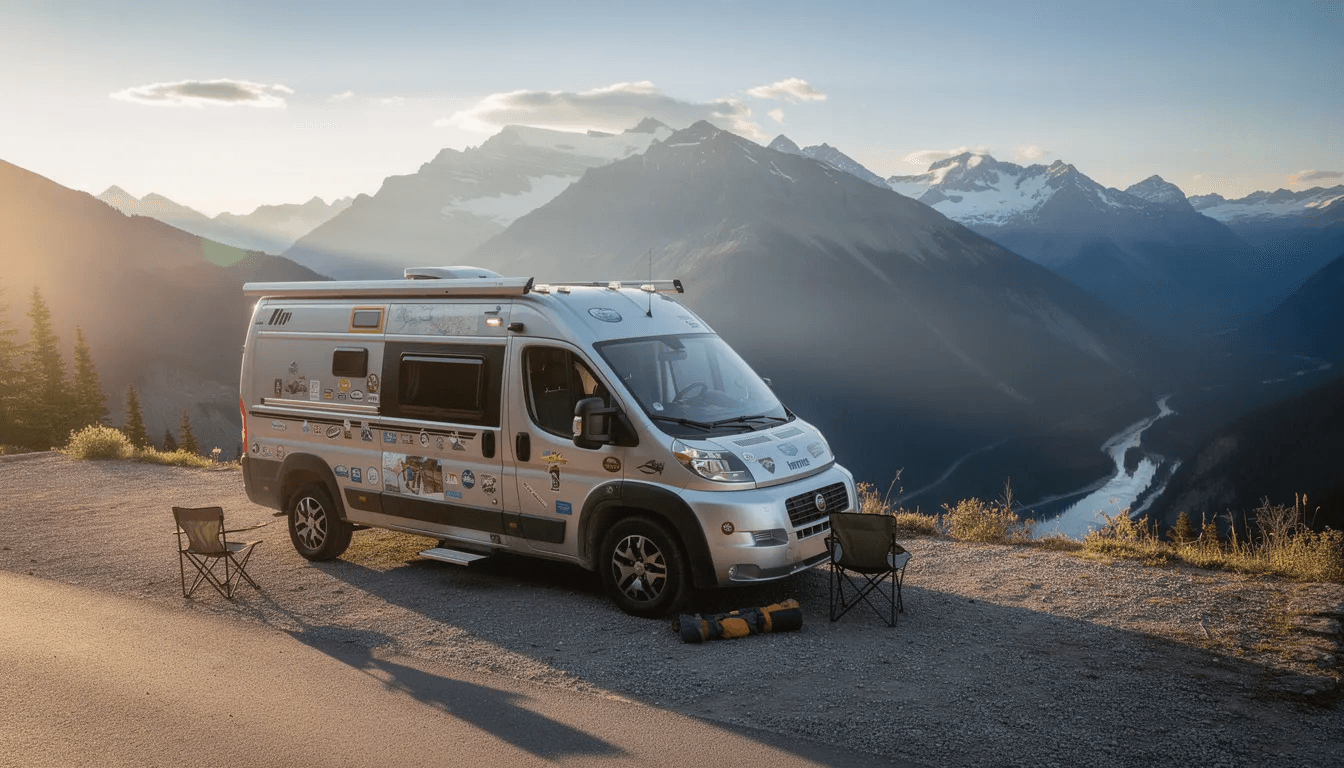
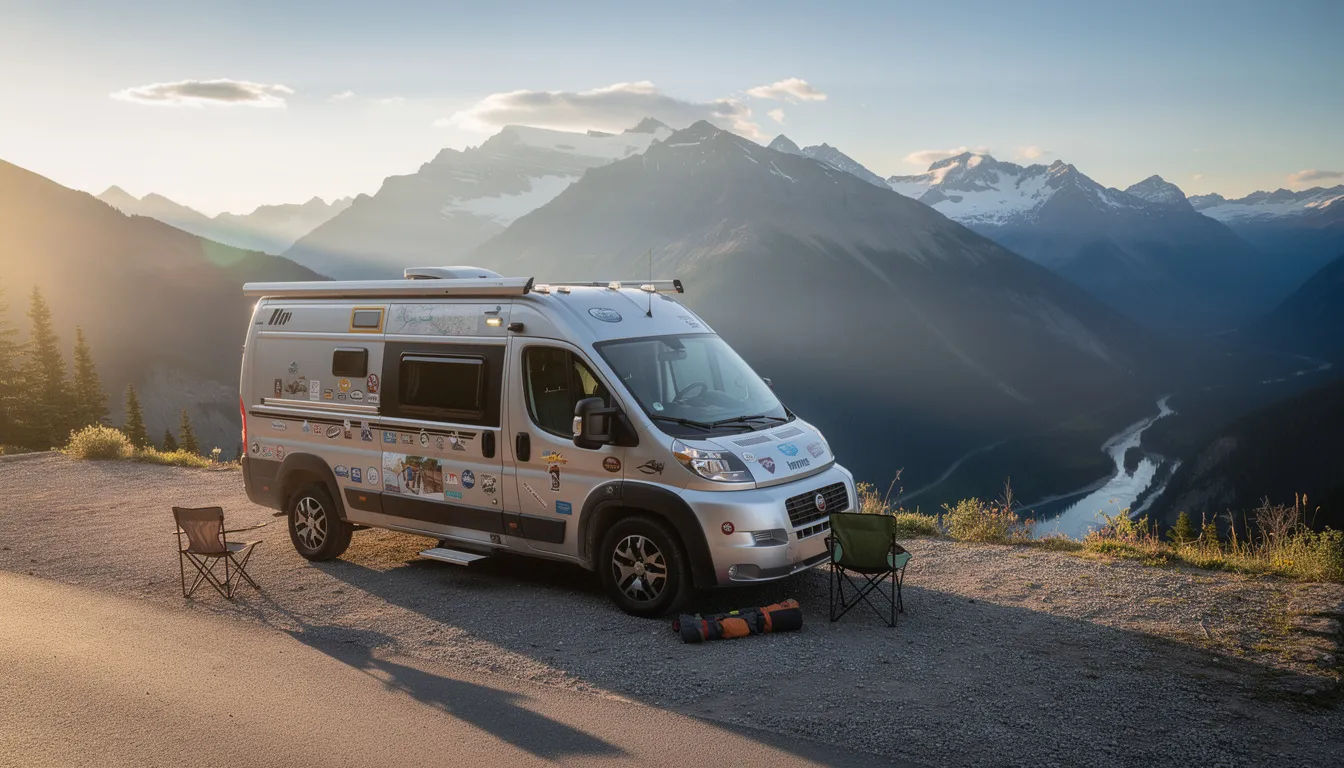
Class B motorhomes (also called camper vans) are the most compact option at 17–22 ft. Built on a van chassis like the Mercedes Sprinter or Ford Transit, they’re ideal for solo travelers or couples wanting easy city parking and better fuel efficiency. The trade-off? Limited storage and sleeping space—usually just enough for short trips rather than full time living.
Class C motorhomes strike a middle ground at 22–35 ft (averaging around 28 ft). The distinctive cabover bunk or storage area provides extra sleeping areas without adding ground-level length. Class c models are a common family choice because 28–32 ft balances ample space with reasonable maneuverability.
Towable RVs
Travel trailers cover the broadest size range at 13–40 ft. From compact teardrop trailers to 36–40 ft bunkhouse models, they can be towed by SUVs or trucks depending on weight. Their flexibility makes them popular for families who want to unhitch and use their separate vehicle for day trips.
Fifth wheels typically run 29–45 ft with a raised front bedroom that couples into a pickup truck bed. Popular for full-timers and families wanting apartment-like space, they offer stability at highway speeds and generous interior room. Expect to need a half ton or heavier truck.
Pop-up campers (or pop ups) fold down to 8–16 ft closed and expand to roughly double when deployed. At 700–4,000 lb, they’re light enough for many crossovers and midsize SUVs—great entry points for camping beginners.
Size at a Glance
RV Type | Typical Length | Typical Sleepers | Best For |
|---|---|---|---|
Class B | 17–22 ft | 2–4 | Solo/couples, weekend getaways |
Class C | 22–35 ft | 4–8 | Families, flexible travel |
Class A | 26–45 ft | 4–10 | Full-timers, luxury seekers |
Travel Trailer | 13–40 ft | 2–10 | Versatile, all travelers |
Fifth Wheel | 29–45 ft | 4–8 | Full-timers, large families |
Pop-Up | 8–16 ft (closed) | 2–6 | Beginners, light towing |
Note that longer isn’t always better for sleeping arrangements. A 30 ft class c rv can sleep as many people as a 35 ft class a due to smart bunk and dinette designs. | |||
 |
Step 3: Choose RV Length by Travel Style and Group Size
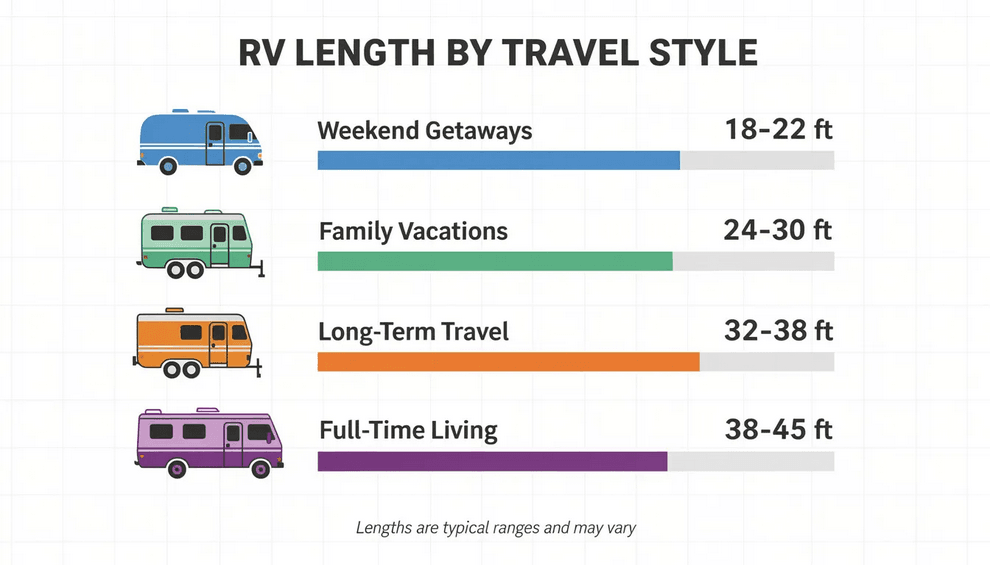
How you camp—weekends, summers, or full-time since the 2020–2024 remote work boom—heavily influences your ideal length. Your travel style matters as much as your family size.
Solo Travelers and Couples
For people who move often, boondock on BLM land, or navigate cities like Denver or Seattle, a 17–24 ft class b or small class c offers maximum flexibility. You can park in standard spaces, access more room in tight campgrounds, and enjoy better fuel economy.
If you prefer staying in one campground for a week at a time and value a real bed plus larger kitchen, a 20–26 ft travel trailer delivers more amenities without excessive length. It’s the balance many couples prefer for long trips.
Families with Young Kids (2–3 Children)
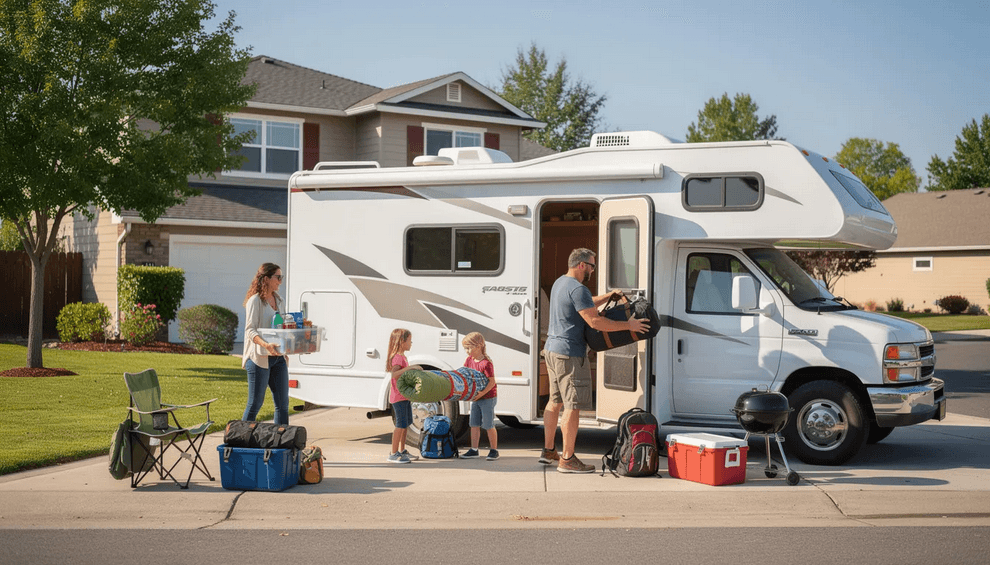
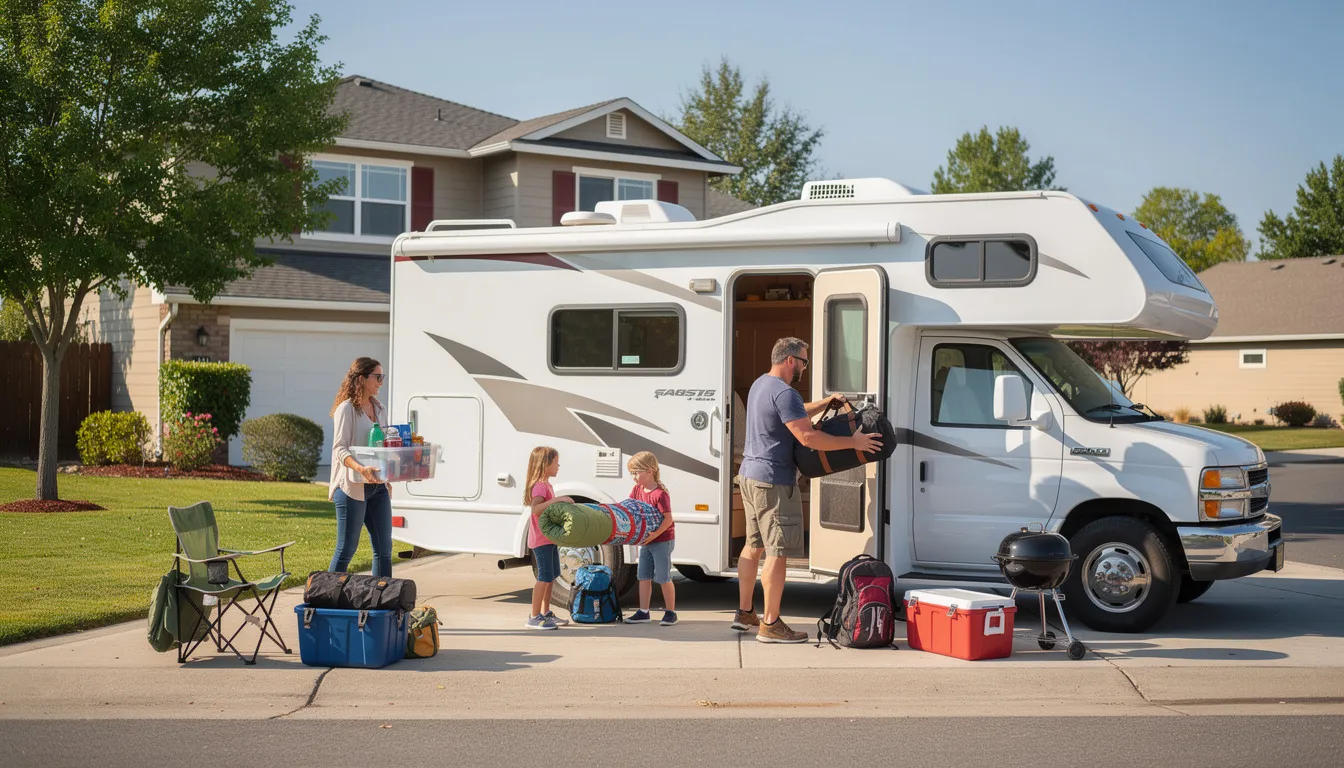
The 26–34 ft length range works well for families, whether in a class c motorhomes configuration (28–32 ft) or a bunkhouse travel trailer (28–32 ft) with at least three sleeping zones.
Look for dedicated bunk beds—common in 2021–2024 family floorplans with rear bunks. These are far more functional than converting the dinette every night, especially with tired kids. Many different models offer how much space you actually need without pushing into large trailers territory.
Larger Families or Multigenerational Groups (5–8 People)
When you need to answer how many people you’re traveling with and it’s more than five, look at 32–40 ft class a motorhomes, 30–38 ft class c with bunks, or 34–42 ft fifth wheels.
Many post-2018 bunkhouse fifth wheels include second bathrooms (half-baths)—a game-changer for morning routines and separate sleeping areas that give everyone privacy.
Full-Time RVers or Digital Nomads
For those pursuing full time living, 34–40+ ft fifth wheels or travel trailers with dedicated office space make sense. Motorized travelers often choose 30–38 ft class a rigs for the all-in-one convenience, while others might compare these to tiny house park model homes as a semi-permanent alternative for compact living.
Since remote work surged in 2020, many different types of floorplans now include dedicated desks or convertible toy hauler garages being repurposed as offices. If you’re among full time travelers, prioritize workspace alongside bedroom and bathroom features.
Don’t Forget About Pets
Large dogs need extra floor space to lie down during travel days. Cat owners may need spots for litter boxes away from main walkways. Factor pets into your size calculations—they take up more room than you’d expect.
Step 4: How RV Size Affects Where You Can Camp
Campground length limits are often stricter than buyers expect when shopping online. Your dream rv might be too big for your dream destination.
Real-World Length Guidelines
- National park campgrounds (Yosemite, Rocky Mountain, Shenandoah): Most friendly to RVs 30 ft and under. Many older loops physically cannot accommodate anything longer.
- Combined length limits: Some parks cap tow vehicle plus trailer at around 40–45 ft total. That 32 ft trailer plus your full-size truck might exceed limits.
- State parks (Texas, Florida, etc.): Generally accommodate 32–35 ft RVs comfortably.
- Private RV resorts: Near major highways, many accept rigs up to 45 ft—but check before booking.
Important clarification: Listed campsite length usually refers to pad length, not your overall rig when unhitched. A 30 ft trailer plus your truck may overhang if the pad is only 35 ft.
Maneuvering and Road Access
Hairpin turns on mountain roads in states like Colorado and Washington can be posted with advisory limits for vehicles over 35–40 ft. Tight, tree-lined campground loops become stressful—or impossible—with a 40 ft motorhome or fifth wheel.
For boondocking enthusiasts, shorter rigs (under 28–30 ft) reach more dispersed camping spots on narrow forest service roads. If winding roads and remote locations appeal to you, size down accordingly—or mix in alternative stays like yurt hut experiences when you want a different kind of nature-focused getaway.
Step 5: Interior Layout vs. Overall Length
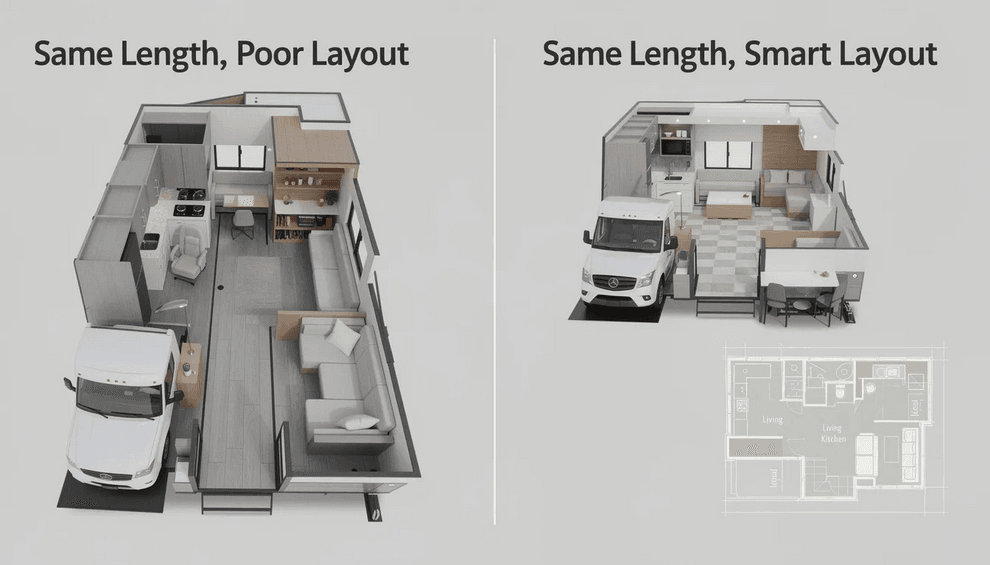
Two RVs of the same length can feel completely different inside depending on slides, ceiling height, and layout. A smart floorplan can deliver more space than raw footage suggests—just like well-designed tiny house floor plans maximize comfort and functionality in limited square footage.
Prioritize Zones, Not Just Feet
Think about your living space in terms of functional zones:
- Sleeping zones: Parents’ bedroom with a door, bunk area for kids, optional convertible dinette or sofa
- Day vs. night usage: Can you leave a bed made while still having a usable dinette in the morning?
- Wet bath vs. dry bath: A wet bath (shower/toilet combo) saves space; a dry bath with separate shower feels more like home
Layout Tips by Traveler Type
For families: Bunkhouse floorplans (common in 28–36 ft trailers and fifth wheels) with four bunks or a bunk-plus-den configuration maximize sleeping arrangements without wasted square footage.
For couples: Rear living room layouts in 26–32 ft trailers or fifth wheels offer better views and seating than bunk models. You’ll enjoy more amenities and more room for relaxation.
The Slide-Out Factor
A 28 ft rv with two slides can feel roomier than a 32 ft no-slide model when parked. Multiple slide outs dramatically expand your living space.
But there are trade-offs:
- More slides mean more weight
- More moving parts that can fail
- Sometimes less insulation where slide floors meet the main body
- Reduced functionality when camping with slides retracted
Ceiling Height Matters
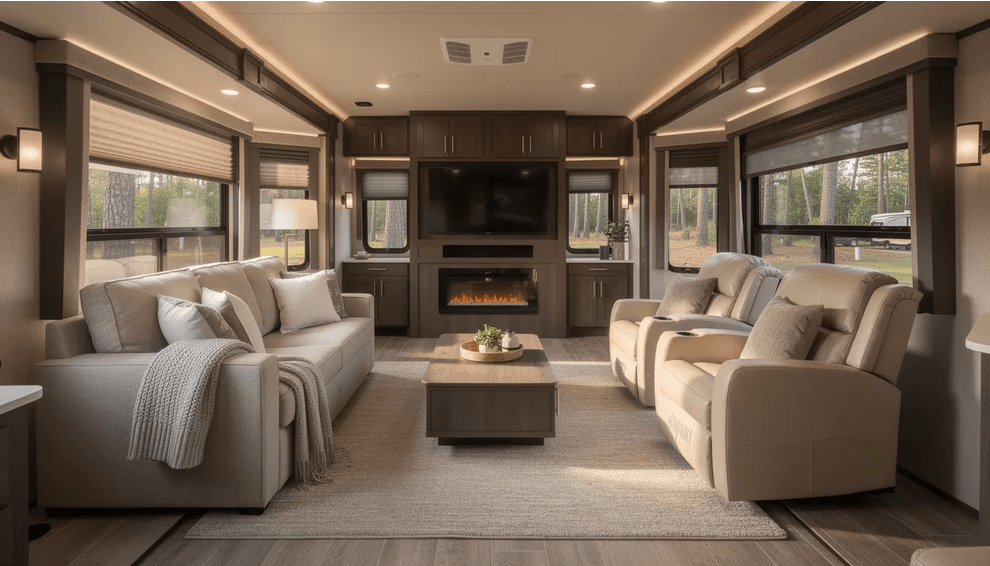
Typical rv interior height ranges 6.5–7 ft. Many newer fifth wheels since around 2018 offer up to 7.5 ft in living areas, making them feel more like apartments. If you’re tall, pay attention to headroom throughout the rig, especially in bathroom and sleeping areas.
The best advice: walk through rigs in person. Stand in showers, sit at the dinette, and lie on the bed. How “size” actually feels matters more than spec sheets.
Step 6: Legal, Safety, and Seating Considerations by RV Size
Being able to sleep six doesn’t mean it’s legal or safe to drive six unbelted passengers down I-10 or I-95. Understanding seating and legal requirements prevents dangerous situations.
Seating vs. Sleeping Capacity
Every moving passenger in a motorhome needs a proper seat belt. Side-facing sofas and rear benches may not count as legal seating in some states in 2024. Always count actual belted seats, not sleeping positions.
For towable rvs (travel trailers, fifth wheels, pop ups), passengers cannot ride in the trailer while moving. Everyone must ride in the tow vehicle. Make sure your car or truck has enough seat belts for your entire group.
Car Seats and Young Passengers
Children’s car seats must attach to forward-facing seats with lap-shoulder belts where possible. This limits options in many motorhomes where the only forward-facing seats are in the cab.
Families with multiple car seats often prefer:
- A class c with belted dinette seats
- A large SUV or truck plus travel trailer configuration
This ensures everyone rides safely and legally.
Licensing and Weight Thresholds
Most RVs under 26,000 lb GVWR don’t require a special non-commercial license. However, if you’re considering a very large diesel pusher or heavy fifth wheel approaching that weight, check with your state DMV. Some states have additional requirements.
The FMCSA offers resources on rv exemptions for rigs approaching commercial weight thresholds—worth reviewing if you’re eyeing the biggest motorhomes class options.
Before You Commit
Always verify:
- Total seat belt count for travel days
- Cargo Carrying Capacity (CCC) for your gear weight
- Payload limits before selecting a specific length or floorplan
Step 7: Storage, Parking, and Ownership Costs by Size
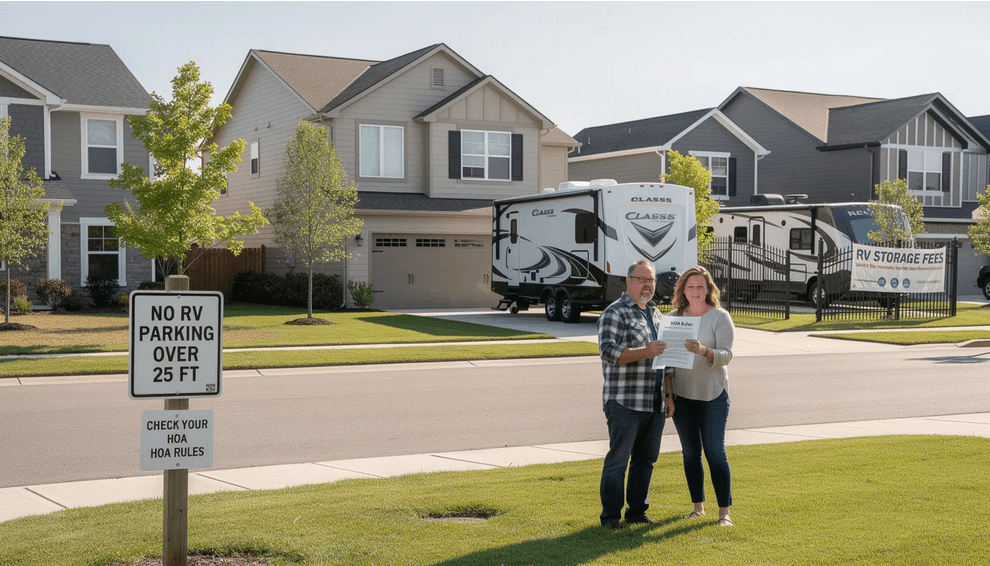
A 40 ft motorhome isn’t just bigger on the road—it’s bigger to store, maintain, and insure year-round. Total cost of ownership scales dramatically with size.
Home Parking Considerations
Many HOAs (especially in suburbs built after 2000) restrict parking RVs over a certain length or height in driveways or streets. Check your hoa rules before purchasing. Getting stuck with storage fees because your rig can’t park at home is an expensive surprise.
Measure your driveway length and turning radius before choosing anything over approximately 28–30 ft. That 35 ft fifth wheel might technically fit but prove impractical for daily use.
Paid Storage Costs
Larger rigs (over 30–35 ft) often require full pull-through storage spaces at dedicated rv storage lots. These premium spots cost more.
Monthly storage fees vary by location, but expect significantly higher costs near metro areas and popular corridors (I-5, I-95, I-10, etc.). A 40 ft rig might cost 30–50% more monthly than a 25 ft trailer at the same facility.
Fuel and Tolls
Taller, heavier class a and large fifth wheels consume significantly more fuel on long interstate trips. Expect:
- 6–9 mpg for large diesel pushers
- 12–15+ mpg for smaller rigs and efficient class b rvs
Some toll roads classify 3-axle motorhomes or truck-plus-trailer combinations in higher fee categories. Size and weight can noticeably change your toll costs on long trips.
Maintenance and Wear
More length and more slide-outs mean:
- More tires to replace
- More seals to inspect and maintain
- More roof area to check every 6–12 months
- More systems (air conditioning, plumbing, etc.) to service
Set a realistic maintenance budget that scales with size. The jump in ongoing costs once you move beyond 30–35 ft can be substantial.
Example Size Scenarios: Matching Real People to Real RVs
Let’s put all this together with concrete scenarios showing how real travelers might choose their right rv size.
Scenario 1: Weekend Couple
Profile: Ages mid-30s, leaving from Dallas or Atlanta for 2–3 night trips. Both work demanding jobs and want easy setup and teardown.
Recommendation: 20–24 ft travel trailer or 19–22 ft class b for easy towing and simple storage at home. A compact towable rv lets them use their existing SUV without upgrading, and storage fits in a standard garage or driveway.
Scenario 2: Family of 5
Profile: Two adults, three kids under 12, planning a 2-week summer trip through Colorado and Utah in 2025. Need enough space for rainy-day activities inside.
Recommendation: 28–32 ft class c rv or 30–34 ft bunkhouse travel trailer with at least three sleeping zones and enough seat belts. This size range accesses most campgrounds while providing beds in sleeping areas where kids won’t need to convert furniture nightly. Look for motorhomes class c models with rear bunks.
Scenario 3: Remote Worker
Profile: Solo or couple working remote since 2020, planning multi-month trips across the West. Needs reliable internet setup and dedicated workspace.
Recommendation: 30–36 ft fifth wheel or travel trailer with dedicated office or toy-hauler garage conversion, plus a capable 3/4-ton truck. The towing capacity of a heavy duty truck handles heavier rigs with office furniture, monitors, and supplies.
Scenario 4: Retired Couple
Profile: Full-timing across the U.S. from 2024 onward, prioritizing comfort over city driving. Willing to book larger private rv parks instead of cramped national park sites.
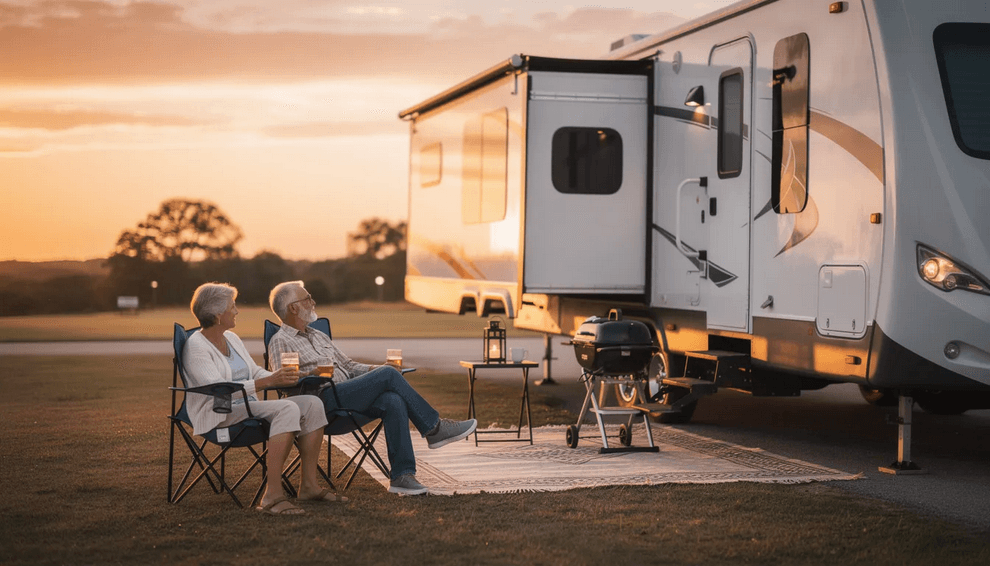
Recommendation: 32–38 ft diesel class a or 34–40 ft fifth wheel. Since they’re avoiding tight campgrounds anyway, the extra features—residential fridges, king beds, washer-dryers—enhance quality of life. This is where motorhomes shine for those embracing the full time travelers lifestyle.
How to Narrow Down Your Final RV Size
Finding your right rv size isn’t guesswork—it’s a practical decision process. Follow this checklist to move from overwhelmed to confident.
Step-by-Step Size Selection Checklist
Step 1: Confirm your current or planned vehicle’s towing capacity with real numbers. Find the GVWR, GCWR, and payload figures. Don’t estimate—verify.
Step 2: Decide your primary camping style (weekend getaways, seasonal trips, full-time) and typical destinations (national parks vs. private rv resorts). This determines maximum practical length.
Step 3: Count required seat belts and sleeping spaces for the next 3–5 years, not just this season. Kids grow. Guests join. Plan ahead.
Step 4: Walk through units between 24–35 ft (for most families) or 17–24 ft (for couples) and compare how each length feels inside. Floor plans differ dramatically.
Step 5: Check campground length limits for your bucket-list parks before committing to anything over 32–35 ft. Don’t buy a rig that won’t fit where you want to camp.
Rent Before You Buy
Renting an rv close to your target size for at least one long weekend validates both comfort and drivability. You’ll discover whether that 30 ft class c feels manageable or overwhelming before signing paperwork.
Many rental companies offer models across the full size range. Use this opportunity to test your assumptions about how much space you actually need.
The perfect rv doesn’t exist in the abstract—it exists in relation to your vehicle, your family, and the trips you realistically plan to take in the next few years. Start with your towing limits, work through the checklist, and trust your in-person impressions.
The road is waiting. Now you know how to choose the right size rv to explore it.
What Size RV Do I Need? (Complete RV Size Guide)
Choosing the right rv size is one of the most consequential decisions you’ll make as an RV buyer. Get it wrong, and you’re stuck with a rig that won’t fit in your favorite campgrounds, strains your tow vehicle, or leaves your family cramped on long trips. Get it right, and you unlock years of comfortable adventures.
Key factors to consider when selecting an RV include the number of travelers, intended destinations, budget, driving comfort, fuel efficiency, storage, and ease of parking.
This guide walks you through exactly how to match rv types, lengths, and classes to your specific situation—whether you’re a couple eyeing weekend getaways or a family planning full time living on the road.
Quick Answer: Best RV Sizes by Traveler Type
So what size rv do you actually need? Here’s a straightforward breakdown by traveler type and length range:
- Solo traveler or couple: 17–24 ft (class b or small class c / compact trailer)
- Family of 4–5: 26–34 ft (mid-size class c rv, class a under 36 ft, or 28–34 ft travel trailer)
- Large families / full time living: 34–40+ ft (larger class a motorhomes, fifth wheel, or 32–40 ft travel trailer)
For most new RV owners, the 28–32 ft range hits the sweet spot. You get enough sleeping space and living space for a family without the major maneuvering headaches that come with larger units.
Here’s something many first-time buyers don’t realize: campsite length limits at popular destinations are often stricter than expected. Many U.S. national park campgrounds were built before 1980 and cap rv length at roughly 30–35 ft. If Yellowstone, Yosemite, or Great Smoky Mountains are on your bucket list, that 40 ft Class A might lock you out of the best spots.
The sections below explain how to balance your tow vehicle limits, camping style, and interior layout with overall length—so you can find the perfect rv for your adventures.
Why RV Size Matters More Than You Think
RV size isn’t just about how many beds you get. It directly impacts your safety, comfort, fuel efficiency, and where you can actually camp.
Driving ease changes dramatically with length. Threading a 32 ft rig through two-lane mountain roads in Colorado demands more skill and attention than cruising in a 19 ft camper van. Class a motorhomes and large trailers require wider turns, longer stopping distances, and more careful lane positioning.
Parking options shrink as size grows. Older national park campgrounds are most friendly to RVs 30 ft and under. A compact class b rvs can access roughly 90% more campsites than a 40 ft class a—that’s not a small difference when you’re trying to book a spot at a popular park during summer.
Fuel use scales directly with weight and frontal area. Heavier, taller RVs burn significantly more fuel on major corridors like I-40 and I-95. Expect 6–8 mpg in a large diesel pusher versus 15–20 mpg in smaller rigs.
Oversizing can also strain your tow vehicle in dangerous ways. Towing a 9,000 lb trailer with a 2020 half ton truck rated for 7,500 lb isn’t just uncomfortable—it’s unsafe and potentially illegal in some states.
On the flip side, undersizing can ruin the experience. If there aren’t enough seat belts or sleeping areas for your family, those 2024 travel conditions (devices, work gear, kids’ stuff) will make every trip feel overwhelming.
Once you pick an rv length, you’re also locking in:
- Which parks and campgrounds you can book
- Where you can store it at home or in paid storage
- What kind of maintenance costs and insurance premiums to expect
How to Choose the Right RV Size: Step-by-Step
Step 1: Match RV Size to Your Vehicle and Towing Capacity
Before dreaming about floorplans or bunk beds, confirm what your current vehicle (or planned purchase) can safely handle. Your towing capacity is the non-negotiable starting point.
Here’s how typical vehicles break down:
- Midsize SUV (e.g., 2023 Toyota Highlander): tow capacity around 3,500–5,000 lb. Usually limited to 14–22 ft lightweight trailers, teardrop trailers, or pop up campers.
- Half-ton pickup (e.g., 2022 Ford F-150 with max tow package): tow capacity 10,000–13,000 lb. Can handle many 25–32 ft travel trailers or smaller fifth wheels.
- Three-quarter-ton truck (e.g., 2021 Ram 2500): appropriate for large fifth wheels in the 14,000 lb range and heavy duty truck campers.
- One-ton truck (e.g., Ford F-350): required for the heaviest fifth wheels and multiple slide outs configurations exceeding 16,000 lb.
To find your specific numbers, check two places:
- Door jamb sticker on your tow vehicle—lists GVWR (Gross Vehicle Weight Rating) and often payload capacity
- Owner’s manual—contains GCWR (Gross Combined Weight Rating) and tongue weight limits
For travel trailers, tongue weight typically runs 10–15% of the trailer’s total weight. For a fifth wheel, expect 15–25% of trailer weight transferred to the truck bed.
A critical warning: the “dry weight” on RV brochures is misleading. That number excludes water, propane, food, bikes, and all your gear. Always use the trailer’s GVWR when estimating real-world towing needs.
If you want a big 35–40 ft fifth wheel, budget for at least a 3/4-ton or 1-ton heavy duty truck—not a midsize pickup. Matching your separate vehicle to your towable rv is essential for safe travels.
Step 2: Understand RV Classes and Typical Sizes
RVs come in a variety of sizes and styles, including Class A, Class B, Class C, travel trailers, fifth wheels, pop-up campers, and teardrop trailers. The size of different types of RVs are indicated by class, from Class A to C.
The question “what size rv” is partly about length and partly about class. Motorized and towable RVs have distinct characteristics, and understanding them helps narrow your options fast.
Motorized RVs
Class A motorhomes represent the largest motorized category, typically measuring 26–45 ft in length. Mainstream family rigs in 2024 often run 32–38 ft, featuring multiple slide outs and at least one full bathroom. These diesel or gas-powered coaches offer house-like amenities—king beds, washer-dryers, and full kitchens—but demand advanced driving skills and larger parking spaces.
Class B motorhomes (also called camper vans) are the most compact option at 17–22 ft. Built on a van chassis like the Mercedes Sprinter or Ford Transit, they’re ideal for solo travelers or couples wanting easy city parking and better fuel efficiency. The trade-off? Limited storage and sleeping space—usually just enough for short trips rather than full time living.
Class C motorhomes strike a middle ground at 22–35 ft (averaging around 28 ft). The distinctive cabover bunk or storage area provides extra sleeping areas without adding ground-level length. Class c models are a common family choice because 28–32 ft balances ample space with reasonable maneuverability.
Towable RVs
Travel trailers cover the broadest size range at 13–40 ft. From compact teardrop trailers to 36–40 ft bunkhouse models, they can be towed by SUVs or trucks depending on weight. Their flexibility makes them popular for families who want to unhitch and use their separate vehicle for day trips.
Fifth wheels typically run 29–45 ft with a raised front bedroom that couples into a pickup truck bed. Popular for full-timers and families wanting apartment-like space, they offer stability at highway speeds and generous interior room. Expect to need a half ton or heavier truck.
Pop-up campers (or pop ups) fold down to 8–16 ft closed and expand to roughly double when deployed. At 700–4,000 lb, they’re light enough for many crossovers and midsize SUVs—great entry points for camping beginners.
Size at a Glance
| RV Type | Typical Length | Typical Sleepers | Best For |
|---|---|---|---|
| Class B | 17–22 ft | 2–4 | Solo/couples, weekend getaways |
| Class C | 22–35 ft | 4–8 | Families, flexible travel |
| Class A | 26–45 ft | 4–10 | Full-timers, luxury seekers |
| Travel Trailer | 13–40 ft | 2–10 | Versatile, all travelers |
| Fifth Wheel | 29–45 ft | 4–8 | Full-timers, large families |
| Pop-Up | 8–16 ft (closed) | 2–6 | Beginners, light towing |
| Note that longer isn’t always better for sleeping arrangements. A 30 ft class c rv can sleep as many people as a 35 ft class a due to smart bunk and dinette designs. | |||
 |
Step 3: Choose RV Length by Travel Style and Group Size
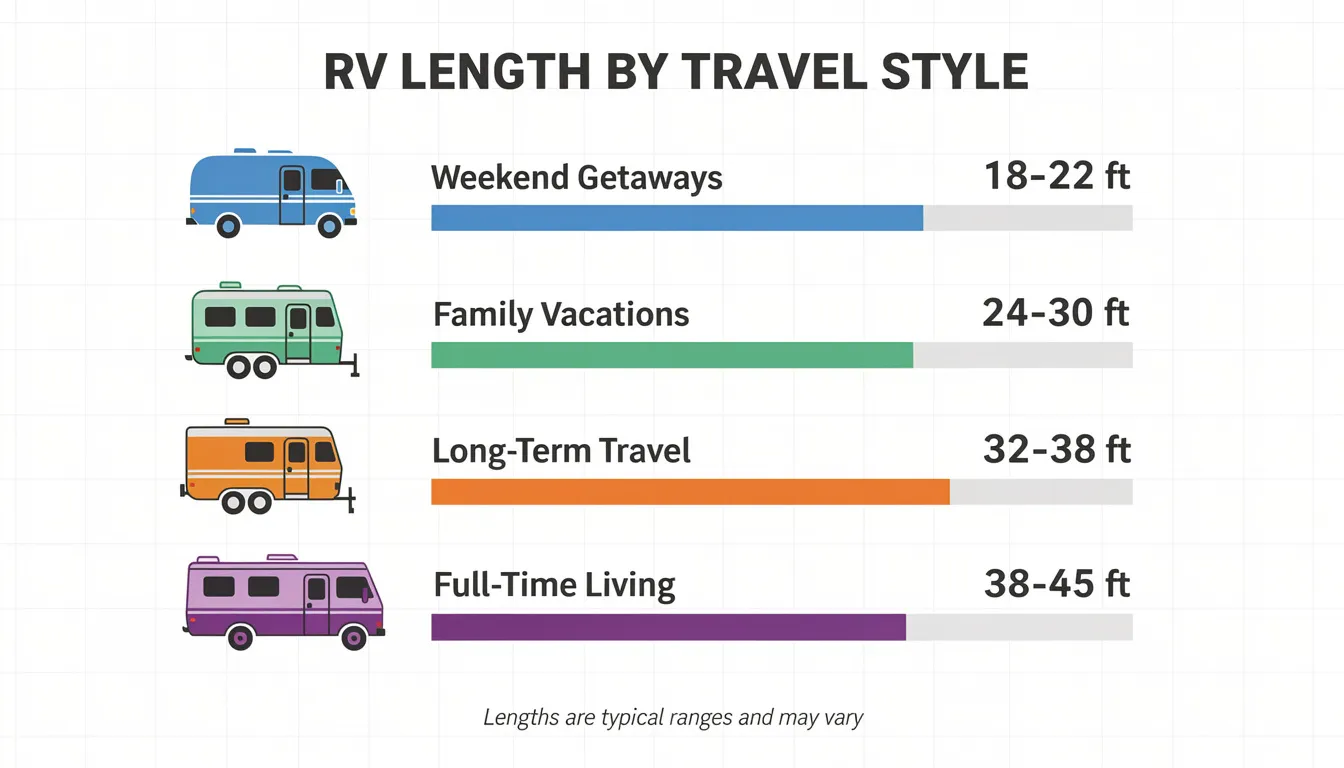
How you camp—weekends, summers, or full-time since the 2020–2024 remote work boom—heavily influences your ideal length. Your travel style matters as much as your family size.
Solo Travelers and Couples
For people who move often, boondock on BLM land, or navigate cities like Denver or Seattle, a 17–24 ft class b or small class c offers maximum flexibility. You can park in standard spaces, access more room in tight campgrounds, and enjoy better fuel economy.
If you prefer staying in one campground for a week at a time and value a real bed plus larger kitchen, a 20–26 ft travel trailer delivers more amenities without excessive length. It’s the balance many couples prefer for long trips.
Families with Young Kids (2–3 Children)
The 26–34 ft length range works well for families, whether in a class c motorhomes configuration (28–32 ft) or a bunkhouse travel trailer (28–32 ft) with at least three sleeping zones.
Look for dedicated bunk beds—common in 2021–2024 family floorplans with rear bunks. These are far more functional than converting the dinette every night, especially with tired kids. Many different models offer how much space you actually need without pushing into large trailers territory.
Larger Families or Multigenerational Groups (5–8 People)
When you need to answer how many people you’re traveling with and it’s more than five, look at 32–40 ft class a motorhomes, 30–38 ft class c with bunks, or 34–42 ft fifth wheels.
Many post-2018 bunkhouse fifth wheels include second bathrooms (half-baths)—a game-changer for morning routines and separate sleeping areas that give everyone privacy.
Full-Time RVers or Digital Nomads
For those pursuing full time living, 34–40+ ft fifth wheels or travel trailers with dedicated office space make sense. Motorized travelers often choose 30–38 ft class a rigs for the all-in-one convenience, while others might compare these to tiny house park model homes as a semi-permanent alternative for compact living.
Since remote work surged in 2020, many different types of floorplans now include dedicated desks or convertible toy hauler garages being repurposed as offices. If you’re among full time travelers, prioritize workspace alongside bedroom and bathroom features.
Don’t Forget About Pets
Large dogs need extra floor space to lie down during travel days. Cat owners may need spots for litter boxes away from main walkways. Factor pets into your size calculations—they take up more room than you’d expect.
Step 4: How RV Size Affects Where You Can Camp
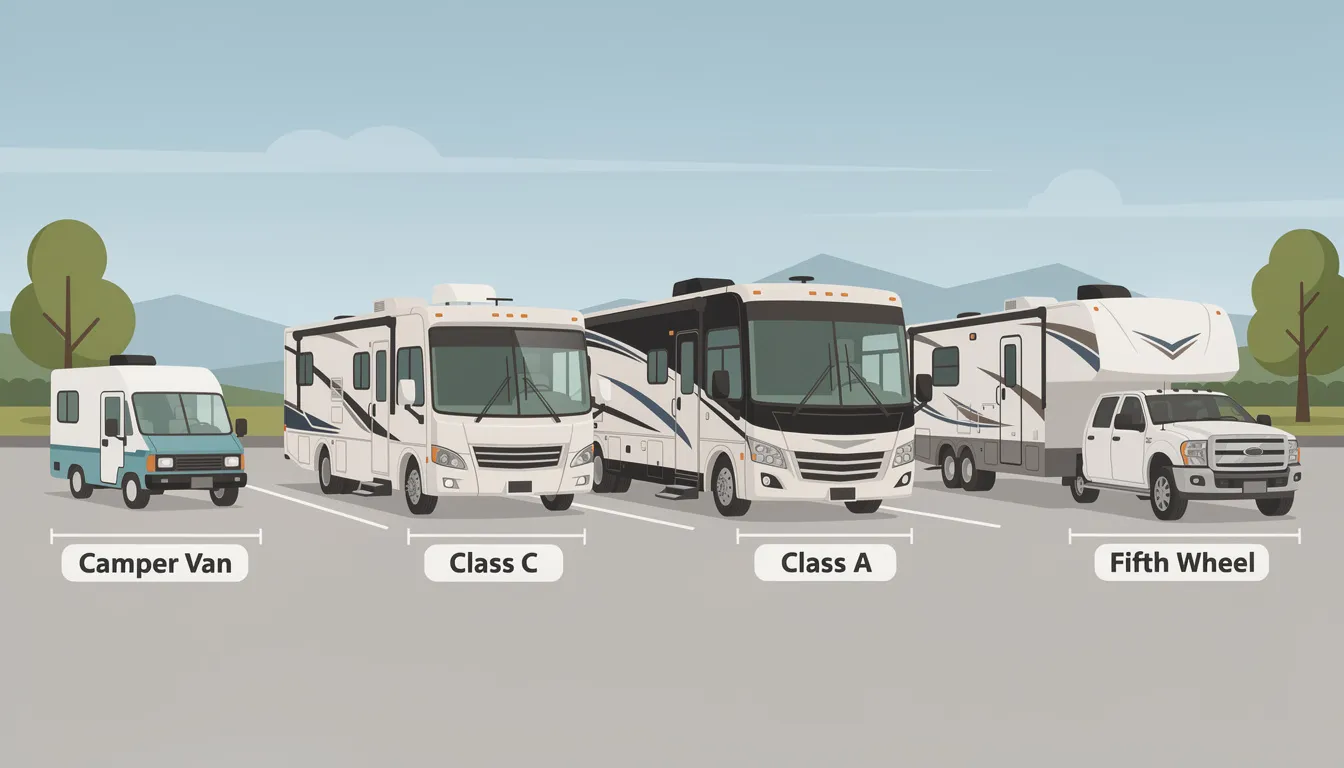
Campground length limits are often stricter than buyers expect when shopping online. Your dream rv might be too big for your dream destination.
Real-World Length Guidelines
- National park campgrounds (Yosemite, Rocky Mountain, Shenandoah): Most friendly to RVs 30 ft and under. Many older loops physically cannot accommodate anything longer.
- Combined length limits: Some parks cap tow vehicle plus trailer at around 40–45 ft total. That 32 ft trailer plus your full-size truck might exceed limits.
- State parks (Texas, Florida, etc.): Generally accommodate 32–35 ft RVs comfortably.
- Private RV resorts: Near major highways, many accept rigs up to 45 ft—but check before booking.
Important clarification: Listed campsite length usually refers to pad length, not your overall rig when unhitched. A 30 ft trailer plus your truck may overhang if the pad is only 35 ft.
Maneuvering and Road Access
Hairpin turns on mountain roads in states like Colorado and Washington can be posted with advisory limits for vehicles over 35–40 ft. Tight, tree-lined campground loops become stressful—or impossible—with a 40 ft motorhome or fifth wheel.
For boondocking enthusiasts, shorter rigs (under 28–30 ft) reach more dispersed camping spots on narrow forest service roads. If winding roads and remote locations appeal to you, size down accordingly—or mix in alternative stays like yurt hut experiences when you want a different kind of nature-focused getaway.
Step 5: Interior Layout vs. Overall Length
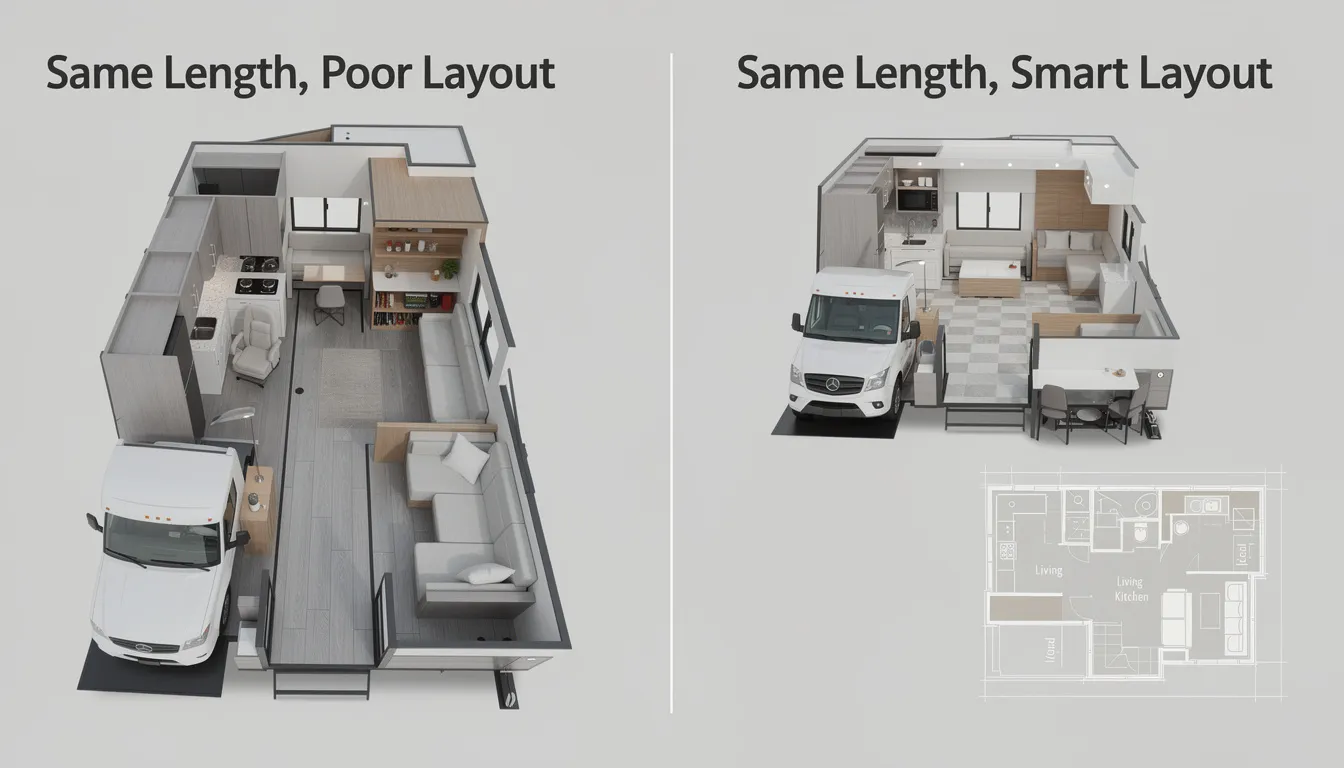
Two RVs of the same length can feel completely different inside depending on slides, ceiling height, and layout. A smart floorplan can deliver more space than raw footage suggests—just like well-designed tiny house floor plans maximize comfort and functionality in limited square footage.
Prioritize Zones, Not Just Feet
Think about your living space in terms of functional zones:
- Sleeping zones: Parents’ bedroom with a door, bunk area for kids, optional convertible dinette or sofa
- Day vs. night usage: Can you leave a bed made while still having a usable dinette in the morning?
- Wet bath vs. dry bath: A wet bath (shower/toilet combo) saves space; a dry bath with separate shower feels more like home
Layout Tips by Traveler Type
For families: Bunkhouse floorplans (common in 28–36 ft trailers and fifth wheels) with four bunks or a bunk-plus-den configuration maximize sleeping arrangements without wasted square footage.
For couples: Rear living room layouts in 26–32 ft trailers or fifth wheels offer better views and seating than bunk models. You’ll enjoy more amenities and more room for relaxation.
The Slide-Out Factor
A 28 ft rv with two slides can feel roomier than a 32 ft no-slide model when parked. Multiple slide outs dramatically expand your living space.
But there are trade-offs:
- More slides mean more weight
- More moving parts that can fail
- Sometimes less insulation where slide floors meet the main body
- Reduced functionality when camping with slides retracted
Ceiling Height Matters
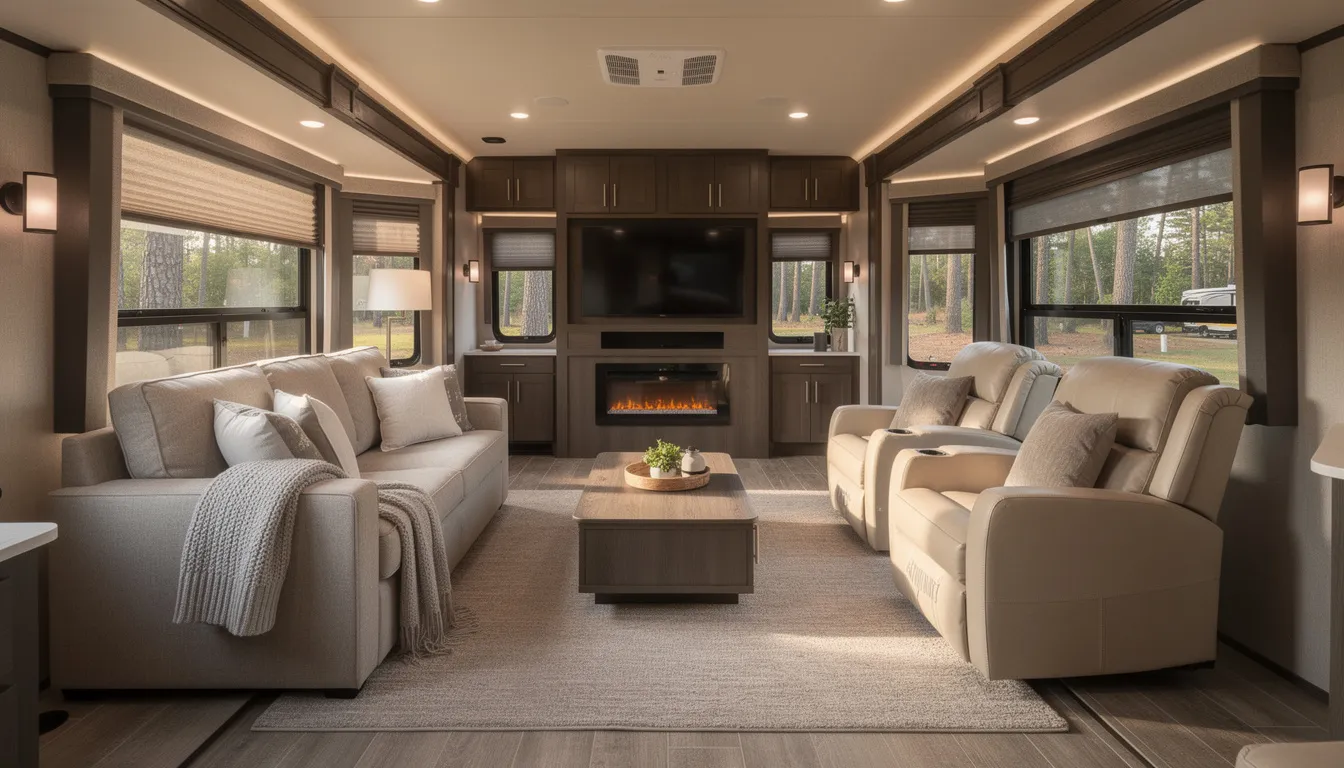
Typical rv interior height ranges 6.5–7 ft. Many newer fifth wheels since around 2018 offer up to 7.5 ft in living areas, making them feel more like apartments. If you’re tall, pay attention to headroom throughout the rig, especially in bathroom and sleeping areas.
The best advice: walk through rigs in person. Stand in showers, sit at the dinette, and lie on the bed. How “size” actually feels matters more than spec sheets.
Step 6: Legal, Safety, and Seating Considerations by RV Size
Being able to sleep six doesn’t mean it’s legal or safe to drive six unbelted passengers down I-10 or I-95. Understanding seating and legal requirements prevents dangerous situations.
Seating vs. Sleeping Capacity
Every moving passenger in a motorhome needs a proper seat belt. Side-facing sofas and rear benches may not count as legal seating in some states in 2024. Always count actual belted seats, not sleeping positions.
For towable rvs (travel trailers, fifth wheels, pop ups), passengers cannot ride in the trailer while moving. Everyone must ride in the tow vehicle. Make sure your car or truck has enough seat belts for your entire group.
Car Seats and Young Passengers
Children’s car seats must attach to forward-facing seats with lap-shoulder belts where possible. This limits options in many motorhomes where the only forward-facing seats are in the cab.
Families with multiple car seats often prefer:
- A class c with belted dinette seats
- A large SUV or truck plus travel trailer configuration
This ensures everyone rides safely and legally.
Licensing and Weight Thresholds
Most RVs under 26,000 lb GVWR don’t require a special non-commercial license. However, if you’re considering a very large diesel pusher or heavy fifth wheel approaching that weight, check with your state DMV. Some states have additional requirements.
The FMCSA offers resources on rv exemptions for rigs approaching commercial weight thresholds—worth reviewing if you’re eyeing the biggest motorhomes class options.
Before You Commit
Always verify:
- Total seat belt count for travel days
- Cargo Carrying Capacity (CCC) for your gear weight
- Payload limits before selecting a specific length or floorplan
Step 7: Storage, Parking, and Ownership Costs by Size
A 40 ft motorhome isn’t just bigger on the road—it’s bigger to store, maintain, and insure year-round. Total cost of ownership scales dramatically with size.
Home Parking Considerations
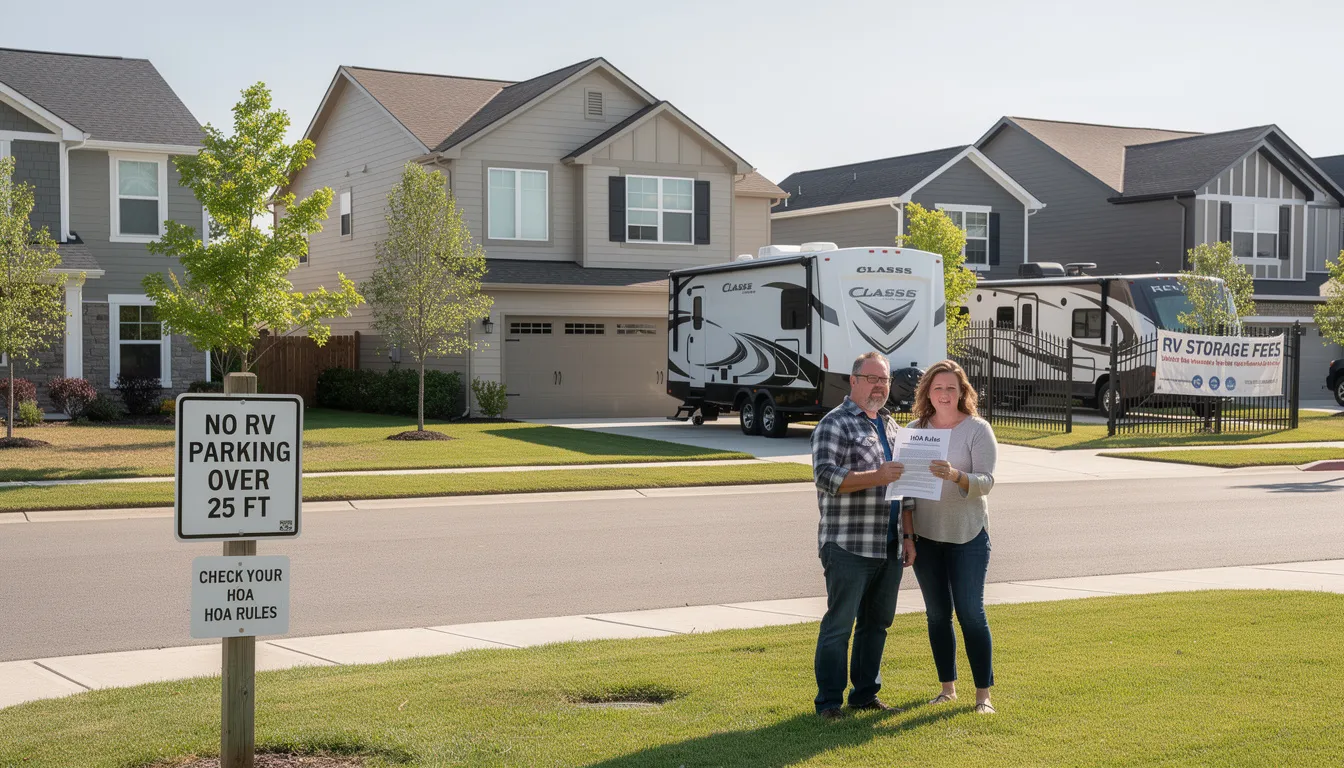
Many HOAs (especially in suburbs built after 2000) restrict parking RVs over a certain length or height in driveways or streets. Check your hoa rules before purchasing. Getting stuck with storage fees because your rig can’t park at home is an expensive surprise.
Measure your driveway length and turning radius before choosing anything over approximately 28–30 ft. That 35 ft fifth wheel might technically fit but prove impractical for daily use.
Paid Storage Costs
Larger rigs (over 30–35 ft) often require full pull-through storage spaces at dedicated rv storage lots. These premium spots cost more.
Monthly storage fees vary by location, but expect significantly higher costs near metro areas and popular corridors (I-5, I-95, I-10, etc.). A 40 ft rig might cost 30–50% more monthly than a 25 ft trailer at the same facility.
Fuel and Tolls
Taller, heavier class a and large fifth wheels consume significantly more fuel on long interstate trips. Expect:
- 6–9 mpg for large diesel pushers
- 12–15+ mpg for smaller rigs and efficient class b rvs
Some toll roads classify 3-axle motorhomes or truck-plus-trailer combinations in higher fee categories. Size and weight can noticeably change your toll costs on long trips.
Maintenance and Wear
More length and more slide-outs mean:
- More tires to replace
- More seals to inspect and maintain
- More roof area to check every 6–12 months
- More systems (air conditioning, plumbing, etc.) to service
Set a realistic maintenance budget that scales with size. The jump in ongoing costs once you move beyond 30–35 ft can be substantial.
Example Size Scenarios: Matching Real People to Real RVs
Let’s put all this together with concrete scenarios showing how real travelers might choose their right rv size.
Scenario 1: Weekend Couple
Profile: Ages mid-30s, leaving from Dallas or Atlanta for 2–3 night trips. Both work demanding jobs and want easy setup and teardown.
Recommendation: 20–24 ft travel trailer or 19–22 ft class b for easy towing and simple storage at home. A compact towable rv lets them use their existing SUV without upgrading, and storage fits in a standard garage or driveway.
Scenario 2: Family of 5
Profile: Two adults, three kids under 12, planning a 2-week summer trip through Colorado and Utah in 2025. Need enough space for rainy-day activities inside.
Recommendation: 28–32 ft class c rv or 30–34 ft bunkhouse travel trailer with at least three sleeping zones and enough seat belts. This size range accesses most campgrounds while providing beds in sleeping areas where kids won’t need to convert furniture nightly. Look for motorhomes class c models with rear bunks.
Scenario 3: Remote Worker
Profile: Solo or couple working remote since 2020, planning multi-month trips across the West. Needs reliable internet setup and dedicated workspace.
Recommendation: 30–36 ft fifth wheel or travel trailer with dedicated office or toy-hauler garage conversion, plus a capable 3/4-ton truck. The towing capacity of a heavy duty truck handles heavier rigs with office furniture, monitors, and supplies.
Scenario 4: Retired Couple
Profile: Full-timing across the U.S. from 2024 onward, prioritizing comfort over city driving. Willing to book larger private rv parks instead of cramped national park sites.
Recommendation: 32–38 ft diesel class a or 34–40 ft fifth wheel. Since they’re avoiding tight campgrounds anyway, the extra features—residential fridges, king beds, washer-dryers—enhance quality of life. This is where motorhomes shine for those embracing the full time travelers lifestyle.
How to Narrow Down Your Final RV Size
Finding your right rv size isn’t guesswork—it’s a practical decision process. Follow this checklist to move from overwhelmed to confident.
Step-by-Step Size Selection Checklist
Step 1: Confirm your current or planned vehicle’s towing capacity with real numbers. Find the GVWR, GCWR, and payload figures. Don’t estimate—verify.
Step 2: Decide your primary camping style (weekend getaways, seasonal trips, full-time) and typical destinations (national parks vs. private rv resorts). This determines maximum practical length.
Step 3: Count required seat belts and sleeping spaces for the next 3–5 years, not just this season. Kids grow. Guests join. Plan ahead.
Step 4: Walk through units between 24–35 ft (for most families) or 17–24 ft (for couples) and compare how each length feels inside. Floor plans differ dramatically.
Step 5: Check campground length limits for your bucket-list parks before committing to anything over 32–35 ft. Don’t buy a rig that won’t fit where you want to camp.
Rent Before You Buy
Renting an rv close to your target size for at least one long weekend validates both comfort and drivability. You’ll discover whether that 30 ft class c feels manageable or overwhelming before signing paperwork.
Many rental companies offer models across the full size range. Use this opportunity to test your assumptions about how much space you actually need.
The perfect rv doesn’t exist in the abstract—it exists in relation to your vehicle, your family, and the trips you realistically plan to take in the next few years. Start with your towing limits, work through the checklist, and trust your in-person impressions.
The road is waiting. Now you know how to choose the right size rv to explore it.