
Dreaming of tiny living in Georgia but drowning in conflicting information about where you can actually build? You’re not alone. With 159 counties, each setting its own zoning regulations and minimum square footage requirements, finding the right spot for your tiny house requires more than wishful thinking—it demands concrete data.
This guide cuts through the confusion with specific county rules, minimum sizes, and practical steps to verify whether your tiny house plan is legal before you buy land.
- Quick Answer: Which GA Counties Actually Allow Tiny Houses Today?
- How Georgia Regulates Tiny Houses Statewide
- GA Counties That Clearly Allow Tiny Houses as Primary Homes
- GA Counties That Allow Tiny Houses With Higher Minimum Sizes
- GA Counties That Welcome Tiny Houses as ADUs or in Parks
- GA Counties That Currently Restrict or Block Tiny Houses
- Spotlight: Example Tiny-Friendly County Profiles
- Where Tiny Houses on Wheels (THOWs) Are Typically Allowed in Georgia
- How to Check if a Specific GA Parcel Allows a Tiny House
- Choosing the Best Georgia County for Your Tiny House Plan
- FAQs About GA Counties That Allow Tiny Houses
- Looking Ahead: How GA County Tiny House Rules Are Changing
Quick Answer: Which GA Counties Actually Allow Tiny Houses Today?
Most Georgia counties technically allow tiny homes, but minimum house size requirements and local zoning ordinances determine whether your specific design will pass muster. The difference between a smooth permit process and a rejected application often comes down to 50-100 sq ft.
Here are the most tiny-friendly counties with the lowest minimums:
- Hall County – Allows houses as small as 256 sq ft with a minimum dimension of 16 feet in both width and length on permanent foundations. Building permits and utility hookups required.
- Monroe County – Permits site-built homes from 250 sq ft with full utilities, permits, and septic approval. One of Georgia’s lowest documented minimums.
- Towns County – Accepts homes under 400 sq ft when built to the International Building Code with Georgia amendments, placed on a permanent foundation with emergency egress.
- Sumter County – Allows 320+ sq ft tiny houses on permanent foundations when landscaped to match surrounding single family homes and connected to water/sewer.
Beyond these standouts, dozens of Georgia counties permit small homes in the 320-800 sq ft range when they’re code-compliant and properly zoned. Counties like Coweta, Houston, DeKalb, and Liberty all have pathways for homes under 800 sq ft, so choosing tiny house plans that fit your life and local regulations becomes just as important as picking the right county.
Important: Even in these tiny-friendly counties, you must verify parcel-specific zoning, HOA restrictions, and utility availability. A county-level “yes” doesn’t guarantee your specific lot qualifies.
How Georgia Regulates Tiny Houses Statewide
Georgia has no single “tiny house law” that applies uniformly across the state. Instead, the framework relies on statewide building codes interpreted and amended by local governments, creating a patchwork of regulations that varies significantly from county to county.
The state primarily uses the International Residential Code (IRC) and International Building Code (IBC) as its foundation. Many counties have adopted Appendix Q of the IRC as of 2024, which specifically addresses homes of 400 sq ft or less of livable space. This appendix tailors requirements for ceiling heights, emergency egress, and loft access to accommodate smaller dwellings.
Under Appendix Q and Georgia’s working definitions, a tiny house generally means something much smaller than a traditional home, whether you favor classic styles like colonial tiny house designs for cozy living spaces or more contemporary looks. In most codes, it means:
- 400 sq ft or less of livable floor area
- Lofts and utility areas (stairs, closets) typically excluded from the count
- Minimum ceiling heights of 6’8” in living spaces, 6’4” in kitchens/bathrooms
- Emergency egress windows required in sleeping areas
- Loft access via stairs or ladders not exceeding 45-degree inclines
Tiny houses on wheels (THOWs) face different treatment entirely. Most local jurisdictions classify them as recreational vehicles or park models under ANSI A119.5 or RVIA standards, which fundamentally changes where you can place them, and should be factored in early if you’re learning how to build a tiny house from the ground up.
Feature | Foundation-Built Tiny House | Tiny House on Wheels (THOW) |
|---|---|---|
Code Used | IRC/IBC with Appendix Q | ANSI A119.5 or RVIA standards |
Typical Use Allowed | Primary residence, ADU | RV/temporary residence |
Where You Can Put It | Residential zones meeting minimum size | RV parks, campgrounds, mobile home parks |
Year-Round Living | Yes, with permits | Usually limited (30-180 days) |
Utility Requirements | Full hookups (electric, plumbing, septic/sewer) | Park-provided hookups |
This distinction between wheels and foundations is perhaps the most critical factor in Georgia tiny home regulations. A 350 sq ft home on a permanent foundation might be fully legal in Hall County, while the same design on wheels could only legally reside in designated parks. |
GA Counties That Clearly Allow Tiny Houses as Primary Homes
Several Georgia counties have written their minimum dwelling sizes low enough that true tiny houses can serve as primary residences. These aren’t loopholes—they’re explicit policies that welcome smaller housing options.
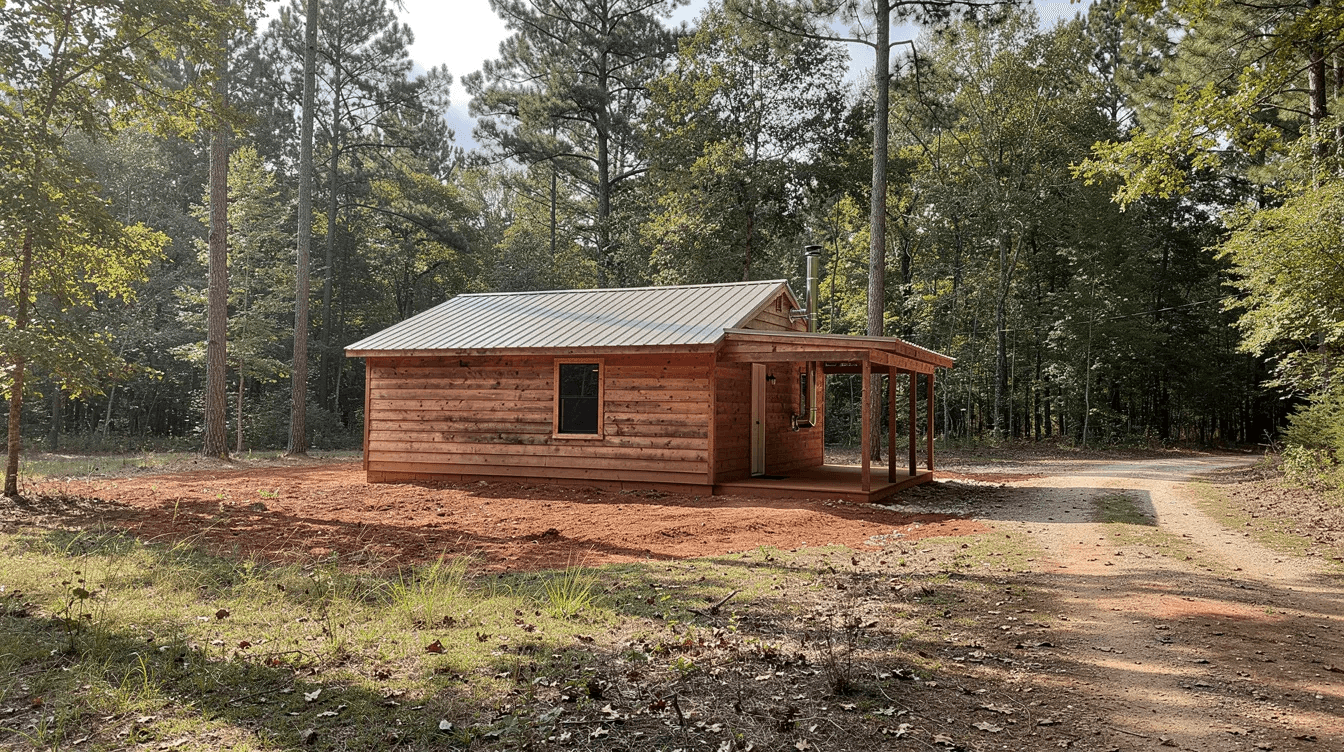
Hall County stands as one of Georgia’s most permissive for ultra-tiny primary homes. The minimum is just 256 sq ft with a required dimension of at least 16 feet in both width and length. Your tiny house must sit on a permanent foundation, pull all required building permits, and connect to approved utilities. The 2023 update to Hall County Unified Development Code Section 3.2 clarified these requirements, making it viable for rural lots zoned agricultural-residential (AR) or estate (E). Expect staged inspections covering foundation, framing, electrical, plumbing, and final occupancy.
Monroe County matches this leniency with a 250 sq ft minimum for site-built homes on permanent foundations. Full IRC compliance including Appendix Q applies, along with attachment to electrical, mechanical, and plumbing services via permitted connections. Before construction, you’ll need a soil percolation test for septic systems. In unincorporated areas zoned rural residential (RR), a 300 sq ft cabin might incur $500-1,000 in permit fees across plan review, inspections, and certificate of occupancy.
Towns County authorizes homes under 400 sq ft under IBC with Georgia amendments. The emphasis falls on permanent foundations, emergency egress in lofts (minimum 24” by 36” opening), smoke/CO detectors, and energy-efficient insulation. This county works well for mountain parcels in recreational residential districts where engineered footings handle steep slopes.
Sumter County sets 320 sq ft as the floor for permanent-foundation tiny houses. Visual conformity matters here—your tiny home should match neighboring single family dwellings through similar siding, roofing, and landscaping buffers. Water and sewer hookups are mandatory, and 2024 code enforcement has focused particularly on flood-prone areas near Americus.
Coweta County aligns at 320 sq ft minimum for primary dwellings on foundations with utility connections. The county also permits accessory dwelling units from 500 sq ft in residential-agricultural (RA) zones, offering flexibility for property owners who want both a primary home and a rental unit.
Houston County recognizes tiny homes under 400 sq ft on permanent foundations when they include egress windows, meet R-19 insulation minimums, and connect to plumbing utilities. Permits are mandatory for all new construction and modifications, with specific requirements varying by proximity to Warner Robins and adjacent municipalities.
DeKalb County permits 350-800 sq ft tiny houses via special ordinance in urban infill zones. These must meet all single family residential districts standards, including 2023 updates that address cottage courts. This creates interesting opportunities for blending ADU potential with primary-residence use near Atlanta.
Liberty County caps qualifying tiny homes at 400-799 sq ft for code-compliant foundation dwellings. THOWs are considered RVs and limited to parks only, so foundation placement is essential for year-round living.
GA Counties That Allow Tiny Houses With Higher Minimum Sizes
These counties technically “allow” smaller homes but set minimums in the 525-800 sq ft range. Some, but not all, tiny designs will qualify—particularly if you’re open to affordable tiny house buildings and designs that push toward the upper end of what’s traditionally considered “tiny.”
- Franklin County – Minimum 800 sq ft on permanent foundation with full utilities required. Tiny houses on wheels are relegated to RV or mobile home parks, effectively excluding sub-600 sq ft primary residences without a variance.
- Rabun County – The 672 sq ft baseline demands IBC adherence and county permits. This creates challenges for mountain tiny builds unless you incorporate loft-heavy designs that maximize livable space under the measurement rules.
- White County – Mirrors Rabun at 672 sq ft minimum with full code compliance and occupancy certificates required. Practical for 700-900 sq ft “small but not ultra-tiny” plans.
- Effingham County – 525 sq ft minimum allows permanent structures on foundations. Wheeled units are permitted only in RV or mobile home parks, making this county workable for modest tiny designs.
- Brantley County – The 800 sq ft threshold ties into affordable housing initiatives. Foundation or skirting is required along with utility hookups, positioning this as an option for those comfortable at the larger end of the tiny spectrum.
- Seminole County – 800 sq ft minimum on foundations with mandatory ties to public water and sewer systems. Suitable for rural areas that still have municipal service access.
These counties represent realistic options if you’re building in the 550-900 sq ft range—small homes that still qualify as “tiny” by many definitions while meeting local zoning rules without variance requests.
GA Counties That Welcome Tiny Houses as ADUs or in Parks
Not every tiny house needs to be a standalone primary residence. Many Georgia counties create pathways for smaller dwellings as accessory dwelling units behind existing homes or within designated parks for THOWs and park models, often working with specialized micro house builders focused on affordability and modern living.
ADU-Friendly Counties
Fulton County, including Atlanta, has emerged as a leader in ADU reform. The county greenlights detached units under approximately 750 sq ft in many single family residential districts per 2024 zoning reforms. Within Atlanta specifically, backyard tiny homes between 300-750 sq ft are permitted subject to 4-foot setbacks, owner-occupancy requirements for the primary dwelling, and separate utility metering. This creates genuine opportunities for rental income or multigenerational housing in metro areas where land costs make standalone tiny homes impractical.
Gwinnett County permits primary dwellings at 750+ sq ft while allowing ADUs as small as 100 sq ft with restrictions. This means your tiny house dreams might work best as a backyard cottage rather than a primary home, particularly in established neighborhoods where the main residence already meets size requirements.
Harris County explicitly endorses ADUs that meet Georgia Residential Code amendments. Tiny house builders can work with these standards to create legal backyard units that serve as rentals, home offices, or housing for family members.
Lincoln County recognizes Appendix Q ADUs on permanent foundations with utilities and HVAC. The county’s acceptance of the small-dwelling appendix signals openness to tiny home concepts when properly integrated into residential lots.
Park-Placement Counties
For those committed to tiny homes on wheels, several counties offer clear paths through park placement:
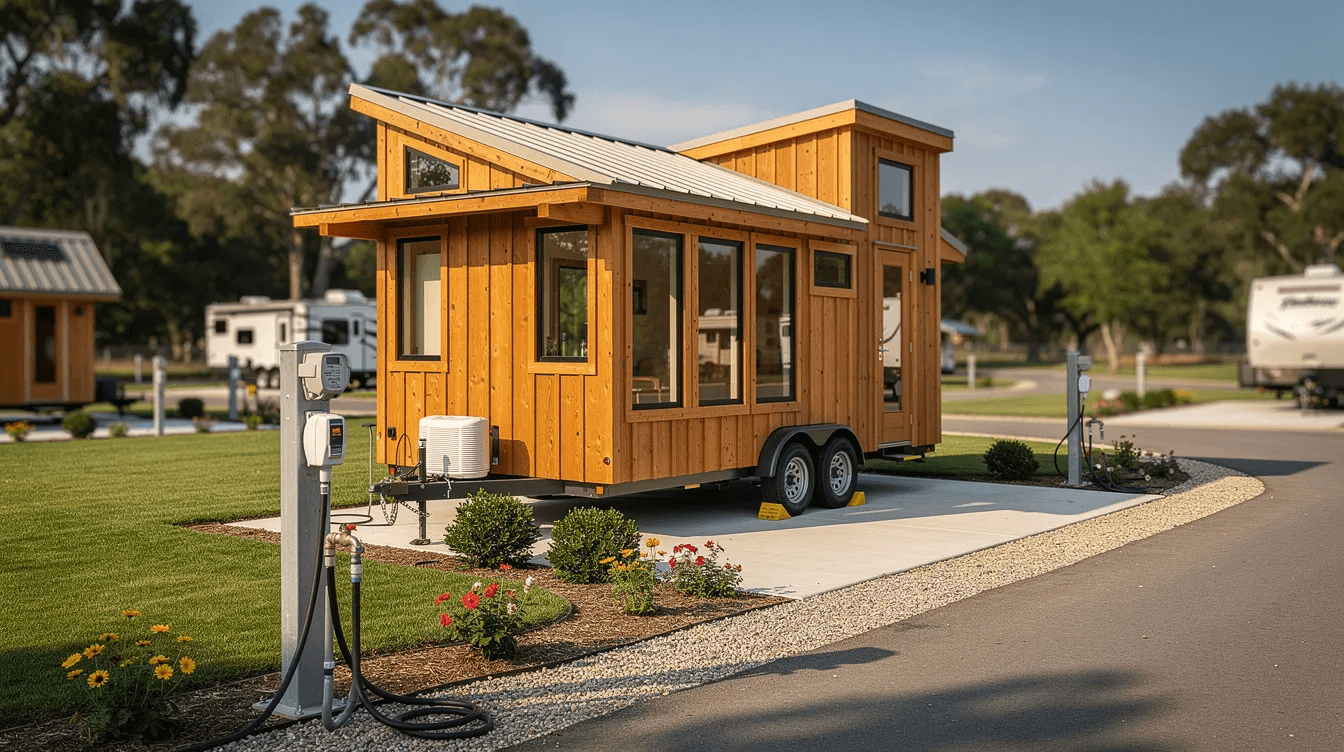
Lumpkin County treats THOWs as RVs with no allowance for permanent residences except in appropriately zoned parks. If you want year-round living, you’ll need to find an RV park or manufactured home community that permits long-term stays.
Union County channels tiny homes primarily into RV, manufactured, mobile home, or campground parks. Micro homes outside parks must meet IBC requirements plus floor area minimums, effectively requiring foundation placement for non-park locations.
Charlton and Camden counties similarly limit THOWs to RV and mobile home parks, often requiring skirting and utility hookups for longer stays. Seasonal or temporary residency rules typically cap stays at 30-180 days.
The distinction matters for how you’ll use your tiny house. ADU placement works well for generating rental income on property you already own, housing aging parents, or creating a home office. Park placement suits those who want the THOW lifestyle with the flexibility to relocate, or who prefer community settings with built-in amenities and social connections.
GA Counties That Currently Restrict or Block Tiny Houses
Some Georgia counties effectively prohibit tiny homes through high minimum sizes or explicit bans. Before purchasing land in these areas, understand that building a sub-1,000 sq ft primary residence may be impossible without significant legal hurdles.
- Douglas County – Minimum 1,800 sq ft for homes effectively blocks tiny houses except for temporary RV stays. This is one of Georgia’s most restrictive counties for small-home enthusiasts.
- Spalding County – Minimum 2,000 sq ft in many residential zones makes classic tiny homes impossible as primary residences.
- Rockdale County – Sets minimums between 1,600-1,800 sq ft depending on the zoning district. THOWs are permitted only as temporary units in campgrounds and RV parks.
- Gordon County – Bans homes under 1,150 sq ft with legal challenges ongoing. Tiny homes currently cannot serve as primary dwellings regardless of construction quality or code compliance.
- Calhoun County – Mirrors the 1,150 sq ft minimum. THOWs may stay temporarily in RV parks but cannot establish permanent residences.
- Banks County – Mandates 1,000 sq ft minimums plus driveway requirements, banning sub-size tiny homes while allowing permitted mobile and manufactured units. No electrical or water hookups for long-term RV use.
- Butts County – Requires 750 sq ft in residential zones and 1,200 sq ft for accessory structures, with height caps at 35 feet. Building permits are essential for any construction.
- Hart and Hancock Counties – Explicitly disallow tiny and park-RV style dwellings in many zoning districts, leaving few options for small-home advocates.
A word of caution: County ordinances change, sometimes suddenly. Tattnall County implemented a temporary moratorium through November 30, 2024, pausing tiny home developments while officials rewrote ordinances. This type of policy flux means any restrictive county could become permissive—or vice versa—within months.
Always verify current local building codes and zoning regulations before committing to land in counties with historically restrictive policies. What was banned in 2023 may be permitted by 2026 as rising housing costs push local authorities to reconsider their approaches.
Spotlight: Example Tiny-Friendly County Profiles
Understanding abstract rules is one thing. Seeing how they apply to real building scenarios is another. These mini-case studies illustrate what the permit process actually looks like in Georgia’s most tiny-friendly counties.
Hall County: 280 sq ft Cabin on Rural Land
Imagine building a 280 sq ft cabin on a 5-acre agricultural-residential (AR) zoned lot. Your first step is zoning verification confirming the 256 sq ft minimum and 16-foot dimension requirements. You’d pay approximately $300 in permit fees, then navigate phased inspections covering slab pour, rough-in electrical and plumbing, insulation, and final walkthrough. Compliance with the 2023 Unified Development Code gets you to certificate of occupancy, typically within 4-6 months if construction proceeds smoothly. The key is ensuring your design meets that 16’ x 16’ minimum footprint from the start.
DeKalb County: 400-600 sq ft Urban Infill Cottage
DeKalb’s 350-800 sq ft ordinance creates opportunities for infill development near Atlanta. A 500 sq ft cottage might require a special use permit navigating ADU overlay rules. You’d coordinate with metro utilities for water and sewer connections, meet single-family standards for setbacks and lot coverage, and potentially explore the cottage court provisions in 2023 code updates. The urban location means higher land costs but eliminates septic concerns and provides walkable neighborhood access, making compact modern tiny house designs especially appealing here.
Monroe County: 300 sq ft Unincorporated Cabin
Building in unincorporated Monroe starts with a percolation test (roughly $400) to confirm septic feasibility. Your foundation pour must meet IRC standards before framing begins. Loft egress per Appendix Q requires a minimum 24” x 36” opening. Full utility connections—electrical, plumbing, HVAC—must be inspected and approved before occupancy. Expect 4-6 inspections from groundbreaking to certificate of occupancy, with total permit costs in the $500-1,000 range depending on complexity.
Towns County: 380 sq ft Mountain Tiny Home
Mountain terrain adds engineering considerations. A 380 sq ft build under IBC with Georgia amendments needs engineered footings to handle slope conditions. Emergency egress requirements apply to any sleeping loft, and proper loft design means straight stairs or ladders at no more than 45-degree inclines. Smoke and CO detectors, adequate insulation for the climate, and permanent foundation attachment are non-negotiable. The extra engineering for slope conditions can add $2,000-5,000 to foundation costs but ensures structural stability.
Where Tiny Houses on Wheels (THOWs) Are Typically Allowed in Georgia
Almost every Georgia county treats THOWs as recreational vehicles, which fundamentally limits where you can live in one full-time. Understanding these restrictions helps you make realistic plans for wheel-based tiny living.
Several counties explicitly reference THOW rules in their ordinances:
Chattooga County defines tiny houses as 400 sq ft or less on trailers or permanent chassis. No permanent RV living is permitted, but THOWs are allowed in RV and mobile home parks with appropriate permits. The distinction between “living temporarily” and “establishing residence” matters significantly here.
Elbert County treats THOWs as RVs with no year-round occupancy permitted outside designated parks. If you want to build on foundation, homes must meet IRC plus Appendix Q standards.
Union, Lumpkin, Whitfield, Charlton, and Camden counties all limit THOWs explicitly to RV parks, mobile home parks, manufactured home communities, or campgrounds. Requirements typically include skirting for aesthetics, utility hookups, tie-downs meeting 90-120 mph wind load standards, and sometimes annual registrations.
Dade County offers an interesting middle ground, permitting 320+ sq ft THOWs in RV and mobile parks alongside 800-1,000 sq ft permanent tiny homes on foundations.
What THOW-Friendly Situations Usually Involve
If you’re committed to living in a tiny house on wheels in Georgia, your options typically include many of the same setups used for tiny house cabin retreats for a cozy getaway, adapted for longer-term stays where local rules allow:
- Zoned RV parks or campgrounds – Most straightforward path, with utilities and legal standing established
- Manufactured-home parks with park-model spaces – Some communities welcome THOWs alongside traditional manufactured homes
- Seasonal or temporary residency – Many parks allow 30-180 day stays, which works for snowbirds or part-time residents
Questions to Ask Any County About THOW Rules
Before committing to a THOW lifestyle in a specific county, get answers to these questions in writing from the local zoning office:
- What’s the maximum continuous stay allowed?
- What utility hookups are required (30-amp vs 50-amp electrical, water, sewer)?
- Are tie-downs required, and to what wind-load specification?
- Is skirting mandatory?
- Do I need annual registration or permits?
- Can I establish legal residency for voting, driver’s license, and mail purposes?
The answers often determine whether THOW living is genuinely viable or merely theoretically possible in a given location.
How to Check if a Specific GA Parcel Allows a Tiny House
County-level approval doesn’t guarantee your specific parcel qualifies for a tiny house. Zoning districts, overlay zones, HOA restrictions, and utility availability all affect whether your plan is actually buildable.
Follow this seven-step verification process before purchasing land:
Step 1: Get the parcel ID and zoning designation Use the county GIS portal, tax assessor website, or services like qPublic to find your parcel number and current zoning classification. Note both the zone code (like AR, RR, or R-1) and any overlay designations.
Step 2: Look up the zoning district’s minimum dwelling size Find the county’s comprehensive plan or unified development code online. Locate your specific zoning district and identify the minimum square footage for single family dwellings. Also check whether accessory dwelling units are permitted.
Step 3: Confirm which code edition the county has adopted Counties may be on the 2018 or 2021 IRC. More importantly, confirm whether they’ve adopted Appendix Q for homes 400 sq ft or less. This affects ceiling height requirements, loft regulations, and egress standards.
Step 4: Ask specifically about THOWs vs. foundation-built units Even in tiny-friendly counties, the rules differ dramatically. A 350 sq ft home on wheels and the same design on a permanent foundation face entirely different regulatory frameworks. Clarify which applies to your intended build.
Step 5: Check with the Health Department or utility provider Septic system feasibility depends on soil percolation tests and lot size. Well drilling has its own permits and depth requirements. If public water or sewer is available, confirm connection fees and requirements. A parcel that’s zoning-compliant but can’t support septic is effectively unbuildable for tiny homes.
Step 6: Email or meet with planning staff Contact the building office or planning department with your exact proposed square footage, construction type (THOW or foundation), and intended use (primary residence, ADU, rental). Written responses create documentation you can reference later.
Step 7: Request written confirmation before closing on land Ask for a zoning compliance letter or similar document confirming your tiny house plan is permitted on the specific parcel. This protects you from staff turnover, misremembered phone conversations, or later disputes about what was approved.
A Real Example of Due Diligence Paying Off
In 2024, a prospective buyer nearly purchased a rural Rabun County lot for a 400 sq ft tiny cabin. The county GIS showed rural residential (RR) zoning, which sounded promising. However, a phone call to planning staff revealed an unlisted 672 sq ft minimum that didn’t appear in online materials. That single call prevented a land purchase that would have been useless for the buyer’s intended purpose.
The lesson: never assume online information is complete or current. Direct contact with local authorities remains essential.

Choosing the Best Georgia County for Your Tiny House Plan
The “best” county depends entirely on your goals. Full-time living, seasonal use, rental income, and tiny home communities—often built around great tiny homes that redefine small space living—each suggest different optimal locations.
Legal Fit
Start with the regulatory framework. Counties like Hall, Monroe, Towns, and Sumter offer the lowest minimums for foundation-built primary residences. If you’re committed to THOWs, you’ll need counties with RV parks that permit long-term stays or the rare jurisdiction that allows rural THOW placement.
For ADU strategies, Fulton County and Gwinnett County provide explicit pathways, particularly valuable if you already own property in metro Atlanta and want to add rental income, similar to how DC tiny homes are revolutionizing urban living through infill cottages and backyard units.
Cost Considerations
Land prices vary dramatically across Georgia. Rural areas in Houston, Monroe, or Sumter counties might run $5,000-15,000 per acre—affordable for cash buyers seeking space. Metro-adjacent counties like Fulton or Gwinnett command $50,000+ per acre but offer established infrastructure, higher rental rates, and proximity to employment. Matching these costs with cute tiny house designs for your dream home and budget-friendly builds can make your plan far more realistic.
Factor in infrastructure costs too. Private well installation runs $10,000-20,000, and septic systems add similar expenses. Public water and sewer connections cost less upfront but come with monthly fees.
Infrastructure and Livability
Beyond legal compliance, consider:
- Utilities: Public water/sewer versus private well and septic
- Broadband: Critical for remote work; rural areas vary dramatically
- Emergency services: Response times for fire and EMS
- Road access: Year-round maintenance, especially in mountain counties
Culture and Future Trajectory
Some counties are actively updating ordinances to accommodate small homes. DeKalb County’s 2023 updates, Atlanta’s ADU reforms, and emerging pilot programs in Richmond County signal growing acceptance. Other counties maintain active resistance or impose moratoria while reconsidering policies.
Recommended shortlist for 250-400 sq ft viability: Hall County, Monroe County, Towns County, Sumter County, and DeKalb County offer the clearest paths to legal tiny living as of 2024-2025.
After identifying promising counties, drill down to specific zoning districts and confirm no HOA restrictions apply to your target parcels.
FAQs About GA Counties That Allow Tiny Houses
Is there any Georgia county with no minimum house size?
Washington and Wheeler counties have minimal zoning and building rules in unincorporated areas, but they still enforce flood regulations, health department requirements, and any city-level codes within municipalities like Alamo. No Georgia county completely waives minimum standards when utilities and safety codes are factored in.
What’s the smallest legal house size in Georgia right now?
Hall County permits 256 sq ft and Monroe County allows 250 sq ft—both among the lowest documented minimums in the state. Towns and Sumter counties allow around 320 sq ft. All require permanent foundations, proper utilities, and building permits.
Can I put a tiny house in my backyard in Atlanta, Savannah, or Athens?
Atlanta has established ADU pathways allowing detached units of 300-750 sq ft with conditions including owner-occupancy and proper setbacks. Athens-Clarke County has similar provisions under development. Savannah allows smaller ADUs but historic district regulations and flood zone constraints add complexity. Local approval through the building office is essential in all three cities.
Can I live year-round in a THOW on my rural land?
In most Georgia counties, no. THOWs are classified as RVs and restricted to parks, campgrounds, or temporary stays. Very few rural counties make exceptions, and even those typically require the land to be zoned for RV use. Buying rural acreage and parking a THOW for permanent residence usually violates local ordinances.
How often do GA counties update tiny-house rules?
Many counties revisited ordinances between 2020-2024 as rising housing costs and affordability pressures mounted. More changes are expected through 2026, including potential statewide legislation like HB 1166 that could override local zoning for 400 sq ft ADUs. Always verify current codes before committing, as what was true six months ago may have changed.
Looking Ahead: How GA County Tiny House Rules Are Changing
Georgia is gradually loosening restrictions in some counties while others maintain resistance. The 2024-2026 period is expected to bring significant ADU and small-home reforms driven by housing affordability concerns.
Emerging Trends
Appendix Q adoption is spreading. More rural county governments are adopting IRC Appendix Q provisions for homes 400 sq ft or less, signaling mainstream acceptance of tiny house construction standards.
Pilot programs are testing new models. Richmond County has piloted tiny home villages and cottage courts featuring 400 sq ft units, providing data that other Georgia municipalities may use to justify similar approaches.
Metro suburbs are reforming ADU rules. Between 2020-2024, multiple Atlanta-area counties updated ordinances to permit smaller backyard units, responding to a 15%+ surge in housing costs that priced many residents out of traditional single family homes.
Legislation may override local resistance. HB 1166, advanced in February 2026 by the House Governmental Affairs Committee, would override local zoning for 400 sq ft or smaller ADUs on single-family lots statewide. If passed, it would eliminate per-jurisdiction battles for ADU permitting while blocking institutional investors from bulk-purchasing these small units.
Moratoria and Policy Flux
Tattnall County’s moratorium through November 30, 2024, exemplifies how quickly policies can shift. Counties may pause all tiny home approvals while rewriting ordinances, creating uncertainty for buyers who purchased land expecting different rules.
Before committing to a long-term plan, check county agendas, planning commission minutes, and resources from the Georgia Department of Community Affairs and Georgia Planning Association. These sources reveal which counties are actively discussing tiny home policies and which direction decisions might trend.
Final Reminder: The information in this guide reflects policies as of late 2024 and early 2025. Local codes, minimum sizes, and THOW versus foundation rules change regularly as local attitudes toward affordable housing evolve. Before buying land or ordering a tiny home, confirm current regulations with the exact county and parcel you’re considering. A 15-minute call to the local zoning office can save months of frustration and thousands of dollars in unusable land purchases.
Your tiny living dream is achievable in Georgia—you just need to match your vision with a county whose rules support it.