
Key Takeaways
- A typical tiny house uses 3–7 kWh per day (90–210 kWh per month), compared to roughly 900 kWh monthly for an average home.
- Most tiny houses run comfortably on 15–30 amps of service with 1,500–3,000 watts of peak power draw.
- Total energy usage depends mainly on heating and cooling choices, plus whether you cook with electricity or propane.
- Energy efficient appliances and good insulation can cut energy costs by 30–50% compared to a poorly designed build.
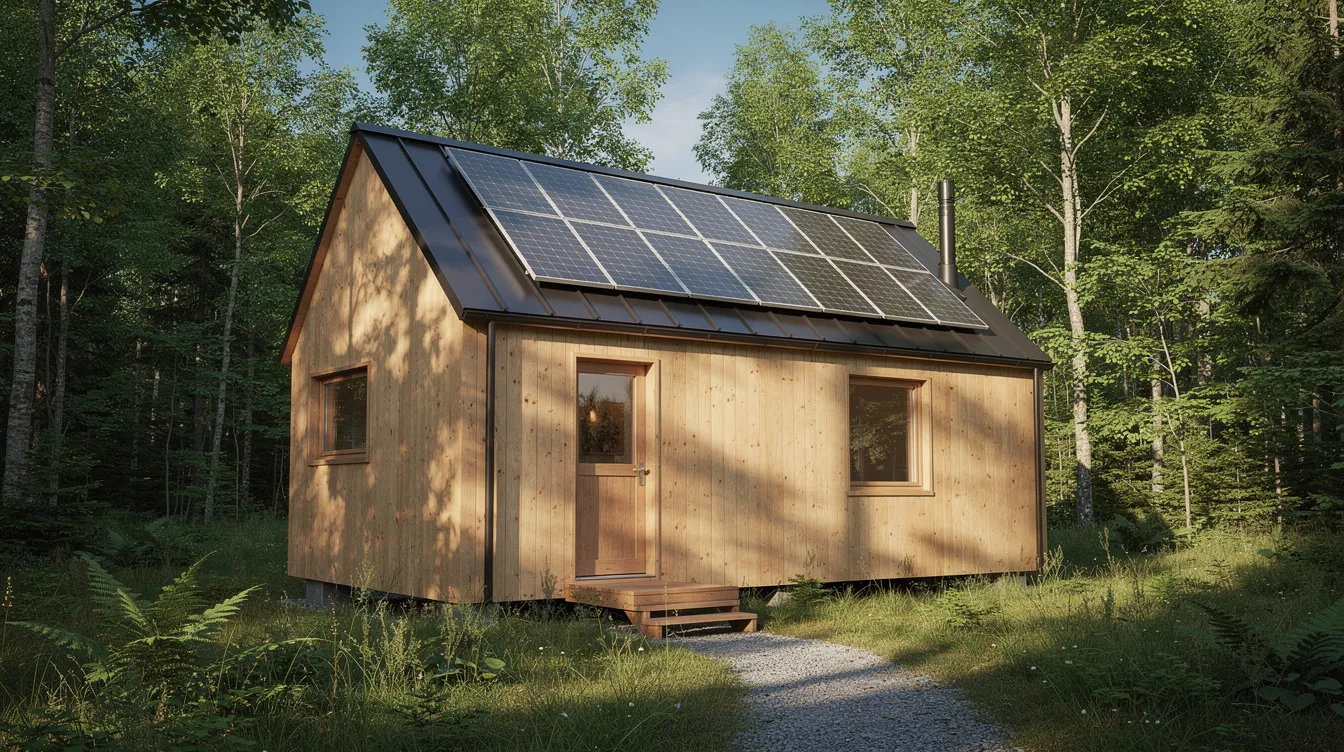
- Many tiny homes can operate off grid with 4–10 modern solar panels plus appropriately sized battery storage.
Introduction: Why Tiny House Electricity Use Is So Different
Tiny houses change everything about energy consumption. When you shrink from 2,000–2,600 square feet down to 100–400 square feet, your electricity needs drop dramatically. The average US home uses roughly 10,500 kWh per year. A well-designed tiny home? Often just 1,000–2,500 kWh annually.
Less floor area means lower heating and cooling loads. Fewer rooms mean fewer lights. Compact kitchens mean smaller, more efficient appliances. The result is significantly lower utility bills and a reduced carbon footprint.
Several factors shape your actual power consumption: lifestyle, climate, electrical systems design, choice of appliances, and whether you’re on or off grid. This guide will help you estimate your own energy usage and design an eco friendly system that fits your needs, and you can find additional inspiration and resources for exploring the world of tiny houses as you plan your build.
- How Much Electricity Does a Tiny House Use? (Quick Answer)
- Understanding Tiny House Power & Energy Usage
- Typical Tiny House Appliances and Their Power Requirements
- How to Estimate Your Tiny House’s Daily and Monthly Energy Use
- Grid-Tied vs Off-Grid: How Much Power Do You Really Need?
- Designing an Energy Efficient Tiny House Electrical System
- How Many Solar Panels and How Much Battery Storage Does a Tiny House Need?
- Ways to Reduce Energy Usage and Energy Costs in a Tiny House
- Environmental Impact: Tiny House Electricity and Carbon Footprint
- FAQ: Tiny House Electricity & Energy Usage
How Much Electricity Does a Tiny House Use? (Quick Answer)
A typical grid-tied tiny home uses 3–7 kWh per day, or roughly 90–210 kWh per month.
Here’s how different setups compare:
- Tiny house on wheels with efficient appliances: 3–5 kWh/day
- Larger foundation tiny house with electric cooking and mini split: 5–10 kWh/day
- Standard US home: 25–33 kWh/day
The average tiny house uses about 7% of the energy compared to an average traditional house, which is largely due to its smaller size and built-in design features.
Understanding how much power you need involves two measurements: daily energy usage (kilowatt hours) and peak power draw (watts or amps). Most tiny houses use 15A, 20A, or 30A service at 120V—that translates to 1,800–3,600 watts of continuous capacity.
For off grid living, owners often design for the lower end (3–5 kWh/day) to keep solar power systems and battery storage affordable.
Understanding Tiny House Power & Energy Usage
Before sizing your electrical system, understand the difference between power and energy. They’re related but not the same.
Power (watts/kW) is how much electricity appliances draw at any moment—like water pressure.
Energy (kWh) is how much electricity you use over time—like total water consumed. This is what utilities bill you for.
Here’s a simple example:
- A 1,000W electric kettle running for 12 minutes (0.2 hours) uses 0.2 kWh
- A 100W fridge running 8 effective hours daily uses 0.8 kWh
Most tiny houses use:
- 120V alternating current for standard outlets and appliances
- 12V, 24V, or 48V direct current on the solar and battery side for off grid setups
Understanding these basics is crucial before deciding how many solar panels or how large a battery bank you need.
Typical Tiny House Appliances and Their Power Requirements
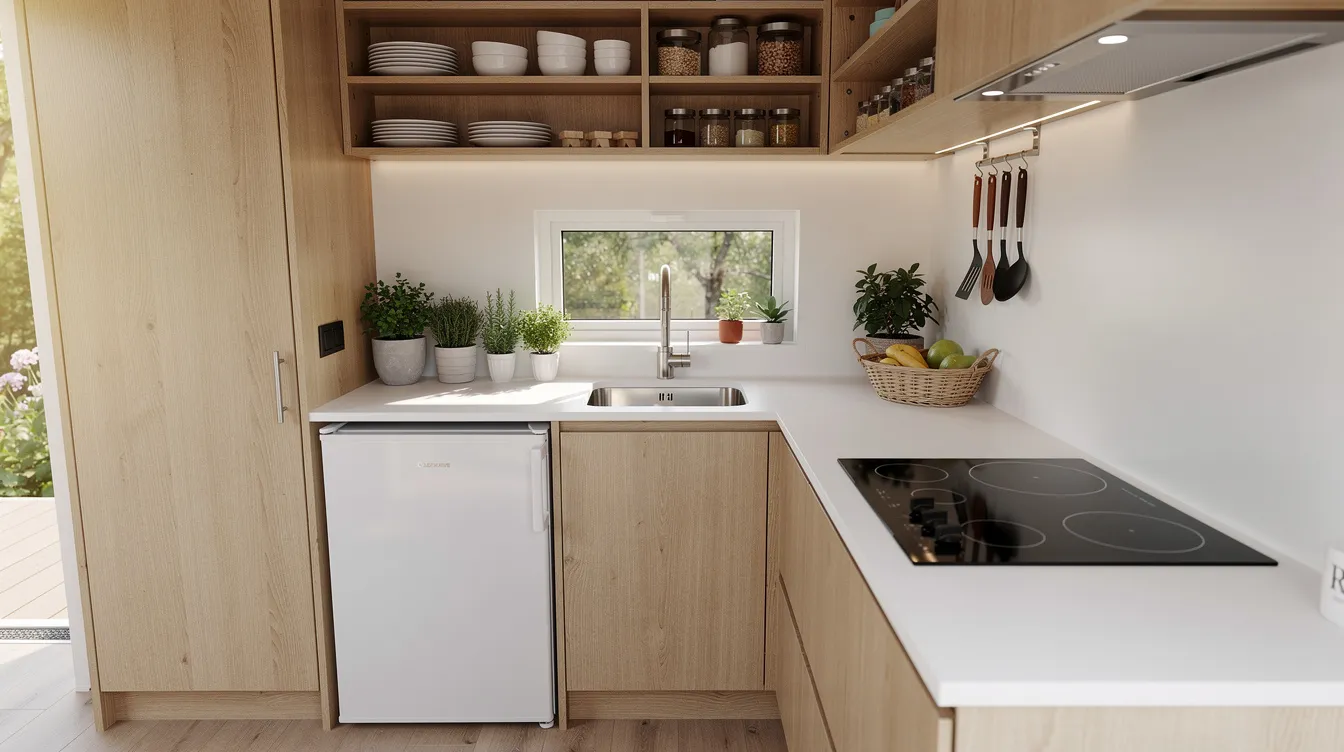
Your appliance choices largely determine total energy usage and peak load. Tiny house owners tend to favor compact, efficient appliances that match their limited space, often pairing them with tiny house interiors that maximize every square foot through smart storage and layout choices.
Common appliances and their typical draws:
- LED lights and electronics: 50–150W while on, 0.3–0.5 kWh/day
- 12,000 BTU mini split: 500–900W running, 1–3 kWh/day in moderate climate
- Compact fridge: 60–150W running, 0.5–1 kWh/day
- Induction cooktop: 1,200–1,800W, 0.5–1.5 kWh/day depending on cooking habits
- Kettle, microwave, toaster: 800–1,500W, low daily kWh due to short run times
Tiny houses typically require less energy for heating and cooling, as they often utilize window air conditioning systems and space heaters instead of central heating systems, and some owners go further by integrating tiny smart home systems for efficient living that automate climate control and lighting.
Many tiny house owners avoid high-demand appliances like electric ovens (2–5 kW), electric water heaters (3–4.5 kW), and electric dryers (4–5 kW). These dramatically increase power needs and system costs. Propane alternatives cut electrical demand by 50–80%.
When estimating power needs, it’s important to account for potential surges in power demand when multiple appliances are used simultaneously, as some devices require more power when they initially turn on. Fridges and air conditioning units may draw 2–3× their running watts during startup.
Investing in energy-efficient appliances, such as Energy Star-certified models, can significantly reduce electricity usage in tiny houses without compromising functionality.
How to Estimate Your Tiny House’s Daily and Monthly Energy Use
To estimate your power needs, make a list of all the appliances you plan to use in your tiny house and their power requirements, then calculate the total wattage needed by adding the power requirements of each appliance.
Follow these steps:
- List every device: lights, fridge, mini split, fans, pumps, electronics, cooking appliances, tools
- Find wattages: check nameplates, manuals, or manufacturer websites
- Estimate daily hours: include duty cycles (fridges run ~8 effective hours)
- Calculate: watts × hours ÷ 1,000 = kWh per item
- Sum totals: add all items for daily kWh
- Extrapolate: multiply by 30 for monthly, 365 for annual
Example for a 250 sq ft tiny house:
Appliance | Daily kWh |
|---|---|
LED lights | 0.3 |
Compact fridge | 0.8 |
Mini split AC | 2.0 |
Laptop/phone | 0.4 |
Induction cooktop | 1.0 |
Miscellaneous | 0.5 |
Total | 5.0 kWh/day |
That’s about 150 kWh/month. At $0.15/kWh, expect roughly $22–25 in monthly energy bills. |
Lifestyle swings totals significantly. Work-from-home adds 2–3 kWh daily. Gas cooking saves 1 kWh. Cold climates add 2–4 kWh for electric heat. Use a plug-in energy monitor or consult an electrician for precise load calculations.
Grid-Tied vs Off-Grid: How Much Power Do You Really Need?
Your grid connection status fundamentally shapes system design and energy costs.
Grid-tied tiny houses:
- Use standard 15–30 amp hookups (similar to RV pedestals)
- Support higher peak loads since the grid acts as an infinite power source
- Energy costs depend on local electricity rates but stay low due to minimal usage
Off grid setups:
- Must size solar array, battery storage, and inverter around worst-case daily usage
- Usually design for lower daily kWh (3–5 kWh/day) to keep systems affordable
- Use more efficient appliances and alternative heating (propane, wood stoves)
Tiny houses can be powered by various sources, including grid connections, solar power systems, and generators, each with its own advantages and considerations.
Generator power is a viable option for tiny houses, especially for those in areas with limited sun, but it typically relies on fossil fuels and requires consideration of noise and less maintenance cycles.
Wind power is an innovative solution for tiny houses, where wind turbines can be installed to harness wind energy, providing a consistent power supply in windy areas.
Real-world examples: Owners of self contained tiny homes for modern off grid living often design carefully around their peak and daily loads so they can run comfortably on solar and battery power alone.
- Grid-tied tiny house in Seattle with electric cooking and mini split: 7–9 kWh/day, around $1–2 daily
- Off grid cabin in Colorado with propane cooking, wood heat, DC fridge: 2–4 kWh/day
Decide your power consumption targets before building—it affects wiring, panel size, and overall electrical system design.
Designing an Energy Efficient Tiny House Electrical System
A tiny house electrical system has the same core elements as a full-size home, just scaled down. Many also integrate renewable energy sources for independence, which aligns well with minimalist tiny houses for sustainable living that prioritize efficiency and low-impact design.
Main components include:
- Power source: grid inlet, solar charge controller, or backup generator
- Breaker panel: sized for expected amps (typically 30–100A)
- Inverter: converts DC to ac power for off grid setups (sized for continuous and surge loads)
- Battery storage: lithium or lead-acid batteries with adequate storage capacity
- Distribution: wiring to outlets, lighting circuits, and fixed loads
Proper grounding and GFCI outlets in wet areas are essential for safety. Small spaces with limited ventilation make correctly sized wiring even more critical—undersized wires create fire risks.
Hire a licensed electrician familiar with tiny homes. DIY wiring errors in compact spaces lead to shock hazards and insurance problems. Professional input is especially important when integrating solar arrays, inverters, and transfer switches.
A well-designed system plus efficient appliances significantly lowers power consumption without sacrificing comfort.
How Many Solar Panels and How Much Battery Storage Does a Tiny House Need?
The number of pv panels depends on daily kWh needs and local sun hours. Tiny houses typically require fewer solar panels compared to traditional homes, making solar energy a more feasible and cost-effective option for off-grid living.
General guidelines:
- For 3 kWh/day with ~4 peak sun hours: 750–1,000W of solar (3–4 × 300W panels)
- For 5–6 kWh/day: 1.5–2.0 kW of solar (5–7 × 300W panels)
- Shading, tilt, and orientation can change requirements by 10–30%
Solar power is a popular choice for tiny houses, allowing homeowners to generate electricity from sunlight, which can be stored in batteries for use when the sun isn’t shining.
Battery storage sizing:
- Aim for 1–2 days of autonomy
- Example: 5 kWh/day × 2 days = 10 kWh usable storage
- Lithium batteries offer 80–90% usable capacity vs 50% for lead-acid
Practical constraints:
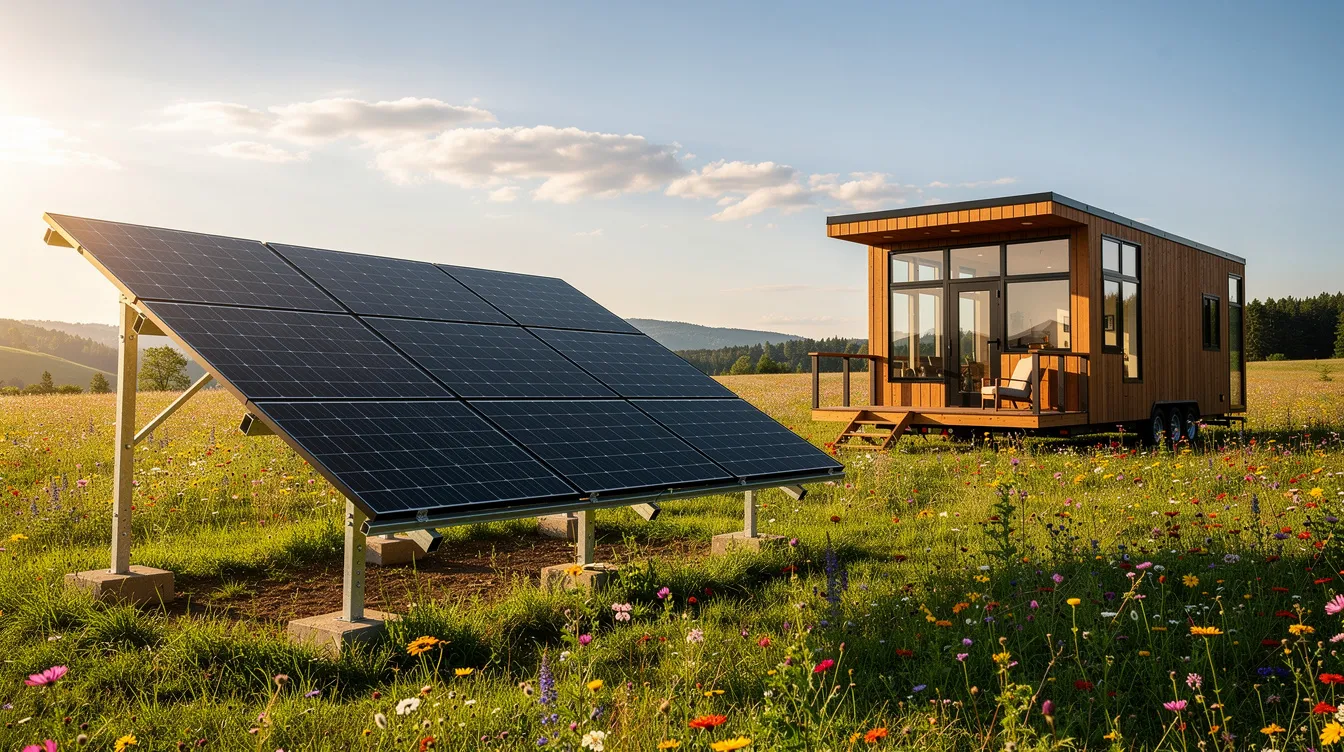
- Limited roof space may require ground-mounted panels
- Weight matters for tiny houses on wheels (batteries add 200–400 lbs)
- Match solar array, inverter rating, and battery bank to your calculated electricity needs
Balance your solar system design with realistic expectations. Full sun locations need fewer panels than areas with limited sun exposure.
Ways to Reduce Energy Usage and Energy Costs in a Tiny House
Tiny homes are already relatively energy efficient, but thoughtful design can further cut energy bills and environmental impact, as shown by many great tiny homes that redefine small space living through smart layouts and envelope design.
Appliance strategies:
- Choose Energy Star fridges and SEER 25+ mini splits
- Use LED lighting with motion sensors
- Opt for heat-pump dryers (1 kWh/load vs 4 kWh for conventional)
- Consider DC fridges for off grid applications
Insulation matters:
Proper insulation in a tiny house minimizes heat transfer, reducing the need for heating or cooling, which can lead to significant energy savings. Quality wall, roof, and floor insulation cuts heating and cooling loads by 30–60% even in a 200 sq ft space. Large windows add natural light but choose double-pane models with low U-values, similar to many elegant tiny homes that redefine modern living by combining energy efficiency with expansive glazing and stylish finishes.
Smart monitoring:
Energy monitors like Emporia ($150) or plug-level meters identify waste. Many tiny house owners discover 10–20% of usage comes from phantom loads.
Behavioral habits:
- Stagger high-draw appliances
- Cook with lids on
- Use pressure cookers
- Favor natural light during daytime
- Ensure proper ventilation to reduce cooling needs
These strategies help you save money while maintaining comfort in your small house.
Environmental Impact: Tiny House Electricity and Carbon Footprint
Lower power usage translates directly to environmental benefits. An average tiny house uses about 7% of the energy compared to an average traditional house, primarily due to its smaller size and built-in design features.
Carbon comparison:
A grid-powered US home using 10,000+ kWh/year produces roughly 7–10 tons of CO₂ annually (at ~0.7 lb CO₂/kWh). A 1,500 kWh/year tiny house? Under 1 ton.
Solar power is a clean, renewable energy source that provides a sustainable solution for tiny house living, allowing homeowners to generate electricity from sunlight. Pairing your tiny home with solar panels can push operational emissions close to zero.
The smaller footprint of tiny houses not only leads to lower energy consumption but also results in reduced waste production, making them more sustainable than larger homes, especially when you choose from tiny house designs for modern living that emphasize compact, efficient layouts. Using solar power in tiny houses can significantly lower utility bills, as tiny homes consume about 7% of the energy used by average sized homes, leading to substantial savings over time.
The minimalist lifestyle extends beyond just electricity. Water use, building materials, and travel patterns all contribute to sustainability, and many people pursue this path through affordable tiny house buildings and designs that keep both upfront and ongoing costs in check. But electricity is an impactful and controllable starting point for eco friendly living, and using a tiny home cost calculator to plan your budget helps you size systems and allocate funds realistically.
FAQ: Tiny House Electricity & Energy Usage
How much does it cost per month to power a tiny house?
At typical US electricity rates ($0.12–$0.25 per kWh in 2026), a tiny house using 100–250 kWh monthly pays roughly $15–$60 in electric bills. Compare that to a standard home that easily spends $150–$250 monthly on electricity alone.
Off grid owners effectively prepay energy costs through solar and battery investment instead of monthly utility bills. Initial system costs of $8,000–$20,000 typically pay back within 5–10 years.
Can a tiny house run entirely on solar power year-round?
Many tiny houses can be fully solar powered, but success depends on climate, shading, roof space, and realistic energy use. Winter months in northern regions may require larger arrays, more battery storage, or supplemental grid power.
Design systems with winter sun hours in mind. Include at least a small backup generator or grid connection for reliability during extended cloudy periods or when you need more power than usual.
Is 30 amps enough for a tiny house electrical system?
A 30 amp, 120V service is enough for most tiny houses that avoid big electric ranges and dryers. That’s 3,600 watts—plenty for lights, mini split, fridge, and smaller appliances if loads are staggered.
Simpler setups work fine on 15–20A. More power-hungry all-electric builds on foundations might opt for 50A or 240V service for more space in the electrical budget.
Should I use propane or electricity for heating and hot water?
Electric heat and hot water simplify the system but require larger electrical service, more solar panels, and bigger battery storage off grid. Propane reduces electrical demand but adds fuel deliveries and combustion safety considerations.
Many off grid owners favor propane for space and water heating. Grid-tied tiny homes often use high-efficiency electric options like mini splits and heat pump water heaters. Base your decision on climate, local energy prices, and your diy route capabilities versus hiring professionals.
Do I need a professional electrician to wire my tiny house?
For safety, code compliance, and insurance, a licensed electrician familiar with tiny homes or RV standards should at least review critical parts of your electrical system. Errors in compact spaces create fire risks and shock hazards.
Professional input is especially important when integrating solar arrays, inverters, battery storage, and transfer switches. This ensures your other house electrical components work safely together and meet local requirements.