

Collecting your own water makes sense for tiny house living.
A tiny house rainwater harvesting system captures rain from your roof, stores it in tanks, and delivers clean water to your fixtures. Rainwater harvesting can significantly reduce reliance on external water sources, providing a self-sufficient water supply for various needs such as drinking, cooking, and irrigation. It’s freedom in liquid form.
This step by step guide covers everything DIY tiny house owners need to build a reliable off-grid water system in 2026 and beyond, and pairs well with a broader guide on how to build a tiny house from foundation to finishes.
- Quick Overview: How a Tiny House Rainwater Harvesting System Works
- Planning Your Tiny House Rainwater Harvesting System
- Roof, Gutters, and Pre-Filtration
- First Flush and Conveyance: Keeping Storage Tanks Clean
- Storage Tanks for Tiny Houses
- Pump System and Pressure Tank for Tiny House Water Supply
- Filtration System and Water Treatment
- Overflow Management and Rain Garden Integration
- Installation Steps: From Bare Tiny House to Running Water
- Maintenance Schedule and Troubleshooting
- Cost, Sizing Examples, and Final Tips
Quick Overview: How a Tiny House Rainwater Harvesting System Works
Whether your tiny home sits on a permanent foundation or rolls on wheels, rainwater harvesting works the same basic way. Rain falls on your roof, flows into gutters, passes through filters, and ends up in storage tanks ready for use.
Implementing a rainwater harvesting system can lower utility bills by utilizing collected rainwater instead of purchasing water from municipal sources. Plus, rainwater harvesting promotes a more sustainable lifestyle by reducing water waste and encouraging the use of natural resources, which can lead to a smaller environmental footprint.
Here’s the flow in plain terms:
Rain hits roof → Gutters → Pre filtration → First flush diverter → Storage tanks → Pump system + Pressure tank → Filtration system → Tiny house plumbing
Core Components
Your rainwater harvesting system needs these parts:
- Collection surface: Your metal roof or other clean roofing material
- Gutters and downspouts: Channel water from roof to storage
- Pre filtration devices: Gutter guards, leaf screens, strainer baskets
- First flush diverter: Diverts dirty initial runoff away from tanks
- Storage tanks or cisterns: Hold your harvested water
- Pump system: Pressurizes water for household use
- Pressure tank: Smooths delivery and reduces pump cycling
- Post-storage filtration system: Cleans water before it reaches fixtures
- Optional rain garden: Handles overflow responsibly
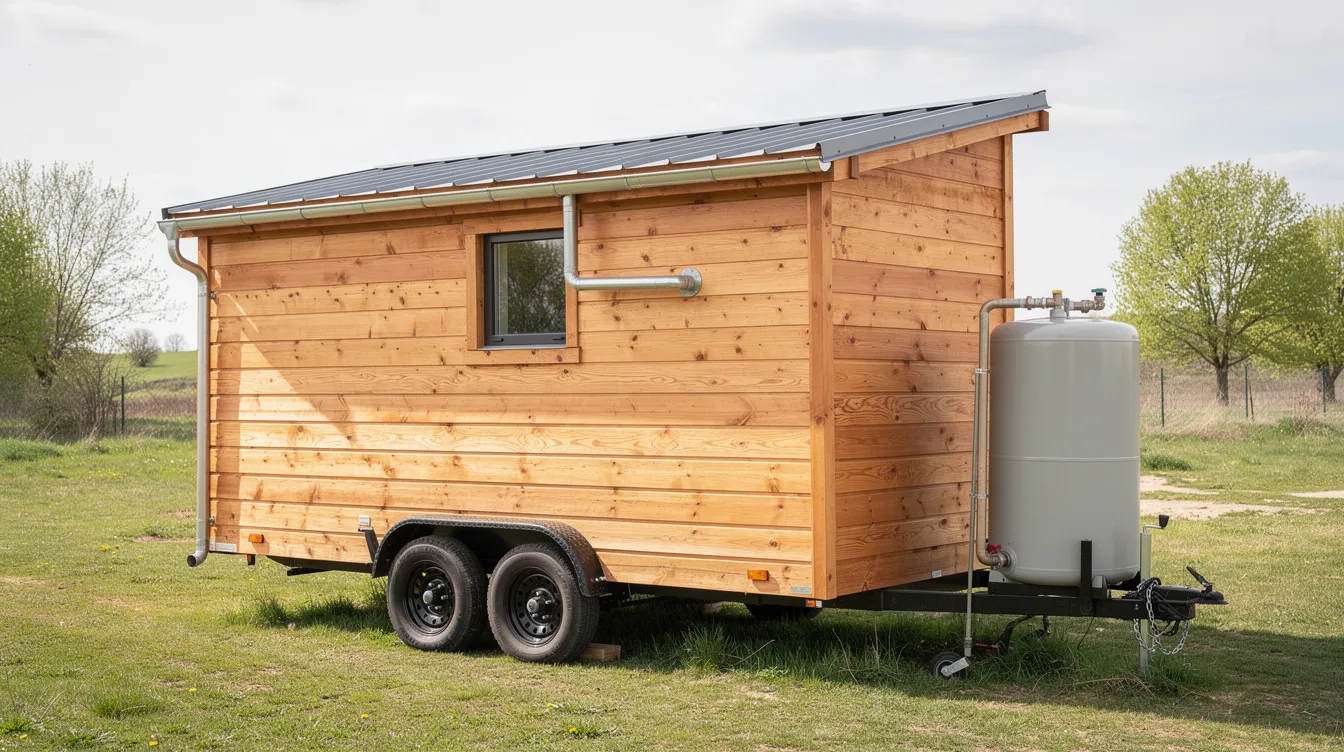
This guide distinguishes between irrigation-only systems (simpler, no pump or filtration needed) and full potable systems for drinking, shower, kitchen sink, and bathroom sink use. Most tiny homes benefit from a complete setup that handles all water needs.
Planning Your Tiny House Rainwater Harvesting System
Good planning avoids undersized tanks and underpowered pumps.
Skipping this step leads to running dry during summer droughts or flooding your site during wet seasons. To install a rainwater harvesting system, first assess your daily water needs to design a system that meets your consumption efficiently.
Estimating Daily Water Needs
Tiny house dwellers use far less water than the average American’s 80-100 gallons per day. Expect these ranges:
- Drinking and cooking: 2-5 gallons per person
- Showering (low-flow 1.5 GPM head): 10-15 gallons per person
- Washing and laundry: 5-10 gallons per person
A 2-person tiny house typically needs 40-60 gallons per day. Using a composting toilet cuts grey water volume by about 30%, and it should be planned alongside tiny house septic and waste system options to keep your setup sustainable.
Calculating Your Harvest Potential
Use this formula from the Texas Water Development Board:
Gallons = Annual Rainfall (inches) × Roof Area (sq ft) × 0.623
For a tiny house in Portland, Oregon (36 inches annual rainfall):
- 160 sq ft roof: 36 × 160 × 0.623 = 3,580 gallons per year (~10 gallons/day)
- 240 sq ft roof: 36 × 240 × 0.623 = 5,370 gallons per year (~15 gallons/day)
Climate Comparison for 200 sq ft Roof
Here’s how much water you can collect in different U.S. locations:
- Austin, TX (34 inches): ~4,240 gallons/year
- Seattle, WA (38 inches): ~4,740 gallons/year
- Asheville, NC (47 inches): ~5,870 gallons/year
Dry climates like Austin need larger tanks (3-6 months storage) because droughts last longer. Rainy Seattle works fine with 1-2 months storage.
Check Local Building Codes
Regulations vary wildly. Texas allows potable harvesting statewide with no permits under 5,000 gallons. Oregon requires county health approval for potable use. California mandates backflow prevention.
Always verify local building codes before connecting to your plumbing. Check rules on overflow discharge too—you can’t erode public rights-of-way.
Roof, Gutters, and Pre-Filtration
Clean collection starts at the roof. About 80-90% of contaminants enter your system here, so investing in proper preparation reduces the load on your filtration system downstream.
Preferred Roofing Materials
For fresh water collection, metal roofs work best. Standing seam metal roofs installed after 2015 (galvalume or aluminum-zinc coated) leach minimal metals—less than 0.1 mg/L.
Avoid these materials for potable systems:
- Asphalt shingles (hydrocarbon runoff)
- Tar roofs (PAHs)
- Lead flashing
- Untreated wood
Preparing Your Existing Roof
Before you collect water, inspect your roof for:
- Moss (harbors bacteria)
- Peeling sealant (leaches VOCs)
- Bird nests (E. coli vectors)
- Overhanging branches (drop leaves and pollen)
Trim trees at least 3 feet from the roof. Power-wash annually with biodegradable detergent.
Gutter Installation
Install gutters and downspouts on your roof to channel rainwater into storage tanks, ensuring they are made from non-toxic materials and properly sloped. For tiny houses on wheels, use 5-6 inch K-style aluminum gutters (0.027-0.032 gauge) secured with hangers every 16 inches and rubber spacers to absorb travel vibrations.
Slope gutters 1/16 to 1/8 inch per foot toward downspouts.
Pre-Filtration Options
Pre-filtration systems, which include leaf guards and strainer baskets, are necessary to remove debris and contaminants from rainwater before it enters the storage tanks.
Common options:
- Gutter guards: #24 mesh (1/16-inch openings)
- Rain heads/downspout screens: Block 95% of debris
- Tank inlet strainers: 200-mesh stainless steel
These capture 70-85% of particulates larger than 100 microns.
Maintenance: Clean after every 1-inch+ rain event and at minimum every 2-3 months. Neglecting this doubles sediment load and fouls pumps within weeks.
First Flush and Conveyance: Keeping Storage Tanks Clean
A first flush diverter is a critical component that routes the initial flow of dirty runoff water away from the storage tank, ensuring that only cleaner water enters the system.
The first 0.1-0.2 mm of runoff carries 50-80% of roof pollutants—pollen, bird droppings, dust, and particulates. For small tanks typical of tiny homes, this contamination concentrates quickly. Diverting it is essential.
How First Flush Works
A simple vertical PVC standpipe (3-4 inch diameter) fills first during rain. Once full, it tips or auto-dumps via a float mechanism, allowing clean water to flow to storage.
Design rule: Use 1-2 gallons of first flush volume per 100 sq ft of roof area.
For a 200 sq ft tiny house roof, install a diverter holding 2-4 gallons. This ensures the dirty water stays out and water quality stays high.
Mounting for Tiny Homes
- Vertical diverter: Attach to trailer frame or exterior wall
- Horizontal pipe: Run under eaves when vertical height is limited
Brad Lancaster’s passive designs in Tucson handle 100 sq ft roofs with just 1-gallon PVC diverters using manual reset.
Conveyance Piping
From gutters to tank, choose:
- Schedule 40 PVC: Durable and cheap, but needs UV protection
- Polyethylene hose: Flexible for mobile homes that move seasonally
- PEX: Burst-resistant to -40°F for cold climates
Protect exposed pipes: Paint PVC to block UV (degrades 20-30% yearly unprotected), insulate lines with foam sleeves, and install drain valves for winter.
Storage Tanks for Tiny Houses
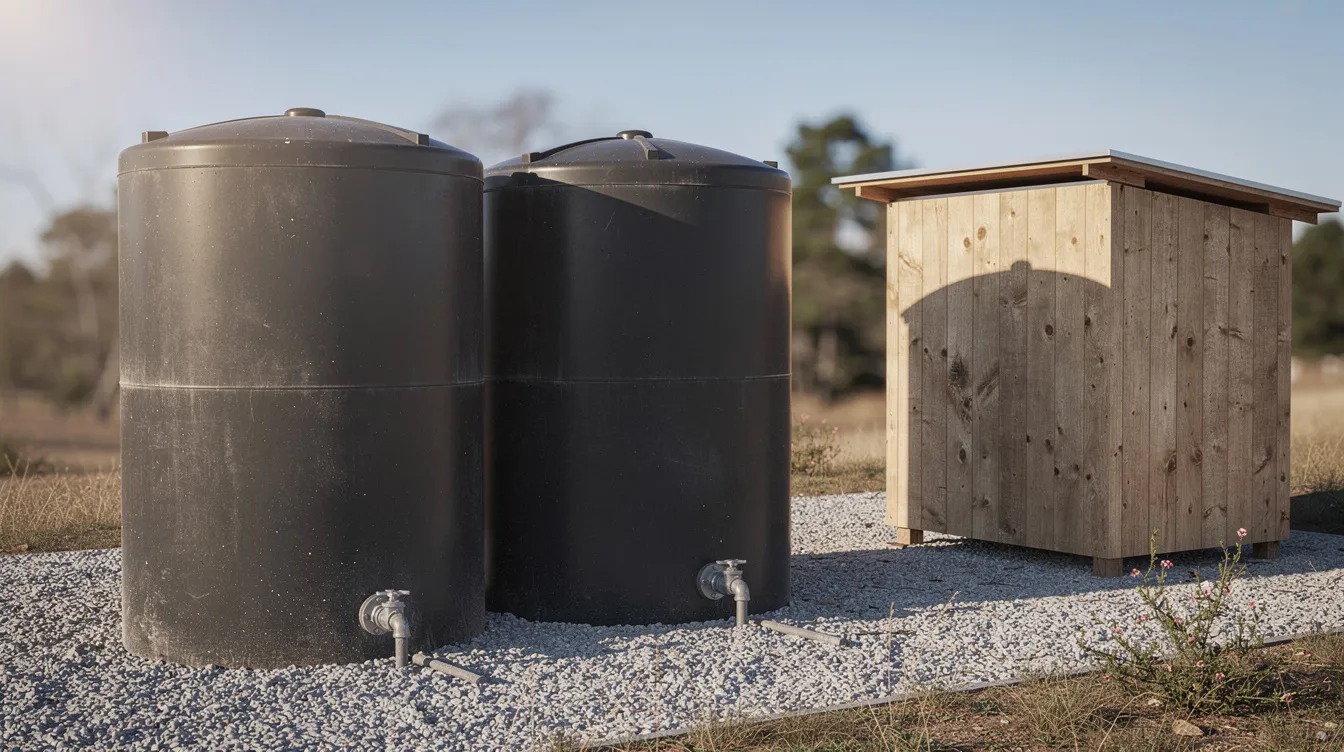
Space constraints demand creative tank placement. Options include the trailer tongue, under the house, beside the deck, or buried nearby, and your choices should align with tiny house plans that fit your life so water storage integrates cleanly into the layout.
Tank Options for Tiny Homes
Select storage tanks that fit your available space and water needs, placing them in shaded areas to prevent algae growth and connecting downspouts with filters to remove debris before water enters the tanks.
Common choices:
- 55-gallon food-grade barrels: $20-40 used, stack 3-4 for 200 gallons
- 275/330-gallon IBC totes: $150-300, caged polyethylene
- Purpose-built poly cisterns: 300-1,500 gallons, slim profiles available
Preventing Algae Growth
Storage tanks, or cisterns, are essential components of a rainwater harvesting system, designed to store filtered rainwater either above or below ground, and should ideally be opaque to prevent algae growth.
Paint IBC totes with UV-resistant exterior paint (Rust-Oleum dark gray blocks 99% of light). Storage tanks for rainwater should ideally be opaque to prevent algae growth, and they require proper maintenance including regular inspections and cleaning to ensure water quality.
Above-Ground vs. Below-Ground
Feature | Above-Ground | Below-Ground |
|---|---|---|
Cost | ~$0.50/gallon | ~$1.50/gallon |
Access | Easy for inspection | Requires manway |
Freeze risk | Higher (insulate or heat tape) | Lower (below frost line) |
Visual impact | Visible | Hidden |
For larger tanks buried nearby, plan excavation to 4-foot frost depth. |
Critical Tank Features
- Screened inlet with debris bucket
- Anti-vortex calming baffle
- 3-4 inch overflow pipe (down-curved screen prevents algae)
- Drain valve for cleaning
- Secure, rodent-proof lid
Placement: Level gravel pad, 18-24 inches from house walls, anchored for wind or towing. A big tank needs solid ground support.
Pump System and Pressure Tank for Tiny House Water Supply
Gravity-fed systems rarely provide enough pressure for comfortable showers. Roof-to-fixture drops in tiny houses generate only 5-10 PSI—far below the 20-40 PSI needed for normal fixtures.
Typical Pump Setup
A 12V DC or 120V AC diaphragm pump draws from storage, feeds a small pressure tank, then connects to your plumbing manifold. This supplies water to your kitchen sink, bathroom sink, and shower.
Recommended specs:
- Flow rate: 2-5 GPM
- Pressure: 30-50 PSI
- Example: Shurflo 3.0 GPM at 45 PSI ($150), solar-compatible on 100Ah battery
Pressure Tank Function
The pressure tank stores 1-2 gallons of usable volume, cutting pump cycles by 70%. This extends pump life threefold and smooths water flow to fixtures.
Size options: 2-6 gallon diaphragm tanks work well for tiny houses.
Installation Tips
- Mount pump on neoprene vibration-damping pads
- Use braided flex hoses to reduce noise transfer
- House pump system in an insulated utility box
- Install a low-water cutoff float switch ($30) to prevent dry-run damage
Optional components: Bypass valve for filling tanks from a hose when rain is scarce, making your system work with various water sources.
Filtration System and Water Treatment
A filtration system is essential for treating collected rainwater, using a series of filters to remove particles, bacteria, and viruses to make the water safe for drinking and cooking.
Non-potable systems (toilets, irrigation) can skip heavy filtration. But for treated water reaching your drinking glass, layer your defenses.
Typical Filtration Order
- Spin-down sediment filter (20 micron): Catches 90% of roof grit, $50
- Pleated sediment filter (5 micron): Finer particles, $30
- Carbon block filter (0.5 micron): Removes taste, odor, VOCs, $40
- UV sterilizer (40 mJ/cm²): Kills 99.99% of bacteria and coliforms, $200
Compact Housing Options
10-inch Big Blue housings fit under a tiny house kitchen sink or in a small utility closet. Berkey gravity filters ($300) work for low-use situations without electricity.
Testing and Maintenance
Test water annually via EPA-certified labs ($100-200) for bacteria, heavy metals, and pH. Urban locations may show elevated lead or copper.
Maintenance schedule:
- Sediment filters: Replace every 3-6 months
- Carbon filters: Replace every 6-12 months
- UV lamps: Service yearly per manufacturer instructions
Note on grey water: Water from showers and sinks should route separately to mulch basins or treatment system—don’t mix it with your potable supply.
Overflow Management and Rain Garden Integration
Even small systems generate overflow during heavy rain. Managing it prevents erosion, mud, and neighbor problems.
Routing Overflow
Size 3-4 inch PVC overflow pipes with 1/4-inch per foot slope. Route water 10-20 feet from your foundation to daylight with rock splash pads at the outlet. Screen ends curl-down to block debris and sunlight.
What Is a Rain Garden?
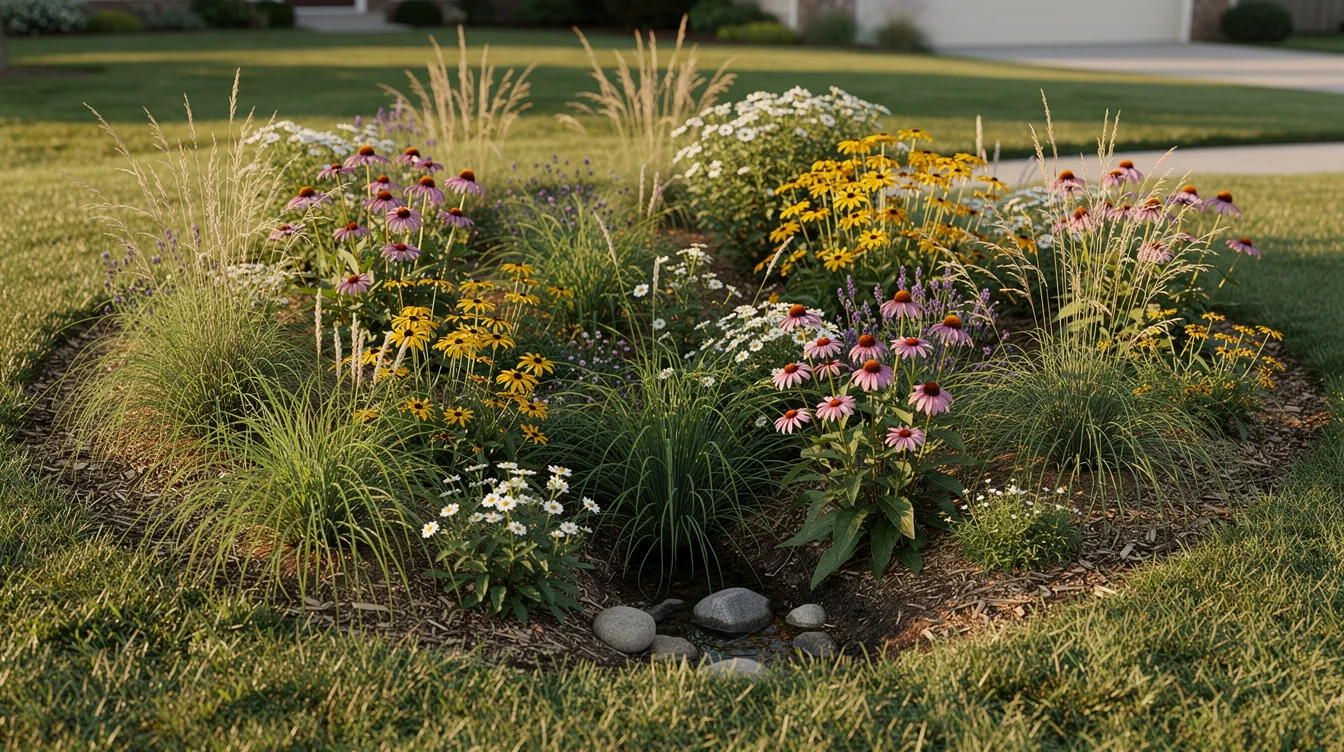
A rain garden is a shallow planted depression that absorbs and filters overflow. It drains water naturally into soil while supporting plants, pollinators, and fruit trees.
Simple Design Example
Create an 8×10 foot rain garden located 6-10 feet downslope from your tiny house:
- 6-12 inches deep with 3:1 side slopes
- 2-4 inches of woodchip mulch
- Plant deep-rooted natives (switchgrass, joe-pye weed) suited to wet-then-dry cycles
This handles overflow from an 825-gallon tank system while cooling your microclimate 5-10°F. Plant on the south side for maximum sun exposure and growth, and consider layering in creative tiny garden ideas for small spaces to maximize food or flowers around your rain garden.
Cold Climate Considerations
In freezing climates, use gravel underplanting for freeze-thaw durability. Respect setbacks (5-10 feet from property lines) when directing runoff.
Installation Steps: From Bare Tiny House to Running Water
Here’s the condensed step by step guide showing the whole build sequence:
Installation Order
- Plan water needs and check codes: Calculate daily usage, verify local regulations
- Prepare roof and gutters: Install gutters with proper slope, add gutter guards
- Install pre filtration and first flush: Mount screens, position diverter
- Set storage tanks and foundation: Level gravel pad, place and anchor tanks
- Plumb conveyance lines: Connect downspouts to tank inlet
- Install pump system and pressure tank: Wire pump (GFCI protected), connect pressure tank
- Connect filtration system: Mount filter housings, install cartridges
- Tie into tiny house plumbing: Connect to manifold, test plumbing connections
- Test, flush, and sanitize: Run 100 gallons through, sanitize with 1 cup bleach per 50 gallons
Realistic Timeline
- Weekend 1: Roof prep, gutters, pre filtration
- Weekend 2: Tanks, pump, pressure tank, basic plumbing
- Day 5: Filtration setup and testing
Safety Practices
- Use only food-grade components
- Pressure-rate pipes appropriately (100 PSI minimum)
- Call a licensed electrician for AC wiring if unsure
- Mobile tiny houses should use quick-disconnect fittings for winterization
Maintenance Schedule and Troubleshooting
Small systems are sensitive. A clogged screen or failing pump quickly affects your whole water supply.
Regular maintenance is crucial to keep your rainwater harvesting system functioning efficiently, which includes cleaning gutters and filters periodically, checking for leaks, and ensuring storage tanks are free from contaminants.
Recommended Schedule
- Monthly: Visual inspection of gutters and tank screens
- Quarterly: Clean pre filtration devices and first flush piping
- Every 3-6 months: Replace filter cartridges based on turbidity
- Annually: Tank inspection, sediment vacuum, system sanitization
It is recommended to check and clean any screen filters every 2 to 3 months, and to clean gutters, downspouts, rain heads, and first flush diverters every 6 months to maintain optimal system performance.
Common Problems and Fixes
Problem | Cause | Fix |
|---|---|---|
Sputtering water | Air in lines | Bleed air at fixtures |
Pump short-cycling | Pressure tank issue | Recharge tank bladder |
Cloudy water | Disturbed sediment | Let tank settle, check inlet baffle |
Algae growth | Light exposure | Paint tank, check for cracks |
Low pressure | Clogged filters | Replace cartridges |
Winter Protection
Where temperatures drop below 32°F, drain pipes or install heat tape (50W per foot). Design easy drain-down valves for seasonal protection.
Keep a simple logbook tracking maintenance dates, filter changes, and test results. This helps you manage your system’s health over years of life.
Cost, Sizing Examples, and Final Tips
A basic tiny house rainwater harvesting system fits modest budgets. More advanced setups with higher-flow pump systems and multi-stage filtration cost more but deliver household-like convenience, especially when paired with affordable tiny house building designs and tips that keep your overall project cost in check.
Example System Packages
Starter System (Solo Dweller, Outdoor Shower)
If you’re just dipping a toe into the lifestyle, prebuilt options like Amazon tiny houses as an affordable starter choice can simplify getting under roof before you add a custom rainwater system.
- 300-400 gallons storage (3-4 barrels): $100-150
- Basic gutters and screens: $100-150
- Gravity filter (Berkey-style): $300
- Simple hand pump backup: $50
- Total: $500-800
Full-Time System (Couple, Indoor Plumbing)
Couples planning to live small long-term can look at great tiny homes that redefine small-space living for inspiration on layouts that leave room for tanks, utility chases, and filtration gear.
- 1,000+ gallon storage (IBC totes or cistern): $400-600
- 12V pump and pressure tank: $300
- Multi-stage filtration with UV: $400
- Gutters and conveyance: $300
- Total: $2,500-4,000
2026 Price Ranges
- Tanks: $20-40 (used barrels) to $800 (500-gallon cisterns)
- Gutters: $2-8 per foot installed
- Pump: $120-200
- Pressure tank: $80-150
- Filtration (complete): $300-600
Rainwater Management Solutions offers pre-plumbed tiny house packages integrating filtration and pumping for under $2,000—a great example of turnkey solutions, similar to how shipping container tiny house designs for modern living bundle structure and systems into a compact footprint.
Best Practices Summary
- Prioritize roof cleanliness (it determines 80% of water quality)
- Right-size storage to local rainfall and dry spells
- Invest in a reliable pump and pressure tank
- Never skip filtration for drinking water
- Test annually if using water for drinking
Your tiny house rainwater harvesting system doesn’t need to be perfect from day one. A simple approach works fine to start. Collect water, learn how much water you actually use, and expand as you understand your needs and local climate better as you decide whether buying a tiny house for sale is right for you.
Water independence is achievable for any tiny house owner willing to plan and build. Start simple, track your supply, and grow your system over time—especially if you dream about tiny house nature retreats that immerse you in the outdoors.