
Key Takeaways
- Most full-time tiny houses need roughly 2–5 kWh per day, depending on climate, appliances, and whether you use propane for heating.
- Many off-grid tiny homes end up in the 8–16 panel range using modern 350–450 W panels, especially when ground space allows for extra capacity.
- How many solar panels you need depends on energy consumption, local sun hours, roof space, and whether you have a backup generator.
- The 30% federal solar tax credit (ITC) in the U.S. can significantly cut upfront system costs through at least 2032.
- Using solar energy helps reduce greenhouse gas emissions and lowers your carbon footprint, contributing to a healthier environment.
How Many Solar Panels Does a Tiny House Need? (Fast Answer)
Most off-grid tiny houses need about 2–4 kW of solar, or roughly 6–12 × 400 W panels, assuming 4–5 peak sun hours and energy efficient appliances. A typical tiny house uses around 4,150 watts per day, which may require about 15 solar panels of around 300 watts each to meet its energy needs. However, with modern high efficiency panels rated at 400W+, you can often get by with fewer.
Here are three concrete scenarios:
- Minimalist off-grid weekend cabin (about 1.5 kWh/day): 3–4 × 400 W panels
- Average full-time couple with propane for heat and hot water (about 3–4 kWh/day): 8–10 × 400 W panels
- High-usage tiny house with electric mini-split and home office (about 5–6 kWh/day): 12–16 × 400 W panels plus larger battery capacity
These estimates assume modern panels with roughly 20–22% solar panel efficiency and locations with 4–5 peak sun hours (Colorado, Tennessee, Northern California). Cloudier climates may need 20–30% more panels.
A typical tiny house needs roughly 300W to 1500W of solar power, often satisfied by 2–6 high efficiency panels (300W–400W each). However, roof space on a typical 24–28 ft tiny house often limits you to 2–6 roof panels. Many tiny house owners mount extra solar panels on the ground or use high-efficiency (400W+) panels due to space limitations.
The following sections walk through step-by-step calculations using real appliance wattages so you can refine these baseline numbers.
Understanding Tiny House Energy Consumption
Knowing your daily energy consumption in watt-hours or kilowatt-hours is the foundation for sizing solar and batteries. Tiny houses generally consume less energy than traditional homes, allowing for smaller and cheaper solar setups.
Here’s what typical daily power consumption looks like for a full-time tiny house in 2026:
- Low-usage: ~1.5–2 kWh/day
- Average: ~3–4 kWh/day
- High-usage (more electric heating/cooling): ~5–7 kWh/day
Daily consumption, sunlight availability, and available roof space are the main factors in determining solar panel needs for tiny houses.
Understanding the difference between watts and watt-hours is crucial. Watts measure instantaneous power draw. Watt-hours measure energy used over time. Your solar system sizing is always based on daily watt-hours, not peak watts.
Use a simple spreadsheet or plug-in power meter over 7–14 days to track actual usage before committing to an off-grid solar design.
Listing Your Appliances and Power Consumption
Create a load list with every appliance, its watt rating, and hours of use per day. Here are typical 2026 wattages:
Appliance | Watts | Typical Hours/Day | Wh/Day |
|---|---|---|---|
9,000 BTU mini-split | 600–900 | 4–8 (cycling) | 1,000–2,000 |
12V DC fridge | 40–80 | Continuous (cycling) | 300–600 |
Induction cooktop | 1,200–1,800 | 0.5–1 | 600–1,800 |
LED lighting (4 fixtures) | 5–10 each | 4 | 80–160 |
Laptop | 60–90 | 4 | 240–360 |
Router | 10–15 | 24 | 240–360 |
Phone charging | 5–10 | 2 | 10–20 |
Well pump | 300–800 | 0.5–1 | 150–800 |
Example calculation: 90 W laptop × 4 hours = 360 Wh/day. Repeat this for each device. |
Switching high-load devices like space heating, water heating, cooking, and clothes drying to propane, wood, or high-efficiency heat pumps dramatically reduces solar and battery sizing, and it should be part of your overall plan if you’re learning how to build a tiny house.
Estimating Daily Energy Needs in kWh
Convert total daily watt-hours into kilowatt-hours by dividing by 1,000. This is the standard for comparing with electricity bills and solar production.
Worked examples:
- Total of 2,400 Wh/day = 2.4 kWh/day (minimalist setup)
- Total of 4,200 Wh/day = 4.2 kWh/day (average off-grid couple)
To determine the right amount of solar panels for a tiny house, calculate total daily watt-hour usage, divide by peak sun hours, and add a 20–30% buffer for inefficiency.
Higher occupancy (two adults plus a child) usually increases energy needs by 20–40% due to more cooking, laundry, and device charging. Compare your final kWh/day number with the earlier scenarios to confirm your estimate is realistic.
How to Translate Energy Needs into Number of Solar Panels
Panel count depends on daily energy needs, local peak sun hours, panel wattage, and system losses from inverters, wiring, and temperature.
The basic sizing formula: required daily energy ÷ (panel wattage × effective sun hours × system efficiency) = how many panels you need.
Typical real-world system efficiency runs about 70–80%. Use 0.75 as a conservative factor to account for inverter efficiency, wiring losses, heat, and dust.
Peak sun hours represent equivalent full-sun time yielding 1 kW/m². Averages:
- Southwest (Arizona, New Mexico): 5–5.5 hours
- Midwest/Tennessee: 4–4.5 hours
- Pacific Northwest: 3–3.5 hours
Modern solar panels for homes and tiny houses are commonly 350–450 W each in 2026. This article uses 400 W panels as the main example.
Example Calculations: How Many Panels for Common Tiny House Setups
The number of solar panels required for a tiny house can vary based on factors such as power consumption, roof space, location, and the efficiency of the solar panels.
Example 1: Weekend off-grid cabin in Arizona
- Daily usage: 1.5 kWh (1,500 Wh)
- Sun hours: 5.5
- System efficiency: 0.75
- Panels: 1,500 ÷ (400 × 5.5 × 0.75) = 0.9 → Round to 2–3 panels
Example 2: Full-time off-grid in Tennessee
- Daily usage: 3.5 kWh (3,500 Wh)
- Sun hours: 4.5
- System efficiency: 0.75
- Panels: 3,500 ÷ (400 × 4.5 × 0.75) = 2.6 → Round to 7–9 panels
Example 3: Grid-tied in Pacific Northwest
- Daily usage: 4 kWh (4,000 Wh)
- Sun hours: 3.5
- System efficiency: 0.75
- Panels: 4,000 ÷ (400 × 3.5 × 0.75) = 3.8 → Round to 9–12 panels
To power a tiny house with an average energy consumption of 21,631 watt-hours per day, approximately 11 solar panels are needed, assuming each panel produces between 250 to 400 watts per hour.
If you can only get 340 W panels, multiply your 400 W panel count by about 1.18. Always round up and add one extra panel to offset shading, winter losses, and future devices.
Roof Space vs. Ground-Mounted Arrays
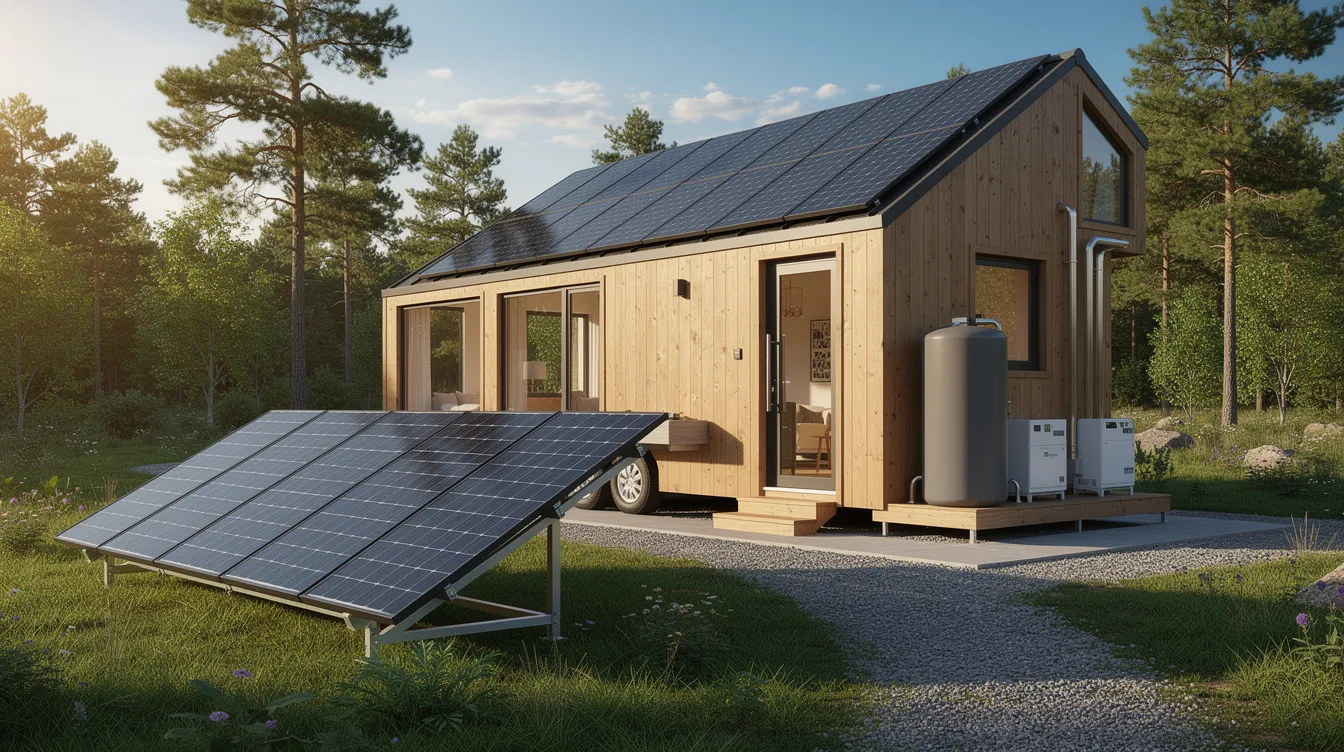
Typical roof dimensions for 20–28 ft trailers offer about 140–200 sq ft total. But usable area is often only 60–120 sq ft after accounting for pitch, vents, and skylights.
A standard 400 W panel in 2026 is roughly 40 in × 75 in (about 21 sq ft). Many tiny house roofs can only fit 2–6 panels safely (800–2,400 W total).
Tiny houses typically have limited roof space for solar panel installation, which can necessitate ground-mounted systems to accommodate more panels and improve efficiency.
Full off-grid systems often need 8–16 panels, similar to many self-contained tiny homes for modern off-grid living, requiring either:
- A ground-mounted solar array near a stationary tiny house
- Portable panel setups on stands or folding kits deployed after parking
Pros of ground-mounted or pole-mounted systems:
- Better tilt angle matching latitude (30–40°)
- Easier cleaning and snow removal
- Cooler panels for better efficiency
- Freedom from roof obstructions
For tiny houses on wheels that move often, a hybrid approach (some roof solar plus portable fold-out panels) balances mobility with enough power.
Off-Grid vs. Grid-Tied Tiny House Solar
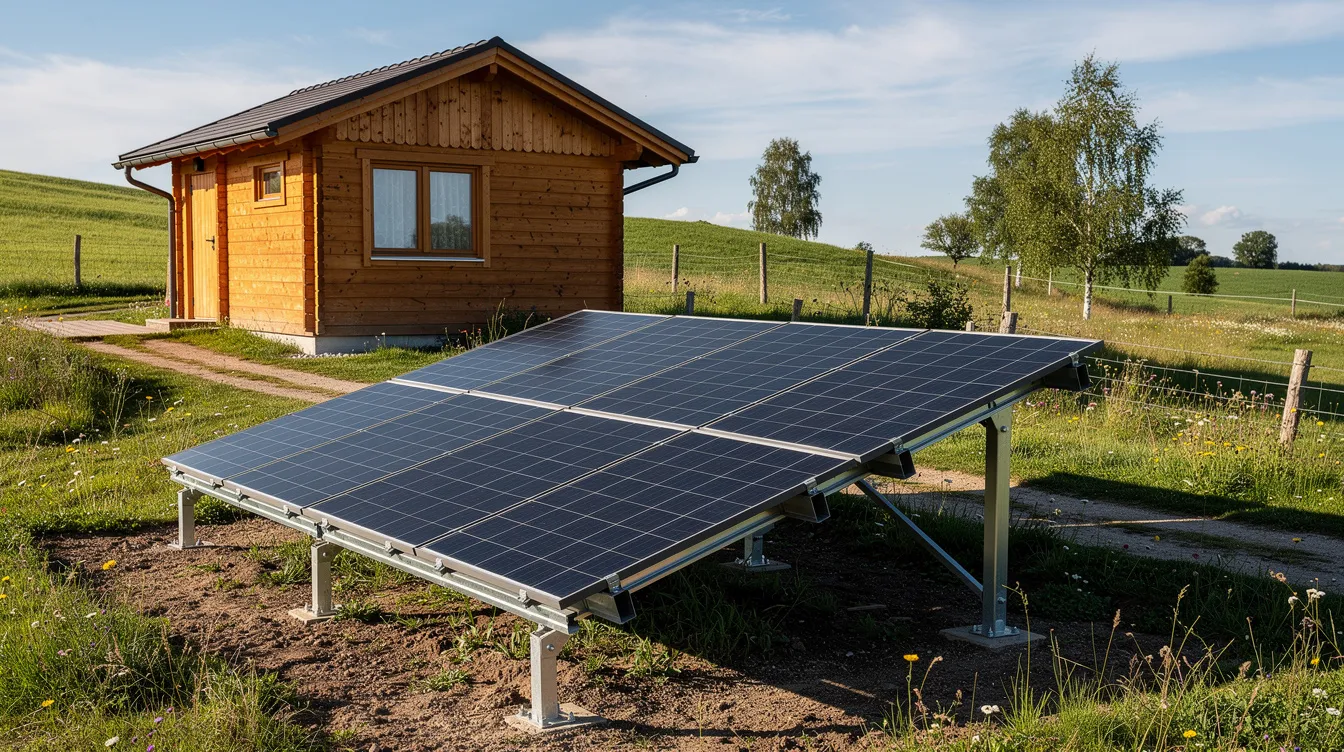
Full off-grid systems supply all power from solar and maybe a backup generator. Grid-tied systems use solar to offset electricity bills while relying on the utility for backup, while minimalist tiny houses for sustainable living often lean more heavily on efficient off-grid setups.
Off-grid living requires not just panels but enough battery capacity and possibly a backup generator for periods of low sun. Grid-tied homes can rely on the power grid for backup power.
Grid-tied systems may need fewer panels if the goal is partial offset of electricity bills rather than 100% self-sufficiency. In many U.S. states in 2026, net metering programs still allow credits for excess solar sent to the grid, improving cost savings.
Decide early whether you want a fully off-grid lifestyle, a grid-tied setup with backup, or a hybrid approach.
Sizing Solar for Off-Grid Tiny Houses
For off-grid systems, size your solar panels for worst-case seasons—short winter days, cloudy weeks—rather than ideal summer output.
Oversize your solar array by 25–50% compared to summer-only needs in northern states or high latitudes (Montana, Vermont, Ontario).
Winter scenario example: A 4 kWh/day usage in a region with only 2.5–3 winter peak sun hours might need 12–16 × 400 W panels to avoid constant generator use.
Pair panel sizing with realistic energy habits:
- Line-dry clothes
- Use propane or wood for most space heating and water heating
- Minimize energy usage during cloudy stretches
Fully electric tiny houses with electric water heater, range, and resistance heating are generally impractical off-grid without a very large solar array and battery bank.
When a Backup Generator Makes Sense
Even well-designed off-grid systems often include a small backup generator for extended storms or unusually high power usage.
Typical generator sizes for tiny house solar:
- 2,000–2,500 W inverter generators: Light backup, charging small battery banks ($800–$1,500)
- 4,000–6,000 W units: Faster charging of larger lithium systems, running heavy loads ($2,000–$4,000)
A tiny house in upstate New York might need a smart generator for 5–10 days each winter despite having a 10-panel array.
Using a generator strategically—only during long cloudy stretches or heavy tool use—allows a smaller solar array and battery bank upfront. Lifetime generator fuel costs run about $0.50–$1/kWh versus solar’s near-zero after payback.
Battery Capacity and Storage for Tiny House Solar
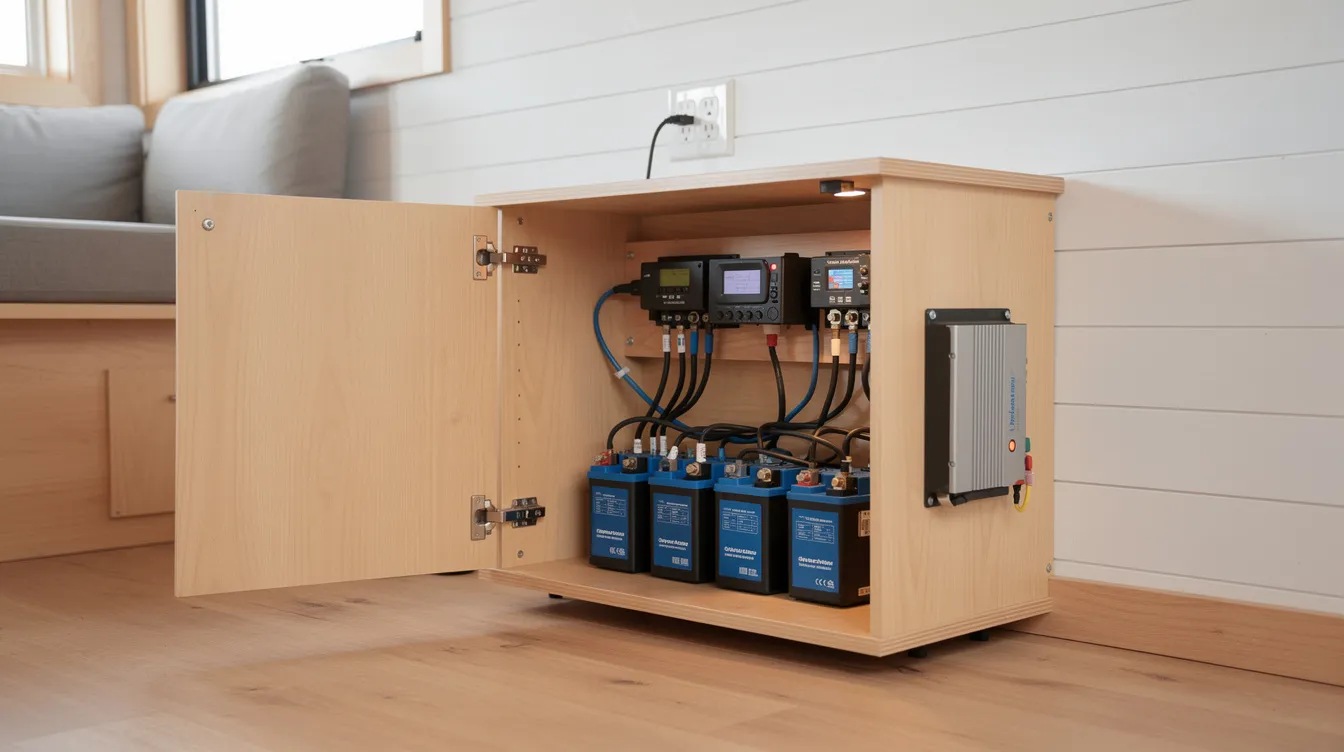
Solar panels alone aren’t enough for off-grid tiny houses. Battery storage is critical for tiny houses, as solar panels only generate power during the day. Batteries power loads at night and during cloudy weather.
Most new tiny house systems use lithium (LiFePO₄) batteries over lead-acid (AGM, flooded). Lithium offers higher usable capacity (~90% of rated vs. ~50% for lead-acid) and longer cycle life (3,000–6,000 cycles).
Battery capacity is expressed in kilowatt-hours (kWh).
Quick rules of thumb:
- Aim for at least 1–2 days of autonomy for off-grid systems
- Average off-grid tiny house using 3–4 kWh/day should start with 6–8 kWh of usable battery storage
Size your solar panels and battery bank together. More panels can offset the need for extremely large battery banks by recharging faster after cloudy spells.
Matching Panel Output to Battery Size
Daily solar production should exceed typical daily energy use by at least 10–30% to ensure energy transfer occurs—running loads while recharging batteries.
Detailed example: A system with 8 kWh of lithium storage and a 3 kW array (7–8 × 400 W panels) in a 4.5 sun-hour location produces roughly 10 kWh gross/7.5 kWh net daily. This covers 4 kWh usage plus recharges a 50% depleted battery bank in about one sunny day.
Oversized arrays relative to batteries are common and beneficial in winter and cloudy climates, as long as solar charge controllers are correctly sized. The charge controller regulates the energy captured and ensures proper charging.
In grid-tied systems, batteries can be smaller or optional because the grid acts as a virtual “battery” when direct sunlight isn’t available.
Cost, Incentives, and Long-Term Savings
Even small solar systems represent a serious investment. But tiny houses have low energy needs, so total solar panel system costs can be much lower than full-size home installations, especially when you accurately estimate build costs with a tiny home cost calculator.
2026 ballpark cost ranges:
System Size | Equipment + Install | Notes |
|---|---|---|
1–2 kW starter | $3,000–$6,000 | DIY panels, inverter, small lithium battery |
3–4 kW robust off-grid | $9,000–$18,000 | 6–10 kWh lithium storage |
Ground mounting + labor | +20–40% | Racking equipment, concrete posts, wiring |
The cost of installing solar panels on a tiny house can vary significantly depending on factors such as the size of the house, energy consumption, equipment costs, and regulatory considerations. |
An initial solar panel array and battery system for a tiny house can cost around $14,000, with potential tax credits reducing the effective cost significantly, which is useful context when comparing the overall budgets of different tiny house designs for modern living.
Lifetime cost savings come from:
- Avoided electricity bills (solar power significantly reduces electricity bills, with many tiny house owners reporting elimination of their energy charges altogether)
- Avoiding grid hookup fees (often $5,000–$20,000 for long rural runs)
- Reduced generator fuel expenses
- Free electricity after payback period
Solar panels can increase the value of a tiny house, as future buyers are often willing to pay more for homes that utilize renewable energy sources.
Using high-efficiency appliances, LED lighting, and good insulation reduces system size and cost more effectively than simply adding more panels, and these same principles carry over to many tiny smart homes designed for efficient living.
Federal Solar Tax Credit and Local Incentives
The federal solar tax credit (Investment Tax Credit) currently allows many homeowners to claim 30% of eligible solar installation costs as a credit against federal income tax through at least 2032.
The federal solar tax credit can lower the total cost of solar installation by at least 30%, and some states offer additional incentives for installing solar batteries.
A 30% credit reduces a $10,000 system’s net cost to $7,000, assuming you have enough tax liability.
Check these before purchasing:
- Whether your tiny home qualifies as a primary or secondary residence for the ITC
- State-level rebates and property tax exemptions (e.g., California’s SGIP-style battery programs offering $200–$400/kWh rebates)
- Local utility rebates or net metering rules affecting grid-tied savings
Incentives change year to year. Confirm current rates and sunset dates with official sources before purchasing equipment. Ask a tax professional about eligibility and documentation for your situation.
Planning and Installing Solar Panels on a Tiny House
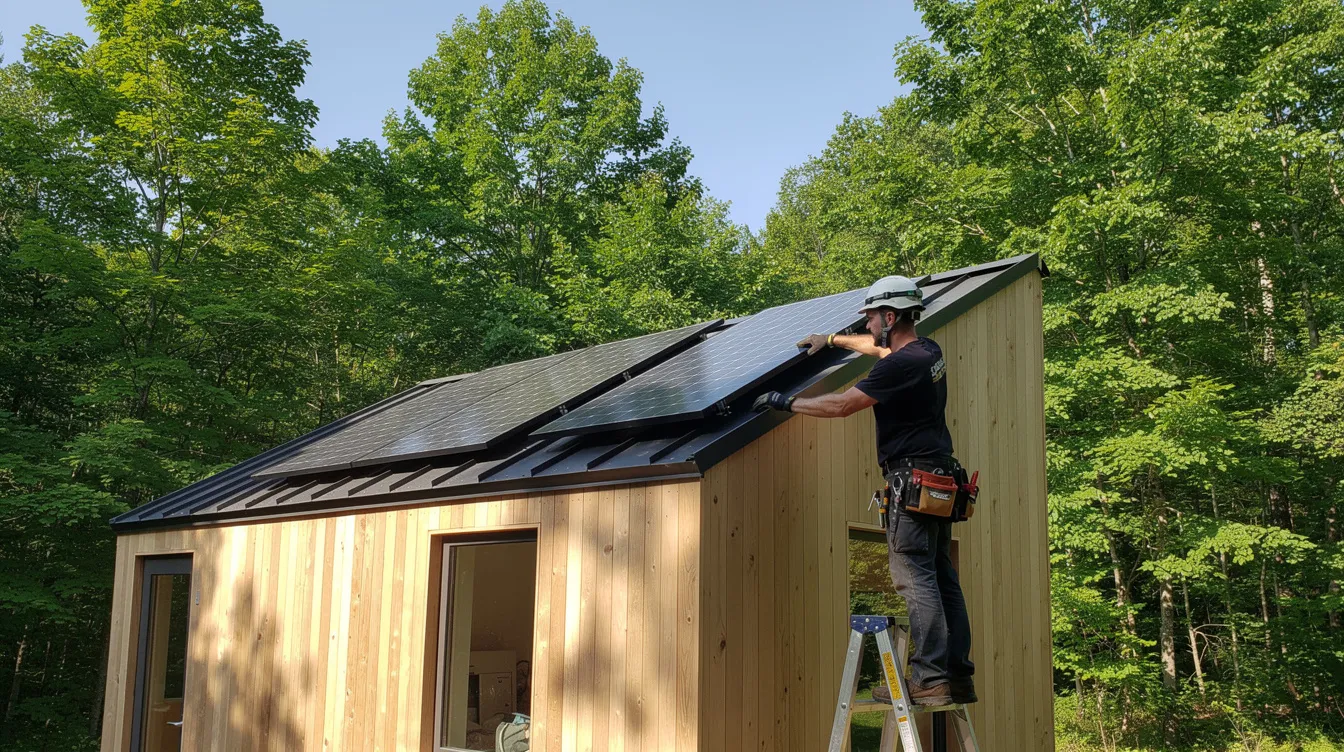
Installing solar panels involves several decisions: DIY vs. professional solar installation, roof vs. ground mounting, equipment selection, and safety compliance.
Tiny houses on wheels may be inspected under RV, mobile home, or residential codes. Follow the most stringent safety and electrical standards regardless.
Careful planning of panel placement, wire runs, and equipment access (for inverters, charge controllers, and batteries) saves time and money later. Consult local regulations about permitting, especially when grid-tying or adding a large ground-mounted array, and align your solar layout with your chosen tiny house plans that fit your life.
Choosing Between Roof-Mounted and Ground-Mounted Solar
Custom layouts for windows, doors, and roof pitch in top custom tiny homes can also influence how many panels you can realistically mount on the roof.
Roof mounting works best when:
- Relatively stationary tiny house
- Simple gable or shed roof with good southern exposure receiving most direct sunlight
- Minimal shading
- Modest energy needs (2–3 kW array or less)
Ground-mounted systems are better when:
- Need for >2.5–3 kW of solar power
- Heavy snow or tree shading on the roof affects when the sun’s rays hit panels directly
- Desire for easy tilt adjustment and cleaning
Ground mounts require posts set in concrete or ground screws, rail systems, and attention to wind loads. Roof mounting adds weight and wind uplift forces, so check roof framing and trailer capacity before installing solar panels directly on the roof surface area.
A typical ground-mounted array for a tiny house positions panels in 2–3 rows facing south at a tilt roughly equal to local latitude, which pairs well with semi-permanent setups like many tiny house park model homes.
DIY vs. Professional Installation
Many tiny house owners with basic electrical skills can assemble small off-grid systems using pre-wired kits. But safety best practices and local codes still apply.
Professional installers add value for:
- Correct wire sizing, overcurrent protection, and grounding
- Proper mounting and weatherproofing
- Designing systems that pass inspections for grid tie or property resale
If you’re new to electrical work, have a licensed electrician review your plans and final connections, especially the AC side with the inverter charger. Professional installation may be required by some lenders, insurers, or jurisdictions for grid-tied systems.
Avoid inferior solar panels from unknown manufacturers—the efficiency of solar panels can vary significantly, and using high efficiency panels can help maximize energy production, especially in limited space where smart layouts like tiny house interiors that maximize every square foot are critical.
Basic Wiring and Safety Considerations
Typical power flow in a tiny house solar power system:
Panels → combiner box → charge controller → battery bank → inverter → AC load center → outlets and appliances
Critical safety requirements:
- Proper grounding and bonding of solar array, inverter, metal trailer frame, and tiny house subpanel
- Correctly sized DC disconnects, fuses or breakers, and surge protection
- Appropriately rated cables and lugs
- Solar charge controllers matched to array voltage and battery type
Always follow manufacturer manuals and local electrical codes. Work inside panels and inverters only with power disconnected. Leave ample space around inverters and batteries for cooling and maintenance access.
FAQ
These questions address common concerns not fully covered in the main sections.
Can a tiny house run completely off solar power in winter?
Yes, but it’s harder in winter due to shorter days and lower sun angle, especially in northern states and Canada. Staying fully off grid in winter requires oversizing the solar array, increasing battery capacity, aggressively reducing electric heating loads, and sometimes using a backup generator during long cloudy stretches. Many owners rely on wood stoves or propane heaters in coldest months to keep electrical needs manageable and produce sufficient energy.
Is roof solar enough if I plan to move my tiny house often?
For tiny houses on wheels that travel frequently, roof-mounted solar offers convenience but limited capacity—often only 600–1,800 W depending on sufficient roof space. Portable folding panels or a small ground array deployed after parking can supplement roof solar for longer stays. Owners who move weekly or monthly often rely partly on campground shore power instead of sizing the right solar system for 100% coverage.
Can I use both solar and shore power for my tiny house?
Yes. Many tiny houses are wired to accept either solar plus battery power or shore power from an RV-style pedestal or standard grid connection. A transfer switch or hybrid inverter can manage the handoff between sources safely, ensuring loads see seamless AC power. Have a qualified electrician design the interface so solar and grid power are never backfed into each other improperly.
How often do I need to replace panels and batteries?
Quality solar panels are commonly warrantied for 20–25 years and often keep producing at 80–85% of original output by that time—reduced efficiency is gradual. Lithium batteries in a well-designed system typically last 8–15 years depending on depth of discharge and temperature, while lead-acid batteries may need replacement every 4–8 years. Inverters and charge controllers often last 10–15 years, so budget for eventual component upgrades.
What if my energy needs grow after I install the system?
Many tiny house solar systems are designed to be modular, allowing owners to add more panels or batteries later if the charge controller and inverter were sized with headroom. Anticipate future loads (e-bikes, larger fridge, power tools, home office) and choose equipment handling an extra 25–50% capacity if budget allows. Adding panels is usually easier than upgrading undersized inverters and controllers, so a bit of over-planning saves money long-term.