
The tiny house movement has captured the imagination of millions seeking affordable housing, simpler living, and freedom from oversized mortgages. But between dreaming about your 300 square feet of perfectly designed space and actually moving in lies a critical hurdle: building codes and zoning laws.
Making your tiny home legal isn’t impossible—it just requires understanding how local governments classify these structures and what rules apply to your specific situation. This guide walks you through the regulatory landscape so you can navigate tiny home codes with confidence.
- Quick Answer: Are Tiny Homes Legal Where You Live?
- What Counts As a Tiny Home Under the Codes?
- Types of Tiny Homes and How Codes Treat Each One
- National Framework: Tiny Home Building Codes vs. RV Codes
- State and Local Tiny Home Codes: Why Location Matters
- Primary Residences vs. ADUs vs. Temporary Units
- How To Research Tiny Home Codes for Your Exact Property
- Cottage Housing, Cluster Developments, and Tiny Home Communities
- Utility Hookups, Safety Details, and Typical Tiny Home Construction Requirements
- Common Pitfalls and How To Avoid Code Problems
- Frequently Asked Questions About Tiny Home Codes
- Key Takeaways: Making Your Tiny Home Code-Compliant
Quick Answer: Are Tiny Homes Legal Where You Live?
Tiny homes are legal in many parts of the United States, but only when they meet applicable building codes, zoning requirements, and—for homes on wheels—RV standards. The legality of your tiny house depends entirely on where you want to place it, what type of structure it is, and how you plan to use it.
Before you invest in plans, materials, or a finished unit, check these three things immediately:
- Local building codes: Determine whether your jurisdiction has adopted the International Residential Code (IRC), which edition (2015, 2018, 2021), and whether IRC Appendix Q (introduced in 2018 for tiny houses under 400 square feet) is recognized
- Zoning ordinances for your parcel: Find out minimum dwelling sizes, whether accessory dwelling units are permitted, and if recreational vehicles can be occupied on residential land
- Foundation vs. wheels classification: Confirm whether your tiny home will sit on a permanent foundation (treated as a dwelling or ADU) or on wheels (often treated as an RV subject to different standards like ANSI A119.5 or NFPA 1192)
Most cities treat tiny homes on foundations as dwellings or accessory dwelling units, requiring standard building permits and inspections. Tiny homes on wheels typically fall under RV regulations and are often limited to RV parks, tiny home communities, or special occupancy parks—not standard residential lots.
In the sections below, you’ll learn exactly how to research the codes that apply to your specific property and how to find a legal path forward.
What Counts As a Tiny Home Under the Codes?
When you’re talking about tiny houses, you’re using a marketing term. Building codes don’t care about lifestyle branding—they define structures by their use and construction type. Understanding how codes classify your tiny home determines which regulations apply.
Under the International Residential Code, a “dwelling unit” is a single unit providing complete independent living facilities for one or more persons, including permanent provisions for living, sleeping, eating, cooking, and sanitation. A “recreational vehicle” is a transportable unit designed for temporary occupancy. A “manufactured home” is factory-built housing constructed to HUD standards. A “park model” is a specific type of RV limited to 400 square feet.
Here’s how codes typically define tiny homes:
- IRC Appendix Q tiny house: A dwelling unit with floor area of 400 square feet or less (excluding lofts), introduced in the 2018 IRC edition
- Ceiling height relaxations: Appendix Q allows ceiling heights as low as 6 feet 8 inches in bathrooms and kitchens, compared to the standard 7 feet, while still requiring attention to tiny house maximum height guidelines and tips if your unit is on wheels
- Loft provisions: Sleeping lofts are permitted with specific ladder or ship’s ladder access requirements, guardrails at lofts over 30 inches above the floor, and emergency egress openings of at least 5 square feet with minimum dimensions of 20 by 24 inches, so selecting the best ladder for a tiny house loft isn’t just a design choice but a code compliance issue
- Reduced room sizes: Kitchens can be as small as 50 square feet if equipped with required appliances, but thoughtful tiny house floor plans that maximize space are still essential for livability
- State adoption varies: About 30 states and numerous municipalities have incorporated Appendix Q as of 2024-2025
Some states and cities still use older IRC editions (2012 or 2015) that don’t reference tiny houses explicitly. In those areas, builders must seek variances or use alternative compliance paths under general dwelling unit definitions.
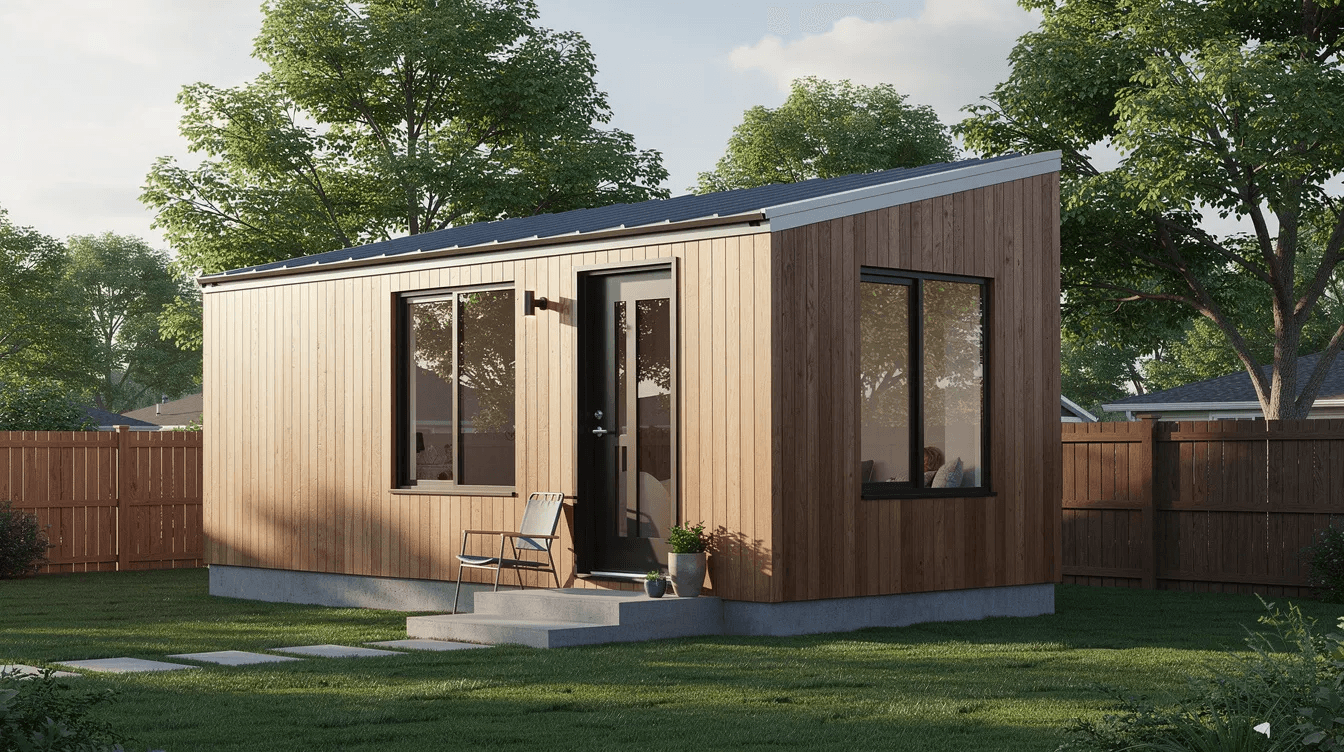
Example comparison: A 380 square foot lofted cottage on a concrete slab would be reviewed under IRC Appendix Q (if adopted locally) as a dwelling, requiring foundation inspections, framing inspections, and typical building permit processes. Design inspirations like modern tiny house layouts for legal living still need to be adapted to these local rules. That same 380 square feet cabin on a trailer frame would likely be classified as an RV or park model, subject to ANSI A119.5 standards and restricted from permanent residential use in most zones.
Types of Tiny Homes and How Codes Treat Each One
The legal path for your tiny home depends heavily on whether it sits on a permanent foundation or on wheels, and whether you intend to use it as a primary residence, ADU, temporary unit, or recreational vehicle. Each classification triggers different code requirements and zoning restrictions.
Here are the main categories and how regulations typically treat them:
Tiny home on a permanent foundation as a primary dwelling: This is regulated as a standard residence under state-adopted IRC or IBC. The structure must meet all structural, energy code, fire safety, and zoning requirements. Some jurisdictions set minimum sizes for primary residences (often 600-1,000 square feet), which may require variances for smaller homes built under Appendix Q.
Tiny home as an accessory dwelling unit: Many states now require cities to allow ADUs, making this a popular legal pathway for homeowners considering accessory dwelling units as part of their housing strategy. For example, a 350 square foot foundation-built ADU behind a 1950s house in California’s Bay Area might secure approval under AB 670 and subsequent laws like AB 1033, which allow ADU sizes down to 150 square feet on owner-occupied lots with 4-foot setbacks and utility connections.
Tiny home in cottage housing or cluster development: Some zoning codes allow groups of small cottages on shared lots with reduced parking and density rules. These developments must still meet residential building codes but may have relaxed lot-coverage requirements.
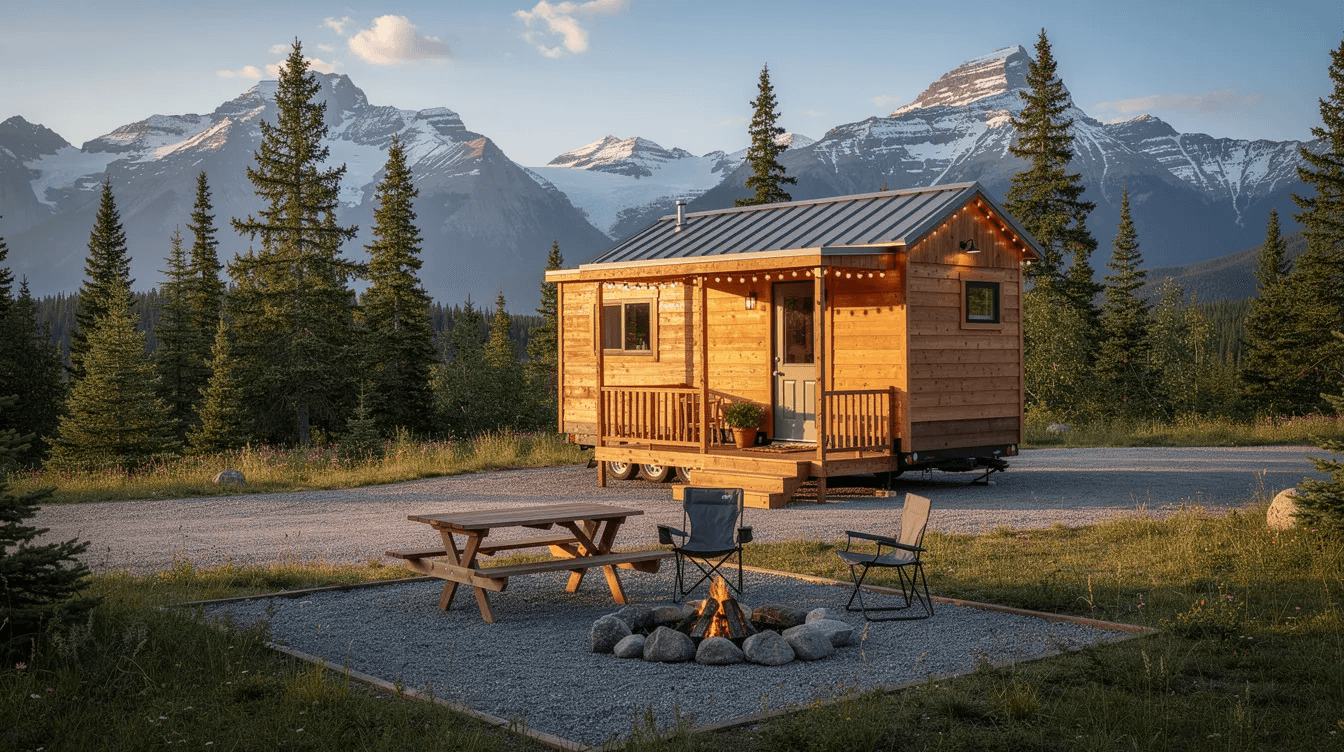
Tiny home on wheels or park model RV: A 26-foot THOW classified as a park model falls under ANSI A119.5 standards, requiring self-contained plumbing, LP gas systems per NFPA 1192, and a roadworthy chassis inspected by RVIA. For people more interested in tiny house camper ideas for adventure living than permanent residence, these RV-style regulations often provide the most flexible path. In Florida, for instance, statutes limit RV occupancy to 180 days annually on private land, effectively barring full-time primary residence use outside approved parks.
Tiny home for agricultural or workforce housing: Some jurisdictions allow small structures for farmworker housing under special permits, with different types of code requirements than standard residential construction.
Primary dwellings and ADUs must meet state and local building codes (typically state-amended IRC/IBC and energy code), fire safety codes from the National Fire Protection Association, and zoning rules covering setbacks, height, parking, and density. RV-type tiny homes must comply with ANSI A119.5, NFPA 1192, or similar standards and are typically restricted to RV parks or special occupancy parks.
Many jurisdictions explicitly forbid recreational vehicles from being used as permanent primary residences outside of approved parks—even when parked on privately owned land.
National Framework: Tiny Home Building Codes vs. RV Codes
Understanding the two main regulatory tracks in the United States is essential before you start construction. Tiny homes fall into either the permanent-dwelling path (governed by building codes) or the RV/transportable path (governed by vehicle and manufacturing standards). Your tiny home’s classification determines everything from financing options to where you can legally live.
Permanent Dwelling Path
Building codes for permanent tiny homes include:
- International Residential Code (IRC): Covers one- and two-family dwellings, including tiny houses on foundations
- IRC Appendix Q: Specifically addresses tiny houses under 400 square feet, relaxing certain requirements while maintaining safety standards
- International Building Code (IBC): Applies to multifamily and commercial buildings; Section 310.4.4 addresses live/work units
- International Energy Conservation Code (IECC): Sets insulation R-values and energy efficiency requirements
- State amendments: Each state adopts IRC/IBC with local modifications affecting everything from seismic requirements to energy standards
RV/Transportable Path
Codes for tiny homes on wheels and manufactured housing include:
- ANSI A119.5: Standard for park model RVs up to 400 square feet, maximum length 40 feet, body width 102 inches
- NFPA 1192: Covers fire suppression, electrical service (typically 30-amp), and holding tanks for recreational vehicles
- HUD Code (24 CFR Part 3280): Governs factory-built manufactured homes over 320 square feet requiring HUD certification labels
Many THOW builders aim to meet ANSI A119.5 or NFPA 1192 to secure RV registration and insurance, though this typically limits where the unit can be legally occupied full time.
Real-world example: In Washington State, a builder creating a tiny home on wheels needs state building code approval and an L&I (Department of Labor & Industries) insignia under WAC 296-150M after factory-built review. Only after receiving this insignia can the unit be sited in a tiny home community or special occupancy park. Similarly, Colorado’s factory-built housing program under HB 17-1163 issues insignias for modular buildings and tiny homes after third-party quality assurance review.
The advantage of foundation homes is full-time residency and access to conventional financing (Fannie Mae recognizes homes as small as 400 square feet if Appendix Q-compliant). The advantage of THOWs is mobility and often lower upfront costs, though insurance and resale options are more limited.
State and Local Tiny Home Codes: Why Location Matters
While the IRC and IBC provide a national baseline, your actual code requirements depend on which edition your state has adopted (2012, 2015, 2018, 2021), what amendments apply, and what additional rules your city or county imposes. A tiny home that’s perfectly legal in Austin, Texas may be prohibited in a town 30 miles away.
Here’s how different states approach tiny home regulations:
State/Region | Approach | Key Details |
|---|---|---|
Colorado | Friendly | HB 19-1120 endorses tiny homes on foundations under 600 sq ft in certain zones; factory-built program under 8 CCR 1507-30 |
Texas | Local opt-in | Adopts 2015 IRC statewide without Appendix Q, but allows cities like Austin to permit THOWs in accessory building zones |
Oregon | Friendly | Structural specialty code based on 2021 IRC with Appendix Q; HB 2001 allows ADUs statewide |
Maine | Friendly | 2019 guidelines endorse homes under 400 sq ft with loft egress requirements |
California | Complex | Health & Safety Code definitions, ADU laws (SB 13, AB 1033), plus local ordinances vary by city |
Connecticut | Restrictive | Many towns mandate minimum 600 sq ft; Stamford allows ADUs since 2021 |
New York City | Restrictive | Minimum dwelling sizes around 800-1,000 sq ft for primary residences |
Some states have centralized divisions that review offsite-built tiny homes. Washington’s L&I program processed over 200 tiny units in 2023, issuing insignias that sometimes preempt local building department review for factory construction. Idaho’s Division of Building Safety (IDAPA 07.07.01) issues modular labels for tiny homes compliant with 2018 IRC. Colorado’s Division of Housing handles factory-built housing under state rules. |
To research your state’s current regulations:
- Search “<State> tiny home regulations 2024 site:.gov”
- Look for “<State> factory built tiny home codes” followed by your state’s administrative code citation (WAC for Washington, CCR for California, etc.)
- Verify the latest adopted building code cycle through your state’s building code council or licensing board
Even in states considered “tiny house friendly,” local zoning may still mandate minimum sizes of 800-1,000 square feet for primary dwellings, prohibit full-time RV living on residential lots, or restrict ADUs to owner-occupied properties. A tiny home might be legal to build in one town and banned in the next county.
Primary Residences vs. ADUs vs. Temporary Units
The same physical tiny house structure can face completely different regulations depending on how it’s classified. A 280 square foot unit might be a permitted ADU in one scenario, a temporary dwelling in another, and a code violation in a third. Whether you’re drawn to cute tiny house designs for your dream home or a more utilitarian layout, understanding these distinctions is critical before you plan your build or purchase.
Primary residences face the strictest requirements. A tiny home on a permanent foundation used as your main dwelling must meet all applicable building, fire, energy code, and zoning requirements—including setbacks, lot coverage, parking minimums, and density limits. Many jurisdictions set minimum dwelling sizes that exceed 400 square feet (sometimes 800-1,000 square feet), requiring variances or special approvals for smaller homes. Full-time tiny living in these zones demands full code compliance.
Accessory dwelling units offer a more accessible path in many areas. States like California (through laws from 2017-2023), Oregon, Washington, New Hampshire (RSA 674:71), and Massachusetts (HD.3742) have passed legislation requiring cities to allow ADUs. However, each city still imposes its own size caps, design standards, setback requirements, and owner-occupancy rules. California’s SB 13 mandates junior ADUs up to 500 square feet, while standard ADUs can reach 1,200 square feet. Most ADU ordinances require permanent foundations—RVs and THOWs are often explicitly excluded.
Temporary units operate under different rules entirely. Some counties issue temporary occupancy permits or “TEM” permits allowing travel trailers, RVs, or THOWs for limited durations—typically 6-12 months, sometimes renewable. Common scenarios include temporary housing during main-house construction, disaster recovery, or seasonal farmworker housing. These permits usually require approved septic/sewer hookup or licensed pump-and-haul service.
Example comparison: That same 280 square foot unit could be:
- A fully legal permitted ADU on a concrete slab in someone’s backyard, meeting all building codes and zoning laws
- A temporary RV with a one-year occupancy permit while the property owner renovates their main house
- A code violation if parked on wheels and occupied full time on rural land without permits in a zone that prohibits residential RV use
How To Research Tiny Home Codes for Your Exact Property
State-level summaries provide useful context, but confirming legality requires researching both building codes and zoning rules for your specific parcel. What applies to the lot next door may not apply to yours if you’re across a jurisdictional boundary.
Follow this step-by-step process:
- Identify jurisdiction: Determine whether your land is in city limits or unincorporated county using GIS tools like your county assessor’s website or parcel viewer
- Find department websites: Locate your local planning and building department contacts—these are often separate offices
- Verify adopted building codes: Search for which building code edition applies (e.g., “2018 IRC with state amendments,” “2021 IBC”) and whether Appendix Q is recognized
- Search zoning code terms: Look up specific ordinances for “accessory dwelling unit,” “minimum dwelling size,” “manufactured home,” “recreational vehicle,” and “special occupancy park”
- Check for specific ordinances: Some cities have adopted explicit tiny home regulations that override default interpretations
Sample search strings:
- “<City, State> zoning code ADU”
- “<County, State> tiny home accessory dwelling units site:.gov”
- “<City, State> minimum dwelling size residential zone”
- “<State> 2024 building code adoption Appendix Q”
When you call the building department, be specific:
“I’m planning a 350 square foot permanent foundation ADU on [Lot Address]. Does your ordinance recognize IRC Appendix Q? What’s the minimum dwelling size for ADUs? Are RV-type units excluded from ADU classification?”
Avoid vague terms like “tiny house” alone—officials may not know what you mean. Specify whether your structure will be on a permanent foundation or trailer frame, whether it’s intended as a primary residence or ADU, and ask directly about minimum size requirements and RV rules.
Request information about:
- Adopted building code edition and any local amendments
- Minimum dwelling sizes for primary residences and ADUs
- Whether RVs or mobile homes can be occupied on residential lots
- ADU size caps and design requirements
- Whether the city recognizes factory-built tiny homes with state insignias
Cottage Housing, Cluster Developments, and Tiny Home Communities
Placing a standalone tiny home in a standard single-family zone often runs into minimum lot size and dwelling size restrictions. A more realistic path for many tiny home enthusiasts involves cottage housing ordinances, planned unit developments, or purpose-built tiny home communities where multiple small units share common infrastructure.
Cottage housing and cluster codes allow groups of small detached homes on shared lots. These ordinances typically reference maximum unit sizes (often 600-1,000 square feet), shared open space requirements, and reduced parking ratios. Sonoma County’s cottage housing provisions, for example, allow units up to 900 square feet with 25% shared open space and reduced parking at 1.25 spaces per unit. Washington State’s cottage housing models under RCW 35.63.285 enable similar clusters of smaller homes built to standard residential codes, making it especially important to choose tiny house plans that fit your life and the applicable zoning envelope.
Purpose-built tiny home communities and RV parks operate differently. Many “tiny home villages” are technically RV parks or special occupancy parks regulated under state park codes. Washington’s RCW 35.21.686 permits tiny house communities as special occupancy parks with density rules (approximately 5 units per acre, 10-foot spacing between structures). In these settings, THOWs and park-model RVs are allowed for long-term but often not legally “permanent” residence.
Check for special park categories: Your state may have a “Special Occupancy Park,” “Organized Camp,” or “Recreational Campground” category that governs density, spacing, utility hookups, and fire access for tiny home communities. California’s Health & Safety Code § 18862.41 allows tiny villages to operate as special occupancy parks with rules like 6 units per acre and 3,000-gallon community septic systems.
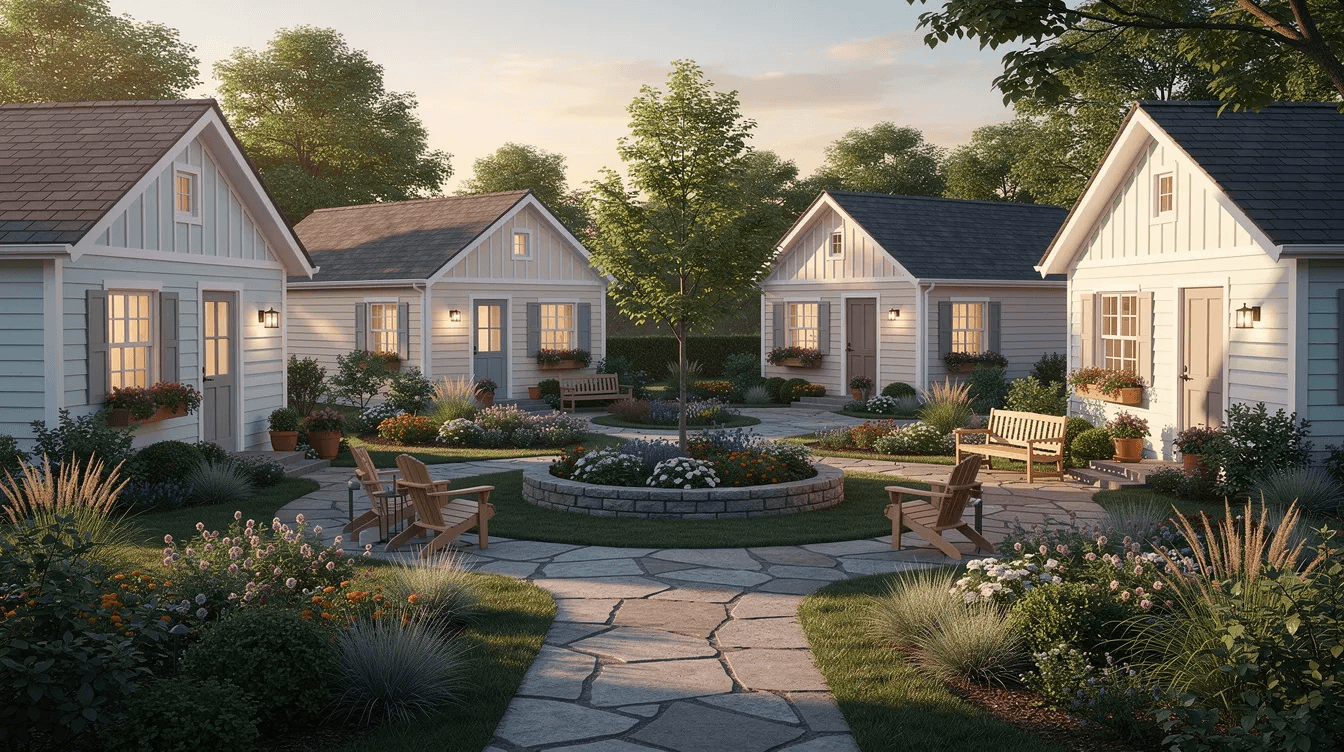
Example: A small cluster of 12-20 detached cottages arranged around shared open space might be permitted as a cottage housing development, with each unit meeting ordinary residential building codes despite being under 600 square feet. Each home could have its own kitchen and bathroom while sharing parking areas and common green space—a model that satisfies both the desire for tiny living and local density concerns.
Utility Hookups, Safety Details, and Typical Tiny Home Construction Requirements
Regardless of size, tiny homes must meet core life-safety and utility standards: safe exits, structural soundness, fire separation, and sanitary connections. Cutting corners on these elements is where many tiny home projects run into serious problems.
Utility requirements vary by structure type:
Requirement | Foundation Tiny Home | THOW/RV Type |
|---|---|---|
Water | Approved connection, minimum 40 psi pressure per IRC P2601 | RV hose connections, park hookups |
Sewer | Connection to approved sewer or engineered septic (IBC Chapter 30) | Black/grey holding tanks (typically 50 gallons), dump station access |
Electric | Permanent service, potentially 200-amp in seismic zones per 2021 NEC | 30-amp shore power with twist-lock connectors |
Inspections | Foundation, framing, rough-in, final occupancy | RVIA certification, state insignia if required |
Common construction code items for tiny homes include: If you’re also thinking through the step-by-step process of how to build a tiny house, these requirements should be integrated into your design from day one. |
- Guardrails on decks or lofts over 30 inches above grade (42 inches height on lofts)
- Smoke and CO alarms near sleeping areas per IRC R314/R315
- Emergency egress windows in sleeping lofts (minimum 5 square feet, 20 by 24 inch dimensions)
- Stair and ladder design constraints from IRC Appendix Q Section Q105
- GFCI outlets in wet areas (kitchen, bathroom)
- 36-inch egress paths per IRC R311.2
- Loft windows with maximum 44-inch sill height
Many local governments publish sample detail drawings—deck foundation details, exit stair configurations, temporary power pole diagrams, and sewer connection specifications—that tiny home owners can adapt. Pairing these technical resources with tiny house interior ideas that maximize space helps you pass inspections while still achieving a comfortable layout. Following these published details helps pass inspections faster than submitting custom solutions.
For offsite-built or modular tiny homes: Factory-built units often require state inspection, approval stamps, or insignias before installation. Washington’s L&I program, Colorado’s Division of Housing, and Idaho’s Division of Building Safety all issue modular labels or insignias for compliant tiny homes. After receiving state approval for the structure itself, local inspectors handle site-specific elements: foundations, decks, and utility connections.
Common Pitfalls and How To Avoid Code Problems
Many tiny home owners encounter trouble not because of the structure itself, but because of zoning violations, utility issues, or unpermitted work. Understanding these common mistakes helps you avoid them.
Typical code violations include:
- Parking a THOW on rural land and living in it full time in a zone that prohibits residential RV use (approximately 72% of U.S. counties cap RV occupancy at 6-12 months)
- Assuming “off-grid” means no permits are required—solar installations, septic systems, and structures all typically need permits regardless of grid connection
- Skipping permits for decks, stairs, exterior structures, and utility hookups that trigger code requirements
- Building to internet plans that don’t conform to the locally adopted code cycle or state amendments
- Using unpermitted travel trailers as rental units on residential property
Real consequences matter: Data from the American Tiny House Association notes that 60% of violations stem from unpermitted RV residency. Maricopa County, Arizona issues fines of $500-$5,000 per month for unpermitted tiny home occupancy. In one Oregon case, a $200,000 fire claim was denied because off-grid solar was installed without interconnection permits, voiding the insurance policy.
Mitigation strategies that work:
- Pursue legal paths such as ADU permits, variances, or conditional use permits when available
- Work with code-literate architects and builders (THIA surveys show 90% approval rates when working with experienced professionals)
- Document compliance with structural, electrical, and plumbing standards through proper permitting
- Get inspections at each required stage: foundation, framing, rough-in plumbing and electrical, insulation, and final occupancy
- Contact your local building department early to understand requirements before committing to a design
Tiny home projects succeed much more often when owners treat them like real houses in the eyes of the code, rather than informal backyard projects that fly under the radar.
Frequently Asked Questions About Tiny Home Codes
Can I live in a tiny house on wheels full time on my own land?
In most residential zones, no. Approximately 80% of residential zones prohibit full-time THOW occupancy without park approval, and many areas cap RV stays at 30-180 days annually. Some rural counties allow longer occupancy with proper permits, but you must verify your specific zoning.
Do I have to follow Appendix Q if my home is under 400 square feet?
Appendix Q is optional—states and localities choose whether to adopt it. If your jurisdiction hasn’t adopted Appendix Q, your tiny home must meet standard IRC dwelling requirements, which may be more restrictive. Check which code edition your area has adopted.
Are shipping container homes treated the same as tiny houses?
Not exactly. Shipping containers require IBC conversion approvals as non-standard materials. They must be evaluated by a licensed engineer and typically need significant modifications to meet residential code for insulation, ventilation, egress, and structural connections.
Can an RV count as an ADU in my city?
Usually not. Approximately 70% of ADU ordinances explicitly exclude RVs, motor vehicles, and THOWs from ADU classification. Most ADU laws require permanent foundations and utility connections rather than RV-style hookups.
What inspections will my tiny home need before I move in?
Foundation-built tiny homes typically require: foundation inspection, framing/shear wall inspection, rough-in electrical/plumbing inspection, insulation inspection, and final occupancy inspection. Factory-built homes need state insignia verification plus local foundation and utility connection inspections.
I already have an existing outbuilding—can I convert it to a legal tiny home?
Possibly, but conversion requires a change-of-use permit, bringing the structure up to current building codes, and adding required systems like proper egress, heating, plumbing, and electrical. The building department must determine if the existing structure can meet code requirements for habitation.
How do I find out if my state recognizes IRC Appendix Q?
Contact your state building code council or search “<State> building code adoption Appendix Q site:.gov.” As of 2024-2025, approximately 30 states have adopted Appendix Q, but local adoption may vary even within those states.
Key Takeaways: Making Your Tiny Home Code-Compliant
Tiny home legality rests on three pillars: structure type and applicable standards (building code vs. RV/manufactured housing standards), land-use and zoning rules, and how the home will be used (primary dwelling, accessory dwelling unit, temporary housing, or recreational purposes). Getting all three elements aligned is the key to legal tiny living.
Your essential action steps:
- Decide foundation vs. wheels: This choice determines whether you’re on the building code path or the RV standards path—two completely different regulatory frameworks
- Confirm your state’s adopted code: Find out which IRC edition applies and whether Appendix Q is recognized in your jurisdiction
- Review local zoning thoroughly: Check minimum dwelling sizes, ADU rules, RV occupancy limits, and any specific ordinances for your zone
- Plan legal utility hookups: Permanent homes need approved water, sewer/septic, and electrical connections; THOWs need compliant hookup infrastructure at their parking location
- Get permits and inspections before moving in: Document compliance at every stage to protect your investment and ensure your home is legally occupied
Tiny home codes have evolved significantly since the 2018 introduction of IRC Appendix Q, with more jurisdictions adopting friendly regulations each year. ADU laws have proliferated since 2017, and industry standards like ICC/THIA 1215 are poised to further unify requirements in upcoming code cycles.
With proper research and open communication with your local building department and planning officials, most tiny home projects can find a compliant path forward. The tiny house movement continues to gain mainstream acceptance, and early engagement with local regulations usually makes it possible to join the growing community of legal tiny home dwellers.