
Tiny house heating and cooling is trickier than it looks. Limited space, thin walls, and constrained power sources make traditional HVAC units impossible. This guide covers concrete system options, layout tips, and cost ranges to help you stay comfortable year-round.
Key Takeaways
- Ductless mini split systems with a heat pump are usually the best all-in-one solution for most stationary tiny homes under 400 sq ft, balancing air conditioning and heating efficiency without requiring space consuming ductwork.
- Backup or supplemental heat—like electric heaters, a compact wood stove, or radiant floor heating—remains important in very cold climates or during power outages.
- Good air circulation and air quality matter just as much as BTUs in such a small interior space. Ceiling fans, trickle vents, and small HRV/ERV units prevent stuffiness and mold.
- Your ideal heating and cooling solutions depend on whether your tiny home is mobile or on a permanent foundation, your climate zone (Maine winters vs. Texas summers), and your power source (grid vs. solar).
- Proper ventilation prevents the “stuffy” feel and mold growth caused by high humidity in small spaces.
- Understanding Tiny House Heating and Cooling Challenges
- Core Systems: Ductless Mini Splits and Heat Pumps
- Other Compact Heating Options for Tiny Houses
- Tiny House Cooling Options and Air Circulation Strategies
- Energy Efficiency, Insulation, and Air Quality in Tiny Homes
- Choosing the Right Heating and Cooling Solution for Your Tiny Home
- FAQ: Tiny House Heating and Cooling Questions
- How many BTUs do I need to heat and cool a 300 sq ft tiny home?
- Can I run heating and cooling in a tiny home entirely on solar power?
- Are electric space heaters safe in such a small space?
- Do I really need mechanical ventilation in a tiny home?
- What’s the best way to prevent condensation on windows and walls in winter?
Understanding Tiny House Heating and Cooling Challenges
Tiny houses typically range from 80–400 sq ft, often under 8.5 ft wide for towability. Standard central HVAC designed for a 2,000+ sq ft home is wildly oversized and highly inefficient here. Traditional HVAC units would dominate your limited space and waste energy.
Key challenges include:
- Limited wall cavities: 2×3 or 2×4 framing restricts insulation to R-13 to R-19, compared to R-30+ in traditional homes
- No ductwork or mechanical rooms: Forces reliance on compact solutions—ductless mini split systems, electric space heaters, window unit air conditioners, and ceiling fans
- Moisture problems: Cooking, showers, and propane appliances create condensation issues in small envelopes, affecting air quality
- Temperature stratification: Heat rises, creating hot or cold spots between lofts and main floors
Tiny homes often struggle with temperature regulation due to their limited space. The small size means there is less space for insulation, making it difficult to maintain comfortable indoor temperatures. Inadequate ventilation can result in stuffiness and excessive humidity, complicating comfort levels.
For tiny homes on wheels (THOWs), add road-legal dimensions, vibration from travel, and the need for quick-disconnect outdoor units or portable cooling solutions, all of which should be considered as you plan and build a tiny house.
Core Systems: Ductless Mini Splits and Heat Pumps
As of 2026, ductless mini split heat pump systems are the primary workhorse for effectively heating and cooling tiny homes. Heat pumps, which can function as both air conditioners and heaters, are suitable for tiny homes as they do not require ductwork and can be installed in limited space.
Basic anatomy:
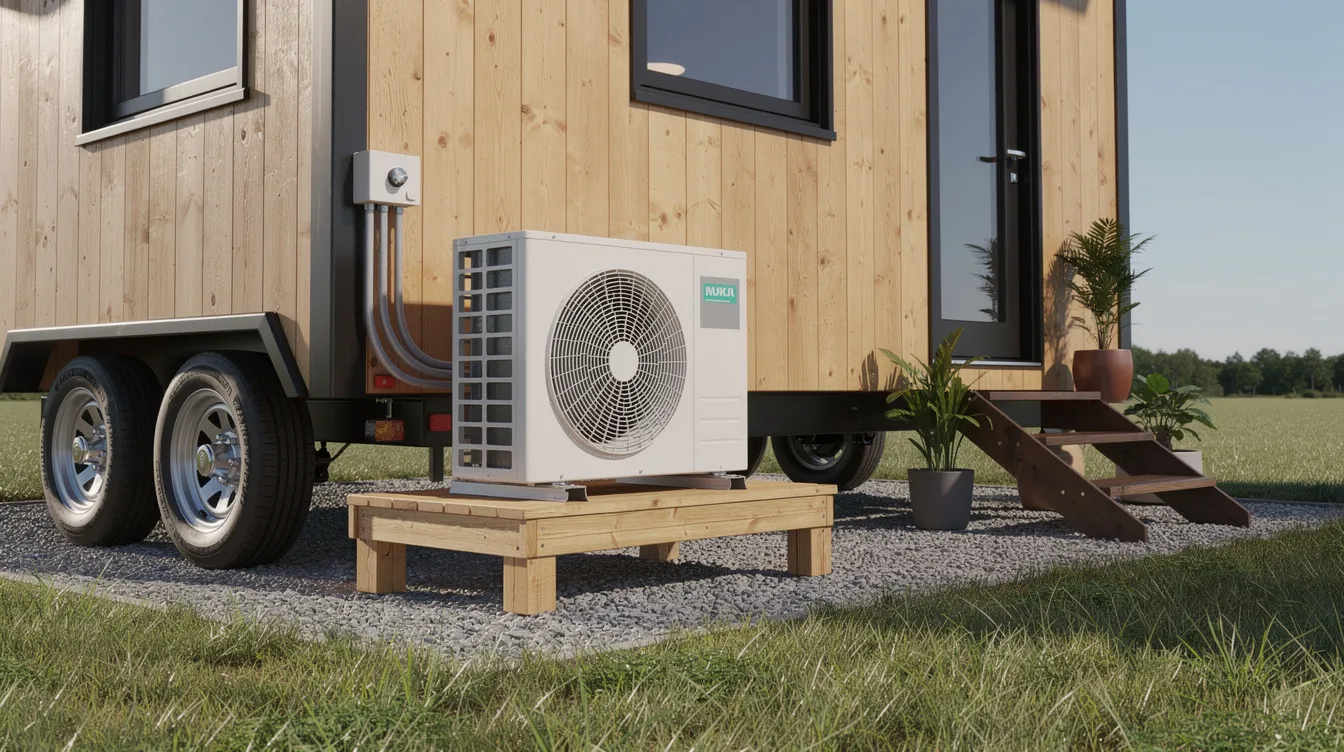
- One compact outdoor unit (24x30x12 inches, 60–100 lbs)
- Connected via refrigerant lines to a single indoor unit
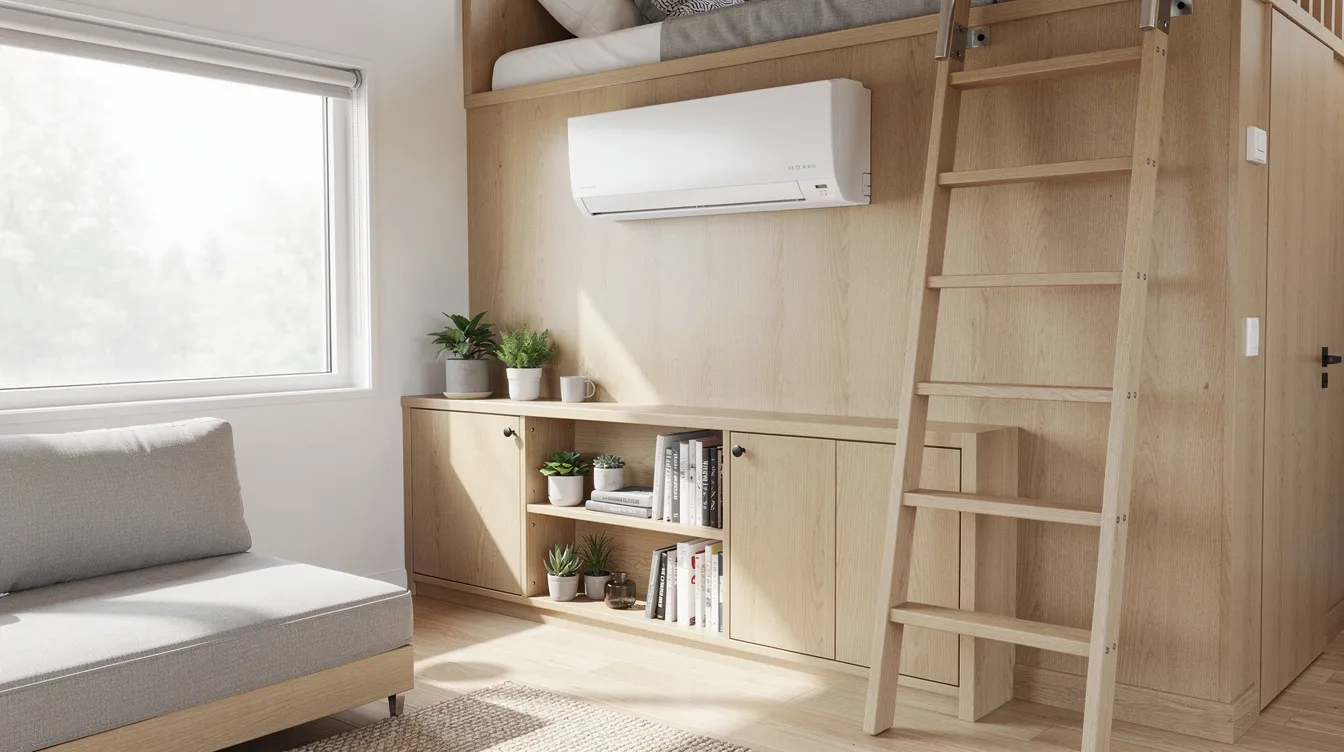
- Wall-mounted 6–8 ft high for optimal airflow
Modern cold-climate mini splits maintain useful heating output down to around 5°F (-15°C), with Hyper-Heating models working down to -13°F. In very cold climates, tiny homeowners may need secondary heating sources, as heat pumps lose efficiency in extreme conditions.
Ductless mini-splits often move 3–4 units of heat for every 1 unit of electricity used. Variable-speed inverter compressors modulate output, making these systems much more energy efficient and quieter than on/off window air conditioners. With SEER2 ratings up to 35, they dramatically reduce hefty energy bills compared to electric resistance heating.
Sizing guidance:
Most 200–350 sq ft tiny houses need a single 9,000–12,000 BTU heat pump. However, oversizing leads to short-cycling and humidity problems. A Manual J-style load calculation is essential rather than guessing based on square footage alone.
Single-Zone vs. Multi-Zone Setups in Tiny Homes
Even in 300–400 sq ft, temperature differences between loft bedrooms and main floors can reach 5–10°F. This makes zoning worth considering.
Single-zone layout:
- One wall-mounted indoor unit on an end wall
- Blows toward the loft ladder
- Open railing helps air circulation into sleeping areas
- Cost: $2,500–$4,500 installed
When multi-zone makes sense:
- Larger tiny homes with separate office pods
- Layouts with closed-off bedrooms or enclosed bathrooms
- Individual temperature control needs
- Cost: $4,000–$7,000 with branch boxes handling multiple units
Installation considerations:
- Route condensate drainage with 3–5% slope
- Mount the outdoor unit on stands 12–18 inches high for snow clearance
- Protect line sets underneath trailers from vibration
Feature | Single-Zone | Multi-Zone |
|---|---|---|
Upfront cost | $2,500–$4,500 | $4,000–$7,000 |
Complexity | Low | Higher |
Best for | Open floor plans | Partitioned layouts |
Efficiency | Good | Better load-matching |
Other Compact Heating Options for Tiny Houses
Not every tiny home will use—or can afford—a full mini split system. Off-grid builds or part-time backyard offices may find affordable tiny house heating setups using lower-cost portable heaters or stoves sufficient.
Electric heating solutions:
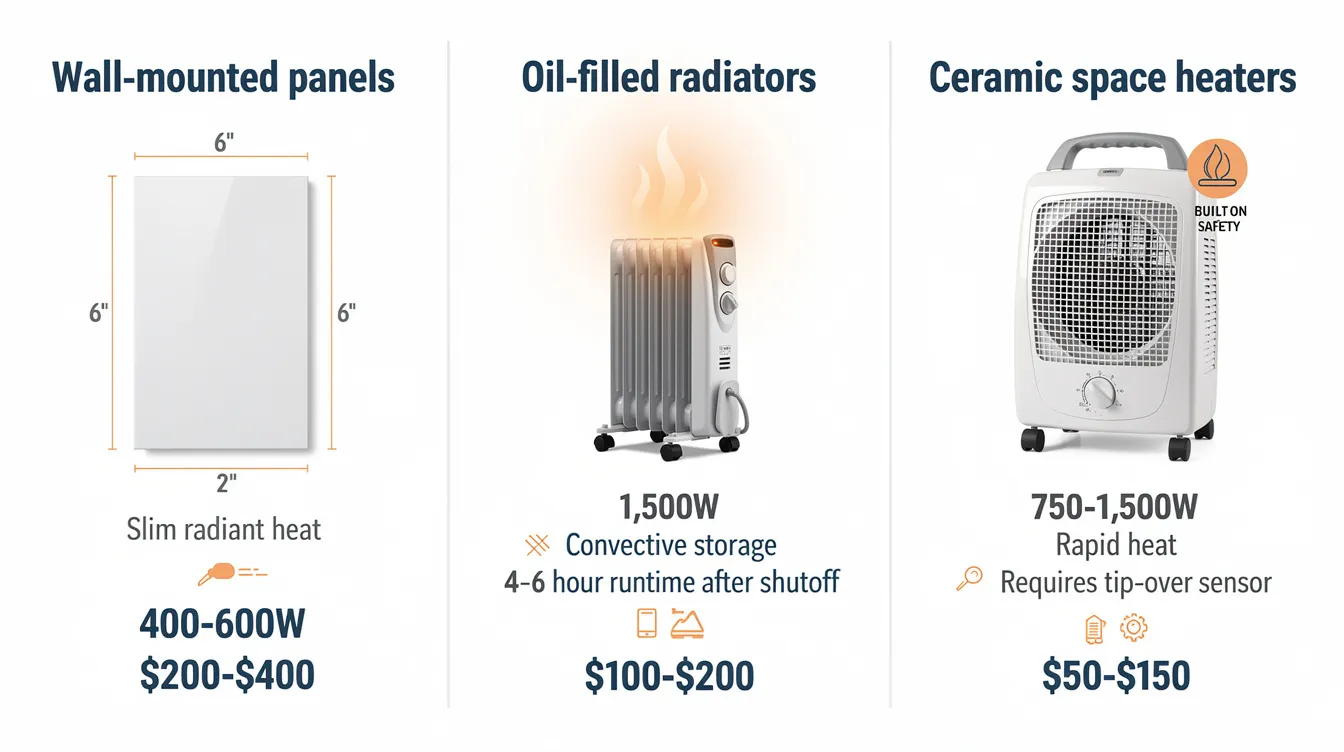
- Wall-mounted panels (400–600W, $200–$400): Slim radiant heat with 6-inch clearances
- Oil-filled radiators (1,500W, $100–$200): Convective storage, 4–6 hour runtime after shutoff
- Ceramic space heaters (750–1,500W, $50–$150): Rapid heat, require tip-over sensors
Electric space heaters are commonly used in tiny homes for localized heating, but they should not be relied upon as the primary heating source due to their limited capacity. They shine in mild climates, shoulder seasons, and as backup during mini split defrost cycles.
Solid-fuel options:
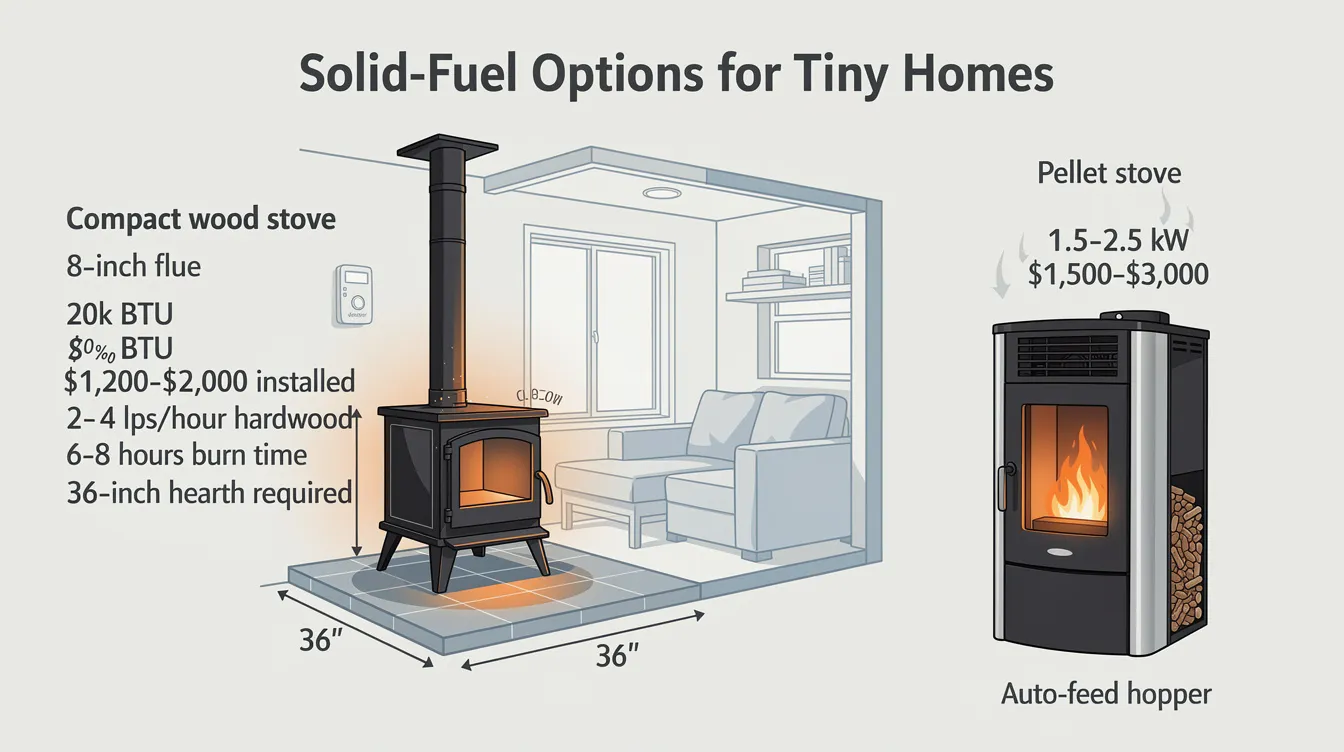
A compact wood stove (8-inch flue, 20k BTU, $1,200–$2,000 installed) suits cold climates and is a common feature in great tiny homes that redefine small-space living. Wood burning stoves burn 2–4 lbs/hour hardwoods for 6–8 hours. You’ll need a 36-inch hearth and CO detectors. Pellet stoves (1.5–2.5kW, $1,500–$3,000) hit 80% efficiency with auto-feed hoppers.
Propane options:
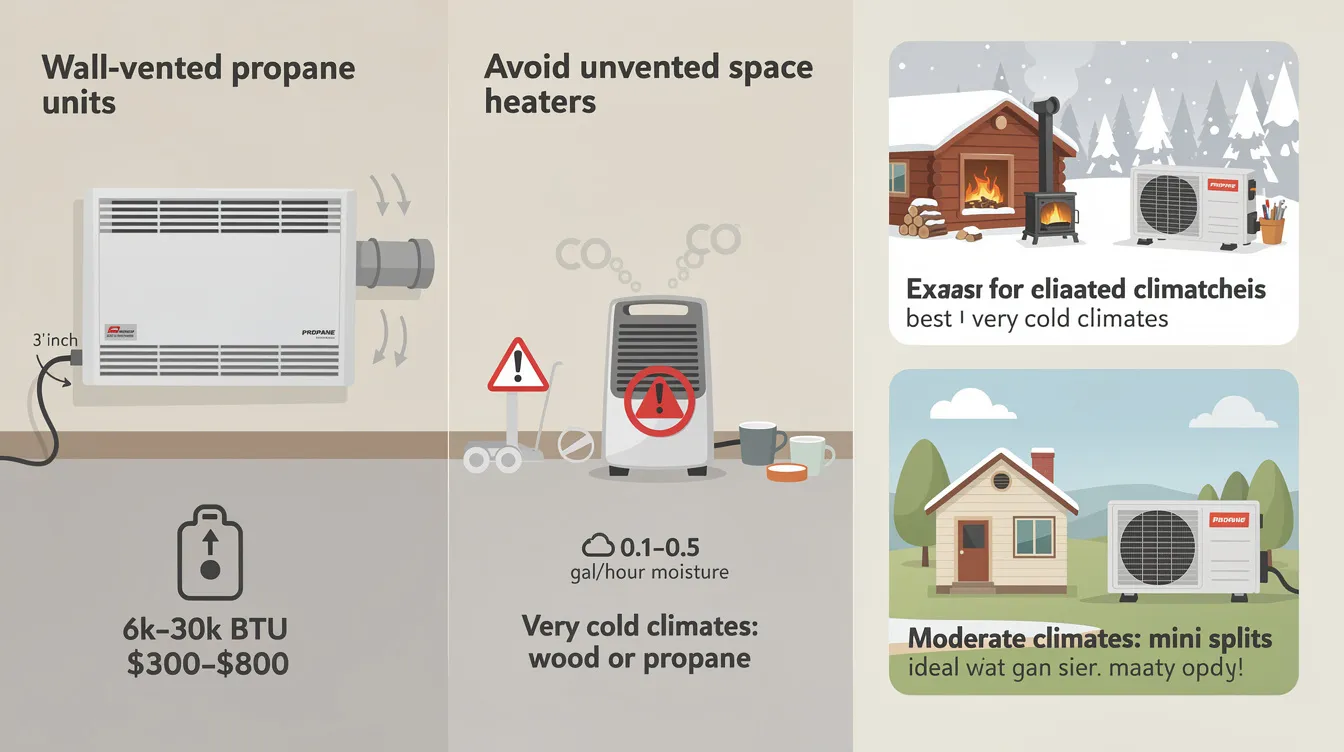
Wall-vented propane units (6k–30k BTU, $300–$800) exhaust via 3-inch vents, minimizing moisture buildup. Avoid unvented portable space heaters—they create CO risks and add 0.1–0.5 gal/hour of moisture. Very cold climates benefit from wood or propane heaters, while moderate climates are ideal for mini splits.
Radiant Floor and Under-Tile Heating
Radiant electric floor mats or hydronic tubing installed under engineered wood, vinyl plank, or tile provide comfortable, invisible heat when integrated into thoughtful tiny house floor plans. This pairs well with tiny houses built on trailers.
Radiant floor heating provides even warmth that eliminates cold spots, especially effective in homes on wheels. It excels at quiet operation with no fan noise or drafts—ideal for work or rest.
Best applications:
- New builds where you design the floor assembly around the system
- Grid-tied homes with predictable electricity costs
- Zoned areas like bathroom and kitchen only
Costs and specs:
- Electric mats: 12–15W/sq ft, $10–$15/sq ft installed
- Full 240 sq ft heated floor: $2,500–$4,000
- Zoned bath/kitchen only: $1,000–$1,500
Limitations:
- 30–60 minute warmup time
- Reduced effectiveness if home is frequently opened to outside air
- Requires robust subfloor insulation (R-10 minimum) to avoid heat loss
Tiny House Cooling Options and Air Circulation Strategies
Cooling tiny homes in hot climates like Texas or Arizona presents challenges, especially for tiny houses in Texas where long, intense summers drive high cooling loads. Solar gain through large windows and roof exposure can quickly overwhelm small spaces. A 300 sq ft home might face 10–15k BTU/h cooling loads in summer heat waves.
Primary cooling options:
Mini split air conditioners and heat pumps are usually the quietest and most efficient choice for daily cooling. But alternatives exist:
Window unit air conditioners ($200–$400, 5k–8k BTU):
- Low upfront cost
- Slide into standard window openings
- Drawbacks: loss of natural light, seasonal lifting, potential leaks
Portable air conditioning units are a practical option for cooling tiny homes, as they can be vented through a window and do not require permanent installation, making them flexible for various layouts and easy to integrate into a tiny smart home setup. They occupy 2 sq ft of floor space and dehumidify 50–80 pints/day.
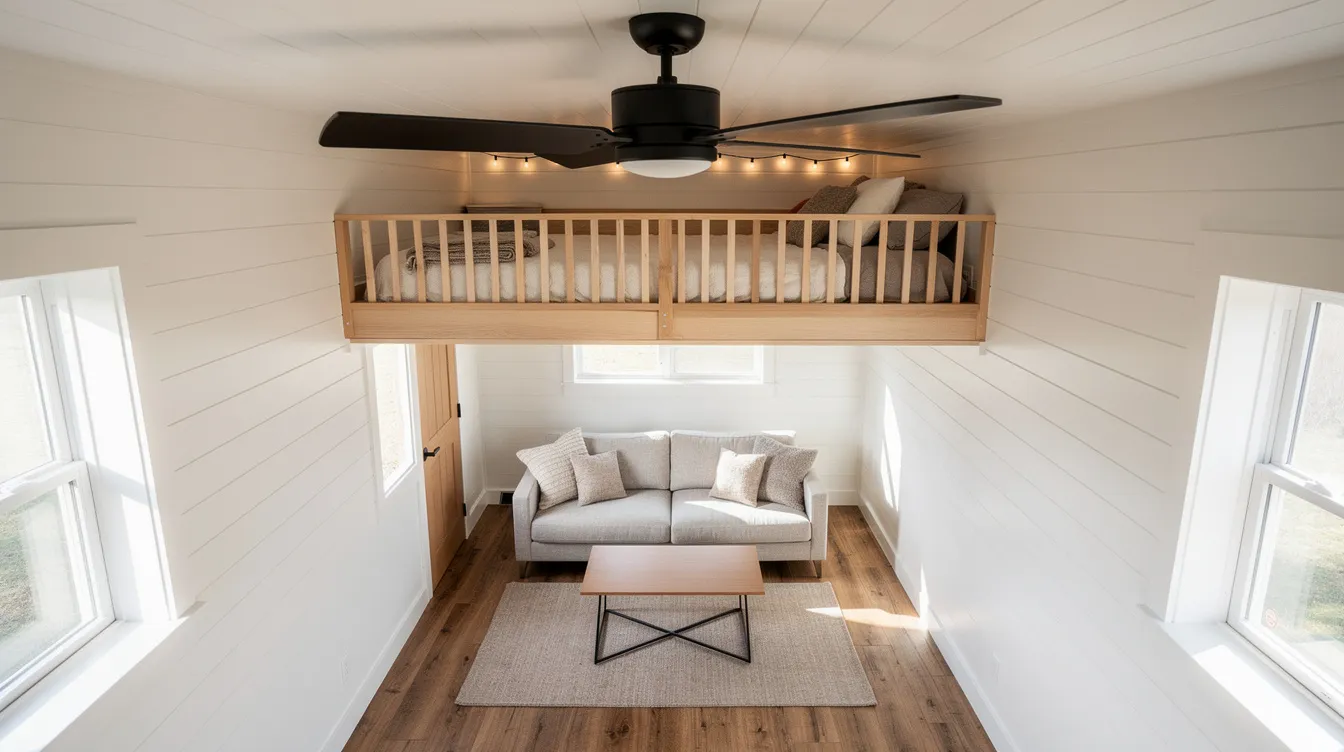
Ceiling fans (48-inch, 5,000 CFM, $100–$300):
- Push cold air down in summer
- Reverse direction in winter to recirculate warm air from lofts
- Don’t consume precious floor space downstairs
External shading from awnings or trees can significantly lower interior temperatures during summer. Thermal blinds or curtains can block heat gain in summer and reduce heat loss in winter.
Airflow and Loft Temperature Management
Loft sleeping areas often run 5–10°F warmer than the main floor because hot and cold air stratifies naturally. Targeted air circulation is critical.
Solutions:
- Mount a small, quiet DC-powered fan (20–50W, 100–200 CFM) near the loft opening
- Pull conditioned air up or push hot air down
- Compatible with solar systems at 0.5 kWh/day
Design tips:
- Keep loft railings open instead of solid partitions
- Add operable skylights for stack-effect cooling
- Avoid blocking air paths with tall storage units
- Cross-breezes can be created by opening windows on opposite sides of the house for ventilation
Smart controls or plug-in thermostats can cycle fans based on loft temperature. A typical improvement: loft drops from 82°F to 74°F after adding a circulation fan and adjusting mini split louvers.
Energy Efficiency, Insulation, and Air Quality in Tiny Homes
In a tiny home, every watt matters, and tools like a tiny home cost calculator help you understand how efficiency upgrades impact your overall budget. Poor insulation or leaky windows can double heating and cooling loads—particularly problematic for off-grid owners relying on limited solar and battery storage.
Envelope upgrades:
- High-R rigid foam under trailer floors
- Closed-cell spray foam insulation provides high R-value (R-5.6 to R-8.0 per inch), creates an airtight seal, and resists moisture
- Continuous exterior insulation where weight allows
- Insulated skirting for stationary units in cold regions
Optimal R-Values for Tiny Homes
Location | Target R-Value |
|---|---|
Walls | R-13 to R-21 |
Ceilings | R-30 |
Floors | R-19+ |
Higher values may be necessary in extreme climates, and choosing tiny house plans that fit your life should include room in the budget and structure for adequate insulation. Using high R-value materials like spray foam insulation is the most effective way to reduce the load on HVAC systems.
Air sealing measures: Even minor gaps around windows, doors, and vents can cause significant energy loss, requiring caulking or weatherstripping to eliminate drafts. Focus on:
- Careful taping of sheathing seams
- Gasketed electrical boxes
- Low-U-value, double- or triple-pane windows
Passive strategies:
- Strategically placed south-facing windows can capture natural heat in winter
- Add fixed or operable exterior shading
- Keep curtains open during the day for solar heat and closed at night to retain heat
Mechanical ventilation, such as an Energy Recovery Ventilator (ERV), is critical in airtight tiny homes to manage humidity and prevent mold. Use a Heat Recovery Ventilator (HRV) or ERV to exchange stale indoor air for fresh air while recovering 70–85% of energy.
Smart Controls and Monitoring
Smart thermostats and connected switches control mini splits, electric heaters, and dehumidifiers, and they pair well with plug-and-play structures like tiny house kits from major retailers. This is especially beneficial for remotely located units or backyard offices.
Modern features include:
- Wi-Fi app control
- Programmable schedules for weekday vs. weekend occupancy
- Geofencing to pre-cool or pre-heat before arrival
- Eco modes reducing runtime 20–30%
Monitor temperature and humidity with compact wireless sensors. Keep relative humidity between 40–50% to prevent mold without excessive dryness. In very small spaces, even minor cooking or showering spikes humidity quickly—automatic bathroom fan timers or humidity-triggered controls help.
Utilizing renewable energy sources, such as solar power, can help tiny homeowners reduce their carbon footprint and energy bills. Smart tools help owners see how insulation improvements reduce runtime and excessive energy consumption.
Choosing the Right Heating and Cooling Solution for Your Tiny Home
There is no single best heating system, especially if you’re designing a custom tiny home tailored to your lifestyle. The ideal mix depends on climate, grid vs. off-grid power, mobility, layout complexity, and budget.
Decision framework:
- Define your climate zone (expected winter lows and summer highs)
- Confirm whether the home will be permanently sited or moved
- Determine whether 120V or 240V service is available
Example scenarios:
Scenario | Recommended System | Approximate Cost |
|---|---|---|
Temperate backyard office | Single-zone 9k BTU mini split | $3,000 |
Cold northern residence | 12k multi-zone + wood stove | $6,000 |
Hot off-grid cabin | 9k solar-compatible + DC fans | $4,000 |
Mini split heat pump systems with professional installation have higher cost upfront but cost less over 5–10 years than cheaper electric heaters and window units. Using the home’s design and environment can reduce load on mechanical systems, improving cost efficiency. |
Improving the insulation of your tiny home can significantly reduce energy consumption by preventing loss of conditioned air, leading to lower energy bills.
Most tiny home owners should consult a qualified HVAC professional familiar with tiny homes for load calculations, line set routing, and code-compliant electrical wires and combustion safety.
FAQ: Tiny House Heating and Cooling Questions
How many BTUs do I need to heat and cool a 300 sq ft tiny home?
Most 250–350 sq ft tiny houses fall in the 6,000–12,000 BTU range depending on insulation quality, window size, occupants, and climate. Well-insulated tiny homes often need only 10–15 BTU/sq ft, while poor insulation pushes needs to 25–35 BTU/sq ft. Oversizing a mini split leads to short cycling and humidity problems above 55%. A professional load calculation beats generic “30 BTU per sq ft” rules that often overshoot.
Can I run heating and cooling in a tiny home entirely on solar power?
It’s technically possible but requires careful planning: a high-efficiency heat pump, 6–10kW solar array, 20–40 kWh battery storage, and lifestyle adjustments during cloudy stretches. Many off-grid owners use a hybrid approach—solar runs a modest mini split in shoulder seasons, plus wood, propane, or low-wattage portable heaters as backup during extreme cold or prolonged storms.
Are electric space heaters safe in such a small space?
Modern portable space heaters with tip-over protection and overheat shutoffs can be safe if used correctly. Require strict adherence to manufacturer clearances from bedding, curtains, and furniture. Only use UL or ETL listed models, avoid extension cords, never operate unattended while sleeping, and ensure total electrical load stays within your wiring and breaker limits.
Do I really need mechanical ventilation in a tiny home?
While you can open windows, relying on that alone is unreliable in cold or very hot weather. Small spaces accumulate humidity and indoor pollutants faster than larger homes. A small HRV/ERV (50–100 CFM, 20W) plus a ducted bathroom fan on a timer provides much better control over moisture and air quality with modest power draw.
What’s the best way to prevent condensation on windows and walls in winter?
Combine several approaches: keep indoor humidity in check with exhaust fans and dehumidifiers, maintain steady interior temperatures using an efficient AC unit or heating system, and upgrade to well-insulated double- or triple-pane windows. Simple daily habits help—run the bath fan 15–20 minutes after showers, cook with lids and an exhaust fan, and avoid drying wet clothes indoors without proper ventilation.