
Introduction to Tiny House Solar Setup
A tiny house solar setup lets you power your small home entirely from the sun. Between 2024–2026, off-grid living has surged as people love the freedom and savings.
Why the appeal? Like tiny mythical heroes overcoming big challenges, a 200–400 sq ft home can run on surprisingly little power. In comparison to the average home, a tiny house is minute in scale—much like Hawaii is to the continental US. Think of Tom Thumb, the legendary tiny man no larger than an average man’s thumb; a tiny house is a miniature form of a traditional home, appearing almost as small next to a mansion. Just as Tom Thumb grew from a tiny baby and then a man, a tiny house can grow in functionality as your needs change, transitioning from a simple shelter to an adult, full-featured living space. In 2025, a couple in Oregon installed a 3 kW system on their 24-foot tiny house and cut grid use to zero.
This guide covers components, sizing, budget, and maintenance.
- How a Tiny House Solar System Works
- Assessing Your Tiny House Energy Needs
- Core Components of a Miniature Tiny House Solar Setup
- Designing and Sizing Your Tiny House Solar System Size
- Roof-Mount vs. Ground-Mount
- Off-Grid vs. Grid-Tie Options
- Costs, Budgeting, and Real-World Systems
- Installation, Safety, and Maintenance
- Planning for Growth
How a Tiny House Solar System Works
Here’s the basic flow:
Solar panels → Charge controller → Battery bank → Inverter → AC outlets
A typical full-time setup: 2.4 kW array, 10 kWh lithium battery, 3,000 W inverter.
- DC power: Comes from panels and batteries
- AC power: Powers your appliances
Many tiny homes mix DC circuits (lights, USB outlets) and AC for efficiency.
Assessing Your Tiny House Energy Needs
Accurate energy calculation is the make-or-break step. If you’re still exploring whether the tiny lifestyle itself is right for you, it helps to look at in-depth inspiration and resources on tiny house living alongside your energy planning.
List all the things you’ll use: mini-fridge, induction cooktop, laptop, mini-split, water pump, even a tiny baby bottle warmer. Like fitting into a five shoe, your energy needs may be smaller than average, but some appliances wear heavily on your energy budget. Calculate daily watt-hours (watts × hours used).
Example daily total: 4–6 kWh/day for full-time living.
Key points:
- Seasonal variation matters—more heating in January, more cooling in July
- Find the right balance between essential and luxury things
- Identify non-negotiables (medical equipment, work laptops) versus luxury loads
- “Tiny feet, tiny loads” is a myth—many tiny homes have energy-hungry devices
Core Components of a Miniature Tiny House Solar Setup
For many people, the goal is a self-contained tiny home for modern off-grid living where solar is just one part of an integrated system.
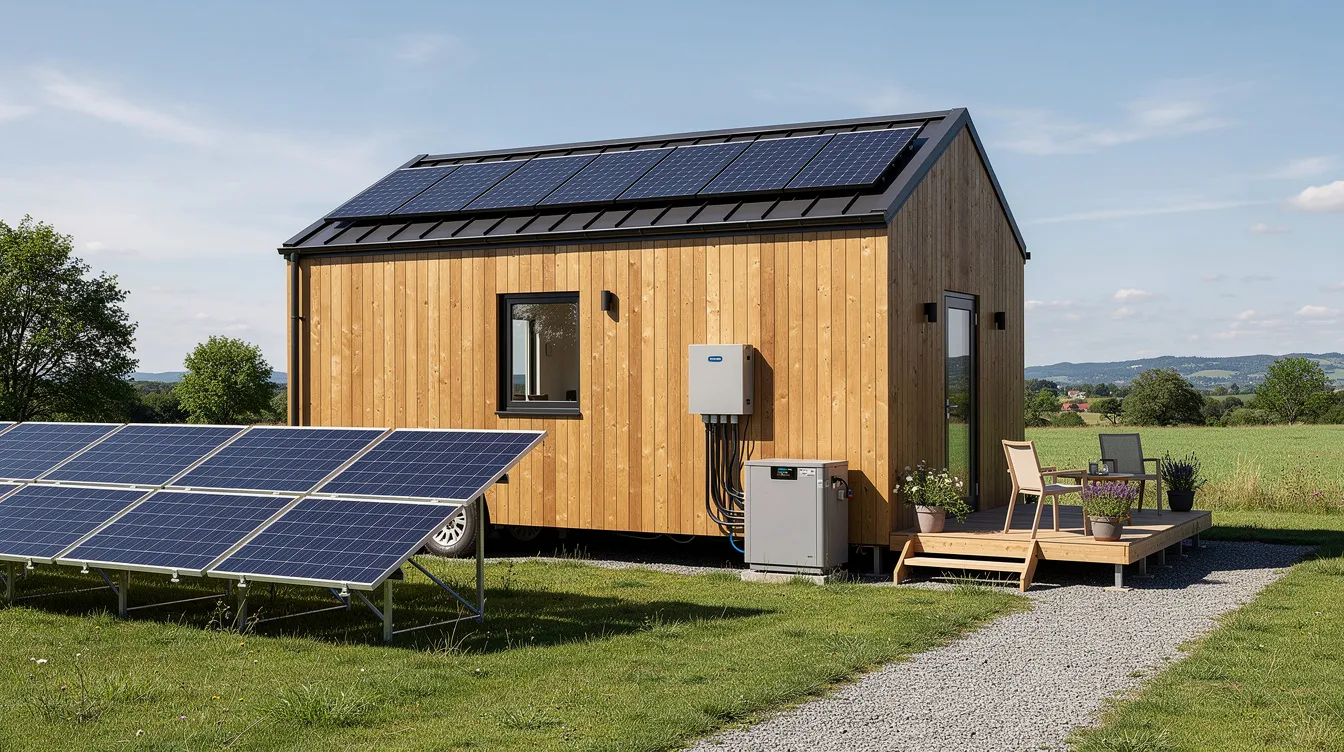
- Solar panels: Monocrystalline, 350–450 W each; roof or ground-mount options
- Charge controllers: MPPT preferred (15–30% more efficient than PWM); example: 40 A MPPT for 24 V systems
- Batteries: LiFePO4 lithium for weight savings; example: 4 × 100 Ah 24 V modules
- Inverters: Pure sine wave, 2,000–3,000 W continuous with 2× surge rating
- Optional: Smart monitors, combiner boxes, backup generator for cloudy weeks
Designing and Sizing Your Tiny House Solar System Size
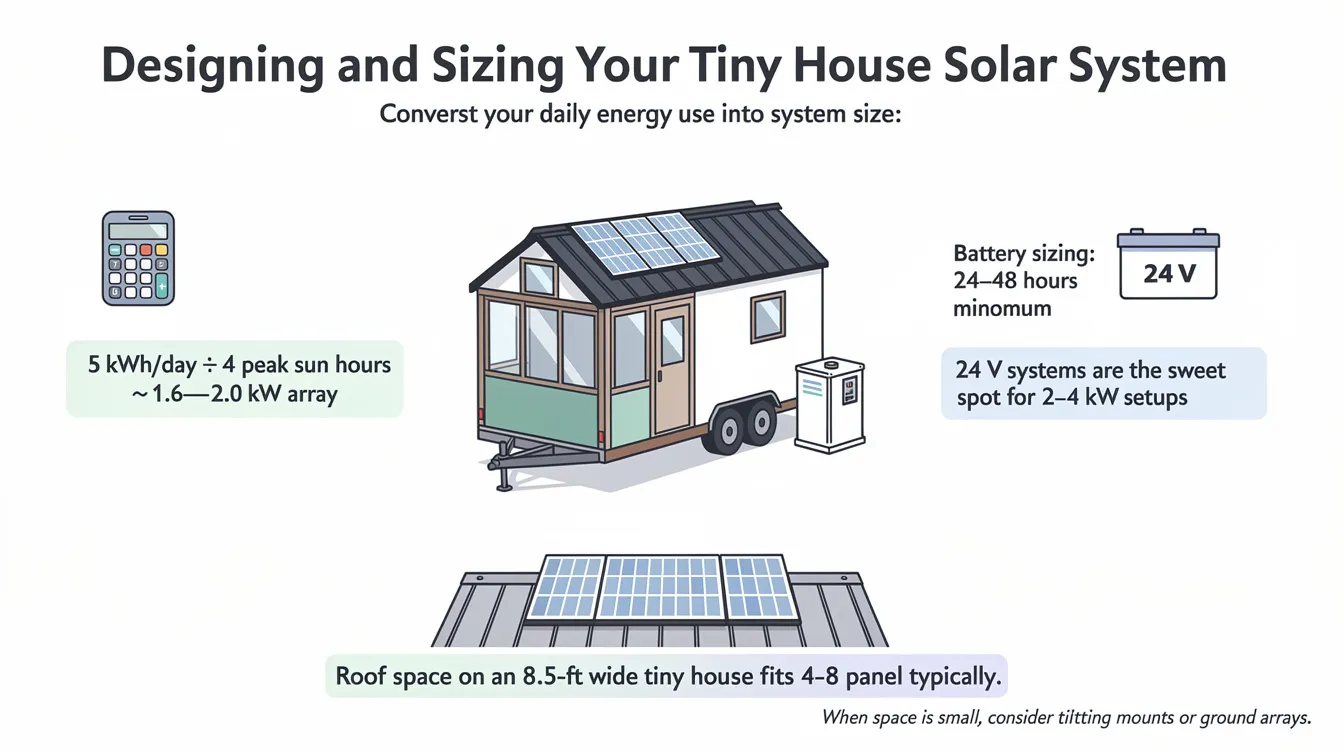
Convert your daily energy use into system size:
- 5 kWh/day ÷ 4 peak sun hours = ~1.6–2.0 kW array
- Battery sizing: 24–48 hours autonomy minimum
- 24 V systems are the sweet spot for 2–4 kW setups
Roof space on an 8.5-ft wide tiny house fits 4–8 panels typically. When space is small, consider tilting mounts or ground arrays.
Roof-Mount vs. Ground-Mount
Your mounting choice should align with your tiny house plans that fit your life, since rooflines, lofts, and porches all affect usable solar space.
Roof-mounted pros:
- Always with the house
- Theft-resistant
- No extra land needed
Ground-mounted pros:
- Easier cleaning
- Better tilt angles
- Room for expansion
Watch cable runs—voltage drop matters over 30–50 ft distances. Route wiring away from curious tiny feet. When comparing mounting options, keep watching for performance issues or changes in output, as monitoring your system helps catch problems early.
Off-Grid vs. Grid-Tie Options
Choosing between off-grid, grid-tie, or hybrid systems often overlaps with whether you prefer minimalist tiny houses for sustainable living, or a setup that keeps one foot on the traditional grid.
- Off-grid: Complete independence, batteries mandatory, ideal for mobile tiny homes
- Grid-tie: Net metering possible, but harder to permit for tiny houses on wheels
- Hybrid inverters: Can feed the grid and charge batteries
Zoning rules changed between 2020–2025 in many areas—check current local codes. For seasonal movers, off-grid with generator backup is usually more realistic, and many start by browsing tiny houses for sale and whether this lifestyle is for them before committing to a custom build.
Costs, Budgeting, and Real-World Systems
As you run the numbers, remember that solar is just one line item alongside affordable tiny house buildings, designs, and tips that determine your overall budget.
2024–2026 price ranges:
Component | Cost |
|---|---|
Panels | $0.70–$1.00/watt |
Lithium batteries | $500–$800/kWh |
Inverters | $1,500–$3,500 |
Sample systems: |
- Minimalist: 800 W array, 5 kWh battery (~$3,000–$5,000 DIY)
- Full-time: 2.4 kW array, 10–15 kWh battery ($4,000–$7,000 DIY) — these often pair well with custom tiny homes tailored to your space and lifestyle.
Budget for mounting hardware, wiring, and permits. A tiny baby system runs lights and charging, but most users upsize quickly.
Installation, Safety, and Maintenance
Treat your tiny house solar setup with full safety seriousness to support the way you live every day; well-built systems are what turn great tiny homes that redefine small-space living into comfortable, reliable dwellings.
- Use proper shutoffs, fuses, and breakers
- Hire licensed electricians for AC panel work
- Clean panels a few times yearly
- Check connections and monitor for production drops, paying attention to the minute details—even down to the atoms—of your wiring and hardware for safety
Think of your system as a collection of artifacts, like all the artifacts in doll houses, where each wire, fuse, and connector is a tiny but essential piece. In some enchanting magic tiny homes with storybook designs, that attention to detail is what makes the space feel both whimsical and dependable. Maintenance is like ensuring every day replicated detail is in place for reliable operation.
Keep batteries in secured compartments away from tiny hands.
Planning for Growth
Design for 25–50% expansion capacity. There are many stories of people who began with a tiny house solar setup and later expanded as their energy needs became larger—perhaps a solo digital nomad in 2024 adds a partner and tiny child by 2027, and energy needs grow, or they upgrade into one of many cute tiny house designs for a dream home.
Document everything: wiring diagrams, serial numbers, manuals.
Like tiny mythical heroes, small systems can tackle big dreams when designed thoughtfully. Start planning your tiny house solar setup today.