
Key Takeaways
- Tiny house stair alternatives range from classic loft ladders to skinny staircases and spiral designs, each balancing comfort, safety, and space saving differently.
- No single solution fits everyone—your choice depends on mobility, ceiling height, budget, and how often you use the loft.
- Smart stair ideas double as storage space with drawers, pull out pantry units, or built-in cubbies under each step.
- Mixing approaches often works best in tiny homes with two lofts—one fixed staircase plus a removable ladder for the second loft area.
- Test options at tiny home festivals when possible before committing to a permanent design.
- Introduction: Why Look for Tiny House Stair Alternatives?
- Option 1: Classic Loft Ladders for Tiny Homes
- Option 2: Space-Saving Tiny House Staircases
- Skinny Staircases and Floating Steps
- Spiral Staircase and Winder Alternatives
- Stairs with Built-In Storage, Drawers, and Pull-Out Pantry
- Adjustable and “No-Stair” Loft Alternatives
- Planning Your Tiny House Stair or Stair Alternative
- Conclusion: Matching Stair Ideas to Your Tiny Lifestyle
- FAQ: Tiny House Stair Alternatives
- How much space do I need for a tiny house staircase compared to a ladder?
- Are skinny staircases and alternating-tread steps safe for everyday use?
- Can I retrofit storage into an existing tiny house staircase?
- What is the best stair option for a tiny home with kids or pets?
- Do tiny house stair alternatives have to meet building code?
Introduction: Why Look for Tiny House Stair Alternatives?
Getting to your tiny house loft is simple in theory.
In practice? Every square inch matters.
A typical tiny home measures 100 to 400 square feet. Traditional full-width stairs need 10-12 feet of run for a standard 8-foot rise. That’s often impossible in a small house on wheels limited to 8.5 feet wide.
Your options include traditional stairs, skinny staircases, spiral staircase kits, loft ladders, adjustable loft systems, and even no-loft layouts. Each trades off comfort, safety, and floor space differently.
Consider this: a 24-foot tiny house completed in 2024 by Tiny House Basics in Oregon initially used a ladder. The owners switched to L-shaped storage stairs, reclaiming 15 square feet of under-stair space for a pantry and drawers. Daily usability improved dramatically for their family of three.
This article compares major alternatives, shows how they affect storage space and headroom, and gives practical selection tips.
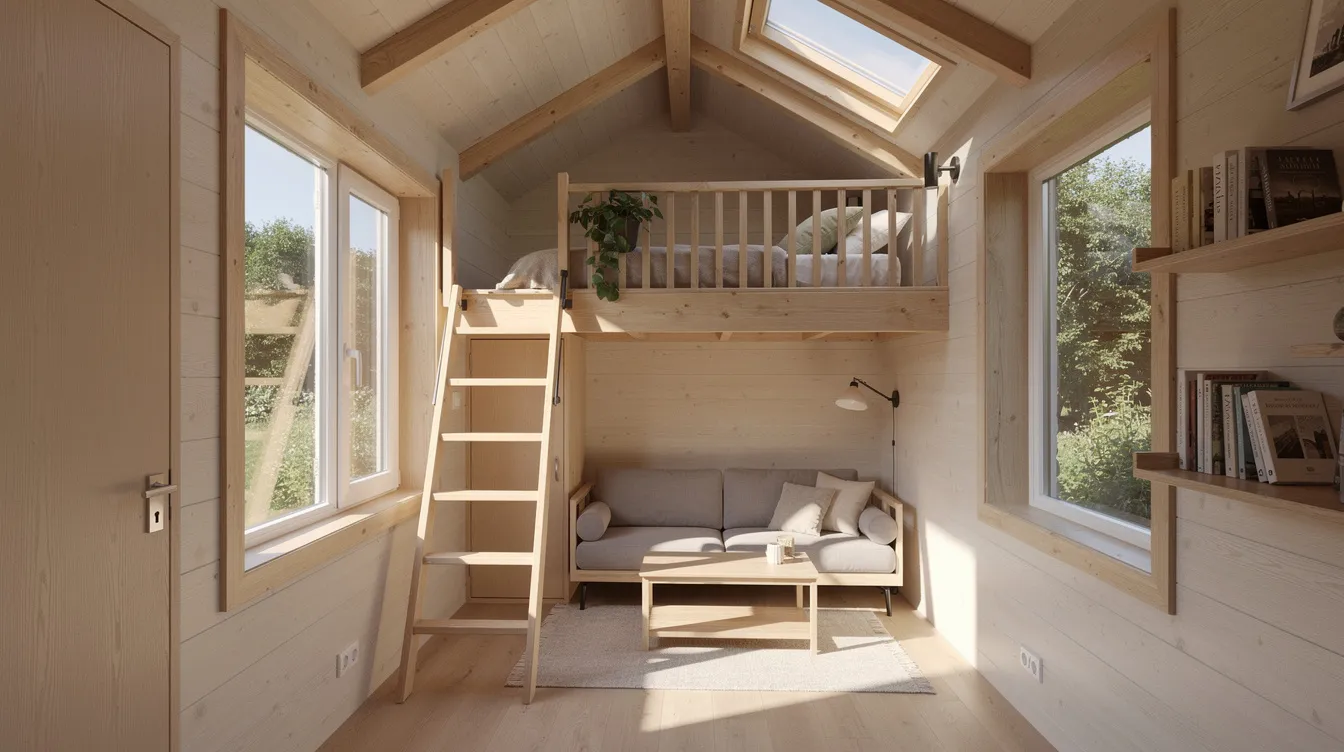
What’s covered next:
- Classic loft ladders and their best uses
- Space-saving tiny house staircases
- Skinny and floating stairs options
- Spiral and winder staircase alternatives
- Stairs with built-in storage and pull-out pantry
- Adjustable lofts and no-stair designs
- Planning your perfect solution
Option 1: Classic Loft Ladders for Tiny Homes
A tiny house loft ladder is steep, minimal, and takes up almost no floor space. It’s most effective in weekend cabins or secondary sleeping lofts.
A static loft ladder is immovable and fixed in place, often made of sturdy materials like metal or wood, and is essential for accessing elevated areas safely, and choosing the best ladder for a tiny house loft means balancing safety, accessibility, and style. Sliding loft ladders can be extended or contracted by sliding the sections in or out, providing adjustable access to different heights and spaces. Folding loft ladders are versatile and compact, allowing for easy storage when not in use, making them ideal for tiny homes with limited space. Removable loft ladders offer convenience and flexibility, as they can be easily detached and reattached, making them practical for various settings. Hinge ladders can be folded and adjusted into various positions, making them suitable for accessing hard-to-reach places in tiny homes.

Pros:
- Excellent space saving in a small space (as little as 2 feet of floor projection)
- Low weight for tiny homes on wheels (under 50 pounds typically)
- Simple DIY build from 2×4 lumber or aluminum channels
- Near-zero permanent floor occupation for removable types
Cons:
- Ladders are generally considered less safe than stairs due to the lack of handrails and support, making them more challenging to climb, especially for children and the elderly
- Not ideal if the loft is a primary bedroom used many times daily
- While ladders save space due to their narrow design, they can be difficult to use for individuals with mobility issues, making stairs a more accessible option for many
Practical sizing guidance:
- Optimal angle: 70 degrees
- Rung spacing: 10-12 inches apart
- Minimum width: 12-16 inches for stability
When to choose a loft ladder:
- Your tiny house has two lofts and one is only for storage
- You’re building a van conversion with a micro loft
- Weekend cabin use rather than daily living
- Budget is tight (DIY under $200 vs. $1,500 for stairs)
- Your tiny home on wheels has strict weight limits
Option 2: Space-Saving Tiny House Staircases
Replacing tiny house ladders with compact stairs improves comfort and safety while still protecting floor area.
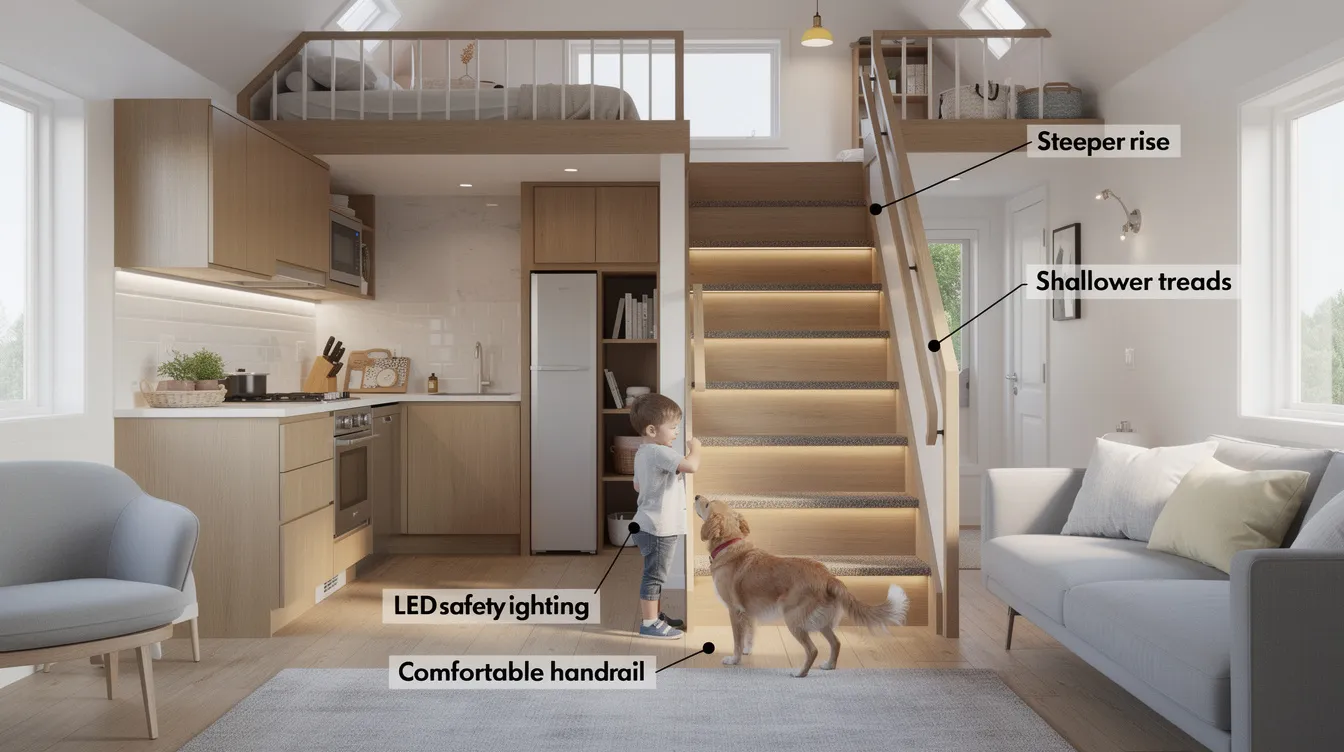
What makes a tiny house staircase “tiny”? Steeper rise (9-11 inches vs. standard 7.75), reduced tread depth (7-9 inches vs. 10), and careful integration with wall space and furniture. This creates a 45-55 degree pitch in just 5-7 feet of run.
General pros:
- 70% less fatigue in daily ascents compared to ladders
- Can integrate storage underneath
- More pet- and kid-friendly (80% of tiny homeowners with children prefer stairs)
- Provides more stability for daily use
General cons:
- Heavier (200-400 pounds) which affects trailer weight
- Requires careful planning and framing
- Needs 6.5-7 feet minimum headroom under the loft edge
Building codes don’t always fully apply to tiny houses. However, borrowing safe dimensions from residential codes and understanding tiny house maximum height guidelines and tips is wise for ensuring safety.
Universal design tips:
- Install 34-38 inch handrails with 1.5-inch diameter grip
- Add LED strip lighting (reduces trip risks by 50% in low-light)
- Use textured treads like bamboo or aluminum grit
- Ensure 36-inch clear approach paths
You can often reconfigure layouts—swapping kitchen and living room positions—to make room for tiny stairs without increasing the footprint.
Skinny Staircases and Floating Steps
A skinny staircase features narrow width (20-24 inches), compact treads, and often open risers. It’s much smaller than a full-width staircase in a larger house.
Common innovative designs include:
- Alternating-tread stairs: Overlapping steps reduce tread width by 50%, fitting in 4-6 feet of run
- Single-stringer floating stairs: Cantilevered steel beams (1.5-inch thick) bolted to load bearing walls create a modern aesthetic
- Wall-mounted steps: Double as shelves, maximizing vertical space
Skinny stairs work well in tiny living spaces from 18-30 feet long where every inch counts, especially when paired with tiny house floor plans that work for you. They’re ideal for loft space used daily by able-bodied adults.
Trade-offs:
- 2-3 week adaptation period required
- 15% higher misstep rates initially
- Alternating treads may be difficult for guests unfamiliar with the layout
- 300-500 pound load limits per OSHA-inspired testing
Layout ideas:
- Skinny stairs hugging a bathroom wall (22-inch width beside a 24-inch vanity)
- Wrapping around a closet
- Spanning over a compact pull-out pantry in the kitchen
Dimension ranges:
- Typical width: 20-24 inches
- Tread depth: 8-10 inches
- Requires 6-foot-2-inch minimum headroom
Style | Aesthetic | Best For | Width |
|---|---|---|---|
Alternating-tread | Industrial/modern | Daily adult use | 20-24” |
Sleek/modern | Visual impact | 24-30” | |
Reclaimed wood stringer | Rustic | Cozy cabins | 22-26” |
Spiral Staircase and Winder Alternatives
Spiral staircases are a popular choice for tiny houses due to their small footprint, making them ideal for accessing lofts without taking up much floor space.
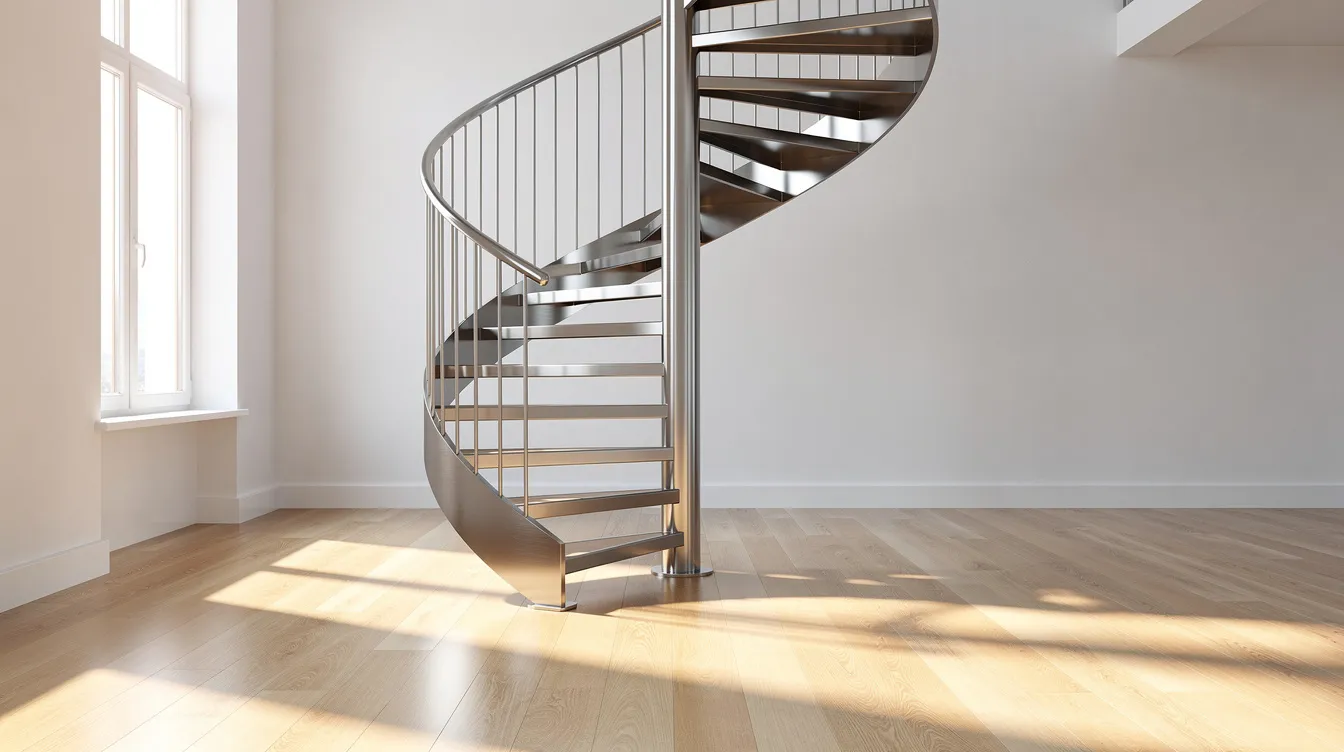
A spiral staircase works with a central 2-3 inch steel pole and radiating wedge treads (7-9 inches deep at the walk line). Typical diameters fitting inside a small house range from 4-5 feet, occupying just 12-20 square feet versus 40+ for straight stairs, which is why many owners use them to maximize space with a stylish tiny house spiral staircase.
Pros:
- Compact footprint with dramatic visual appeal
- Easier to use than a vertical ladder for most adults
- Aligns cleanly with a loft opening
- Metal models support up to 700 pounds
Cons:
- 20-30% slower ascent speeds for carrying bulky items
- Vertigo risks for about 10% of users
- Less kid friendly for small children
- May require custom fabrication
Winder alternatives use steps that turn 90° or 180° with triangular treads. They’re a middle ground between straight and a winding staircase, using 30-36 inch wide landings.
Case example: A 20-foot tiny home completed in 2023 by Tiny House Factory installed a 4-foot metal spiral from Rc Staircase. Installation took 4 hours and cost $3,500. The design preserved much space in the living space below.
Selection criteria:
- Minimum 7-foot ceiling height at center
- Consider wheel compatibility (fixed bases vs. bolted for tiny homes on wheels)
- Position near windows for light
- Spirals suit corners; winders work mid-wall
Stairs with Built-In Storage, Drawers, and Pull-Out Pantry
Turning the volume under and inside stairs into storage space eliminates the need for separate cabinets and dressers in your tiny house and mirrors many ideas from inspiring tiny house interiors that maximize every square foot.
Integrating storage into stairs by converting each tread into drawers or cubbies is a popular method for maximizing space in tiny houses. Tansu steps, which are essentially storage box stairs, allow homeowners to use the space within the stairs for storage, effectively combining functionality with design.
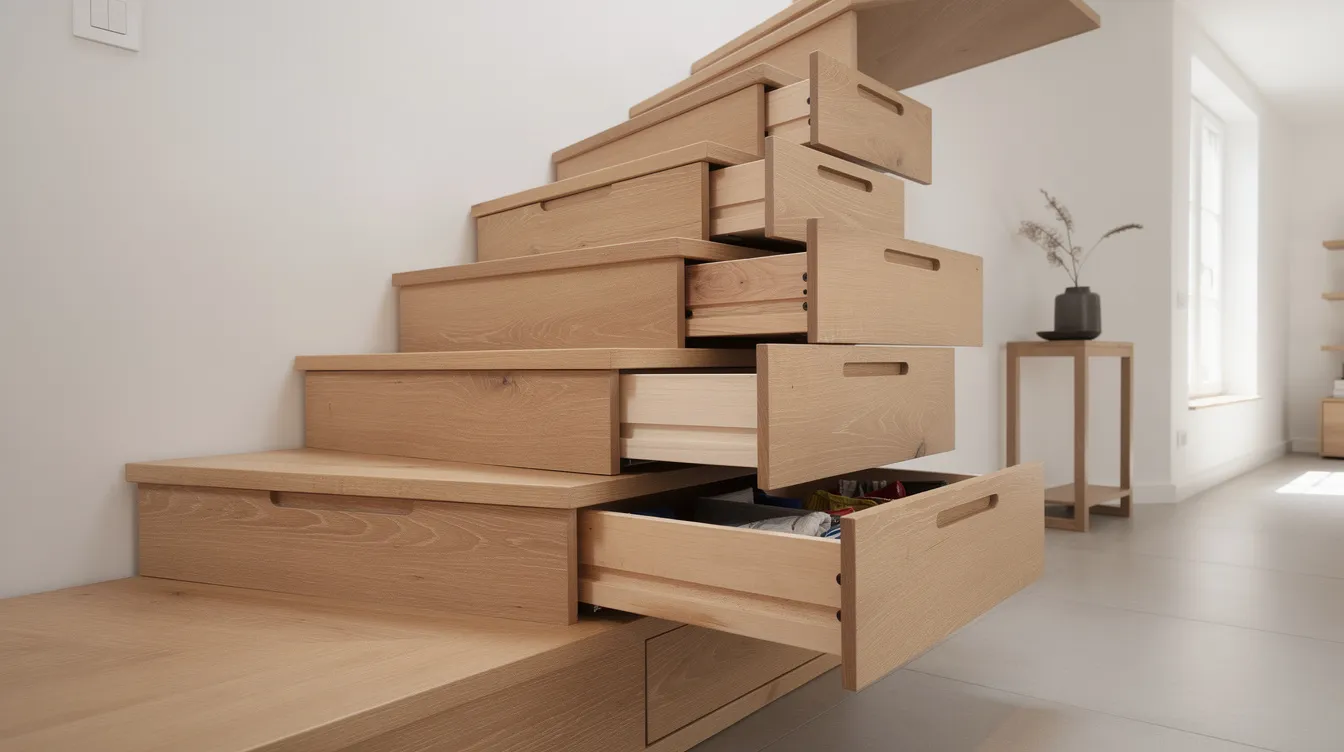
Stairs can provide additional storage options in tiny houses, as the space under the stairs can be utilized for storage solutions, unlike ladders which do not offer this feature. Utilizing the area under and around stairs for storage boxes, floating shelves, or kitchen cabinets can effectively maximize vertical space in tiny homes.
Specific storage features:
- Deep drawers (18-24 inches) for clothing on heavy-duty slides
- Cubbies for shoes and everyday items
- Broom closets in odd-shaped voids
- A narrow pull out pantry running the full depth of the staircase
A detailed build from Tiffany the Tiny Home (2020) showcases an L-shaped unit: three drawer steps with 7-inch treads housing clothes and towels, plus under-stair voids for a water tank and storage area.
Construction considerations:
- Load bearing walls must support both loft and staircase
- Use 3/4-inch plywood partitions stiffened with 2×6 framing (16-inch OC)
- Plywood gussets prevent racking
- Quality drawer slides (100-pound KV slides) ensure durability
Real measurements:
- Stair treads: 7-9 inches deep with integrated drawers
- Total stair width: 22-24 inches
- Added weight: approximately 300 pounds
Trade-offs: Storage stairs create more room for belongings but add weight. This matters if your tiny home sits on a trailer—consider tongue weight increases of 5-10%.
Adjustable and “No-Stair” Loft Alternatives
Adjustable loft systems raise and lower the loft platform so you don’t need permanent stairs or ladders, fitting well with exploring the world of tiny houses, inspiration and resources focused on flexible, minimalist living.
Options include manual winches (1:40 ratio), electric motors (1/2 HP), or counterweight systems positioned over living areas. The platform drops 4-6 feet during daytime for maximum openness.
Modular or collapsible staircases can be a flexible solution for tiny houses, allowing homeowners to adjust or disassemble the stairs when more living space is needed, especially in custom tiny homes designed for perfect small-space living.
Pros:
- Maximum space saving during the day
- Fully open floor area with no permanent climbing structure
- Easily stored when not in use
Cons:
- Higher cost ($2,000-10,000)
- Annual cable inspections needed
- 500-pound weight limits
- Complex safety requirements (locking mechanisms, cable checks)
No-loft alternatives skip vertical access entirely:
- Murphy bed folding into walls (sleeps two in 40 square feet)
- Convertible sofas with daily setup in 30 seconds
- Slide-out or pull-out bed designs
- Ground-floor bedroom configurations
When to skip a loft entirely:
- Mobility limitations among residents
- Long-term living situations
- Families with toddlers (35% of long-term tiny dwellers opt out)
- Preference for ground-floor privacy
Option | Daily Effort | Privacy | Cost |
|---|---|---|---|
Adjustable loft | Moderate | High | High |
Murphy bed | Low | Medium | Medium |
No-loft bedroom | None | High | Varies |
Planning Your Tiny House Stair or Stair Alternative
Here’s a few ideas to guide your decision-making process:
Assessment checklist:
- Who will live in the tiny home? (Consider age, mobility, pets)
- How often is the loft used daily?
- What must be stored under or around the stairs?
- What’s your budget range?
Measuring exercises:
- Ceiling height at loft edge
- Loft opening size (minimum 24×36 inches recommended)
- Maximum footprint available for any staircase
- Clearance in walkways (36-inch minimum)
Sketch multiple layouts:
- Straight stairs along one wall
- Spiral staircase in a corner
- Ladder on a rail (library style)
- Compare circulation patterns and storage space
Before finalizing your stair choice, it also helps to look at affordable tiny house buildings, top designs and tips so your access solution aligns with your overall build budget.
Budget ranges:
- DIY wood ladder: Under $200, depending partly on the best foundation for a tiny house and whether your build is on wheels or a fixed base
- Alternating-tread kit: $1,500-2,000
- Custom metal spiral: $3,000-5,000
- Storage staircase with drawers: $2,000-4,000, as seen in many of 15 great tiny homes that redefine small space living
Safety features to include regardless of choice:
- Handrails where possible (34-38 inches high)
- Lighting on each step or pathway
- Non-slip finishes on treads
- Secure loft guardrails (42-inch minimum height)
- 1.5-inch diameter grip rails
The perfect fit depends on your specific construction and layout—mock up the footprint with tape on your floor to visualize the real impact.
Conclusion: Matching Stair Ideas to Your Tiny Lifestyle
Tiny house stair alternatives span from simple loft ladders to elaborate storage staircases with a pull out pantry. Each serves different needs.
The perfect solution matches your daily habits, mobility needs, and storage requirements—not a design trend. A double staircase serving two lofts might work for one family. A removable ladder suits another.
Testing options in person helps tremendously. Visit tiny home festivals or open houses before committing. Many tiny homeowners recommend starting with a temporary solution like a removable loft ladder during construction, then upgrading to a more complex staircase once the room layout is finalized. This approach lets you picture the final result before permanent installation.
Your tiny house design options are limited only by creativity and careful measurement. With the right climb solution, reaching your loft becomes a pleasure rather than a daily challenge.
FAQ: Tiny House Stair Alternatives
How much space do I need for a tiny house staircase compared to a ladder?
A straight staircase typically needs 8-10 feet of run, while a skinny staircase or alternating-tread design fits in 5-7 feet. A loft ladder uses as little as 2 feet of floor space when leaned or mounted, and near-zero when removable or stored vertically. Spiral staircases trade length for diameter, usually needing a circular area of about 4-5 feet. Mock up the footprint with tape on your floor to visualize actual space consumption before making decisions.
Are skinny staircases and alternating-tread steps safe for everyday use?
Many people use alternating-tread stairs daily in tiny homes successfully. They require careful footing and an adaptation period of 2-3 weeks. Including handrails, adequate lighting, and non-slip treads improves safety significantly. Avoid alternating-tread designs in homes with very young children, mobility challenges, or frequent guests unfamiliar with the layout. Visit a built example or create a temporary mock-up before committing.
Can I retrofit storage into an existing tiny house staircase?
Closed-riser stairs can often be modified to add side-access cabinets, pull-out drawers, or narrow pantries under the lowest steps. Plan structural cuts carefully so stairs still support the loft and maintain rigidity. Start with simple cubbies or removable boxes in step voids before attempting complex drawer systems. Using prefinished plywood and quality drawer slides shortens retrofit time and improves durability.
What is the best stair option for a tiny home with kids or pets?
Full or semi-full staircases with regular treads and risers work best when possible. Sturdy handrails, solid guardrails at the loft edge, and non-slip finishes are essential safety features for family-friendly tiny homes. Storage stairs or compact winder staircases balance safety and space saving when standard staircases won’t fit. Position stairs so potential falls land toward soft areas like sofas rather than high-traffic kitchen zones.
Do tiny house stair alternatives have to meet building code?
Code requirements vary by region and how your tiny house is classified (RV, park model, ADU, or permanent residence). Even when not strictly required, using residential code dimensions as a safety benchmark is wise. Some compromises are common in tiny homes—steeper rise, narrower treads—but basic safety principles should still guide your design. Consult a designer or local inspector early to avoid costly redesigns and rest easy knowing your build meets reasonable standards.