

Key Takeaways
- Typical turnkey tiny house solar systems cost between $6,000 and $18,000 in 2026, while DIY builds can start around $3,500 for minimal setups.
- Most full-time off grid tiny homes use 1–4 kW of solar panels plus 5–20 kWh of batteries, with battery size being the biggest cost driver.
- The 30% federal solar tax credit (available through 2026) plus state rebates can cut your upfront cost by thousands of dollars.
- You can start with a small solar system for essential loads and expand later as your budget allows.
- This guide provides clear example budgets for weekend cabins, full-time off grid living, and hybrid grid-tied setups with backup power.
Introduction: Why Tiny House Solar Costs Matter in 2026
Solar power has become the go-to choice for tiny home owners chasing energy independence. Since 2022, utility prices have climbed steadily. More people work remotely. And the desire to live simply without monthly electric bills keeps growing.
A tiny house typically uses far less electricity than a standard home. Energy consumption for a tiny home often runs around 16 kWh per day compared to 30 kWh for larger homes. But don’t let that fool you into thinking solar setup is simple. Roof space for solar panels is severely limited on most tiny homes, which means careful planning matters, especially if you’re also thinking about exploring the world of tiny houses more broadly.
When you hear “tiny house solar setup cost,” remember it includes more than just panels. You’re paying for inverters, batteries, mounting hardware, wiring, and potentially labor. This guide focuses on real-world 2026 price ranges—not idealized numbers from five years ago. All costs are in USD, but the percentages and component splits apply similarly in other countries.
- How Much Does a Tiny House Solar Setup Really Cost?
- Key Components of a Tiny House Solar Power System
- Breakdown of Tiny House Solar Panel & Battery Costs
- Example Tiny House Solar Cost Scenarios
- Cost Comparison: Traditional Built-In Solar vs All-in-One Solar Generators
- Factors That Affect Tiny House Solar Setup Cost
- Reducing Tiny House Solar Costs Without Sacrificing Comfort
- Pros and Cons of Solar Power for Tiny Homes
- FAQs: Tiny House Solar Setup Cost & Design
- How many solar panels do I need for a typical tiny house?
- Is it cheaper to keep my tiny house on the grid instead of going fully off grid?
- How long do tiny house solar systems and batteries last before they need replacing?
- Can a tiny house solar system run air conditioning or electric heating?
- Are there special permits or inspections needed for solar on a tiny home?
How Much Does a Tiny House Solar Setup Really Cost?
Here’s the direct answer: expect to pay roughly $3,500–$8,000 for a DIY basic system and $8,000–$18,000 for a professionally installed full off grid setup with storage. Installing a complete solar system for a tiny house can cost between $10,000 and $15,000, which includes additional equipment like batteries and inverters.
Common system tiers break down like this:
- Weekend or seasonal tiny cabin: 400–800 W solar panel array, 2–5 kWh batteries. Cost runs approximately $3,500–$7,000. Perfect for light usage—LED lights, phone charging, small fridge.
- Part-time or grid-assisted tiny home: 1–2 kW solar panels, 5–10 kWh batteries. Budget $6,000–$12,000. Handles moderate daily usage with grid backup available.
- Full-time off grid tiny house: 2–4 kW solar panels, 10–20 kWh batteries. Expect $10,000–$18,000. Supports year-round independent living with efficient appliances.
- High-usage off grid (electric cooking, mini split heat pump, home office): 3–5 kW solar panels, 15–30 kWh batteries. Plan for $14,000–$25,000 or more.
A small 1 kW solar system can cost around $3,250, while a larger 3 kW system may cost approximately $9,750 before any incentives or rebates. System cost scales with your daily energy use (kWh per day), not square footage alone, so it helps to pair your solar budgeting with a detailed tiny home cost calculator when planning your overall project.
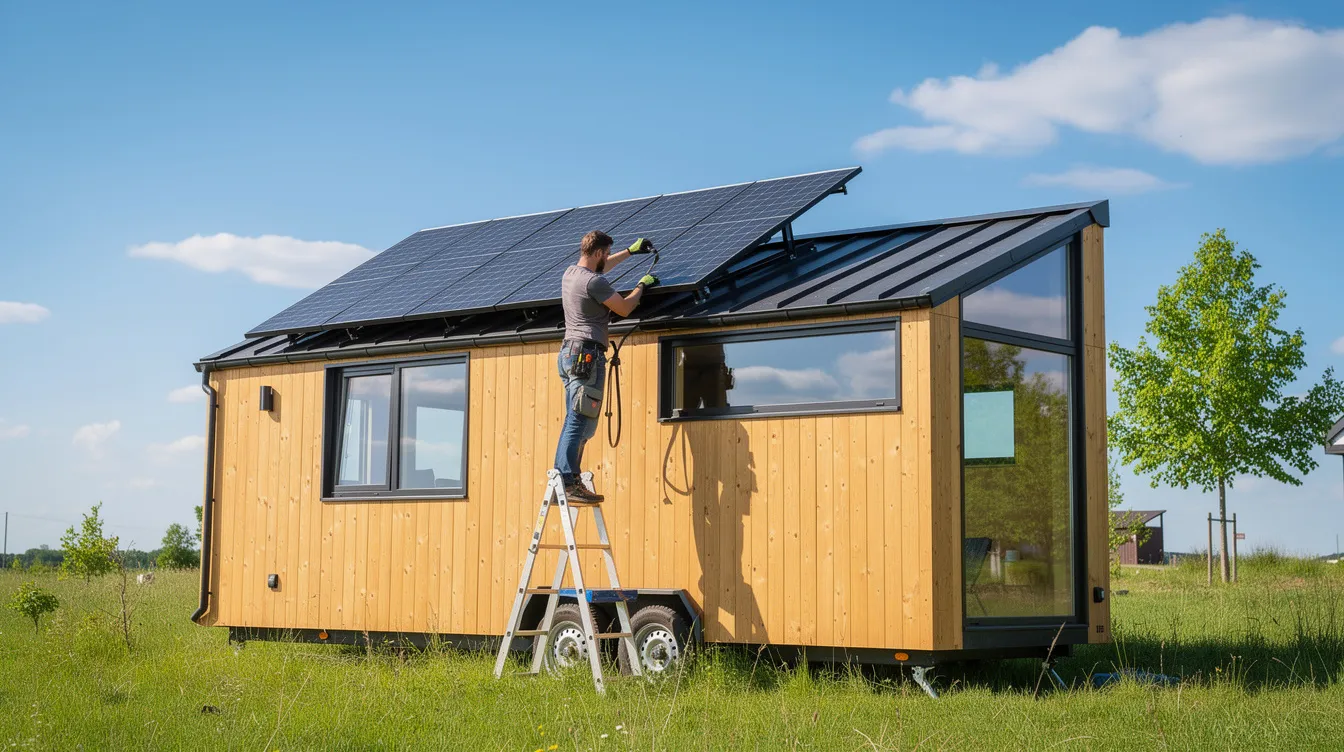
DIY installation can drop costs 20–40%, but understand the safety and permitting requirements before grabbing your tools. These prices reflect typical 2025–2026 market rates for mainstream residential solar components.
Key Components of a Tiny House Solar Power System
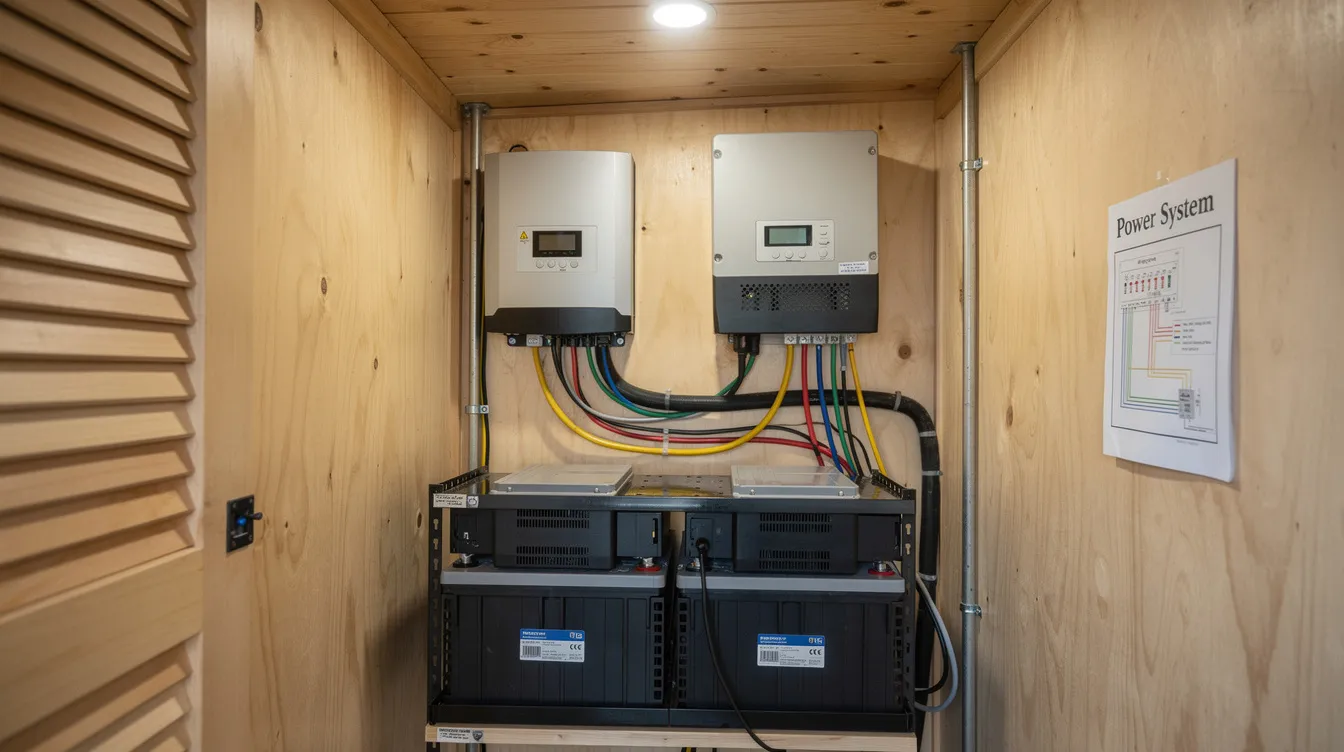
Understanding each component helps explain where your money goes. A typical solar power system for a tiny house includes solar panels, batteries, an inverter, and a charge controller.
Here’s what you’re buying:
- Solar panels: Convert sunlight into electricity. Quality panels cost $0.60–$1.10 per watt in 2026. A 1–3 kW array runs approximately $600–$3,300 for hardware alone.
- Charge controller: Regulates power flowing from panels to batteries. MPPT controllers cost $80–$300 for tiny home sizes.
- Inverter or inverter-charger: Converts generated DC power into AC power for home use. Pure sine wave inverters in the 3–5 kW range cost $1,000–$2,500. All-in-one inverter-charger units simplify wiring but typically run $1,500–$2,500.
- Battery bank: Stores excess energy generated during the day for use at night or during cloudy days, enhancing energy independence. This is usually your biggest line item.
- Mounting and racking: Roof rails or ground mount hardware. Budget 10–20% of hardware costs.
- Wiring and protection: Breakers, fuses, disconnects, and conduit. Add $150–$500 depending on complexity.
- Optional monitoring: Smart systems to track production and usage. $100–$300.
Traditional built-in systems use separate components wired together. All-in-one portable solar generators bundle the inverter, MPPT controller, and battery into one unit—simpler but less customizable.
Breakdown of Tiny House Solar Panel & Battery Costs
Solar panels are now relatively cheap. Batteries remain the main cost driver for off grid tiny homes.
Solar Panel Costs:
- Typical 2026 panels range from 375–450 W per module
- The cost of solar panels for tiny homes typically ranges from $2,275 to $6,825, depending on the system size and components used
- Example: Four 400 W panels (1.6 kW total) cost roughly $960–$1,760 for hardware, plus $200–$400 for racking and mounts
- High-efficiency panels command a premium when roof space is limited, but they produce more power per square foot
Battery Costs:
- Lithium iron phosphate (LiFePO4) dominates the tiny home market for good reason: longer lifespan, lighter weight, deeper discharge capability
- Lead-acid batteries cost less upfront ($1,500–$3,000 for equivalent capacity) but need replacement every 3–7 years versus 8–15+ years for lithium batteries
- LiFePO4 costs approximately $350–$700 per kWh in 2026 depending on brand and form factor
Example battery bank costs (hardware only):
- 5 kWh: $1,750–$3,500
- 10 kWh: $3,500–$7,000
- 15 kWh: $5,250–$10,500
Days of autonomy—how long you can run without sun—directly affects required battery capacity and cost. Want three days of backup instead of one? Triple your battery size.
Many tiny homes pair solar with a backup generator or grid connection to reduce battery bank size and save money upfront, while fully self-contained off grid setups resemble the top self contained tiny homes for modern off-grid living that integrate power, water, and waste systems.
Example Tiny House Solar Cost Scenarios
These scenarios are simplified but grounded in real 2025–2026 price ranges and typical tiny house consumption patterns.
Scenario 1: Weekend Off Grid Tiny Cabin
A 200–300 square foot cabin used mainly on weekends. Loads include LED light fixtures, phone and laptop charging, small fridge, and water pump—very similar to many minimalist tiny houses for sustainable living that prioritize simplicity over heavy electric loads.
System specs: 800 W solar panels, 5 kWh LiFePO4 battery, 2–3 kW inverter
DIY cost estimate:
- Panels: $480–$880
- Inverter: $300–$600
- Battery: $1,750–$3,500
- Balance-of-system: $300–$500
- Total: $2,830–$5,480
Professional install: $6,000–$10,000
Scenario 2: Full-Time Off Grid Tiny Home
A 250–400 square foot home occupied year-round. Efficient fridge, laptop and monitor, internet equipment, well pump, occasional microwave or induction cooktop—amenities that increasingly show up in tiny smart homes designed for efficient living.
System specs: 2.4 kW solar panel array, 10–15 kWh LiFePO4 storage, 4–5 kW inverter-charger
DIY cost estimate: $8,500–$15,000 Professional install: $15,000–$22,000
With the 30% federal tax credit, a $15,000 system effectively costs $10,500. State rebates may reduce this further.
Scenario 3: Grid-Tied Tiny House with Backup Power
A tiny home on a serviced lot with grid access. Goal: cut bills and have blackout protection, often starting with tiny house plans that fit your life and allow for future solar and battery integration.
System specs: 1.5–3 kW solar panel array, 5–10 kWh battery
Cost comparison:
- Pure grid-tied solar (no batteries): $4,000–$8,000
- Hybrid solar with batteries for backup: $8,000–$14,000
Net metering, where available, lets you sell excess electricity back to the utility.
Real quotes vary by location, brand choices, and whether you hire a solar installer or an RV specialist electrician familiar with tiny homes.
Cost Comparison: Traditional Built-In Solar vs All-in-One Solar Generators
Two dominant approaches exist for powering tiny homes with clean energy, both of which show up in many of the great tiny homes that redefine small space living.
Traditional built-in systems wire separate components into your home’s electrical panel. Solar panels connect to a charge controller or inverter-charger, then to a battery bank, which feeds your tiny house subpanel.
- More efficient per dollar at larger sizes (above 2–3 kW of solar)
- Require more design and installation labor
- A 2–3 kW traditional system with 10–15 kWh lithium storage costs approximately $10,000–$18,000 in 2026
- Better for long-term stationary off grid living
- Easier to expand over time
All-in-one solar generators bundle inverter, battery, and solar charge controller into a single unit. Wiring is simple: solar panels → power unit → outlets or circuits.
- Popular units with 1–3 kWh capacity and 3–5 kW output, plus folding or rigid solar panels, run approximately $4,500–$7,500
- Great for light to moderate loads
- Ideal for movable tiny homes or trial runs before committing to a large system
- Limited expansion options
- May need replacement sooner than component-based systems
Quick comparison:
- All-in-one systems are usually cheaper under certain sizes and easier to install
- Traditional systems integrate more cleanly with a home’s electrical panel and offer better customization
- Long-term serviceability favors traditional setups—you can replace individual components rather than the whole unit
Factors That Affect Tiny House Solar Setup Cost
Two tiny homes of similar size can have very different solar budgets. Here’s why:
- Daily usage: Running electric heat, electric water heaters, and full-size fridges drastically increases kWh per day and required system size. Calculate how much power you actually need before sizing equipment.
- Location and climate: Arizona gets 5.5–7 peak sun hours daily. The Pacific Northwest gets 3.5–4.5 hours. Northern climates may need 30–50% larger arrays. While solar panels can generate electricity even on cloudy days, their efficiency is still dependent on sunlight availability.
- Roof size and orientation: Limited roof space may force you toward higher-efficiency panels or a ground mount installation, which adds $500–$1,500 in hardware. Tiny homeowners can overcome space limitations by installing panels on the ground near the house, improving energy efficiency to reduce the number of panels needed, or using high-efficiency solar panels that generate more electricity in less space.
- On-grid vs off grid: Off grid setups need larger battery banks and often backup power, substantially increasing total spend, but they also enable the kind of independence showcased in elegant tiny homes that redefine modern living.
- Level of backup power desired: Multi-day autonomy costs significantly more than just a few hours of outage coverage.
- DIY vs professional installation: Labor runs 10–30% of total project cost. Foundation tiny homes often require permitting and inspection.
Do a basic load calculation before requesting quotes. List your appliances, their wattage, and daily hours of use. This exercise alone can save you from over-buying or under-sizing.
Plan for future expansion. Install extra roof rail length, larger conduit, or a higher-capacity inverter now. It’s cheaper than expensive rework later.
Reducing Tiny House Solar Costs Without Sacrificing Comfort
Smart energy choices can cut your required solar system size—and cost—by 30–50%.
Practical strategies:
- Prioritize efficiency: Choose Energy Star appliances. LED lighting uses 80% less electricity than incandescent. An efficient mini split heat pump sized for tiny homes uses 60–70% less power than resistance heating.
- Shift high-energy loads off electricity: Consider propane for water heating, cooking, and backup space heating. A propane setup costs $1,500–$3,500 to install but can reduce daily electrical demand by 30–50%.
- Optimize insulation and air sealing: Better envelope means smaller heating and cooling loads, allowing a smaller solar system and battery bank.
- Adjust usage patterns: Run high-draw appliances like a microwave or washing machine when the sun is strongest. Rely more on direct solar output and less on batteries.
- Start modest, expand later: Design wiring and mounting for future growth. Add more panels or an extra battery once your budget allows, just as many affordable tiny house designs are built to upgrade over time.
- Use smart plugs and monitoring: Track which devices use the most power. Knowledge is the first step toward cutting waste.
The cheapest kWh is the one you never have to produce. This is especially true on a small roof.
Pros and Cons of Solar Power for Tiny Homes
Solar isn’t automatically right for every tiny house, especially in heavily shaded locations.
Advantages:
- Lower or eliminated electric bills over the 20+ year lifespan of modern panels. You can save between $250–750 per year on your electric bill by installing solar panels on a tiny home. A small solar system between 1 kilowatt and 3 kilowatts in size will result in average savings of between $250 and $750 annually.
- The overall payback period on solar panels is typically between 4–9 years in most states, making them a good investment for energy savings.
- Solar energy is a clean and renewable energy source, significantly reducing carbon footprints compared to fossil fuels.
- Solar panels can increase energy independence by reducing reliance on grid power, providing backup power during outages, and potentially allowing for complete off grid living.
- Quiet operation compared to generators—important in small spaces and natural settings.
Downsides:
- The initial investment for a solar energy system can be high, often requiring several thousand dollars upfront, which can be a barrier for some homeowners.
- Space constraints on tiny house roofs can limit system size and may require creative mounting or trade-offs in energy use.
- Batteries add complexity, limited lifespan, and replacement cost compared to grid-only solar.
- Some mobile tiny homes may face challenges with permitting or connection rules in RV parks and campgrounds.
Weigh these pros and cons against your long-term plans. Are you stationary or mobile? What’s your climate? Your budget? Your lifestyle—and does buying a tiny house for sale that fits your needs make more sense than building from scratch?
FAQs: Tiny House Solar Setup Cost & Design
Common questions not fully covered above.
How many solar panels do I need for a typical tiny house?
Most full-time tiny homes run on 1–3 kW of solar panels. That usually means 4–10 modern panels depending on wattage and roof space. To cover an annual power consumption of 4,380-kilowatt hours (kWh), a tiny home would require approximately 140 square feet of roof space for solar panels, assuming the use of eight 375-watt panels.
Exact numbers depend on your daily kWh use and location. Do a simple load calculation before deciding. Very minimalist or weekend-only tiny homes can get by with fewer panels, while all-electric, high-comfort setups may need more.
Is it cheaper to keep my tiny house on the grid instead of going fully off grid?
Tying into existing grid power is usually cheaper upfront than building a large system with big batteries. However, long-term savings and resilience may still favor solar plus a small battery, especially where electricity rates are high or outages are frequent.
Hybrid approaches work well. Grid connection plus a smaller solar system plus modest battery capacity balances cost and independence effectively.
How long do tiny house solar systems and batteries last before they need replacing?
Quality solar panels commonly carry 20–25 year performance warranties and often produce useful power well beyond that with some degradation. Modern LiFePO4 batteries typically last 8–15+ years depending on depth of discharge and cycle count. Lead-acid banks may need replacement after 3–7 years.
Factor at least one battery replacement into very long-term off grid cost planning. A $6,000 battery bank replaced in 15 years is a real future expense.
Can a tiny house solar system run air conditioning or electric heating?
Efficient mini split heat pumps can be powered by a well-sized tiny house solar system, but they significantly increase required solar panel and battery capacity. Straight electric resistance heating—space heaters, electric baseboards, large electric water heaters—is usually too power-hungry for small, cost effective off grid systems.
Combine good insulation, passive design, and non-electric or hybrid heating solutions to keep system size and cost manageable.
Are there special permits or inspections needed for solar on a tiny home?
Rules vary widely by jurisdiction and whether your tiny house is on wheels, on a foundation, or classed as an RV, ADU, or permanent dwelling. Check local building codes, electrical codes, and park or campground rules before installing a permanent solar system.
Consult a licensed electrician or solar installer familiar with tiny homes to ensure safe, code-compliant installation. This protects your investment and ensures you qualify for available incentives. Performing security verification of your installer’s credentials and checking references helps avoid problems down the road.