
Summer heat hits tiny houses hard. The small space that makes your home cozy in winter becomes a challenge when temperatures climb. But here’s the good news: keeping your tiny house cool doesn’t require complicated systems or sky-high electricity bills.
Key Takeaways
- Most tiny homes under 400 sq ft can stay comfortable in July–August heat with one right-sized cooling system plus simple passive strategies
- Ductless mini split systems are usually the most energy efficient, all-in-one heating and cooling solution for stationary tiny homes
- Ceiling fans, natural ventilation, shade, and insulation upgrades can cut how often AC units need to run
- The best cooling options depend on climate (humid vs. dry climate), mobility (on wheels vs. foundation), and budget
- Combining cost effective mechanical cooling with smart daily habits keeps summer electricity bills low
- Why Cooling a Tiny House in Summer Is Different
- Start With Passive Summer Cooling Strategies
- Main Mechanical Cooling Options for Tiny Houses
- Fans, Airflow, and Loft Comfort
- Choosing the Right Cooling Solution for Your Tiny House
- Daily Habits to Keep Your Tiny House Cooler
- FAQ
- How many BTUs of cooling does a typical tiny house need in summer?
- Can a mini split system run on solar power in a tiny home?
- Is a ceiling fan enough to keep a tiny house cool without AC?
- Are evaporative coolers a good idea for humid climates?
- What’s the most cost effective way to cool a tiny house in summer?
Why Cooling a Tiny House in Summer Is Different
Tiny homes under 400 sq ft heat up and cool down faster than traditional houses during summer. That high surface-to-volume ratio means your small space can gain 10-20°F above outdoor temperatures within hours from solar radiation alone. Typical tiny house layouts—open lofts, large picture windows, and limited wall depth—affect heat gain and air circulation significantly.
Traditional HVAC units and ducted systems are often oversized and inefficient for such small spaces. Ductwork wastes valuable floor space, and oversized units short-cycle, reducing efficiency by 20-30%. Balancing cooling solutions, energy efficiency, and limited installation space is critical, which starts with tiny house floor plans that maximize comfort and airflow.
The main cooling options include:
- Mini split systems
- Window and wall mounted units
- Portable air conditioning
- Ceiling fans and oscillating fans
- Passive strategies like shade and ventilation
Start With Passive Summer Cooling Strategies
Passive cooling reduces indoor temperatures without constantly running mechanical cooling. These tactics can cut cooling loads by 20-50% before any AC kicks in. They improve comfort on moderately hot days and help any installed air conditioning work less on very hot days.
Whether your tiny house is parked permanently or moved seasonally, these strategies work, and they can be especially important in hot regions like tiny home communities across Texas.
Use Natural Ventilation and Night Cooling
Strategic window placement can enhance air circulation by allowing natural airflow. Installing windows on opposite sides of your home fosters cross ventilation, creating a cooling breeze. Open windows in early morning and evening to flush out warm air.
“Night flushing” is powerful: opening windows at night to allow a natural breeze can help cool a tiny home, especially when paired with fans to circulate the cool air during the day. This can drop indoor temperatures by 5-10°F.
For lofts where hot air rises:
- Install roof vents or operable skylights at the highest point
- Use oscillating fans or ceiling fans to push fresh air through sleeping areas
- Add insect screens and lockable window hardware for safe, bug-free ventilation
Add Strategic Shade and Sun Protection
Direct summer sun on large south- or west-facing windows quickly overheats a tiny home’s interior. Strategic window placement can enhance natural ventilation and heat regulation—south-facing windows allow sunlight in winter while window coverings can minimize heat gain in summer.
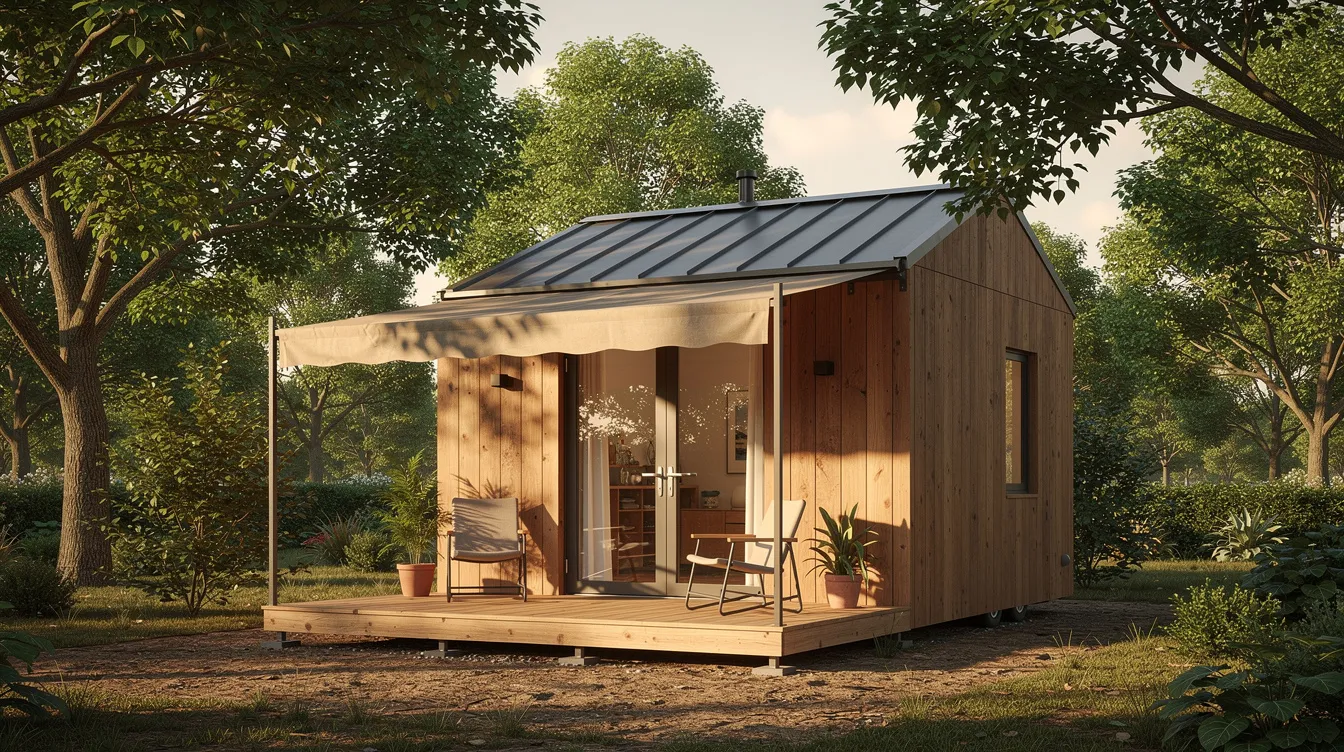
Solar shades block UV rays and sunlight while still allowing a view outside, helping to regulate the sunlight entering through the windows. Exterior options like awnings and shade sails block high-angle sun before it hits glass, cutting window surface temperatures dramatically.
Roof overhangs can block high summer sun while allowing low winter sun to enter, providing a natural way to regulate indoor temperatures throughout the year.
Planting trees around your tiny home can provide shade and cooling through the evaporation process in the leaves, with some trees providing the equivalent cooling of 10 air conditioners. For warm, coastal or island locations, many of the same principles show up in tropical tiny homes designed for beachfront climates. Position the narrowest wall toward the afternoon sun to reduce summer heat gain significantly.
Improve Insulation and Air Sealing
Effective insulation is crucial for tiny homes as it helps maintain comfortable indoor temperatures by reducing heat loss in winter and heat gain in summer. Good insulation works year round and should be planned from the start if you’re building a tiny house from scratch.
High-quality insulation materials, such as rigid foam or spray foam panels, are essential in tiny homes to effectively control temperature despite limited wall space. Improving insulation in tiny homes can significantly reduce energy consumption by preventing conditioned air from escaping, leading to lower energy bills.
Key steps:
- Seal gaps around doors, windows, and utility penetrations with weatherstripping
- Install reflective foil or radiant barriers in the roof to reduce radiant heat
- Check underfloor insulation and skirting for tiny houses on wheels
Using thermal mass materials like concrete or stone in construction helps regulate indoor temperatures by absorbing heat during the day and releasing it at night.
Main Mechanical Cooling Options for Tiny Houses
When passive strategies aren’t enough—during heat waves, in humid climates, or with metal-clad exteriors—mechanical cooling becomes essential. Calculate your home’s square footage and typical climate highs before selecting cooling capacity.
For a well-insulated tiny house, plan for 20-30 BTU per square foot. A 350 sq ft space typically needs 6,000-9,000 BTUs, with an extra 10-20% for lofts.
Ductless Mini Split Systems
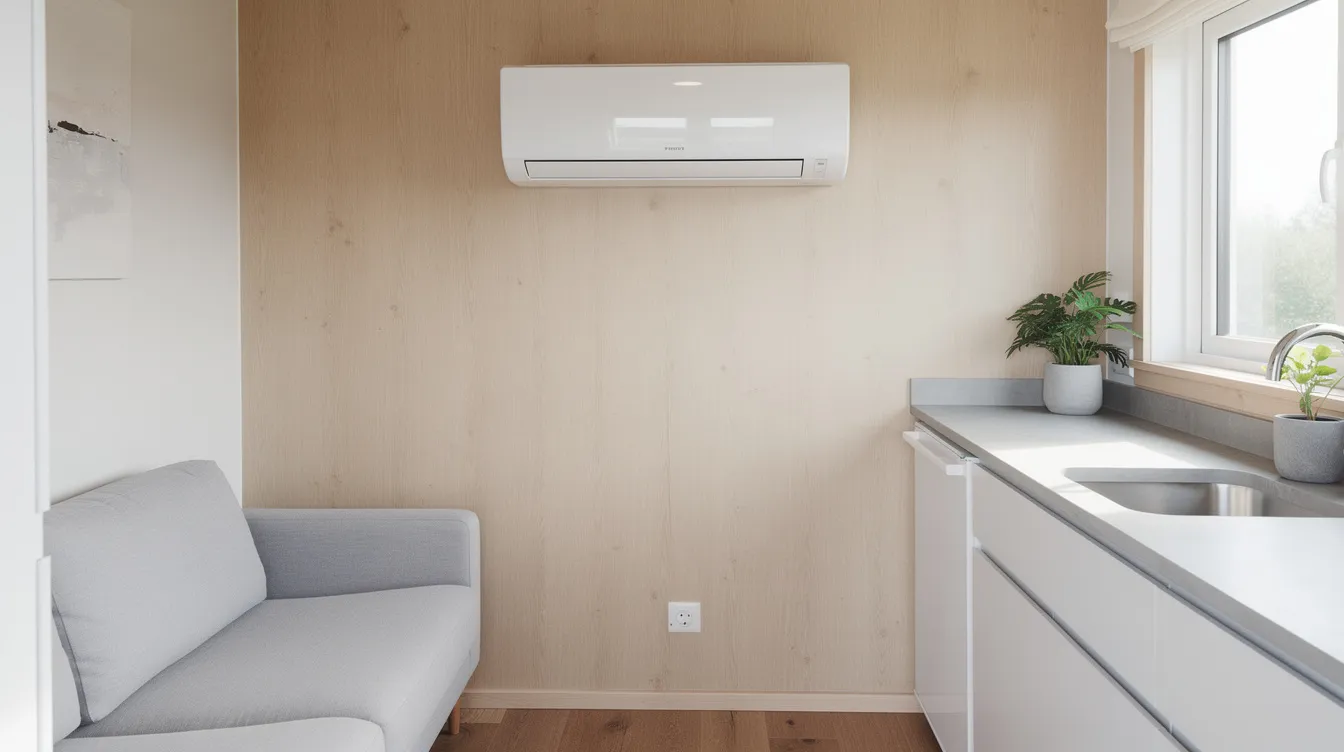
Mini-split systems are ductless heating and cooling solutions that consist of one or more indoor units connected to a single outdoor unit, allowing for efficient temperature control without the need for ductwork.
A 9,000-12,000 BTU mini split is often enough for a well-insulated tiny house under 400 sq ft. Mini-split systems are particularly advantageous for tiny homes due to their compact size and ability to provide both heating and cooling, making them a versatile year round comfort solution.
These systems allow for individual temperature control in different zones of a tiny home, which can enhance comfort and energy efficiency by only heating or cooling occupied spaces. Mounting options include high wall mount, ceiling cassette, or low floor mount—all saving valuable floor area.
Benefits include:
- Quiet operation (20-30 dB)
- High energy efficiency ratings (SEER 22+)
- Built-in dehumidification
- Precise consistent temperature control
Professional installation is usually recommended, but DIY-friendly systems exist.
Wall-Mounted AC Units and PTACs
Wall-mounted air-conditioning units are a popular option for tiny homes, as they do not block windows and can be installed during the building process, although they may be noisier than other options.
Pros:
- Permanent installation
- No blocked views
- Potential integrated heating element
Cons:
- Requires cutting a wall opening
- 40-50 dB noise levels
- Less energy efficient than quality mini splits
Plan these during the design stage to avoid structural issues with framing.
Window AC Units
Window air conditioning units are a cost-effective solution for cooling tiny homes, typically requiring only one or two units to effectively cool the space due to its smaller size.
Installation basics include secure mounting brackets, foam side panels, and proper drainage so water exits outdoors. Look for Energy Star-rated compact models designed for narrow or sliding windows commonly found in tiny homes.
Drawbacks include loss of natural light, obstructed window, and potential noise issues.
Portable Air Conditioning Units
Portable air conditioning systems are ideal for tiny homes as they are easy to install, affordable, and can provide year-round comfort, with options available for both single-hose and dual-hose configurations.
Dual-hose models are more efficient—single-hose units pull room air for exhaust, reducing efficiency by 20%. They require a window or vent kit to exhaust outside air.
Advantages:
- No permanent installation
- Easy to relocate
- Can store away in colder months
Limitations include floor space usage, hose heat loss, and typically lower energy efficiency.
Evaporative Coolers for Dry Climates
Evaporative coolers use water evaporation to blow cold air—ideal for arid regions. They work poorly in humid climates where indoor air is already close to saturation.
Benefits include low electricity use and fresh air exchange. You must leave a window cracked so moist air can exit and avoid condensation buildup.
Fans, Airflow, and Loft Comfort
Using ceiling fans or oscillating fans can create a breeze that helps keep a tiny home cool, making them effective alternatives to air conditioning. Fans don’t lower actual air temperature but can make it feel 4-8°F cooler.
Lofts in tiny homes often feel much hotter due to rising warm air and limited headroom. Good air circulation makes a modest cooling system feel far more effective while saving energy, especially in carefully planned tiny house interiors that maximize every square foot.
Ceiling Fans in Tiny Houses
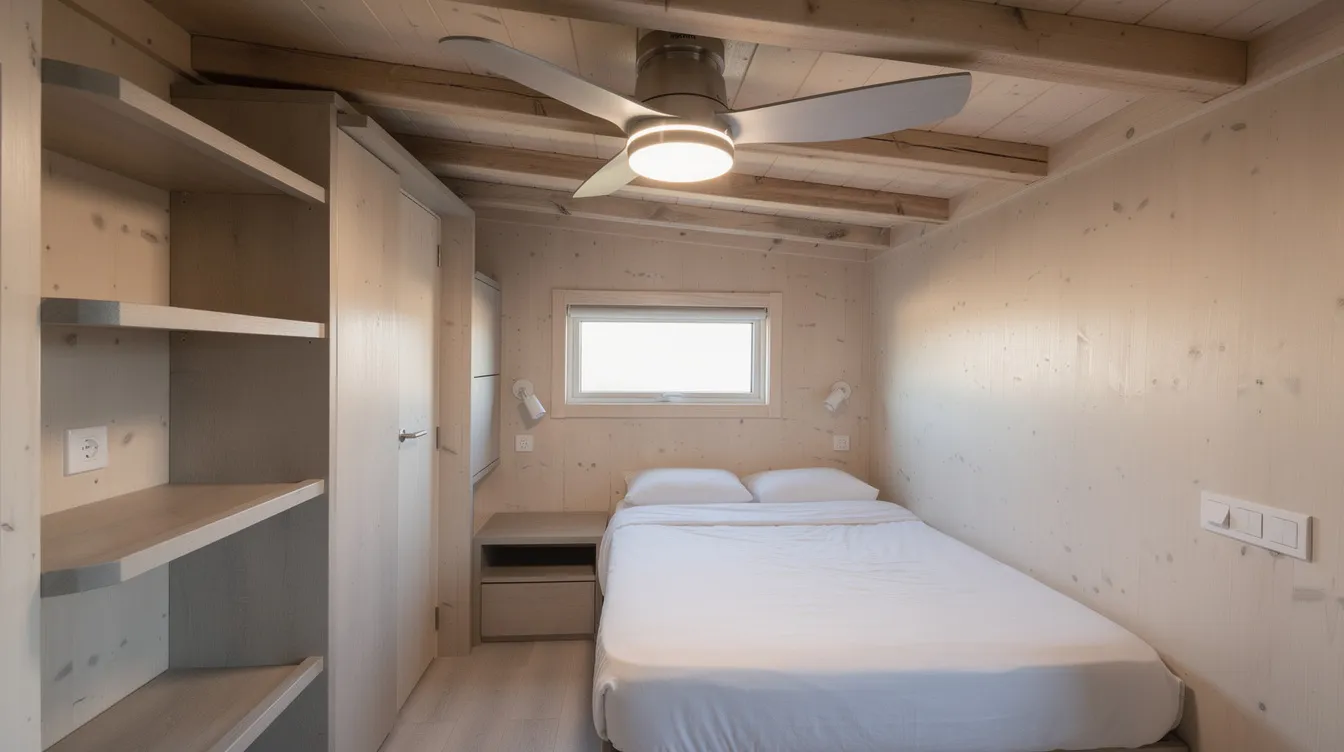
Ceiling fans and oscillating fans can be effective in cooling tiny homes by improving air circulation, making the space feel cooler without the need for air conditioning.
Recommendations:
- Choose compact, low-profile models for low ceilings
- Use summer setting (counterclockwise) to push air downward
- Many include integrated LED lighting, saving ceiling space
- Reversible fans help redistribute warm air in winter for tiny home heating
Oscillating and Box Fans
Position oscillating fans to move cool air up into a loft or draw outside air through open windows at night. Quiet, variable-speed models work best in small spaces.
Fans are especially helpful for off grid setups where full air conditioning may not run every day. Portable fans are easy to store and supplement other AC units on the hottest days.
Choosing the Right Cooling Solution for Your Tiny House
There’s no one-size-fits-all answer. Climate, power source, mobility, and layout all matter. Start by listing your climate data and whether you’re on-grid or off grid.
Match BTU capacity to your tiny house size and insulation quality. Compare up-front costs versus long-term operating costs.
Stationary vs. Mobile Tiny Homes
For permanent tiny homes on a foundation, ductless mini splits and wall mounted units work best with predictable power connections. For tiny houses on wheels, portable AC units, compact window units, and evaporative coolers fit more easily, and both approaches benefit from tiny house plans tailored to your lifestyle and budget.
Vibration and road travel can shorten equipment life if not installed securely. Check local codes and campground rules about exterior condensers and noise limits.
Balancing Budget, Comfort, and Energy Efficiency
Budget Level | Solution | Best For |
|---|---|---|
Low ($200-400) | Fans + basic window unit | Budget-conscious, mild climates |
Medium ($400-800) | Portable AC + strong passive cooling | Renters, mobile homes |
Higher ($1,500-3,000) | Quality mini split system | Long-term, stationary homes |
A more efficient mini split costs more upfront but pays off over 5-10 years through lower energy use. Choose Energy Star-rated equipment and check SEER ratings. Use programmable thermostats to avoid over-cooling an empty entire tiny home. |
Daily Habits to Keep Your Tiny House Cooler
Everyday routines—cooking, showering, electronics—can add significant natural heat in such a small volume. Simple schedule tweaks may reduce indoor temperatures noticeably, especially in highly efficient tiny homes that redefine small space living.
Reduce Indoor Heat Sources
- Cook with outdoor grills, microwaves, or slow cookers instead of ovens during peak heat
- Shower in cooler mornings or evenings with proper ventilation running
- Switch to LED lighting—they emit 90% less heat than incandescents
- Air-dry laundry outdoors instead of using dryers that add heat and humidity; habits like these support the light, airy feel of many cute tiny house designs focused on simple living
Smart Window and Door Management
Close windows, doors, and blinds before mid-morning on hot days to trap cool night air. Reopen them in evening once outdoor temperatures drop for proper airflow—window placement and shading are key considerations in modern tiny house designs for comfortable living.
Use door sweeps and weatherstripping to stop hot air from sneaking in. Monitor indoor humidity, especially in humid regions where moisture control matters for different temperatures throughout the space, including traditional-inspired layouts like colonial tiny house designs for cozy living.
FAQ
How many BTUs of cooling does a typical tiny house need in summer?
Many well-insulated tiny houses under 300-350 sq ft can be cooled with 6,000-9,000 BTUs. Larger or poorly insulated units may need closer to 12,000 BTUs. Consider climate, sun exposure, and loft space when sizing—not just square footage. Manufacturer sizing charts or an HVAC professional can provide accurate load calculations.
Can a mini split system run on solar power in a tiny home?
High-efficiency mini splits can run on solar, but only if the solar array and battery bank are sized for peak summer loads. Off grid owners should combine solar-powered mini splits with strong passive cooling, ceiling fans, and strict daytime usage limits. Work with a solar designer who can model energy use for July and August conditions.
Is a ceiling fan enough to keep a tiny house cool without AC?
A ceiling fan alone won’t lower air temperature, but it can make it feel several degrees cooler. In mild or coastal climates, a ceiling fan plus good cross-ventilation might be enough. In hotter inland or southern regions, fans should be paired with an AC unit or mini split for truly hot days.
Are evaporative coolers a good idea for humid climates?
Evaporative coolers work best in very dry climates and perform poorly in humid areas because they add moisture to already damp air. Using them in high-humidity regions can make the interior feel muggy. Traditional air conditioning or mini split systems are better for humid coastal or southeastern locations.
What’s the most cost effective way to cool a tiny house in summer?
The cheapest approach combines night ventilation, window blinds, a small Energy Star window AC, and a ceiling or oscillating fan. While a mini split has higher upfront cost, it may be most cost effective long-term due to superior energy efficiency. Factor both purchase price and monthly utility costs over several years when deciding on your cooling strategy and reducing your carbon footprint.