The choice between leasing and buying land for your tiny house comes down to one core trade-off: flexibility versus permanence. Leasing land keeps upfront costs low and lets you relocate easily, while buying land builds equity and gives you complete control over your property.
Both paths work for tiny house living, but they serve different financial situations and lifestyle goals. This comparison breaks down the key factors to help you determine which option fits your circumstances.
- Tiny House Land Lease vs Buying Land: Key Differences
- Upfront Costs and Financial Investment
- Flexibility and Mobility Options
- Legal Rights and Property Control
- Equity Building and Long-Term Value
- Zoning and Permit Considerations
- Maintenance and Utility Responsibilities
- Location and Community Factors
- Tiny House Land Lease vs Buying: Which Should You Choose?
Tiny House Land Lease vs Buying Land: Key Differences
The fundamental difference is temporary access versus permanent ownership.
- Land lease agreements provide lower upfront costs and mobility, making them ideal for tiny homes on wheels and those testing the tiny house movement lifestyle.
- Buying land offers stability, equity building, and full property control, better suited for foundation-based tiny houses and long-term residents who can choose the best foundation for a tiny house to match their site and goals.
Zoning laws and building codes vary widely between regions and determine whether you can legally place a tiny home on a specific piece of land. Before committing to either option, contact local city or county authorities to confirm applicable zoning ordinances and building codes.
Upfront Costs and Financial Investment
Initial financial requirements differ dramatically between leasing and purchasing land. Understanding these differences helps you plan your budget realistically.
Leasing Land for Tiny Houses
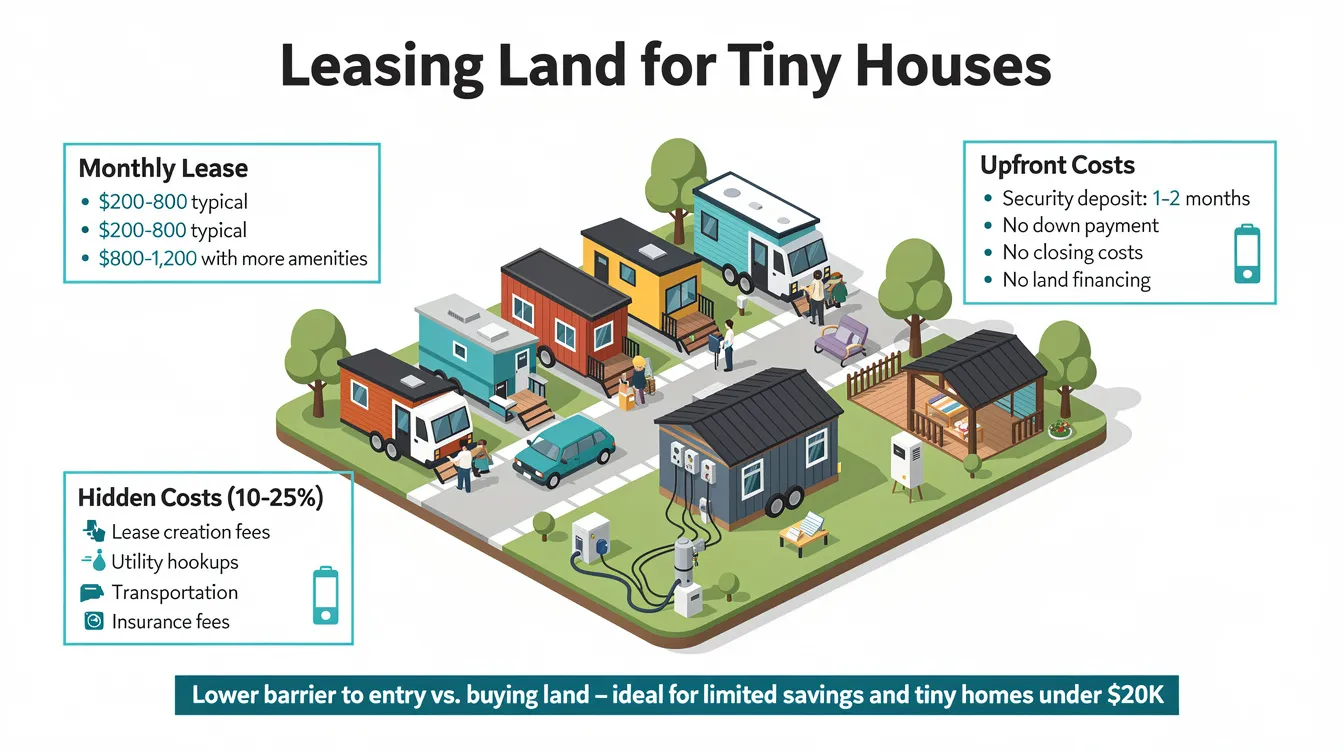
Monthly lease payments typically range from $200-800 depending on location, amenities, and whether you’re in an RV park, mobile home park, or private lot arrangement. Communities with more amenities may push toward $800-1,200 monthly.
Security deposits are usually required, often covering 1-2 months of rent. Beyond that, there’s no down payment, no closing costs, and no land purchase financing needed.
Hidden costs can add 10-25% to expected expenses. These include:
- Lease creation fees
- Utility hookup charges if not included
- Transportation costs for moving a tiny house on wheels
- Additional fees for insurance requirements
The barrier to entry remains significantly lower than purchasing, making leasing an attractive option for those entering the tiny house movement without substantial savings or exploring tiny homes under $20K for sale to keep overall costs down.
Buying Land for Tiny Houses
Land purchase prices vary dramatically by location. Rural raw land can cost $5,000-$30,000 for buildable lots, while suburban parcels near cities often run $30,000-$100,000 or more. Urban infill lots can exceed $100,000 even for small footprints.
Down payments for raw land typically fall in the 20-50% range. Financing costs are less favorable than traditional home mortgages, often requiring credit scores above 700 and interest rates 1-2 percentage points higher than residential loans.
Additional upfront costs include:
- Surveys: $200-$1,200
- Land clearing: $1,200-$8,000 per acre
- Utility installation: $15,000-50,000 depending on infrastructure needs
- Grading, driveway access, and septic system installation
Purchasing land typically requires a larger upfront investment compared to leasing, but it allows for long-term stability and the potential to build equity in both the home and the land.
Flexibility and Mobility Options
Your ability to relocate your tiny house depends heavily on whether you lease or own the land beneath it.
Land Lease Flexibility
Renting land for a tiny house can provide flexibility, especially for those with mobile tiny homes, allowing for a change of scenery as leases expire. Land leases can vary in duration, with some agreements renewing monthly and others annually, making them more suitable for different types of tiny house setups.
Leasing works well for:
- Testing different locations before committing long-term
- Seasonal living arrangements
- Those who want the freedom to follow job opportunities or personal interests
- Tiny homeowners who prioritize experiences over permanence
However, mobility has its own costs. Professional transport for a tiny house on wheels runs $1-5 per mile. A 100-mile move costs several hundred to $1,000, while cross-country relocations can reach $5,000-$15,000. Each move requires permits for oversized loads.
Owned Land Permanence
Buying land provides stability but limits mobility. Your property becomes a fixed location, which works better for tiny houses on permanent foundations or self-contained tiny homes for off-grid living that rely on on-site utilities.
Ownership allows for:
- Long-term landscaping and property improvements
- Building materials investments that add lasting value
- Solar panels, gardens, and other infrastructure that enhance livability
- Creating roots in a community with neighbors you know
Relocation from owned land is complex. You must sell the property, move your tiny house separately (if possible), or maintain two properties. This makes ownership better suited for those certain about their location choice.
Legal Rights and Property Control
Ownership versus leasing fundamentally changes your control over what happens on and to the property.
Leased Land Rights
Your rights on leased land are limited to what the land lease contract specifies. Landowners typically retain:
- Final authority on zoning and land use decisions
- Approval power over modifications or permanent structures
- The ability to change lease terms or choose not to renew
- Control over what types of dwelling units are permitted
Some areas have minimum size requirements for homes, while others might restrict the types of dwellings allowed on residential lots. On leased land, the landowner handles these compliance issues, but you have no direct influence over decisions.
A concerning statistic from recent research: over 50% of manufactured home owners who rent land have no formal lease, making them vulnerable to unexpected rent increases or displacement.
Owned Land Rights
Purchasing land gives you full control within local regulations. As a landowner, you can:
- Modify, improve, and develop property as desired
- Apply for variances if local codes restrict your plans
- Build additional structures like workshops or guest quarters
- Rent portions of larger properties to other tiny house owners for income
Ownership protects you from displacement and unexpected rent increases. You maintain direct relationships with local government planning departments and can advocate for your interests when zoning changes arise.
Equity Building and Long-Term Value
How each option affects wealth building over time is one of the most significant financial considerations.
Land Lease Equity
In a land lease agreement, homeowners usually build equity only in the home itself, not the land, which can result in lower overall equity compared to owning both the home and the land.
Monthly lease payments do not contribute to ownership or investment returns. Over many years, cumulative payments may exceed what land purchase would have cost. For example, $800 monthly over 10 years totals $96,000—more than many rural properties cost.
Selling a tiny house tied to leased land presents challenges. Buyers hesitate due to lease uncertainty, and homes classified as personal property rather than real estate have limited resale markets.
Land Ownership Equity
Buying land means building equity in both the land and your tiny house over time. Choosing affordable tiny house designs and builds can further improve your return as land typically appreciates in value, with remote properties gaining 2-3% annually and premium locations seeing 5-7% growth.
Ownership advantages include:
- Combining home and land creates stronger resale value
- Easier qualification for financing when property includes land
- Ability to leverage property equity for future investments
- Creating a legacy asset that can be passed to family
Real estate ownership remains one of the most reliable paths to build equity over the long run, even with a non-traditional home like a tiny house.
Zoning and Permit Considerations
Zoning laws and permits create different experiences depending on your land arrangement.
Leased Land Permits
On leased property, the landowner typically handles major zoning compliance. This reduces your burden but also limits your control.
When looking for land for a tiny house, consider whether you prefer urban, suburban, or rural locations, as each has different zoning laws and building restrictions. Leased properties must already comply with local codes, so your options narrow to locations where landlords have done the due diligence.
Potential restrictions on leased land include:
- Requirements that wheels remain on tiny houses on wheels
- Limits on permanent utility installations
- Size maximums often around 400 square feet
- Requirements for certifications or specific building standards
Owned Land Permits
Property ownership means full responsibility for permits and zoning compliance. You’ll work directly with local building officials and planning departments.
This direct relationship offers advantages:
- Ability to appeal zoning decisions or seek variances
- Control over permit timing and construction schedules
- Opportunity to influence local regulations through civic participation
- Freedom to pursue creative solutions to code challenges
Many states are updating regulations to explicitly define tiny homes and adopt standards like IRC Appendix Q, which helps foundation homes under 400 square feet meet safety requirements. Pairing compliant tiny house plans that fit your life with ownership positions you to take advantage of these evolving regulations.
Maintenance and Utility Responsibilities
Who handles land maintenance, public utilities, and infrastructure differs significantly between arrangements.
Land Lease Maintenance
Landowners typically handle major infrastructure including roads, shared water systems, and primary electrical connections. Lease agreements specify tenant responsibilities, usually covering:
- Yard and site care
- Minor utility management
- Property cleanliness
- Personal structure maintenance
Utilities may be included in rent or separately metered. This arrangement reduces your workload but limits control over upgrades or infrastructure improvements.
Tiny house communities are becoming increasingly popular as they offer a sense of belonging and shared resources among residents. Exploring the broader world of tiny houses, inspiration, and resources shows how living in such communities often means shared amenities like gardens, workshops, and communal spaces, reducing individual maintenance burdens.
Owned Land Maintenance
Full responsibility for all land maintenance, utilities, and infrastructure falls on the property owner. This includes:
- Bringing in utilities or building off-grid systems
- Maintaining access roads and driveways
- Installing and maintaining septic systems or composting toilets
- Managing stormwater and site grading
If you are considering rural land for your tiny house, you may need to plan for off-grid utilities, such as solar power and rainwater collection, if public services are not available. Understanding how to build a tiny house with these systems in mind is key, as off-grid systems require higher upfront investment but provide more freedom and independence.
Utility hookup costs for owned land range from $5,000-15,000 for grid connection. Off-grid systems using solar panels and alternative waste systems may cost more initially but reduce ongoing expenses.
Location and Community Factors
Each option affects where you can live and how you connect with neighbors.
Lease Location Options
Leasing provides access to established tiny house communities, RV parks, and mobile home parks. These locations offer:
- Built-in community connections and shared amenities
- Opportunity to live in expensive areas without purchasing costly land
- Proximity to urban amenities and services
- Immediate access to like-minded neighbors
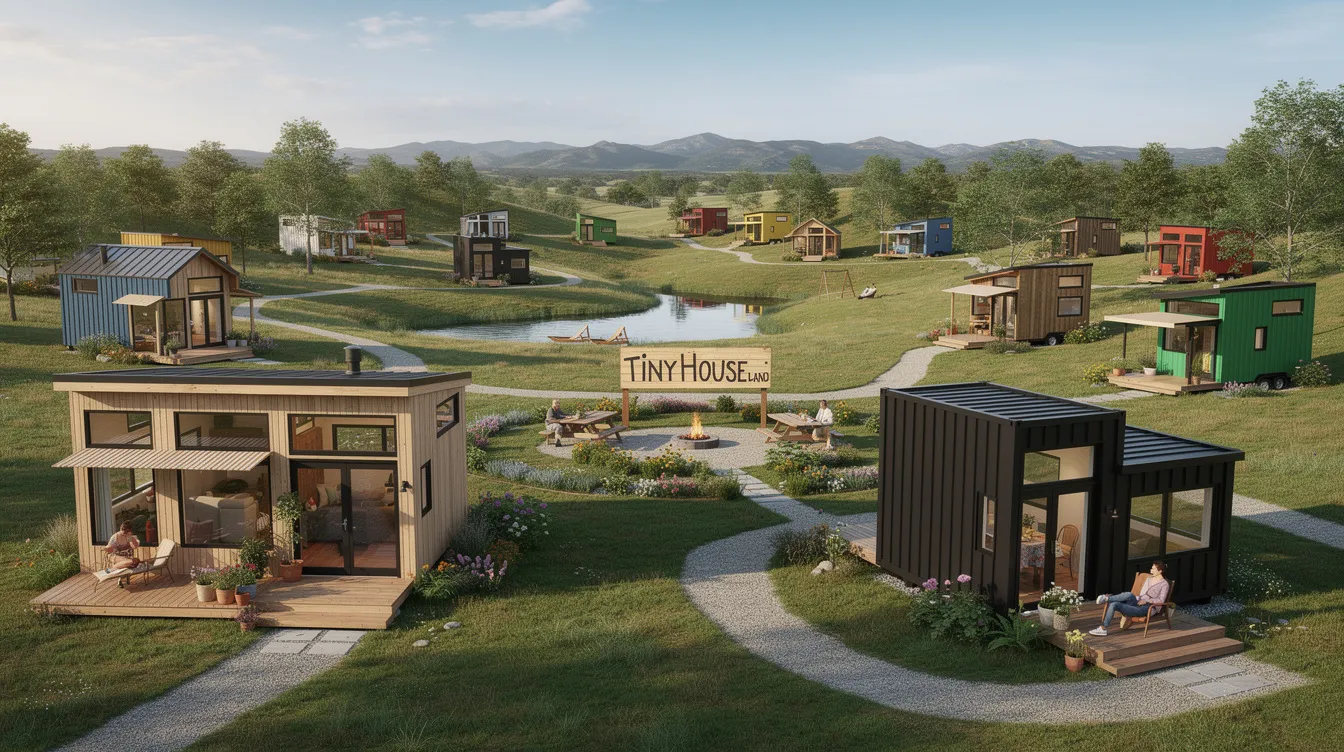
Living in a tiny house community can provide opportunities for skill-sharing and collaboration among residents, enhancing the communal living experience. Comparing modern tiny house designs helps match your home to communities that often feature shared amenities such as gardens, workshops, and communal spaces, which can foster a strong sense of community.
Online platforms such as Zillow and LandWatch can help identify available plots for tiny houses, and working with a real estate agent experienced in tiny home projects can streamline the process of finding lease opportunities or connecting with top micro house builders who understand local markets.
Owned Land Locations
Purchasing land opens unrestricted location choices within legal compliance. You can:
- Access rural and remote locations not available for lease
- Create your own tiny house community on larger properties
- Choose locations based purely on personal preference
- Build community connections organically with adjacent property owners
Remote ownership does carry challenges: poorer infrastructure, longer drives for amenities, and potential regulatory obstacles with well permits and road access. Resale in remote locations may also take longer.
Tiny House Land Lease vs Buying: Which Should You Choose?
Choose land leasing if you want:
- Lower upfront costs and minimal financial barriers
- Maximum flexibility to relocate
- Access to established tiny house communities
- Freedom from long-term property commitments
- A testing ground before making permanent decisions
Choose buying land if you want:
- Long-term stability and permanence
- Equity building in both home and property
- Complete control over land use and improvements
- Foundation-based tiny house construction
- Protection from rent increases and displacement
Both options can support successful tiny house living. The right choice depends on your budget, lifestyle goals, and how you envision your future in the tiny house movement, including whether buying a tiny house for sale is right for you. Pay close attention to local laws and regulations regardless of which path you choose, as compliance determines whether your tiny house dream becomes reality.