
Key Takeaways
- In a tiny house, loft stairs must balance safety, comfort, and ultra-efficient stair storage—not just get you up and down.
- Compare tiny house stairs vs loft ladders up front so readers can quickly see which suits their small space and lifestyle.
- Several specific loft stair designs exist (box stairs, spiral staircase, alternating tread, folding, double staircase, super compact steps) with real-world dimensions and use cases.
- Simple formulas with example numbers (e.g., 84” rise, 7” risers, 22” tread width) help you build tiny house stairs with confidence.
- FAQs tackle practical concerns like codes, planning permission, pets/kids, and retrofitting existing tiny homes.
- Introduction: Why Loft Stairs Matter In A Tiny House
- Tiny House Stairs vs Loft Ladder: What Works In Small Spaces?
- Planning A Tiny House Loft Staircase: Dimensions & Safety
- Box Stairs With Storage: The Workhorse Of Tiny Home Loft Stairs
- Compact Loft Stairs Ideas For Tiny Homes
- Double Staircase & Multi‑Loft Layouts
- How To Build Tiny House Stairs Step‑By‑Step (Overview)
- FAQ: Tiny House Loft Stairs Questions Answered
- Do tiny house loft stairs need to follow standard building codes?
- Do I need planning permission just to add or change loft stairs?
- Are spiral or alternating tread stairs safe for kids and pets?
- How much does it cost to build tiny house stairs with storage?
- Can I retrofit proper stairs into an existing tiny house with a ladder?
Introduction: Why Loft Stairs Matter In A Tiny House
In a tiny home, your loft stairs or ladder becomes a central feature. It affects safety, storage, and daily comfort. Get it wrong, and you’ll curse those steps every morning.
Many tiny house lofts sit 6–8 ft (72”–96”) above the main floor. That height demands thoughtful tiny house staircases design, especially when you’re also juggling tiny house maximum height guidelines and tips. A bad staircase wastes precious space. A good one creates storage underneath and feels natural to climb.
This guide covers design ideas, example dimensions, and storage tricks like a pull out pantry. You’ll learn how to choose between loft stairs and a loft ladder. We’ll give you a few ideas that actually work in tiny living spaces, similar to other tiny house interiors that maximize every square foot.
Tiny House Stairs vs Loft Ladder: What Works In Small Spaces?
This is the first step in planning your loft area. Should you use stairs or a ladder? The answer depends on your lifestyle.
Stairs are generally easier to climb than ladders, making them a more comfortable option for accessing lofts in tiny houses. You can carry coffee upstairs. You can navigate them half-asleep. For full-time living, kids, pets, or anyone over 40, stairs win.
While stairs provide easier access, they also require more space than ladders. A ladder might occupy under 2 square feet. Stairs can take 20–30 square feet. That’s a big trade-off in small spaces.
Here’s the breakdown: Ladders cost $50–200 and save space but increase fall risks by 3–5 times. Stairs cost $500–2,000, provide built in storage, and feel safer at night. Using stairs in a tiny house can also provide additional storage options, as they can be designed to incorporate drawers or compartments beneath the steps, unlike ladders.
Many builders switch from loft ladders to stairs after 6–12 months. The convenience factor becomes impossible to ignore, especially for everyday use.
Planning A Tiny House Loft Staircase: Dimensions & Safety
Getting dimensions right is the backbone of any tiny house staircase project. Mess up the measurements, and you’ll have awkward, unsafe stairs.
Three key measurements matter. Total rise: floor to loft in inches. Total stair run: horizontal length available. Tread width: side-to-side stair step dimensions.
Here’s a worked example: 84” rise ÷ 7” riser height = 12 steps. If you have 96” of available space for run, each stair tread run is 8”. That creates a comfortable climb.
The minimum width for tiny house stairs should be at least 20 inches to ensure safety and usability. Typical safe ranges include tread width around 22”–24”, riser height 7”–10”. Ensuring adequate tread depth allows for easier climbing, even in steep stair designs.
Building codes for mobile tiny homes often mirror residential codes but are applied more flexibly. Check local 2025–2026 guidelines before committing to your plan.
How To Calculate Tiny House Stair Dimensions (With Real Numbers)
Let’s walk through calculations for a specific example: 7’6” (90”) loft height and 8’ (96”) available run.
The ideal height for each step in a tiny house staircase should be between 7 and 12 inches to facilitate comfortable climbing:
Riser Height | Number of Steps | Tread Depth |
|---|---|---|
7” | 13 steps | 7.4” |
8” | 11 steps | 8.7” |
9” | 10 steps | 9.6” |
Every riser must be the same height. Deviations over 3/8 inch cause tripping, especially when sleepy. Muscle memory develops for consistent steps. |
When designing stairs, the average angle should be between 30 and 45 degrees for conventional stairs, while industrial stairs can have angles ranging from 40 to 70 degrees. Aim for 35°–45° in your tiny house for comfort.
Target at least 74” headroom over the stair path. Nobody wants to bump their head under the loft ceiling every morning.
Structurally Sound: Attaching & Supporting Your Tiny House Stairs
Stairs in a tiny house need solid support. Most builders screw into wall studs, rest the base on the floor, and brace with vertical panels instead of metal brackets.
Heavy-duty brackets rated around 1,000–1,200 lbs work well. Simpson Strong-Tie LUS28 brackets are popular. Many builders add vertical plywood walls for extra strength and racking resistance.
Common materials include 3/4” plywood or solid lumber. Pre-drill screw holes and use construction adhesive for a squeak-free stair. This matters in a moving house.
If your tiny home is on wheels, secure stairs for travel. Lock drawers and latch any pull out pantry units. Road forces of 5–10G can shake loose anything unfastened.
Box Stairs With Storage: The Workhorse Of Tiny Home Loft Stairs
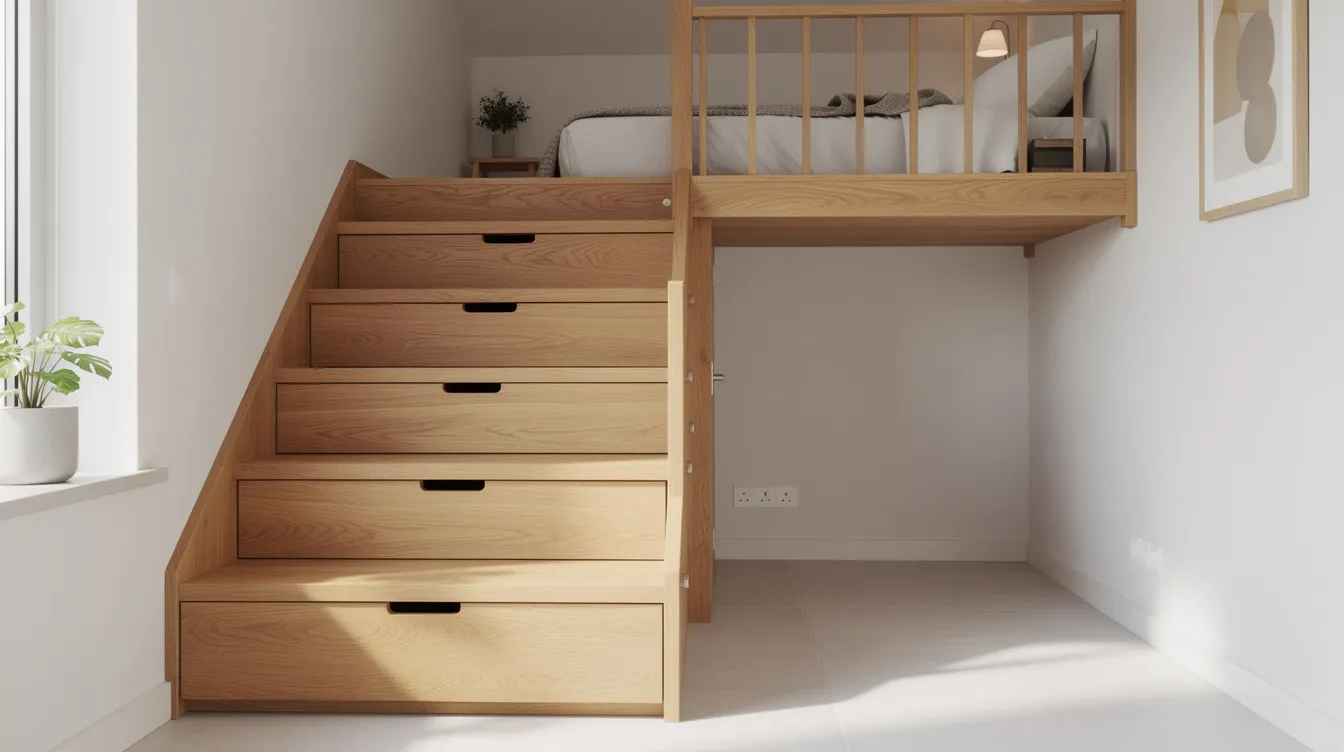
Tansu steps are a type of storage box stairs that can be used in tiny houses, providing both a means of access to lofts and additional storage space. Each step is essentially a cabinet carcass.
Using a series of boxes to create stairs allows for maximizing storage space, as it eliminates the stringers that block access to the area beneath traditional stairs. Each box typically measures 20”–24” wide, 7”–10” tall, and 9”–12” deep.
Storage staircases are built-in stairs with drawers, shelving, or cabinets incorporated into the risers. This approach makes it easy to add stair storage like drawers, cupboards, and a pull out pantry for the kitchen.
Using the stair structure for storage, such as under-stair drawers or a custom closet, optimizes space. A 10-step unit can provide 15–30 cubic feet of storage underneath.
Boxes can be screwed together and to wall studs. They’re even reconfigurable if your tiny house layout changes in the future.
Designing Stair Storage: Drawers, Cupboards & Pull Out Pantries
Stair storage in a tiny house can replace entire dressers or kitchen cabinets. Think creatively about what goes where.
Incorporating pull-out pantries and drawers into the design of stairs can significantly enhance storage solutions in tiny houses, making use of otherwise wasted space. Here are concrete storage ideas:
- 3–4 deep drawers at foot level for shoes and cleaning supplies
- A tall broom closet box for vacuum or mop
- A slim pull out pantry on full-extension rails for dry goods
- Upper cupboards for linens or seasonal items
Combined units can maximize utility by integrating a staircase with a clothes closet or kitchen cabinetry. Integrating a staircase into another part of your tiny house, such as the kitchen, can maximize space and create unique storage solutions, even if it results in oddly shaped cupboards, but remember that built-in storage also affects your overall tiny home budget and cost calculations.
Place heavy daily-use items (pots, dry food, shoes) in lower drawers. No awkward bending required.
Size a pull out pantry at 6”–8” wide, full stair depth, on 100 lb+ soft-close slides. Rail alignment is critical for smooth operation. Use ball bearing drawer slides and soft-close hinges to protect cabinetry.
Finish Work: Making Tiny House Stairs Look Built‑In
Once the box structure is solid, finish work transforms the stairway into a piece of furniture.
Drawer and door faces should be flush for a clean, modern tiny house look. This prevents catching clothes as people climb upstairs.
Materials for stairs can range from wood for a rustic look to metal for a modern design. Use durable finishes such as hardwax oil or polyurethane on stair treads. Consider contrasting paint or stain on faces.
Flush pulls or recessed handles are ideal in small spaces. Nothing should protrude into the walking path.
Time investment reality: a detailed stair with storage can realistically take 40–60 labor hours for two people. Budget accordingly for this project.
Compact Loft Stairs Ideas For Tiny Homes
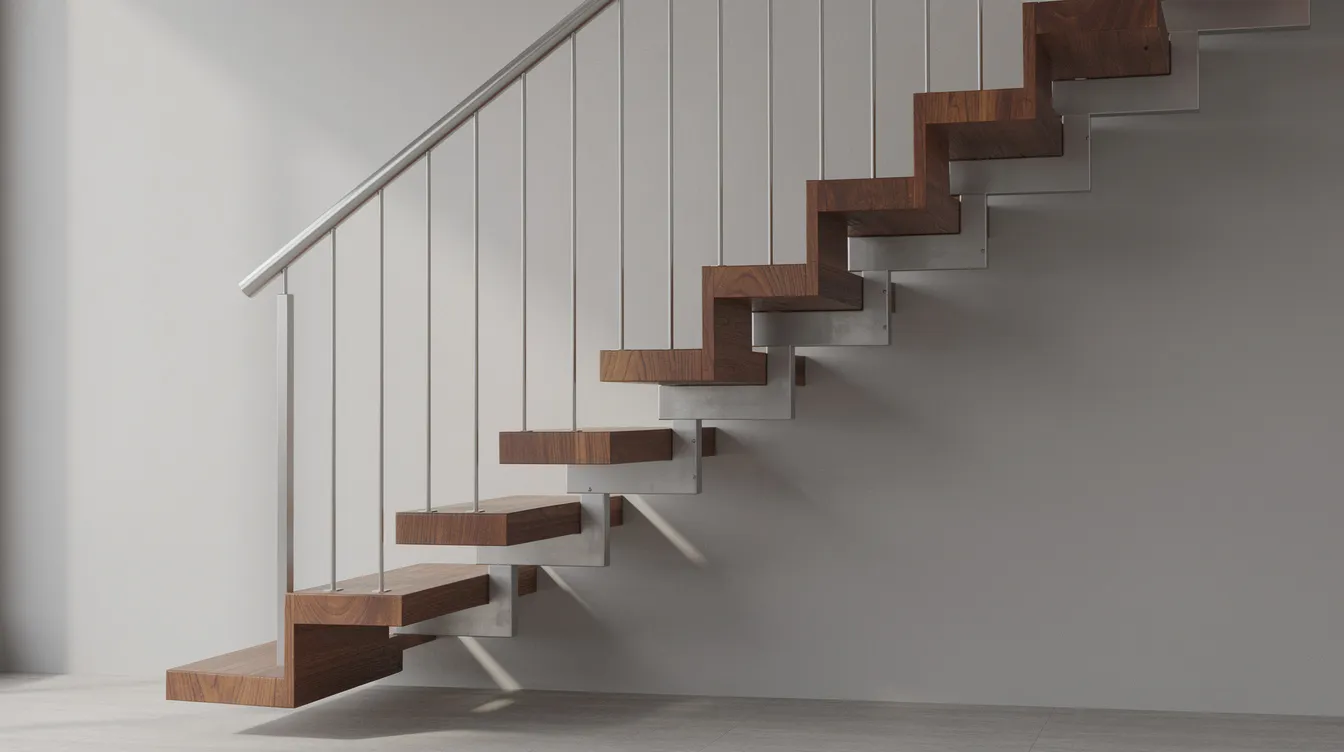
Beyond standard box stairs, several space-saving loft stairs concepts suit very small spaces. Floating or skinny stairs are minimalist, narrow staircases that provide access without blocking light or sightlines.
Each design choice trades some comfort for space efficiency. They suit specific users—typically adults without mobility issues or toddlers.
These options help most when the tiny house is under 24 ft or the great room is narrow. Let’s examine each idea.
Tiny Spiral Staircase For Vertical Tiny Houses
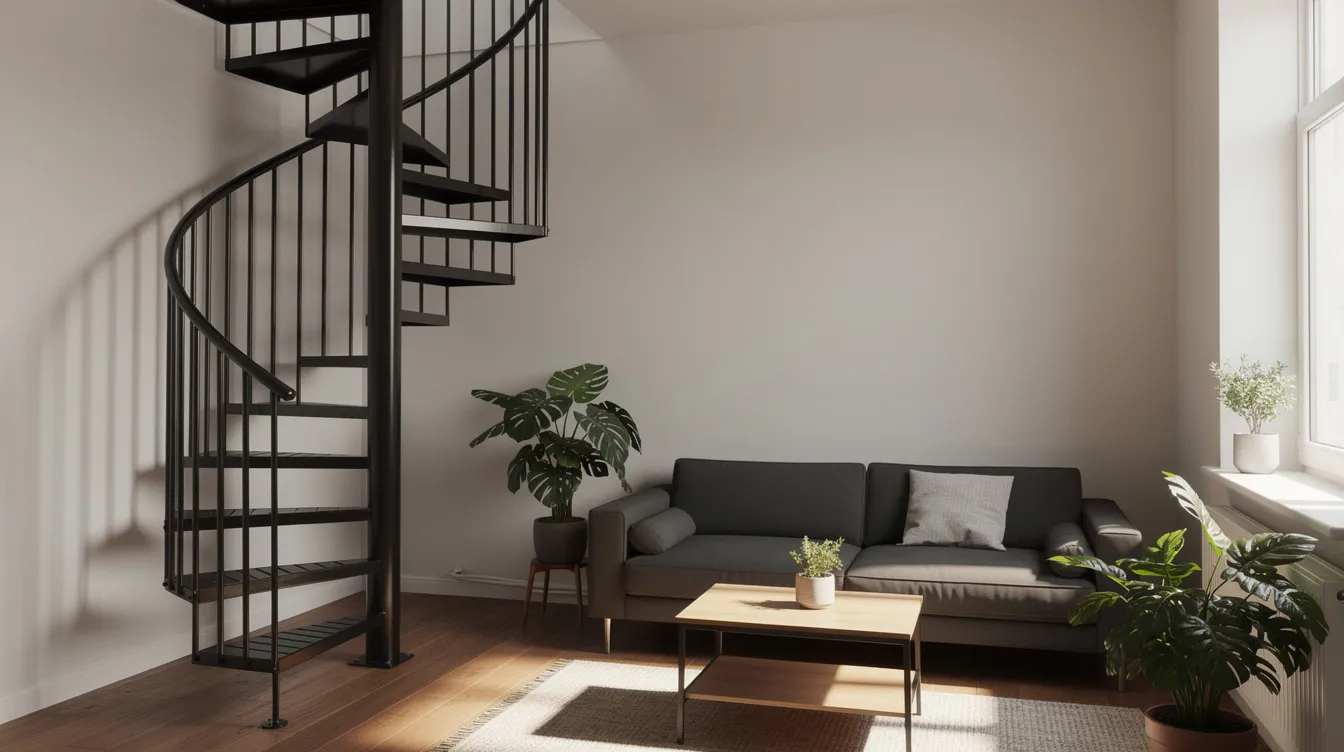
Spiral staircases rise around a central pole, taking up a minimal footprint of 3’6” in diameter. Compare that to 5-foot residential spirals.
A tiny spiral staircase works tucked in a corner of the great room or next to a bathroom wall. This keeps floor area open for living. A winding staircase can be a visually appealing option that takes up minimal space, resembling a sculpture while providing access to loft areas.
Metal spiral kits ship flat and adjust for specific loft heights. They’re best for agile adults without large pets or mobility issues. Open risers can be tricky for dogs.
Imagine the spiral arriving at a small platform landing. It creates an elegant bedroom entrance above while freeing room below for a desk or reading nook.
Alternating Tread Stairs: Super Compact Steps
Alternating tread stairs allow for a steeper climb with deeper treads for foot comfort in tight spaces. The left and right treads overlap, cutting run length by roughly 30–40%.
Alternating tread staircases save space and can be a practical solution for tiny homes, allowing for easier access to lofts while taking up less room than traditional stairs.
Example dimensions: 7”–9” risers, 8”–9” deep alternating treads, about 18”–22” overall width. These super compact steps work best when always used the same way.
Designate an “up” side and “down” side so muscle memory develops. Pros include minimal footprint and more comfort than a vertical ladder. Cons include a learning curve and challenges for children.
Add sturdy handrails and good lighting. Rope railings offer a rustic, lightweight option for safety.
Folding, Sliding & Disappearing Loft Stairs
Folding staircase concepts hinge up against a wall or slide into the loft to free floor space during the day. Steps on wheels provide flexibility to move the staircase completely out of the way.
Retractable or sliding ladders can be stored vertically or slid along a track against the wall when not in use. A sliding loft stair on wall-mounted tracks moves sideways to clear the kitchen or hallway.
Pulley system ladders are fixed-position ladders that can be hoisted to the ceiling to open up the floor below. These work well for storage lofts accessed occasionally.
Disappearing staircase concepts must still meet basic safety: non-slip treads, consistent risers, secure locking mechanisms. Recommend these primarily for occasional-use lofts like guest beds or storage areas.
Repurposed & DIY Creative Loft Stairs
Repurposed elements—old bunkbed steps, industrial ladders, boat stairs, or modular storage cubes—can be adapted for a tiny house staircase, especially if you’re already exploring the broader world of tiny house living and inspiration.
IKEA-style storage units work as step bases. Add thicker treads and internal reinforcement for safety. Modular options for stairs can be adjusted or disassembled as needed.
Check salvage yards or online marketplaces for narrow spiral kits or compact stair modules. Stand firm on checking structural integrity.
Any repurposed solution must be securely fastened to tiny home framing. Combining repurposed stairs with fresh stair storage fronts creates a custom look on a small budget.
Double Staircase & Multi‑Loft Layouts
Some tiny homes have two lofts—sleeping plus storage or office. This can justify a double staircase or mixed stairs/ladder approach, and should be considered early when choosing tiny house floor plans that fit your lifestyle.
A common layout: full tiny house stairs serve the main sleeping loft while a slim loft ladder or alternating tread climbs to a secondary loft. Two staircases in one house sounds excessive, but it works in larger builds.
A staircase with bookshelves, like the one in the mcg loft design, can serve dual purposes by providing both access to the loft and additional storage for books. The second stair integrates with storage rather than standing alone.
True double staircase pros: easy access for two people on different schedules, zoned spaces, more permanent feel. Cons: consumes floor area. This works best in 28–34 ft tiny homes or gooseneck trailers with two lofts, and needs to be factored into overall tiny house plans that fit your life.
Integrate the second stair with bookcases, a desk nook, or a wardrobe. Never waste volume in a compact tiny house. Consider how a water tank or mechanical space might tuck beneath.
Using Stairs To Define Zones In A Tiny House
Placing stairs along one side visually separates the kitchen from the living room without adding walls. The staircase becomes a design choice that shapes your layout.
Example: stairs start near the front door, turn once, then arrive at a loft above the bathroom. This creates a cozy reading corner below the staircase platform, assuming your tiny house foundation choice and structure can support the concentrated load.
Under-stair storage becomes a coat closet, pull out pantry, or media cabinet. Each tiny house zone stays organized with storage needs addressed.
A simple floor plan photo or sketch helps visualize how a double staircase or side stair shapes the interior. The first step is imagining the possibilities.
How To Build Tiny House Stairs Step‑By‑Step (Overview)
This is a high-level build roadmap, not a full woodworking manual. DIY-oriented readers can create beautiful stairs with proper planning, and may want a separate guide on how to build a tiny house from the ground up.
The process breaks into clear stages: measuring, sketching, building boxes or stringers, assembling, then finishing. Use one consistent example (90” rise, 84” run, 22” wide stairs).
Mock up your loft stairs in cardboard or cheap lumber first. Test comfort in small spaces before cutting expensive wood. If unsure about structural details, hire a carpenter for consultation.
From Sketch To Cardboard Mockup
Draw side-view and top-view sketches showing each stair tread, riser, and storage box. Plan window and door clearances.
Cut cardboard or OSB templates of treads. Tape them in place and simulate climbing to the loft. This low-cost trial saves days of rework.
Builders often shift the stair away from windows or doors after testing. Adjust tread depth and riser height at this stage. Create variations before committing to permanent materials.
Building Boxes Or Stringers For Your Tiny House Staircase
Two main approaches exist: stacked boxes (cabinet-style) vs. traditional stringers with framed storage underneath.
For boxes, use 1/2”–3/4” plywood sides with glued and screwed butt joints. Add backs for racking resistance. Label each box with position (bottom, middle, top).
For stringers, cut notches for treads, then enclose sides with vertical panels to create stair storage cavities. Pre-drill screw holes into wall studs.
Secure boxes to each other and to the tiny house frame. They must behave as a single unit during travel.
Finishing Touches: Safety, Comfort & Style
Add non-slip surfaces—grooves, rubber strips, or textured finish—on treads for safety. This matters in any room with regular foot traffic.
Gentle rounded edges on tread fronts avoid bruised shins. Especially important in narrow tiny house stairs where missteps happen.
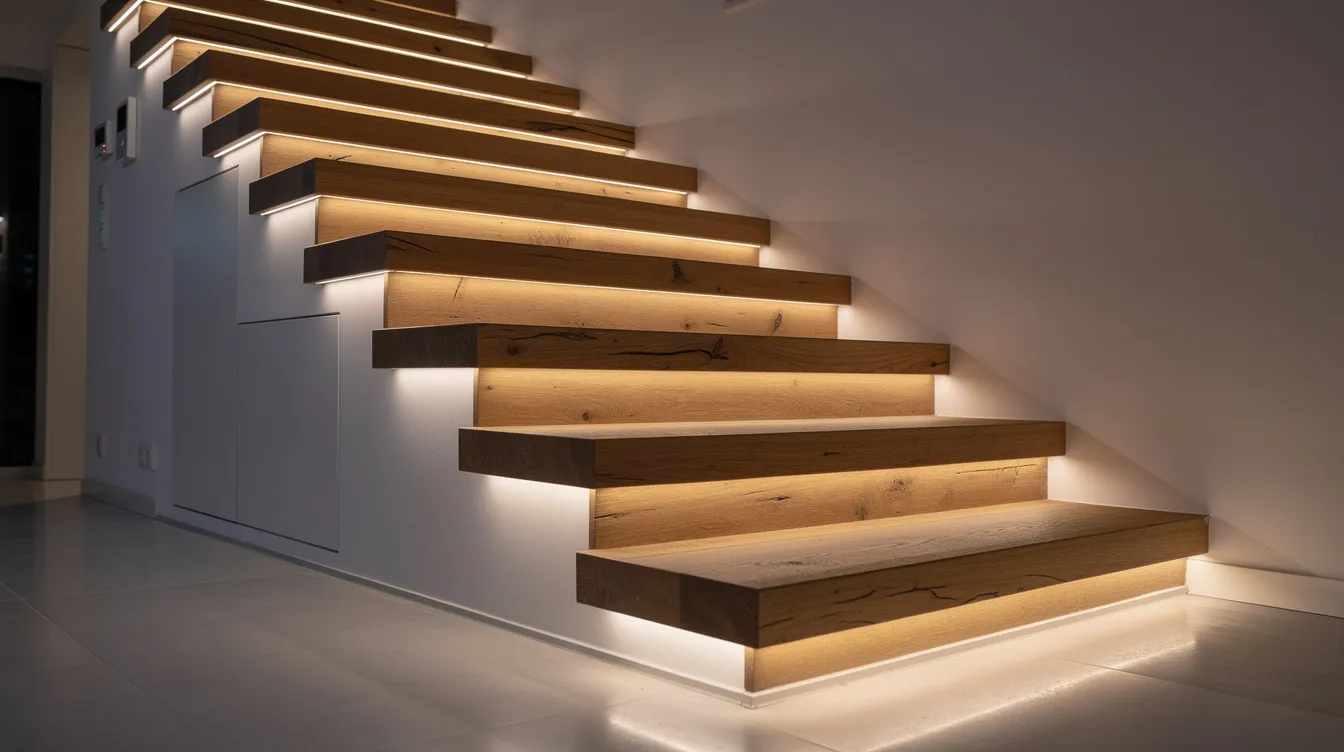
Warm lighting along the stair path enhances safety. LED strip lights under treads work beautifully. Control them with a 3-way switch from bed and main floor.
Consider carpeting or runner rugs for comfort and noise reduction. Secure firmly so nothing slips. Coordinate stair finishes with loft railing and flooring so the tiny home feels cohesive. This growing trend in tiny house design creates a polished, intentional look.
FAQ: Tiny House Loft Stairs Questions Answered
This FAQ addresses common concerns not fully covered above, especially around regulations and daily use. Answers are practical, based on typical 2024–2026 tiny home builds. Always verify local rules.
Do tiny house loft stairs need to follow standard building codes?
Many mobile tiny homes on trailers are not always held to full residential codes. However, following code-like dimensions (tread depth, riser height, headroom) is wise for safety.
For tiny houses on foundations, local building officials usually expect compliance with standard stair rules. Small variances may be discussed case-by-case. Check with your municipality or certifying body before committing to an unusual loft staircase design.
Do I need planning permission just to add or change loft stairs?
Interior changes like swapping a loft ladder for tiny house stairs usually don’t trigger full planning permission in most jurisdictions.
Permits are more likely needed if structural walls, rooflines, or exterior openings are modified to accommodate the staircase. Contact your local building department for written guidance. This protects you when selling or insuring the tiny house.
Are spiral or alternating tread stairs safe for kids and pets?
Very compact designs like tiny spiral staircases and alternating tread stairs are generally best for adults with good balance.
Open risers, narrow treads, and steep angles challenge toddlers, older adults, and large dogs. Use full-depth box stairs with solid risers and handrails for family-oriented tiny homes. Reserve compact options for guest attic or storage lofts.
How much does it cost to build tiny house stairs with storage?
Basic DIY box stairs in plywood cost a few hundred dollars in materials. Custom hardwood staircases with drawers, cupboard doors, and a pull out pantry can exceed $1,000–$2,000.
Hardware (soft-close slides, hinges, heavy-duty brackets) adds significantly to the budget but improves durability. Prioritize structural strength and safe proportions over luxury finishes if working with tight funds.
Can I retrofit proper stairs into an existing tiny house with a ladder?
Many owners successfully replace loft ladders with compact tiny house stairs after living in their homes for a year or two.
Retrofits usually require sacrificing or rearranging some furniture, built-ins, or a portion of the kitchen. Start with a cardboard mockup and consult a builder. Ensure new stairs don’t overload the trailer or compromise structural framing.