

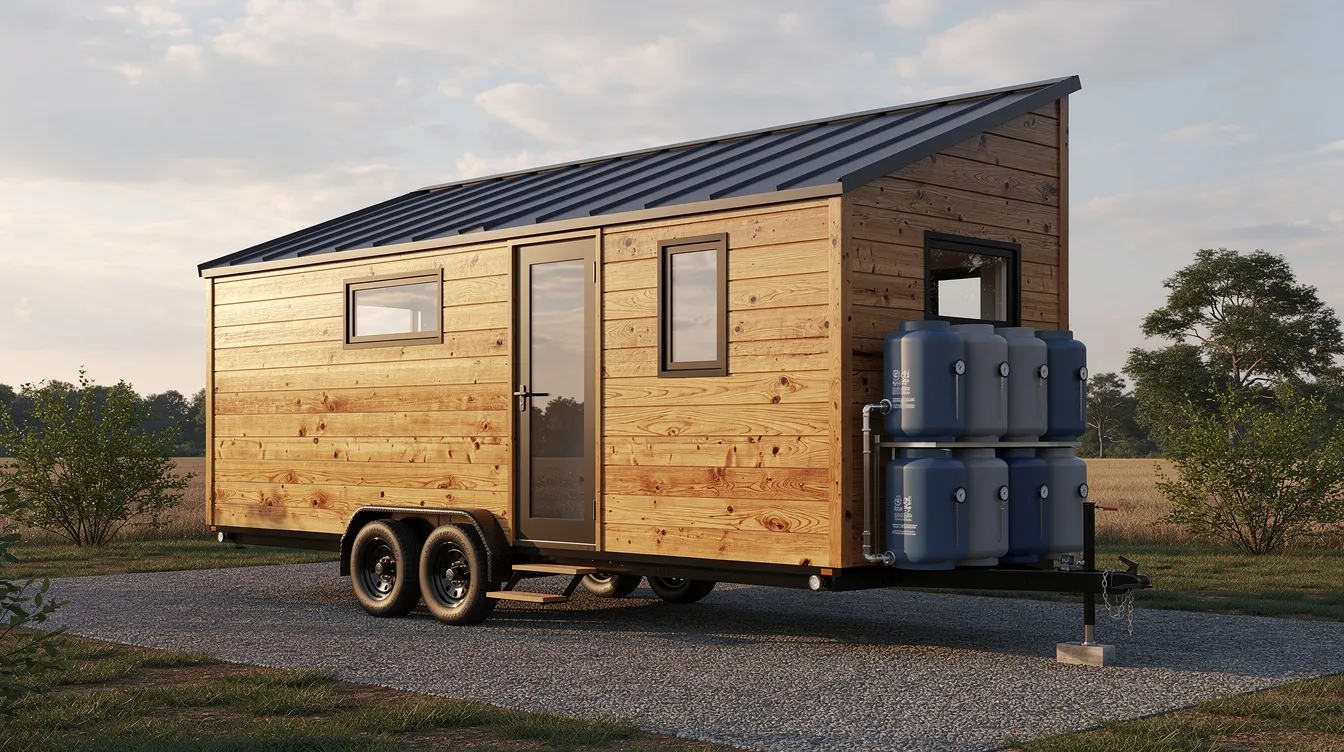
A tiny house rainwater collection system captures precipitation from your roof, filters it, stores it, and delivers it through your plumbing as running water. This setup can fully replace a municipal water hookup for tiny homes, giving you complete water independence. A well-designed rainwater harvesting system can provide year-round running water for a tiny house, even in areas with around 20-25 inches of annual rainfall.
Rainwater harvesting makes sense for tiny houses. Limited space rules out bulky infrastructure. Off-grid locations make utility connections expensive or impossible. Well drilling averages $15,000-$30,000. Your roof is already there, ready to collect water every time rain falls.
This guide covers the full system: catchment roof, gutters, pre filtration, first flush, storage tanks, pump system, pressure tank, and final filtration. Whether you’re building a full-time off-grid tiny house, a backyard ADU, a weekend cabin, or a traveling tiny home that parks seasonally, these principles apply and pair well with a step-by-step guide on how to build a tiny house.
- Planning Your Tiny House Rainwater Harvesting System
- Catchment Roof, Gutters, and Pre Filtration
- First Flush Diverters for Tiny House Rainwater
- Storage Tanks and Cistern Options for Tiny Houses
- Pump System, Pressure Tank, and Providing Running Water
- Filtration and Treatment for Potable Tiny House Rainwater
- Seasonal Operation, Maintenance, and Long-Term Care
- Example Tiny House Rainwater System Layouts
Planning Your Tiny House Rainwater Harvesting System
Correct sizing is the most important step. Get it wrong, and you’ll either run dry during summer or waste money on oversized tanks. Plan before you buy anything.
A well-designed rainwater harvesting system can maximize the amount and quality of water collected by calculating the volume of water flowing off your roof based on its area and average annual rainfall, using the formula: Gallons = Rainfall (inches) × Roof Area (sq ft) × 0.623.
Here’s a concrete example:
- A 24 ft × 8.5 ft tiny house roof = 204 square foot roof area
- Portland, OR receives about 37 inches of annual rainfall
- 37 × 204 × 0.623 = approximately 4,500 gallons per year
- That’s about 12 gallons daily averaged
How much water does one person need? Here’s a breakdown:
Use | Daily Gallons |
|---|---|
Drinking and cooking | 1-2 |
Shower (low-flow head) | 2-5 |
Toilet (composting paired) | 0.5-1.5 |
Laundry (weekly average) | 0.5-1 |
Total | 10-15 |
Climate and seasonality matter more for tiny homes than regular houses. Your small roof area means every dry spell hits harder. |
- Southwest U.S. (Tucson, 12 inches/year): Plan for 1,000-2,000 gallons storage to cover 4-6 month droughts
- Pacific Northwest (Seattle, 38 inches/year): 400-800 gallons often suffice with frequent refills
Key site constraints to consider:
- Space for tanks beside or under your tiny house
- Freeze depth in cold climates (bury tanks 24-48 inches below frost line)
- Truck access if water ever needs delivery as backup
Mobile homes require smaller, modular tanks you can transport. Permanent setups can use larger tanks or buried cisterns, especially in self-contained tiny homes for modern off-grid living. Choose based on how often you move.
Catchment Roof, Gutters, and Pre Filtration
The roof and gutters form your catchment stage. Everything starts here. To install a rainwater harvesting system, first evaluate your roof to ensure it is clean and free of debris, as this affects water quality.
Best roofing materials for potable use:
- Metal roof (standing seam or corrugated painted steel)
- Smooth, non-porous surfaces that minimize bacterial growth
Materials to avoid:
- Asphalt shingles (leach hydrocarbons)
- Wood shakes (foster mold)
The ideal tiny house roof design for house rainwater collection is simple. A single-slope or gable roof with minimal valleys works best and should coordinate with tiny house floor plans that work for you. Position 1-2 downspouts on the tank side. Overhangs of 12-24 inches help shed debris and allow clean gutter runs.
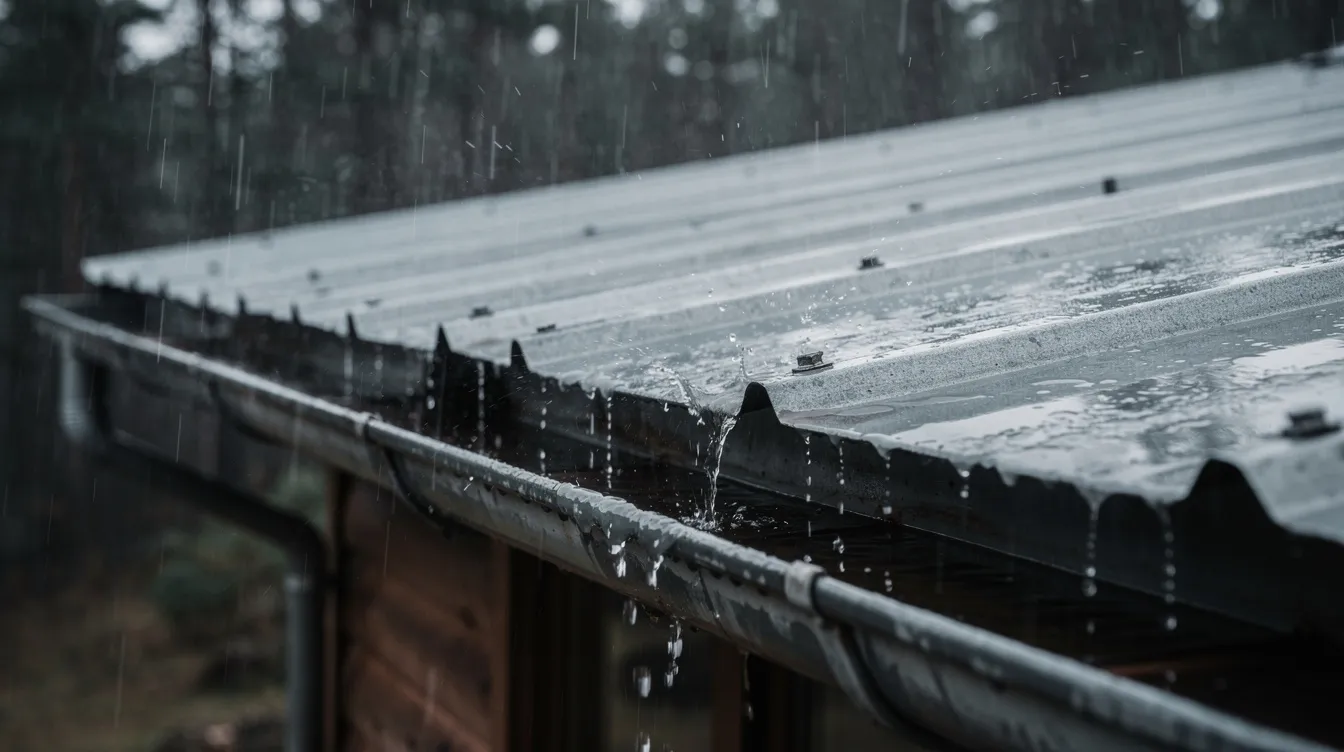
Gutter choices for tiny houses:
- 5-inch K-style aluminum ($1.50-$3/ft, lightweight for travel)
- Half-round stainless steel ($4-$6/ft, more durable)
- Fasten with hangers spaced every 16 inches, rated for 50 lbs to handle highway towing vibrations
Pre filtration devices go in before water enters storage:
- Gutter guards (micromesh screens, 1,000 micron)
- Leaf screens at downspout entries
- Rain heads (like WISY filters) capturing particles over 440 microns
The installation of conveyance piping, which connects the components of the rainwater harvesting system, is typically done using 3- or 4-inch diameter PVC piping, which is cost-effective and readily available. Standard downspout sizes work fine for most tiny roofs: 2×3 inches for roofs under 800 square foot, 3×4 inches for larger surfaces. Use Schedule 40 PVC or flexible hose to connect gutters to your first flush and tanks.
Maintenance schedule:
- Inspect after every big storm
- Check every 2-3 months in leafy areas
- Clear 1-2 inches of debris from gutters regularly
First Flush Diverters for Tiny House Rainwater
The first flush diverter is an essential component of a rainwater collection system, routing the initial flow of dirty runoff water away from the storage tank to ensure cleaner water is collected. This matters even more on small roofs, where dust, pollen, and bird droppings concentrate in limited runoff.
A first flush diverter is an essential component that routes the initial flow of dirty runoff water away from the storage tank, helping to maintain water quality. Studies show the first 0.1-0.2 inches of rainfall can carry 90% of roof contaminants.
Compact first flush design for tiny houses:
A vertical 3-4 inch PVC standpipe mounted against your exterior wall works well. It takes minimal space and integrates directly into your downspout line.
Sizing rule:
Capture 1-2 gallons per 100 square foot of roof area.
- 200 sq ft roof = 2-4 gallons diverted
- 250 sq ft roof = 2.5-5 gallons diverted
Typical components:
- Inlet tee connecting to downspout
- Standpipe (2-4 ft tall)
- Small drain valve or orifice at bottom
- Ball or flap mechanism that seals after diversion
Where should the first flush discharge go? A rain garden is a great idea. Route it to a mulch basin, planted area, or anywhere away from your trailer foundation. This water can do double duty irrigating fruit trees or landscape plants on the south side of your property.
- A first flush diverter should be emptied and cleaned out after each rainfall event to prevent dirty runoff from entering the storage tank
- Check for blockages monthly
- Replace O-rings or seals annually
DIY first flush systems cost under $50 using PVC parts. Commercial units run around $200.
Storage Tanks and Cistern Options for Tiny Houses
Storage tanks are often the largest and most visible part of a tiny house rainwater system. Choose wisely.
Cisterns, which can be made from various materials like plastic, fiberglass, or concrete, are used to store filtered rainwater and should ideally be opaque to prevent algae growth, especially when integrated into affordable tiny house buildings and designs.
Common tiny house storage options:
Type | Capacity | Cost | Best For |
|---|---|---|---|
Slimline vertical | 300-550 gal | $800-1,500 | Sidewall mounting |
Low horizontal | 500-1,000 gal | $1,000-2,000 | Under-deck placement |
IBC totes (caged) | 275 gal each | $200-400 | Modular, portable setups |
A big tank isn’t always better. Larger tanks mean more weight and space consumption. For mobile setups, consider grouping IBC totes (4 totes = 1,100 gallons at around $1,000 total). |
Cisterns, which store filtered rainwater, can be made from various materials including plastic, fiberglass, and concrete, and should ideally be opaque to prevent algae growth. Clear or translucent tanks allow light in, which can double bacteria counts within two weeks.
Volume guidance:
- Weekend cabin in wet climate: 300-500 gallons
- Full-time off-grid in moderate rainfall: 800-1,500 gallons
- This provides a good amount of buffer for dry spells
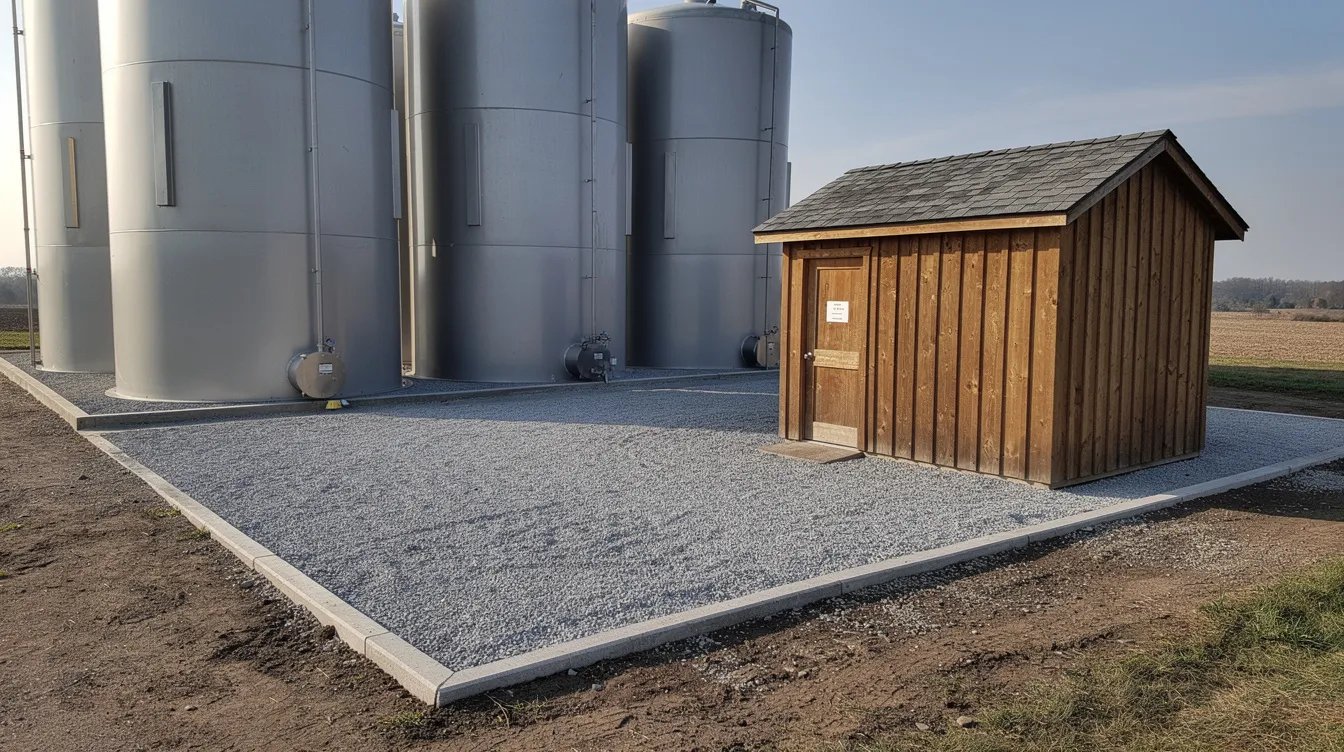
Placement strategies:
- Mobile tiny homes: Strap tanks to a separate skid (watch 1,000 lb axle limits)
- Stationary houses: Partially bury for stability and insulation, or mount on a concrete pad
When installing storage tanks for rainwater, they should be placed at least 24 inches away from any structure and on a level surface to ensure stability and proper function. Use compacted gravel (4-inch depth) as a stable base.
Other requirements:
- Screened vents (24-mesh) to allow air flow without insects
- Overflow pipe curled downward to prevent mosquito breeding
- Some states mandate specific setbacks or overflow provisions
Pump System, Pressure Tank, and Providing Running Water
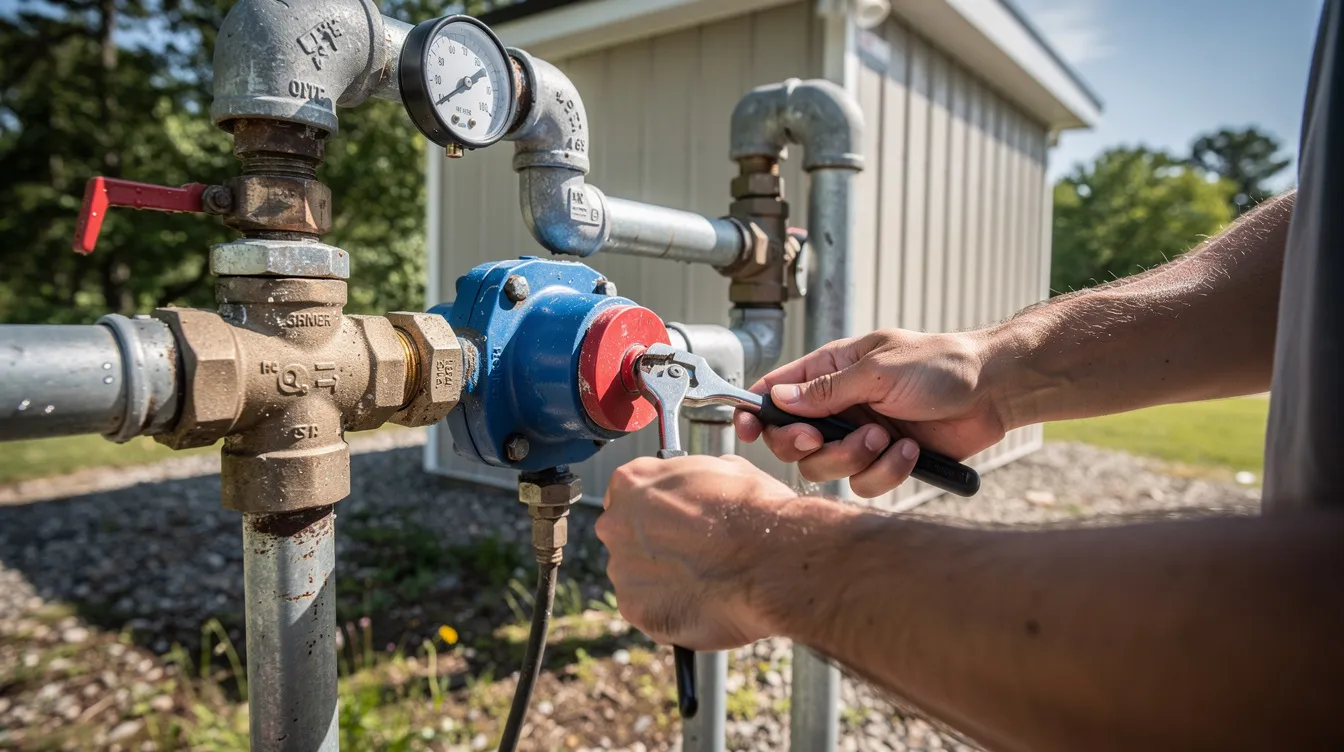
Tiny houses need a pump system to provide household-type running water pressure. Without it, you’d rely on gravity flow alone, which limits fixture options and water pressure at your kitchen sink, bathroom sink, and shower.
Basic plumbing layout:
Tank outlet → Sediment prefilter → Pump → Pressure tank → House plumbing manifold
This connected system delivers water to your kitchen, shower, and toilet on demand. The supply stays pressurized so fixtures work normally.
The pressure tank role:
A pressure tank stabilizes water pressure and reduces pump cycling. Without one, your pump kicks on every time you turn a tap. This causes wear and annoying noise.
- Very small systems: 2-5 gallon tank
- Full-time living: 10-20 gallon tank
- A 4.5-gallon RV accumulator ($100) cuts pump cycles by 70%
Pump types for tiny homes:
Type | Power | Flow | PSI | Cost | Best For |
|---|---|---|---|---|---|
12V DC RV pump | Solar compatible | 3.0 gpm | 45 | $200 | Off-grid, mobile |
120V AC jet pump | Grid power | 10 gpm | 50+ | $400 | Stationary, full-time |
Power considerations: |
- 12V pumps draw about 4 amps (50-200W hourly)
- For solar setups, this is manageable with a 100W panel
- Pumps cycle 5-10 minutes daily for 15 gallons of use
Practical tips:
- Mount pumps on rubber vibration-damping pads (reduces noise 10-15 dB)
- In cold climates, use heat tape (50W/ft) to prevent pipes from freezing
- Install in an insulated utility box under the tiny house
A tankless water heater works well with rainwater systems for hot water supply, keeping your system compact, and should be planned alongside tiny house septic options for sustainable living solutions.
Filtration and Treatment for Potable Tiny House Rainwater
Most tiny house residents want drinking and cooking water that’s safe and tastes good. This requires proper filtration beyond the pre filtration and first flush stages.
Non-potable vs. potable:
- Non-potable: fine for washing, irrigation, toilet flushing
- Potable: safe for drinking, cooking, requires full treatment
Typical filtration train for potable house rainwater:
- Sediment filter (5-20 micron): Removes particles and sediment
- Carbon filter (GAC): Removes odors, VOCs, improves taste
- UV sterilizer (40 mJ/cm²): Kills 99.99% of bacteria and pathogens
A compact, wall-mounted setup fits most tiny house layouts. Install near your pump and pressure tank for a simple approach that keeps plumbing runs short.
Key requirements:
- Use NSF-rated components
- Food-grade hose for all potable water lines
- This ensures water quality meets safety standards
Maintenance intervals:
- Best practice is to check and clean any screen filters every 2 to 3 months to ensure optimal performance of the rainwater harvesting system
- Replace cartridge filters every 3-6 months (depends on turbidity)
- UV lamp replacement annually
- Visual inspection for leaks or discoloration monthly
If you’re in a dusty or urban area, consider occasional water testing. A $50 test kit can check for coliform bacteria and heavy metals. This is especially important when relying solely on tiny house rainwater for all domestic use, including drinking water.
Seasonal Operation, Maintenance, and Long-Term Care
Tiny house rainwater systems are mechanical. They need regular attention to remain reliable, especially in off-grid situations where backup options are limited.
Routine checks:
- Inspect gutters and pre filtration screens after major storms
- Confirm tank levels (ultrasonic sensors with app tracking work well)
- Monitor pump performance and noise (cycles over 20/day may signal leaks)
Seasonal tasks:
Spring/Summer:
- Maximize capture by ensuring all filters are clean
- Check that overflow drains water properly to prevent flood damage
Fall/Winter:
- Every 6 months, it is recommended to clean gutters, downspouts, rain heads, and first flush diverters to maintain the efficiency of the system
- In freezing climates, drain exposed lines
- Add insulation and heat tape where needed
- Slope pipes to pump for complete drainage
Storage tank care:
- Inspect interior every 1-2 years
- Gently flush settled sediment from the bottom
- Avoid harsh chemicals (chlorine over 50 ppm harms beneficial microbes)
- Keep tanks opaque and vents screened to prevent algae growth
Tracking usage:
Install a 0.1 gpm flow meter to understand your consumption. This data helps you:
- Fine-tune rainwater harvesting capacity
- Adjust habits (shorter showers, low-flow fixtures)
- Identify leaks before they waste your supply
Low-flow fixtures can cut demand 30-50%. Every gallon saved extends your independence between wet weather.
Once properly set up, a tiny house rainwater harvesting system typically needs only a few hours of maintenance per season. The effort pays off in dependable fresh water and genuine water independence.
Example Tiny House Rainwater System Layouts
Here are three configurations showing how all components fit together. Adapt these templates to your climate, space, and lifestyle, just as you would when choosing tiny house plans that fit your life.
Minimalist Weekend Cabin
- Storage: Single slimline tank (300-400 gallons), paired with one of the best tiny house designs for modern living
- Pre filtration: Basic gutter screens
- First flush: Simple PVC standpipe (2 gallons)
- Pump: Basic 12V pump, no pressure tank
- Filtration: Sediment only (non-potable)
Pros: Low cost (~$1,500), minimal maintenance Cons: Limited to hand pump or gravity in power outages, not potable Best for: Wet climates, occasional use
Full-Time Off-Grid Tiny Home
- Storage: 800-1,500 gallons across 2-3 tanks, a range that works well for many small homes in Washington State
- Pre filtration: WISY rain heads, quality gutter guards
- First flush: Standpipe diverting 5 gallons
- Pump: 120V multistage with 14-gallon pressure tank
- Filtration: Full multi-stage plus UV for potable water
Pros: High reliability, supports full-time living Cons: Higher cost ($4,000-6,000), more complex maintenance Best for: Moderate rainfall areas, permanent placement
Mobile Tiny House
- Storage: 2 IBC totes on separate skid (550 gallons), which can also complement tiny barn ideas for cozy living
- Pre filtration: Quick-disconnect downspout connections
- First flush: Compact inline diverter
- Pump: Stowable 12V package that drains for travel
- Filtration: Modular cartridge system
Pros: Portable, can be topped off at various locations Cons: Smaller supply, may need refills in dry areas Best for: Those who move 2-3 times per year
Each system represents a great example of matching complexity to actual needs. A weekend cabin doesn’t need industrial-grade filtration. A full-time home shouldn’t rely on hand pump backup alone.
The trees around your parking spot, your roof area, local rainfall patterns, and daily demand all influence the right choice. I hope this guide gives you the foundation to design a resilient system that delivers running water wherever your tiny house takes you.
Start by calculating your collection potential with the formula. Sketch your layout. Then build component by component. The freedom of managing your own water supply is worth the planning.