

Wiring a tiny house isn’t rocket science.
It’s actually a scaled-down version of regular home electrical work. Smaller space. Fewer circuits. Lower loads. But the same safety rules apply.
This guide walks you through tiny house electrical wiring basics from start to finish. You’ll learn how to calculate your power needs, choose the right service size, wire circuits safely, and prepare for inspection as part of the broader process of learning how to build a tiny house from planning to finishing.
Key Takeaways
- A tiny house electrical system works like a miniature version of a standard home setup, with a main service entrance, breaker box, and individual circuits running to outlets and light fixtures.
- The two common service sizes for tiny houses are 30 amp and 50 amp, which determine how much power the house can use at one time. A 30 amp service is typically suitable for smaller builds without heavy appliances, while a 50 amp service is necessary for air conditioning and electric cooking.
- Safe electrical wiring requires correct wire sizes, properly installed circuit breakers, proper grounding, and GFCI protection near water sources.
- The National Electrical Code (NEC) serves as the main reference for wiring standards and safety regulations in tiny house electrical systems. Every DIY plan should be verified against the 2023 NEC and inspected by a licensed electrician.
- Planning outlet locations, future solar or off grid options, and scheduling an electrical inspection early will prevent expensive changes later.
- Introduction: How Tiny House Electrical Systems Work
- Step 1: Calculate Your Tiny House Electrical Needs
- Step 2: Choosing Your Service Size and Power Source
- Step 3: Understanding the Breaker Box and Circuits
- Step 4: Tiny House Electrical Wiring Basics (Wire Sizes and Layout)
- Step 5: Planning Outlets, Switches, and Light Fixtures
- Step 6: Safety Devices—GFCI, AFCI, and Grounding
- Step 7: Temporary Power, Extension Cords, and Shore Power Hookups
- Step 8: Off Grid Options and Future-Proofing Your Electrical System
- Step 9: Working With Electricians and Passing Electrical Inspection
- FAQ: Tiny House Electrical Wiring Basics
Introduction: How Tiny House Electrical Systems Work
Think of your tiny home’s electrical setup as a smaller sibling to a regular house electrical system. Power enters through a service entrance, flows to a breaker box, and branches out to individual circuits feeding your outlets, switches, and light fixtures.
How does power enter? Three common methods:
- Shore power inlet (like an RV hookup)
- Direct grid power from a utility connection
- Off grid systems with solar panels, batteries, and inverters
The core components stay the same regardless of power source:
Component | Function |
|---|---|
Service entrance | Where power enters the tiny house |
Breaker box / electrical panel | Distributes power and provides overcurrent protection |
Branch circuits | Individual wires running to different areas |
Outlets and switches | Where you plug in and control multiple devices |
Light fixtures | Provide illumination throughout |
Important safety note: Working on electrical systems involves shock and fire risks. Always follow code and schedule an electrical inspection before closing walls. |
This guide focuses on North American 120/240V systems using the National Electrical Code (NEC) as of 2023-2026.
Step 1: Calculate Your Tiny House Electrical Needs
Before buying a single wire, figure out how much electricity your tiny house will actually use, just as you would when reviewing tiny house plans that fit your lifestyle and budget.
You need two numbers:
- Total daily energy (kWh per day)
- Peak load (amps running simultaneously)
List Your Electrical Items
Start by writing down every appliance with its wattage:
Appliance | Watts | Daily Hours | Daily Wh |
|---|---|---|---|
LED lighting (10 fixtures) | 100 | 5 | 500 |
Small fridge | 150 | 24 (cycling) | 1,200 |
Laptop | 65 | 4 | 260 |
Microwave | 1,000 | 0.25 | 250 |
Toaster | 1,500 | 0.1 | 150 |
Hair dryers | 1,500 | 0.1 | 150 |
Convert Watts to Amps
Calculating the electrical needs of a tiny house involves listing all electrical items and their wattage, then using the formula watts/volts=amps to determine the required amperage.
Example: A 1,500W toaster at 120V:
- 1,500 ÷ 120 = 12.5 amps
For 240V appliances (like some air conditioning units or electric water heater options):
- 4,800W dryer ÷ 240V = 20 amps
Why Both Numbers Matter
Daily energy tells you how large your battery bank needs to be for off grid living. Peak load determines your service size and breaker box capacity.
When wiring a tiny house, it’s important to size the circuits for their expected load plus 25%, as stipulated by electrical codes.
Realistic Ranges
The typical electrical requirements for a tiny house can range from 0 to 30 amps, depending on the appliances used and whether energy-intensive devices like electric stoves or refrigerators are included.
- Minimalist builds: 3-5 kWh/day, 20-30 amp peak
- All-electric with AC: 10-15 kWh/day, 40-50 amp peak
A typical tiny house using propane for heating water and cooking stays comfortably in the lower range, especially when paired with self-contained tiny home features for off-grid capability or modern tiny house designs optimized for efficient living.
Step 2: Choosing Your Service Size and Power Source
Your service size (measured in amps) controls how many devices can run at once.
Common Options
Service | Total Watts | Best For |
|---|---|---|
20 amp | 2,400W | Emergency/minimal use |
30 amp | 3,600W | Small builds, propane heat/cooking |
50 amp | 12,000W (split-phase) | All-electric, air conditioning |
For tiny houses, 30 amp service is generally sufficient for small builds without heavy appliances, while 50 amp service is recommended for those using air conditioning and electric cooking. |
Many tiny house owners opt for dual service options, installing both 30 and 50 amp inlets to allow flexibility in plugging into different power sources. This lets you plug into any RV park or campground and can be planned early if you’re considering Home Depot tiny house kits as a starting shell for your build.
How Many Amps Do You Need?
If you use natural gas or propane for:
- Cooking
- Hot water
- Heating
Then 30 amps usually covers your electrical needs. The electrical requirements of a tiny house can range from 0-30 amps, depending on the types of appliances used and their energy consumption.
If you’re going all-electric with a mini-split, induction cooktop, and electric water heater, plan for 50 amps.
Power Sources
Shore power: Connect to an RV park or campground pedestal. The most common method for tiny houses on wheels.
Grid power: Permanent underground connection from the utility. Requires permits and inspection.
Off grid: A solar system with solar panels, charge controller, battery bank, and inverter provides independence from grid power.
Size your service with a 20-25% margin for future additions. If you calculate 35 amps, go with 50 amp service.
Step 3: Understanding the Breaker Box and Circuits
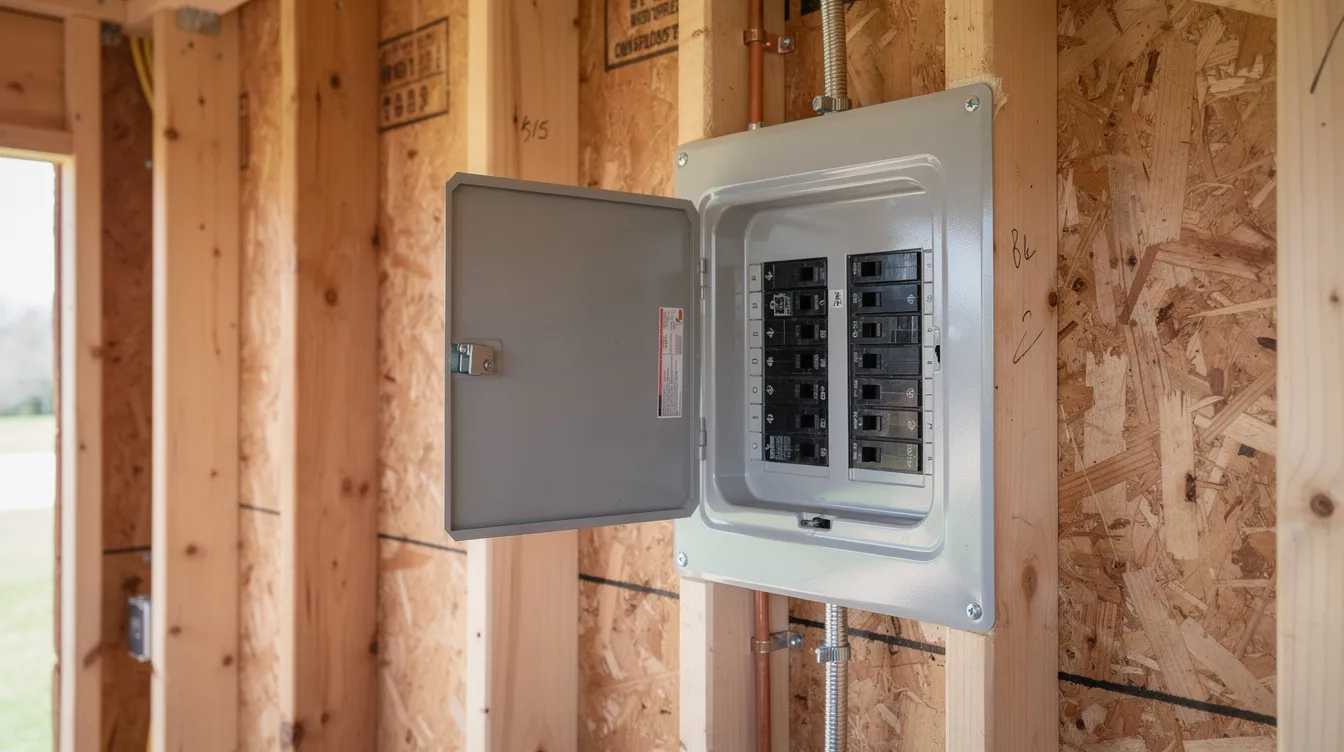
The breaker box is the heart of your tiny house electrical system.
It takes power from your main feed and distributes it to individual circuits throughout your entire tiny house. Circuit breakers are safety devices that stop the flow of power when there is an overload or a short in the circuit, and they need to be sized properly for their application.
Panel Sizing
Many tiny houses use compact panels with 6-12 spaces. That’s plenty for a small space. For comparison, a typical home has 20-40 circuits.
Your main breaker must match your service rating. If you have 50 amp service, install a 50 amp main breaker.
Typical Circuits
Circuit | Amps | Wire Gauge |
|---|---|---|
General lighting | 15 | 14 AWG |
General outlets | 20 | 12 AWG |
Kitchen small appliances (2 circuits required) | 20 | 12 AWG |
Bathroom | 20 | 12 AWG |
Mini-split AC | 15-20 | 12 AWG |
Dedicated appliance | 30 | 10 AWG |
Critical rule: Never put a 20 amp breaker on 14 gauge wire. Oversizing a breaker on small wire is a major fire hazard. The breaker won’t trip before the wire overheats. |
Power Flow
Here’s how AC power moves through your entire house:
- Shore power cord or grid connection
- Power inlet on exterior wall
- Main breaker in electrical panel
- Individual circuit breakers
- Wire runs to outlets, switches, and light fixtures
In tiny houses, 120-volt circuits are commonly used for most appliances, while 240-volt circuits are reserved for larger appliances like ranges and dryers.
Step 4: Tiny House Electrical Wiring Basics (Wire Sizes and Layout)
Choosing the correct wire gauge is essential for safe house electrical wiring in a compact space.
Wire Types
The wiring for tiny houses is typically done with Romex, which is a type of non-metallic sheathed wire commonly used in residential wiring.
Wire gauge is crucial in tiny house wiring; common sizes include 14 gauge, 12 gauge, and 10 gauge, with larger numbers indicating smaller wire sizes.
Wire Size | Ampacity | Common Use |
|---|---|---|
14 AWG | 15 amps | Lighting circuits |
12 AWG | 20 amps | General outlets, kitchen |
10 AWG | 30 amps | High-draw appliances |
Cable Anatomy
Every NM-B cable contains three wires:
- Hot (black or red): Carries current to the device
- Neutral (white): Returns current to the panel
- Ground (bare copper or green): Safety path for fault current
After the main bonding point, grounds and neutrals must stay on separate bars in subpanels.
Voltage Drop
Long wire runs increase voltage drop. For runs over 50 feet, consider upsizing the wire. A 3% maximum voltage drop is the standard target.
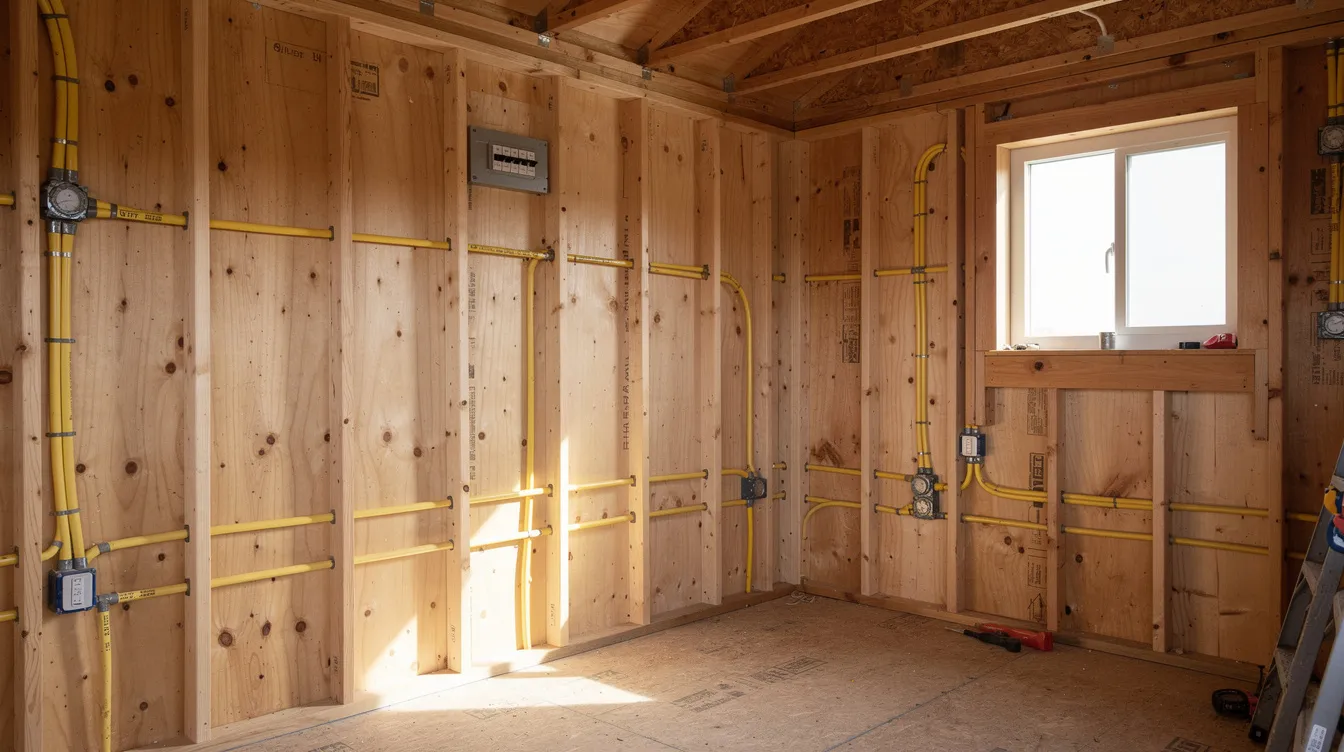
Planning Your Layout
- Locate your electrical panel centrally (often near the kitchen)
- Map each circuit’s path on your floor plan
- Group outlets logically (one circuit per area)
- Avoid sharp bends and minimize crossing paths
- Plan conduit runs for future solar power additions
Step 5: Planning Outlets, Switches, and Light Fixtures
Good outlet placement makes daily life easier in a tiny house, while poor placement can lead to frustration and the need for extension cords, just as thoughtful layouts do in tiny house interiors that maximize every square foot.
It is essential to plan outlet locations during the design phase of a tiny house, coordinating them with tiny house floor plans that maximize comfort and functionality, as adjustments can be made more easily before the walls are up.
Outlet Spacing Guidelines
- Living areas: No point along a wall more than 6 feet from an outlet
- Kitchen: At least two 20-amp small appliances circuits, outlets above counters
- Bathroom: GFCI-protected outlet within reach of the sink
- Loft: At least one outlet for phone charging and small devices
Don’t overload one circuit with multiple devices. Spread outlets across circuits to balance the load.
USB Ports
Consider installing outlets with built-in USB ports at:
- Bedside areas
- Desk or work surfaces
- Kitchen counter
This eliminates bulky charging adapters.
Switch Placement
- Entry door: Controls main living area lights
- Loft access: Three-way switches let you control lights from top and bottom
- Bathroom: Inside or just outside the door
Light Fixtures
Tiny house ceilings often have limited depth. Standard recessed cans need 6+ inches of clearance. Options for shallow ceilings:
- Slim LED recessed lights (3-4 inches)
- Surface-mounted fixtures
- Track lighting
- Ceiling fan with integrated light
LED lighting draws far less power than incandescent—typically 8-12W versus 60W for equivalent brightness.
Step 6: Safety Devices—GFCI, AFCI, and Grounding
The NEC focuses heavily on preventing shock and fire. Your tiny house must meet these safety requirements regardless of size.
GFCI Protection
GFCI (Ground Fault Circuit Interrupter) outlets are required in areas where water is present, such as kitchens and bathrooms, to prevent electrocution.
GFCIs detect unintended current flow and shut off power within milliseconds. They trip at just 5 milliamps—well below the 10 milliamps that can cause ventricular fibrillation.
Required locations:
- Kitchen (within 6 feet of sink)
- Bathroom
- Outdoors
- Near any water source
Install via GFCI receptacles or GFCI breakers in your panel. Breakers protect the entire circuit.
AFCI Protection
AFCI (Arc Fault Circuit Interrupters) are designed to stop the flow of electricity when they sense an arc, which can occur from improper wiring or other issues, and are generally required in all bedrooms to reduce fire risk.
Combination AFCI/GFCI breakers simplify compliance in a compact panel with limited spaces.
Grounding
Grounding is essential for safety in tiny house electrical systems, as it provides a backup pathway for electricity to flow safely into the ground, preventing electrical shocks.
Proper grounding helps reduce the risk of equipment damage from voltage spikes caused by lightning or electrical surges, contributing to system stability.
For tiny houses on foundations: A grounding rod, typically a 10-foot copper rod, is driven into the earth and connected to the electrical system to ensure proper grounding.
For tiny houses on wheels:
- Bond to the trailer frame
- Connect to a grounding electrode when parked
- Coordinate with shore power grounds
Every circuit’s ground wire must run continuously back to the panel’s grounding bar.
Step 7: Temporary Power, Extension Cords, and Shore Power Hookups
Many tiny homeowners start with temporary power before establishing a permanent connection.
Shore Power Inlets
The setup costs for shore power, which allows a tiny house to connect to grid power, can range from $270 to $680, including the power inlet, shore power cord, and surge protector.
30A inlet: Uses TT-30P connector, requires 10 AWG power cord 50A inlet: Uses 14-50 connector, requires 6 AWG power cord
Installation Tips
- Mount inlet 18 inches above ground
- Use weatherproof box rated for outdoor exposure
- Route through conduit with proper strain relief
- Connect directly to main lugs in your electrical panel
Extension Cord Warnings
Never use an undersized household extension cord as your main feed. A bad idea that causes fires.
Using long, undersized cords for high loads can cause overheating, voltage drop, and potential fire risk. Check that:
- Amperage rating matches your service
- Wire gauge is appropriate (10 AWG minimum for 30A)
- Cord is outdoor-rated
- Length is 50 feet or less
For full-time setups, permanent wiring through conduit is always preferred. The temporary cords should be removed once you receive permanent service.
Step 8: Off Grid Options and Future-Proofing Your Electrical System
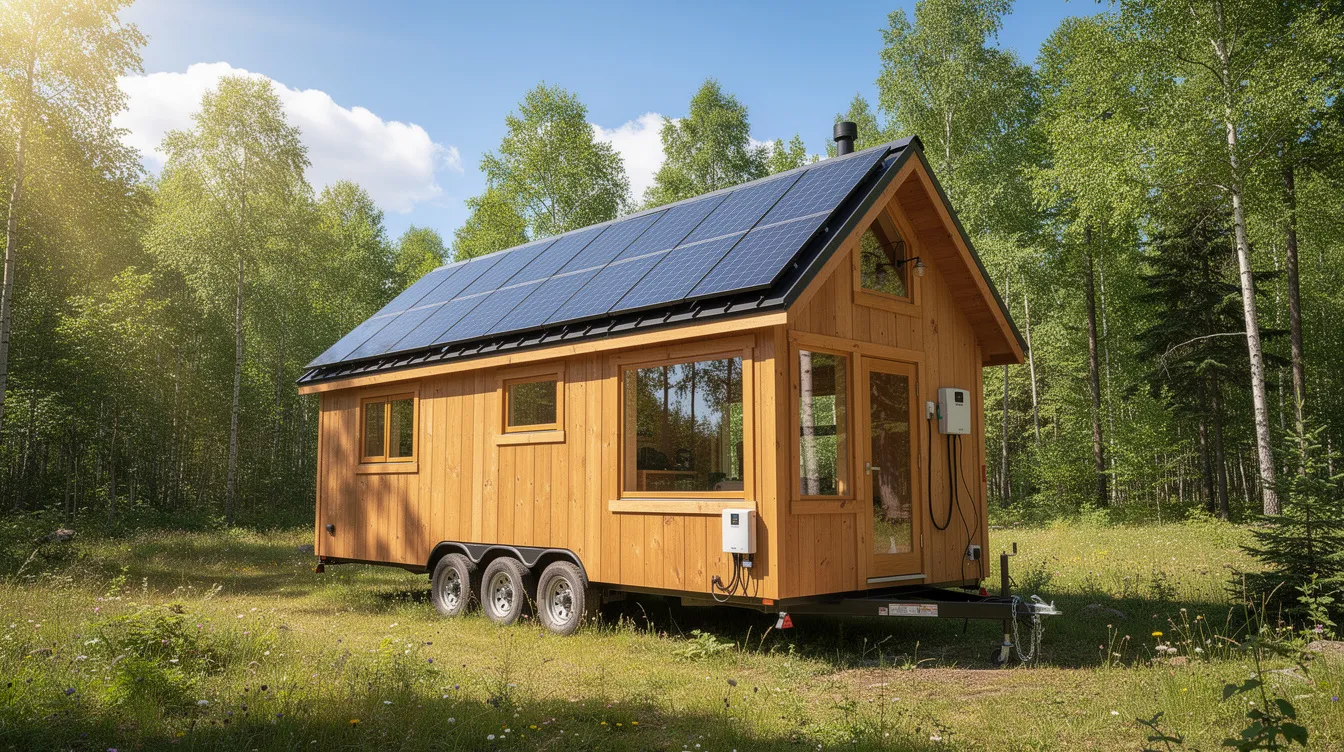
To power a tiny house off grid, you’ll need a standalone electrical system that typically includes solar panels, a charge controller, deep-cycle batteries, and an inverter to convert DC to AC power, which pairs well with self-contained tiny homes designed for modern off-grid living.
Off Grid Components
Component | Function |
|---|---|
Solar panels | Convert sunlight to direct current |
Charge controller | Regulates charging to protect batteries |
Battery bank | Stores energy for use anytime |
Inverter | Converts DC to AC power for your panel |
Solar electric systems for tiny houses require photovoltaic panels, batteries for storage, an inverter to convert the electricity, and appropriate wiring to distribute the power throughout the house. |
Sizing Your Solar System
The number of solar panels needed for a tiny house depends on daily energy usage and sunlight exposure, with an average requirement of 4 to 6 panels to meet basic needs like lighting and refrigeration.
Use your daily kWh calculation from Step 1:
- 5 kWh/day need ≈ 1.5-2 kW of panels
- Battery bank should hold 1-2 days of use (10-20 kWh)
Future-Proofing Strategies
Even if you’re starting with grid power, prepare for off grid capability so that, whether you buy or build, your setup supports the realities of deciding if a tiny house for sale is right for you:
- Leave extra spaces in your breaker box
- Run conduit from roof to panel location
- Designate space for inverter and batteries
- Install a small solar system now and expand later
DC Circuits
Some builders add 12V DC circuits for efficient appliances like fans or specific DC lights. But most modern tiny homes keep all loads on standard AC power through the inverter, regardless of whether they follow cute tiny house designs focused on charm and aesthetics.
A grid tied system with battery backup offers the best of both worlds—utility power when available, independence when needed.
Step 9: Working With Electricians and Passing Electrical Inspection
Even if you do much of the electrical work yourself, a licensed electrician and formal electrical inspection are vital for safety, insurance, and parking legality.
Cost Expectations
The cost of wiring a tiny house typically ranges from $500 for materials to $1,000-$3,000 for labor if hiring an electrician. A complete electrical system for a tiny house can cost between $920 and $5,000, depending on whether the work is done DIY or by a professional, so using a tiny home cost calculator to plan your overall budget is essential before you start.
The cost difference between DIY and professional installation is significant, but so is the peace of mind.
Working With Electricians
Present a clear electrical diagram showing:
- Load calculations with all electrical items
- Circuit list with appropriately sized breakers
- Panel location and service size
- Special breakers (GFCI, AFCI)
This saves time consuming back-and-forth and demonstrates you’ve done your homework.
Inspection Checkpoints
Inspectors look for:
- Secure cable support (stapled within 12 inches of boxes)
- Correct wire size for each breaker
- Proper GFCI/AFCI installation
- Labeled breakers
- Accessible electrical panel (36 inches clearance)
- Correct terminations at outlets and fixtures
Rough-In Inspection
Schedule a rough-in inspection before insulation and wall coverings go up. Fixing wiring issues is far easier—and cheaper—with exposed walls.
Requirements vary by jurisdiction. Reference the 2020 or 2023 NEC editions and check for local amendments. Many tiny houses follow building codes similar to RVs under NEC Article 551.
FAQ: Tiny House Electrical Wiring Basics
How many amps do I really need for a tiny house?
Many 20-28 foot tiny homes using propane for heat and cooking do well on 30 amps. That gives you 3,600 watts to work with simultaneously—enough for efficient appliances, LED lighting, a small fridge, and occasional use of hair dryers or a microwave.
All-electric builds with air conditioning and electric water heaters typically require 50 amps or more. Add up your likely simultaneous loads in watts, divide by 120 volts to get amps, then add a 20-25% safety margin when choosing service size.
Can I wire my tiny house myself, or do I need an electrician?
Many owners run their own cable, install electrical outlets, and mount boxes. This saves money on the time consuming labor portion of the project.
However, most hire a licensed electrician to plan the system, make electrical connections at the panel, and verify code compliance. Some jurisdictions legally require that main service and breaker box work be done or supervised by a licensed electrician to pass electrical inspection.
Is 120V enough, or do I need 240V in a tiny house?
A fully 120V system can run most tiny house loads, including small water heaters and mini-splits designed for 120V. You can live comfortably without any 240V circuits.
But large electric ranges, full-size dryers, and some high-output mini-splits need 240V. If you plan any high-demand appliances, installing a 120/240V panel and service upfront provides flexibility with minimal extra cost.
What kind of breaker box should I buy for a tiny home?
Choose a compact main-breaker load center sized slightly above immediate needs. A 60-100 amp, 8-12 space panel works well even if incoming service is only 30 or 50 amps.
Select a common brand with widely available breakers. Square D QO, Siemens, and Eaton are good choices. This makes it easier to add or replace circuit breakers later if your power needs grow.
How do I know if my extension cords and shore power cords are safe?
Check the cord’s amperage rating and wire gauge against your service size. For 30 amp service, use 10 AWG cable minimum. For 50 amp, use 6 AWG.
Verify that plugs and connectors are RV-rated and weather resistant. Never use indoor-only cords outdoors. Keep lengths under 50 feet when possible to minimize voltage drop. For full-time living, replace temporary cords with permanent conduit wiring.