
Introduction to DFW Tiny Home Communities
If you’re searching for a DFW tiny home community where you can live affordably, build genuine connections with neighbors, and stay within reach of major North Texas job centers, your options are better now than at any point in the last decade. Tiny homes can be as small as 100 square feet, yet a family of four can live comfortably in a 36-foot tiny house – and communities designed around this style of living are steadily expanding across the Dallas–Fort Worth metroplex.
This guide from Explore Tiny House is here to help you find and evaluate the tiny home communities that actually exist in and around DFW. We’re not a builder or a developer – we’re an information platform that covers tiny house design, legal considerations, and community profiles so you can make confident decisions. Whether you’re considering a tiny house on wheels parked in a dedicated village, a small cottage on a foundation, or a park-model setup in a welcoming RV resort, this article breaks down specific DFW-area communities, realistic pricing, zoning and legal basics, and a practical framework for choosing the right community for your life.
The tiny home movement addresses real economic and social shifts, and Dallas–Fort Worth is one of the places where those shifts are most visible. Read on for everything you need to plan your move.
Why Tiny Home Communities Are Growing in DFW
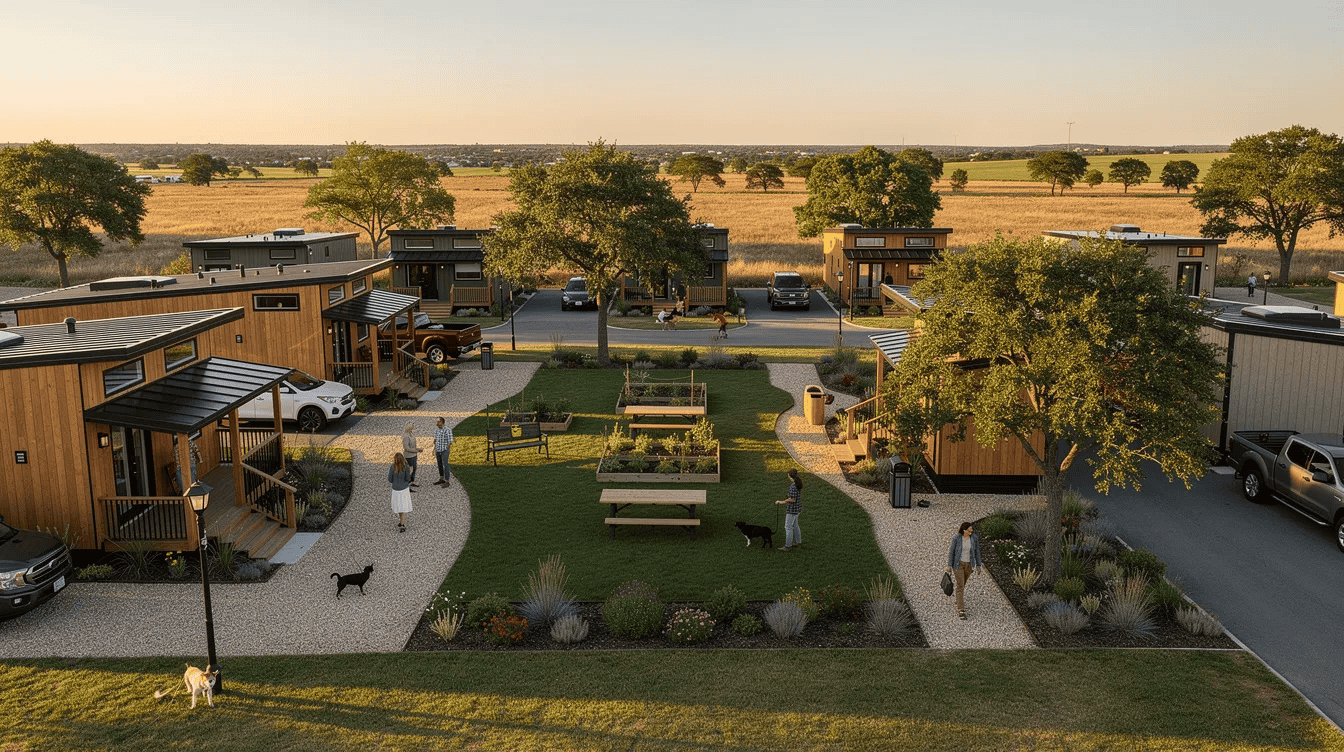
Dallas–Fort Worth housing prices have climbed steadily for years, pushing people to rethink what home ownership – and home life – can look like. Suburban sprawl means longer commutes, higher utility bills, and less free time. Meanwhile, interest in sustainability, minimalist living, and financial independence is pulling more people toward smaller-footprint homes. Tiny homes often cost significantly less than traditional homes, and living in tiny home communities can lower living costs significantly compared to conventional DFW neighborhoods.
DFW’s geography makes it uniquely suited for tiny living. The metroplex blends dense urban employment centers with vast stretches of rural and semi-rural land in counties like Wise, Collin, Hunt, and Denton. That mix creates space for dedicated tiny home villages inside city limits, ranch-style enclaves on unincorporated county land, and everything in between. Remote work has only accelerated this: people who once needed to live close to Downtown Dallas or Fort Worth can now live 45 minutes out and still stay connected.
The timeline matters, too. Lake Dallas Tiny Home Village – the first of its kind in the U.S. – was approved by the Lake Dallas City Council in the mid-2010s and helped spark broader interest across North Texas. That project demonstrated that zoning changes, community design, and tiny living could coexist within a real municipality, setting an example that other towns and developers have followed.
Benefits of Joining a DFW Tiny Home Community
Choosing a tiny home community in the DFW area isn’t just about saving money – though that’s a major draw. It’s about reshaping your day to match the life you actually want. Here’s what draws people to these communities across North Texas.
Lower Cost of Living Compared to Traditional DFW Housing
Tiny home communities can dramatically reduce both your upfront home cost and your monthly housing expenses compared to a typical DFW mortgage or apartment rent. Tiny homes often appreciate differently than traditional homes, but the entry price is far lower: custom-built tiny houses on wheels in the DFW market commonly range from $40,000 to $100,000, while traditional starter homes in the metroplex often start above $200,000.
Monthly lot lease costs vary by location and amenities. Lake Dallas Tiny Home Village offers lots for $700–$750/month, which includes water, sewer, trash, and lawn care. Tiny-house-on-wheels lots cost $500/month at Tiny Lots on the Prairie near Decatur, with electric billed separately. Monarch Springs Ranch charges $700/month for resident-owned tiny homes. More rural sites farther from the city center tend to run lower, while communities closer to suburbs like Denton or Lewisville reflect their convenient location with moderately higher rents.
Tiny homes consume a fraction of the energy required by larger homes, which means utility bills – especially electricity for heating and cooling – stay remarkably low even during Texas summers.
Intentional Community and Shared Amenities
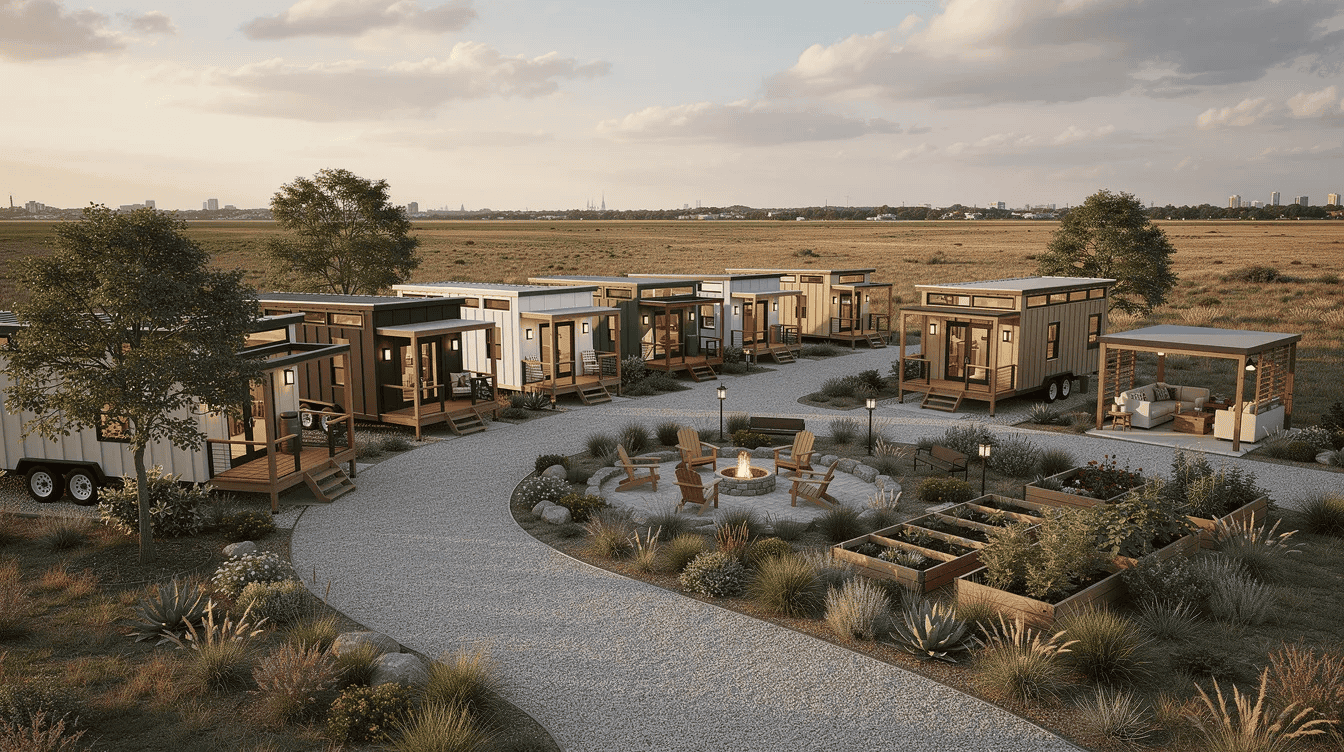
Tiny home communities often include shared amenities that create a strong, interactive social atmosphere. Many DFW-area communities foster this on purpose: community gardens, shared clubhouses for game nights and potlucks, fire pits, walking paths, and laundry facilities are common. The Waters Tiny Home Community has a private fishing lake, two dog parks, and a community building. Vintage Grace Tiny Home Community features several stocked fishing ponds. Community-designed tiny home villages often allow for social activities that bring neighbors together naturally.
These shared resources can reduce the need to pay separately for a gym, coworking space, or recreation in the city. The social aspect matters, too – you’re surrounded by people who made a similar choice to downsize and simplify, which tends to create supportive, like-minded neighborhoods.
Closer to Nature While Staying Connected to DFW
Many DFW-area communities sit near lakes – Lewisville Lake, Lake Lavon, and various private ponds – or on lightly rural land north and east of Dallas. That means you get open sky, wildlife, fishing access, and genuine quiet without losing touch with the metroplex.
Commuting is feasible from most of these places. Lake Dallas is 30–45 minutes from major job centers. Decatur is about 45 minutes to Fort Worth. Nevada, TX is roughly 35 minutes east of Dallas. High-speed internet is available in many of these communities, making remote work viable even in more rural locations. For people who work from home a few days a week and commute the rest, this setup can be the sweet spot between nature and career.
Types of Tiny Home Communities Around Dallas–Fort Worth
The phrase “DFW tiny home community” covers several distinct setups, each with different rules, costs, and levels of permanence. Understanding the differences will save you time and help you find places that genuinely fit.
Dedicated Tiny Home Villages (Lots Only)
These are purpose-built communities where residents bring their own tiny house on wheels and lease a prepared pad. Lake Dallas Tiny Home Village is the clearest example: 13 lots, each around 800–900 square feet, with full utility hookups. Leases are typically 12 months, and short-term or nightly rentals like Airbnb are prohibited. Communities near Decatur and Nevada, TX follow a similar model.
This setup suits people who already own a tiny house on wheels or are ready to build one. You own your home and lease the land beneath it, keeping monthly costs predictable while maintaining the flexibility to relocate your home if needed.
Mixed Tiny Home and Small Cottage Communities
Some communities blend tiny houses on wheels with small bungalows, park models, and cottages. The Lake Dallas project includes small bungalows between 700–1,100 square feet alongside the tiny home lots, creating a range of home sizes within a single neighborhood. This style appeals to couples, small families, or multi-generational households who want shared amenities but need more square footage than a sub-400-square-foot home provides.
These communities may have slightly higher HOA dues or community fees in exchange for more robust infrastructure – paved roads, landscaping, stronger utility systems, and sometimes a playground or green space for kids.
RV Parks and Resorts That Welcome Tiny Homes
Throughout North and East Texas, many RV parks accept tiny homes or park models on long-term lots. The pros include lower lease costs, flexible terms, and extensive hookups (20, 30, and 50 amp electric, water, sewer). The cons are real: these parks tend to have a more transient population, stricter RV-type rules, and less of the intentional “tiny-only” culture you’d find in a dedicated village.
Still, this can be a practical entry point for DFW residents testing tiny living before committing to a curated tiny home community. It’s easier to ship or tow a tiny home into an RV park for a trial period than to sign a year-long lease in a village you haven’t experienced day to day.
Notable Tiny Home Communities Serving the DFW Area
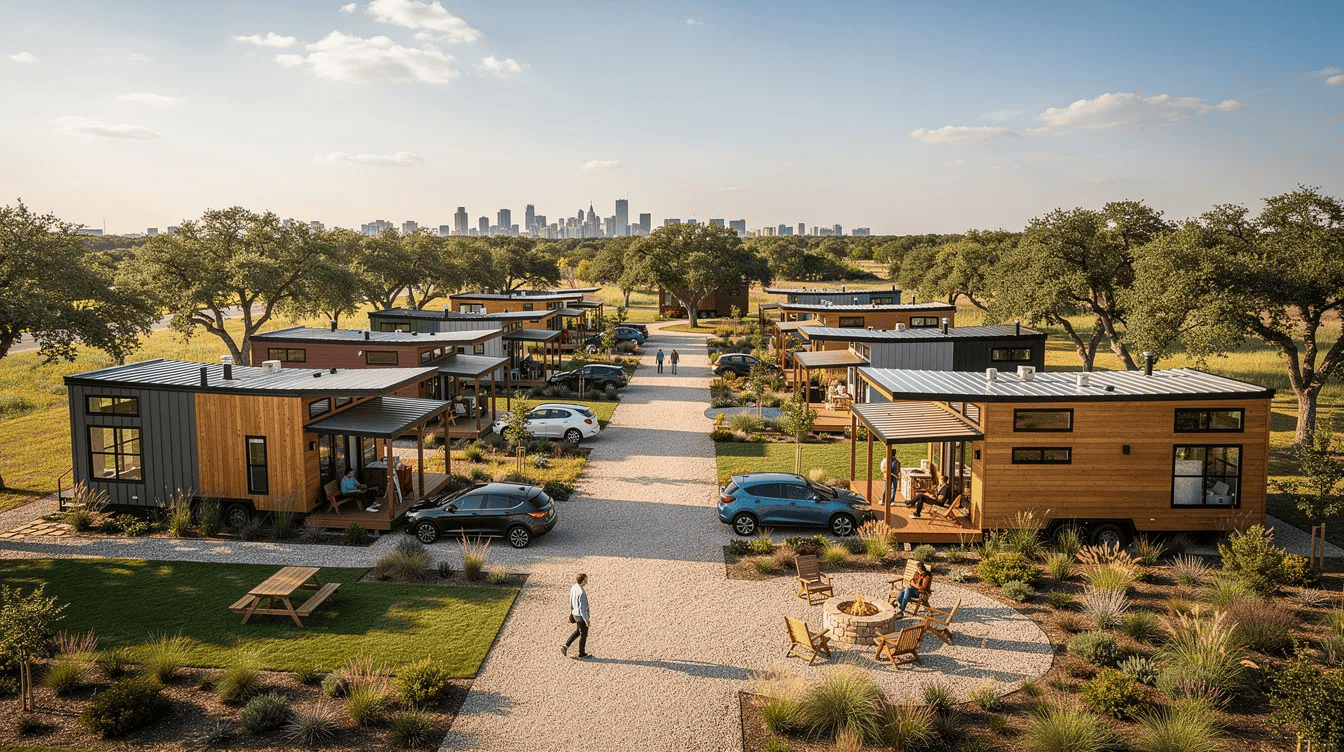
These are real, named communities in and around the DFW metroplex focused on long-term tiny living. Each has a distinct character, location, and set of rules.
Lake Dallas Tiny Home Village – Lake Dallas, TX
Lake Dallas Tiny Home Village is the first of its kind in the U.S. – a fully zoned tiny home community inside city limits, located at 204 Gotcher Avenue in Lake Dallas, TX 75065. It sits just north of Dallas between Denton and Lewisville, roughly 30–45 minutes from major DFW job centers.
The community includes 13 lots with a waitlist, so demand consistently outpaces supply. Lot sizes run approximately 800–900 square feet, and homes must be tiny houses on wheels – no park models, mobile homes, or shipping containers. Homes must meet IRC Appendix Q standards and carry NOAH or equivalent certification. Lot lease at Lake Dallas costs $700–$750 per month, with water, sewer, trash, and mowing included; electric is metered separately. Lake Dallas requires a $1,000 refundable deposit for lot lease. Leases are 12-month renewable, and no short-term rentals are allowed.
Amenities include a shared washateria with four washers and dryers, a community garden, a courtyard, and a backyard gathering space. Across the street you’ll find Lake Dallas City Park, and downtown services and schools are within walking distance. This community is best for people who want tiny living within a real city, with walkability, stability, and a strong sense of neighborhood.
Tiny Lots on the Prairie – Decatur, TX
Situated on a private 7.5-acre property southeast of Decatur, this gated community is about 10 minutes from the Decatur town square, roughly 30 minutes from Denton, 45 minutes from Fort Worth, and about an hour from central Dallas. The site has seven reinforced concrete pads, each approximately 10×30 feet, with tie-down anchors for high-wind safety.
Tiny-house-on-wheels lot community costs $500 per month, with electricity billed separately. The minimum lease is 12 months, with a one-time $250 setup fee. Pets are allowed with approval (up to two per household, some breed restrictions). The property is smoke/vape free.
Amenities include two ATSA-certified storm shelters, a gated and fully fenced perimeter, a walking path, a community clubhouse, and grounds maintenance. Water is filtered well water, and multiple amperage options (20, 30, 50 amp) are available for electric hookup. The rural prairie setting emphasizes peace, open sky, and privacy – ideal for people who bring their own tiny home and want a quiet, low-cost base within commuting range of DFW.
The Waters Tiny Home Community – Near Lake Lavon / Nevada, TX
Located at 105 Waters Way, Nevada, Texas 75173 – about 35 minutes east of Dallas in a rural corner of Collin County near Lake Lavon – The Waters is a secure, gated community focused on long-term residents. Note that this is an age 55+ community, so it’s specifically designed for retirees and older adults.
Lot sizes run around 32×110 feet. Lot rent is approximately $775/month for pond-view lots; other lots may vary. The Waters Tiny Home Community has a private fishing lake with a walking trail and fishing pier. Other amenities include two dog parks, a community building with laundry and gathering space, a community garden, fire pits, and outdoor seating areas. Swimming in the pond is not allowed, and residents are expected to follow community guidelines for cleanliness and safety.
This community appeals to people over 55 who want lake access, quiet living, and nature-forward amenities without moving far from the Dallas metroplex. If you’re under 55 or looking for a family-friendly site with kids, you’ll need to look elsewhere.
Monarch Springs Ranch and Other Rural North Texas Tiny Enclaves
Communities like Monarch Springs Ranch in Celeste – roughly an hour northeast of Dallas – represent the more rural, ranch-style end of the DFW tiny home spectrum. Monarch Springs Ranch charges $700 monthly for lot lease for resident-owned tiny homes on private land with access to ponds, fire pits, and open acreage.
The typical arrangement at these places: lease a lot, bring your own tiny home, and share access to green spaces and natural features. The pros are real – more privacy, stargazing, fewer neighbors, genuine quiet. The trade-offs are equally real: longer commutes, potentially limited broadband, and less structured infrastructure than a village like Lake Dallas. These enclaves suit people who dream of rural life and are willing to create their own routines around a more spread-out community.
What It Costs to Live in a DFW Tiny Home Community
There are two main cost categories: the home itself and the ongoing lot or community fees. Here’s what to expect in North Texas as of the mid-2020s. Prices change, so always verify directly with the community.
Upfront: Buying or Building Your Tiny Home
Custom-built tiny houses on wheels from DFW-area builders typically range from $40,000 to $100,000 depending on size, finishes, insulation, and off-grid features. Resale units can cost more for high-quality builds – a 35×10-foot Minimaliste-built unit, for example, has listed near $108,900. DIY builds can come in lower if you have construction skills and time. Prefab options from national manufacturers offer another path.
Size, finishes, towing requirements, and whether you want solar panels or composting toilets all affect the final price. Use a tiny home cost calculator to sketch your budget before committing, and compare quotes from multiple builders. Naming your tiny home can personalize your living space once it’s built – many owners in these communities do exactly that.
Ongoing: Lot Rent, Utilities, and Community Fees
Monthly lot lease ranges across DFW-area tiny communities currently fall between $500 and $775:
- Tiny Lots on the Prairie (Decatur): $500/month + electric
- Lake Dallas Tiny Home Village: $700–$750/month (water, sewer, trash, lawn care included; electric extra)
- Monarch Springs Ranch (Celeste): $700/month
- The Waters (Nevada, TX): ~$775/month for premium pond-view lots
What’s typically included: water (well or municipal), sewer or septic, trash pickup, basic lawn care, access to shared amenities. What’s commonly extra: electricity (metered separately), propane, high-speed internet, pet fees, and one-time setup or application fees.
Comparing Tiny Community Costs to Traditional DFW Housing
A rough comparison helps frame the savings. Average apartment rent in Dallas–Fort Worth often starts at $1,300–$1,800/month for a modest unit. A starter home mortgage (with taxes and insurance) on a $250,000 house can easily exceed $2,000/month. By contrast, a tiny home payment of $400–$800/month (if financed) plus $500–$750 in lot rent puts total monthly housing costs well below what most DFW residents pay.
Utilities and maintenance costs are lower, too, because you’re heating, cooling, and maintaining a fraction of the square footage. The trade-off: in lot-leased communities, you don’t own the land, which affects long-term equity planning. Your home may hold or gain value, but land appreciation goes to the property owner, not to you.
Legal and Zoning Considerations for Tiny Homes in DFW
Zoning laws can greatly influence the placement of tiny homes in DFW. This section gives you a high-level overview specific to the Dallas–Fort Worth region – not legal advice. Consult local planning departments or a land-use professional before making commitments.
How Local Codes Affect Where You Can Park or Build
Cities like Dallas and Fort Worth – and many inner suburbs – have minimum square footage and building code requirements for homes on foundations. A 200-square-foot house on a permanent foundation may not meet those minimums unless the city has adopted IRC Appendix Q, which sets standards for dwellings up to 400 square feet. Many DFW-area municipalities have not yet adopted Appendix Q, though some have expressed intentions.
Tiny houses on wheels are often treated more like RVs, which means they may be restricted to RV parks, designated tiny home villages, or specific rural land with allowances. Smaller municipalities and ETJs (extra-territorial jurisdictions) tend to be more flexible. Lake Dallas created a Planned Development (PD) overlay to legally permit its tiny home village – a strategy other North Texas towns are beginning to explore.
HOA Rules, Deed Restrictions, and County Regulations
Before you buy land in the DFW suburbs with the plan to park a tiny home in the backyard, check for HOA covenants and subdivision deed restrictions. Many HOAs in Collin, Denton, and Tarrant Counties explicitly ban non-traditional structures, RVs parked as primary residences, and homes below certain square footages. These rights are typically enforceable even if the city or county would otherwise allow it.
Unincorporated county land – places like Wise County (near Decatur), parts of Collin County, and Hunt County – may offer more flexibility. Tiny Lots on the Prairie sits on unincorporated county land where only a septic permit was needed. But even on rural land, you still need to meet requirements for septic systems, road access, and utility connections.
Insurance, Registration, and Financing in Texas
Tiny houses on wheels are typically registered as recreational vehicles or trailers in Texas, which affects both insurance options and where you can legally park. Some communities require NOAH certification or equivalent inspections for safety and insurance eligibility – Lake Dallas Village requires this specifically.
Financing a tiny home without a traditional 30-year mortgage is one of the bigger hurdles. Options include RV loans, personal loans, builder financing, or paying cash. Standard mortgage products rarely apply to homes under 400 square feet or on wheels. Before signing anything, confirm how your chosen community requires homes to be classified and insured.
How to Choose the Right DFW Tiny Home Community
Comparing DFW-area tiny home communities means looking beyond price. Here’s a checklist to guide your evaluation.
Location, Commute, and Access to Daily Needs
Map your commute times to key job centers: Downtown Dallas, Fort Worth, Plano, Frisco, Arlington, and DFW Airport. Check how far you are from grocery stores, medical care, schools (especially if you have kids), and major highways like I-35W, US-380, and US-75.
Your lifestyle preferences should drive community selection. Do you want an urban-edge site you can walk to restaurants from? A lakefront lot with a fishing pier? A rural ranch where you can see the Milky Way? DFW has all three – just at different price points and commute distances.
Community Culture and Rules
Visit in person. Walk the property. Talk to residents about noise levels, events, pets, kids, and visitors. Every community has rules – minimum and maximum home sizes, exterior standards, age requirements for homes, quiet hours, and rental policies. Many DFW-area communities prohibit nightly or Airbnb-style rentals to protect resident stability.
Match the community’s vibe to your own values. Some are retiree-focused and deliberately quiet. Others are family-friendly with a playground and green spaces for kids. Some attract artists and remote workers. The fit matters as much as the price.
Amenities, Infrastructure, and Internet
Evaluate the quality of roads, pad sites, water pressure, and waste systems before signing a lease. In rural DFW fringe areas, verify internet availability and speed – especially if you work remotely. Some communities include Wi-Fi; others leave it to the resident.
Weigh the amenities you actually want (clubhouse, trails, garden, pool, gym, storm shelters) against the additional cost. Multifunctional furniture is commonly used in tiny homes to save space, but shared community amenities can offset what your small home can’t fit – a full-size washer, a large gathering table, or workout equipment.
Long-Term Stability and Ownership Model
Most DFW tiny home communities operate on a lot-lease model: you own the home, the community owner owns the land. Ask about long-term plans – is the owner planning to sell the property, redevelop, or raise rents significantly? What are the lease terms (length, renewal process, rent caps)?
A few communities nationally operate as co-ops or resident-owned models, though these are still rare in North Texas. Wherever you land, insist on a written lease with clear rules and transparent communication from the management team.
Steps to Get Started with Tiny Living in DFW
Here’s a practical roadmap from idea to move-in for people ready to take action.
Step 1: Clarify Your Tiny Home Goals and Budget
Decide whether you want full-time or part-time tiny living, off-grid potential, the ability to tow your home elsewhere, or a parked-permanently setup. Sketch a realistic budget that covers the home itself, monthly lot fees, utilities, insurance, and a maintenance fund. Living in tiny homes encourages a minimalist lifestyle and decluttering – start thinking about what you truly need before you shop for a home or a community.
Step 2: Tour DFW-Area Tiny Communities
Schedule visits to multiple communities: closer-in options (Lake Dallas, suburban villages) and more rural sites (Decatur, Celeste, Nevada). When you meet management, ask about waitlist length, screening criteria, minimum stay, what’s included in rent, and future development plans. Talk to current residents if possible – their day-to-day experience tells you more than any website.
Step 3: Choose or Build Your Tiny Home
Align your home’s dimensions, hookups, and exterior style with your target community’s requirements. Get written confirmation that your planned unit type is accepted before signing a build contract. If you’re buying a custom tiny home, research DFW-area builders, tour model homes, and read contracts carefully for timelines, warranties, and certification standards. Certification (NOAH, Bildsworth, or state inspector) is often required and helps with insurance.
Step 4: Plan the Move and Adjust to Tiny Living
Downsizing is the unglamorous but essential step. Declutter aggressively, sell or donate furniture that won’t fit, and choose multi-purpose items designed for small spaces. Create storage strategies before move-in day, and be flexible during the first months as your routines adjust to a smaller footprint. Explore Tiny House offers tips, checklists, and design inspiration to support this transition.
How Explore Tiny House Helps Your DFW Tiny Home Journey
Explore Tiny House is an information and community platform – not a builder, developer, or real estate company. We publish detailed guides on tiny home design, legal and financing explainers for Texas, photo galleries, and profiles of tiny communities across the country.
Use our site to compare living setups, explore tiny house pros and cons, get downsizing tips, and stay up to date on new or expanding DFW communities. Whether you’re years away from your dream move or ready to tour this weekend, our resources are built to help you make informed, confident decisions.
Frequently Asked Questions About DFW Tiny Home Communities
These questions address the sticking points that most often delay people from committing to a DFW-area tiny community.
How much does it typically cost per month to live in a DFW tiny home community?
Total monthly costs depend on your home payment and lot rent. Lot leases in the DFW area currently range from $500/month (Tiny Lots on the Prairie) to $775/month (The Waters). If you’ve paid cash for your tiny home, your total monthly housing cost could be $500–$800 plus utilities. If you’re financing, add $300–$800/month depending on your loan. Compared to average DFW apartment rent of $1,300–$1,800, the savings are significant.
Can I park my tiny home on private land anywhere around Dallas–Fort Worth?
It depends on zoning, deed restrictions, and county rules. In city limits, most municipalities restrict where non-standard homes can be placed – tiny homes on wheels are often treated as RVs. Unincorporated county land in North Texas tends to be more flexible, but you’ll still need septic and utility compliance. Agriculturally zoned parcels and municipalities that have adopted tiny-friendly ordinances (like Lake Dallas) are your best bets. Always verify with the local planning department before buying land.
Are DFW tiny home communities family- and pet-friendly?
Many communities welcome both families and pets. Lake Dallas allows families with kids. Tiny Lots on the Prairie allows pets (up to two per household, with breed restrictions and approval). However, some communities are age-restricted – The Waters requires all residents to be 55 or older, so children aren’t permitted. Pet rules (leash requirements, waste cleanup, number and breed limits) vary by community, so ask before you commit.
Can I rent out my tiny home on Airbnb or as a short-term rental in these communities?
Most established DFW-area tiny communities prohibit nightly or short-term rentals to protect residents’ quality of life. Lake Dallas Tiny Home Village, for example, requires owner occupancy and does not allow subleases or vacation rentals. If hosting guests or running a rental business is part of your plan, check each community’s lease and rules carefully – you may need to look at private land or a different arrangement.
Do DFW tiny home communities allow fully off-grid living?
Most formal communities require hookups to their water, sewer, and electric systems for safety and code compliance. Some allow solar panels, composting toilets, or rainwater collection as supplements, but full off-grid living is rare in village-style setups. If you’re seeking a fully self-sufficient tiny home experience, you’ll likely need to explore rural land ownership in unincorporated county areas and build custom utility solutions.
Conclusion: Finding Your Tiny Home Community in DFW
DFW offers a genuine spectrum of tiny home communities – from the fully zoned, walkable Lake Dallas Tiny Home Village to the wide-open prairie pads near Decatur and the serene fishing-lake setting at The Waters. Whether you’re drawn to lower housing costs, intentional community, or the chance to live closer to nature while staying connected to major North Texas cities, there’s a community that fits.
Start by defining your priorities – budget, commute tolerance, community culture, and long-term goals. Then visit, ask hard questions, and compare. Browse Explore Tiny House for design ideas, little houses in Texas, and community profiles to keep your research moving. The right DFW tiny home community is out there – your job is to find the one that matches your life.