
Kohler generators range from 12kW to 60kW, covering everything from essential circuit backup for smaller homes to full-power coverage for luxury estates. Choosing the right Kohler generator size depends more on your actual electrical load than your home’s square footage – understanding the capacity tiers, what each powers, and how to calculate your true power requirements will help you select the unit that keeps your home running without overspending.
Types of Kohler Generator Sizes
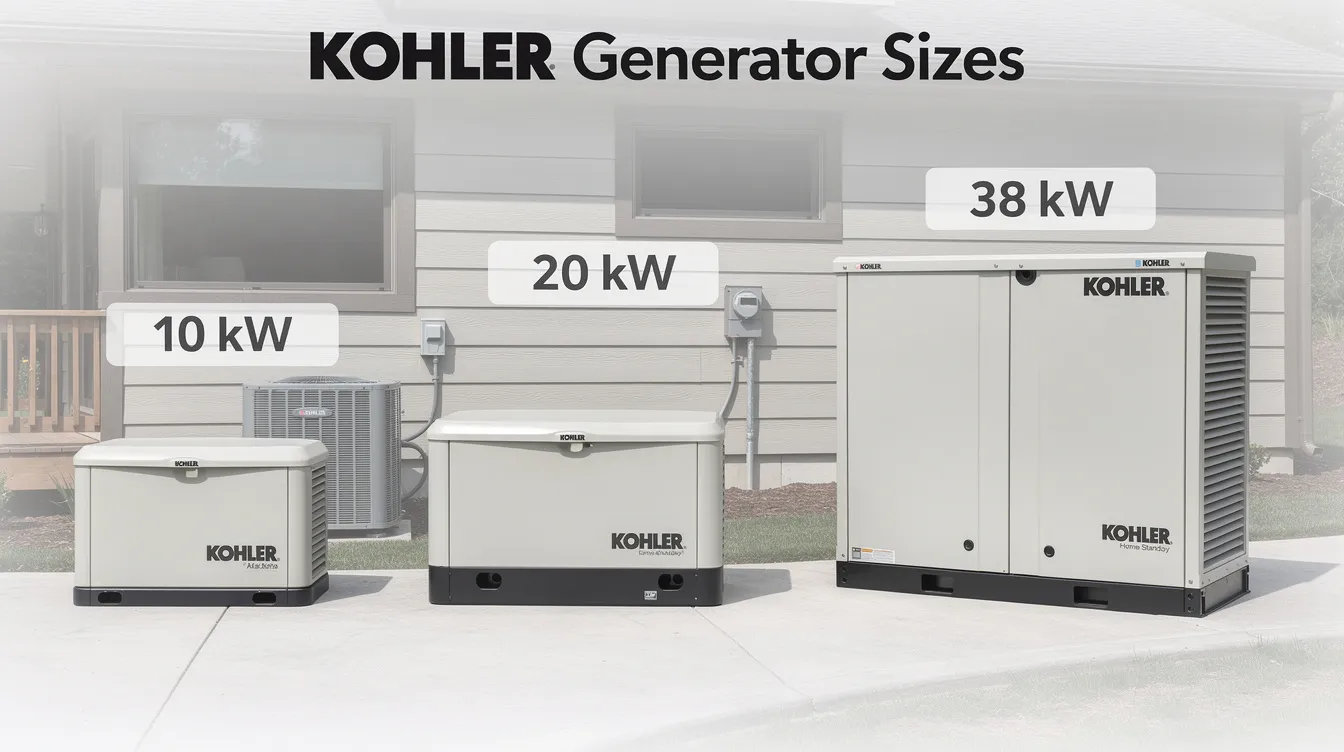
Kohler organizes its residential standby lineup by power output capacity, measured in kilowatts (kW). Each tier matches a different level of home backup – from keeping the basics running to powering every circuit in a large residence without compromise.
Small Capacity Generators (10–14kW)
Essential power backup is suitable for homes with a power requirement of 10–12 kW. A 10–14 kW generator can power basic necessities for smaller homes: a refrigerator, sump pump, furnace, select lighting, and a few outlets. These air-cooled units are ideal for budget-conscious homeowners who want reliable backup for critical systems without covering every appliance. Kohler’s RESV models in this range deliver approximately 10 kW on LPG and 9 kW on natural gas, with motor-starting capacity around 16.8 kVA at 240V – enough to handle compressor startups on smaller cooling equipment. Kohler generators run on natural gas or propane, with lower power output when using natural gas.
Medium Capacity Generators (16–20kW)
Mid-sized homes typically require generators in the 14–20 kW range. At this capacity, you can support central air conditioning, major kitchen appliances, and most daily-use systems comfortably during an outage. 20 kW generators are often suitable for normal living with one central air conditioning unit. Air-cooled models in this tier, like the 20RCA, represent the sweet spot for homeowners who want comfort without the cost of whole-home coverage. Air-cooled models typically range from 12kW to 20kW.
Large Capacity Generators (24–38kW)
Whole-home backup requires generators of 20–26 kW or more for larger homes with high demand appliances. Kohler’s liquid-cooled RCLA and RCLC models – including the 24RCLA, 30RCLA, and 38RCLC – power multiple HVAC systems, electric water heaters, workshop tools, and other high-draw equipment simultaneously. Liquid-cooled generators range from 24kW to 60kW for larger homes, and liquid-cooled systems handle larger homes and extended runtime requirements far more effectively than air-cooled alternatives. These units are designed for seamless power transition during outages with minimal load shedding.
Premium Capacity Generators (48–60kW)
Luxury homes may need generators sized from 30–48 kW – or even 60 kW – due to excessive energy demands. Models like the 48RCLC and 60RCLB handle multiple air conditioning units, pool equipment, workshop tools, smart home systems, and EV chargers without compromise. At this capacity, fuel supply infrastructure (gas line sizing or propane tank capacity) and installation complexity become significant factors. These premium units deliver the ultimate residential backup solution for homeowners who accept no power compromise.
What to Look For in Kohler Generator Sizing
Proper sizing is the single most important step in generator selection. An undersized unit leads to overloads and premature failure; an oversized one wastes money on capacity you’ll never use. Several key factors determine the right fit.
Total Load Calculation
A generator’s rated running wattage must exceed the total continuous load of everything you plan to power simultaneously. But running watts alone don’t tell the full story. Appliances with motors – central air conditioning compressors, well pumps, sump pumps, refrigerators – require 2–3 times more power to start than to run. Starting wattages for motors can exceed running requirements by five times in some cases. Generator size needs to account for the running wattage of appliances and their startup wattage.
Kohler addresses this with PowerBoost technology for motor startups, which manages voltage dips when large loads kick on. Many appliances in a home do not run simultaneously, which impacts sizing calculations – you don’t need to sum every starting watt in the house, just account for the largest surge that could realistically occur at one time. A professional load assessment is recommended for selecting the right generator size.
Home Square Footage and Layout
While determining generator size depends more on electrical load than home square footage, square footage provides a useful starting point. Air-cooled models suit homes up to 2,500 square feet. A 20kW generator is recommended for a 3,500-square-foot home. Multi-level homes with separate HVAC zones, detached structures, or long wire runs may need additional capacity to compensate for voltage drop.
Future electrical additions matter too. If you’re considering an EV charger, pool automation, home expansion, or additional HVAC zones, sizing up now is far less expensive than replacing a generator later. Kohler offers models up to 60 kW in the residential lineup, providing room for growth.
Critical Appliance Requirements
Not all appliances carry equal weight. High demand appliances like central air conditioning, electric heat, well pumps, and electric ranges dominate your load calculation. A single 5-ton AC unit can draw 6,000+ starting watts. An electric dryer, electric water heater, and range together can add another 10,000–15,000 running watts.
Smart prioritization of circuits matters. Load management can allow smaller generators to serve larger homes by prioritizing circuits – keeping essential systems (refrigerator, lighting, heating, internet) running while shedding non-essential outlets during peak demand. A licensed electrician evaluates your electrical panel for sizing and can identify which circuits to prioritize.
How to Choose the Right Kohler Generator Size
- Home electrical load assessment – Having a certified dealer perform a load calculation is recommended for accurate sizing. This evaluation determines actual power requirements and prevents the most common mistake: undersizing based on running watts alone while ignoring startup surges.
- Backup power priorities – Essential-only coverage (refrigerator, furnace, sump pump, lighting) may need just 10–14 kW. Whole-home coverage with central air conditioning jumps to 20–26 kW or higher. Decide your comfort threshold before selecting a capacity tier.
- Budget and installation costs – A 20kW air-cooled system costs $8,000 to $12,000 installed. Larger liquid-cooled units can reach $15,000 to $25,000 installed. Annual maintenance costs range from $200 to $300, with total annual ownership costs averaging $500 to $650. Professional installation is essential for Kohler generators.
- Fuel availability and consumption – Kohler generators can run 5–7 days on a 500-gallon propane tank. Larger generators require appropriately sized natural gas lines or propane storage. Fuel pressure and line diameter become critical factors for units above 30 kW – insufficient supply prevents the generator from reaching full rated output.
- Local codes and setback requirements – Generators must meet local codes for electrical and fuel connections. Units need placement at least 18 inches from walls. Setback requirements include 60 inches from windows and doors. Concrete pads must extend below frost lines in colder climates. Snow clearance around units should be at least 36 inches.
Frequently Asked Questions
What size Kohler generator do I need for a 2,000 square foot home?
Most 2,000-square-foot homes fall into the 16–20 kW range, assuming one central air conditioning unit, standard kitchen appliances, and typical electrical loads. However, the actual answer depends on your specific systems: if you have electric heat, a well pump, or multiple high-draw appliances, you may need to step up to 24 kW. If you’re only backing up essential circuits, a 14 kW unit may suffice. Air-cooled models suit homes up to 2,500 square feet and keep installation simpler.
Can I run my whole house on a 20kW Kohler generator?
A 20 kW Kohler generator handles normal living comfortably for most average-sized homes with one central air conditioning unit, a refrigerator, kitchen appliances, lighting, and general outlets. Where it gets tight is simultaneous use of multiple large motors – running the AC, electric dryer, and electric range all at the same time may exceed capacity. Kohler generators use PowerBoost technology for motor startups, which helps manage transient surges. Load-following technology optimizes fuel consumption based on demand, keeping the unit efficient under varying loads.
How do I calculate the right generator size for my specific home?
Start by listing every appliance and system you want powered during an outage. Note each item’s running wattage (from the nameplate or owner’s manual), then identify which have motors and add their starting wattage. Sum the running watts of everything that could operate simultaneously, then add the single largest starting wattage spike. This gives your minimum capacity. For accuracy, a professional load assessment is recommended – a licensed electrician evaluates your electrical panel and accounts for factors like voltage drop, future additions, and derating for altitude or temperature.
What’s the difference between air-cooled and liquid-cooled Kohler generator sizing?
Air-cooled generators typically range from 12kW to 20kW and use simpler V-twin engines at 3,600 RPM. Air-cooled units require less maintenance than liquid-cooled models and cost significantly less to install. Liquid-cooled generators range from 24kW to 60kW and handle sustained heavy loads far more effectively, especially in hot climates where air-cooled engines can overheat. If your home requires more than about 20 kW of backup capacity, liquid cooling is your only option in the Kohler residential lineup.
Find Your Ideal Kohler Generator Size
Proper sizing is the foundation of reliable backup power. Kohler uses commercial-grade components in its generators and emphasizes durability over price – these units can deliver 20 to 30 years of service with proper maintenance. Kohler offers a standard five-year warranty covering 2,000 hours of operation, and Kohler generators operate 4–7 dBA quieter than competitors. Oil and filter changes are required every 200 hours, annual maintenance includes air filter inspection and spark plug examination, and battery testing is part of the annual service checklist. Professional maintenance programs ensure proper care without tracking intervals yourself, because neglected units often fail prematurely during critical outages. Kohler generators include cold-weather starting systems for extreme conditions, keeping your home protected year-round. Contact a certified Kohler dealer to get a professional load calculation and select the generator size that matches your home’s real power requirements.
Tiny Home Generators (Below 10kW)
For tiny homes and small cabins with minimal electrical needs, generators below 10 kW provide sufficient backup power. These compact units can handle essential circuits such as lighting, a small refrigerator, basic heating or cooling, and charging outlets. Kohler offers smaller air-cooled models suitable for tiny homes that prioritize portability and efficiency. Because tiny homes often have limited space and simpler electrical systems, sizing calculations focus on critical loads only, making a sub-10 kW generator an economical and practical choice. Many owners also combine backup generation with solar panels for tiny houses or invest in custom tiny homes designed for efficient power use, whether they’re exploring inspiring examples of great tiny homes, comparing tiny house kits from major retailers, or planning self-contained off-grid tiny home setups. Additionally, refueling needs are minimal, and maintenance remains straightforward, ensuring reliable operation without excess complexity.