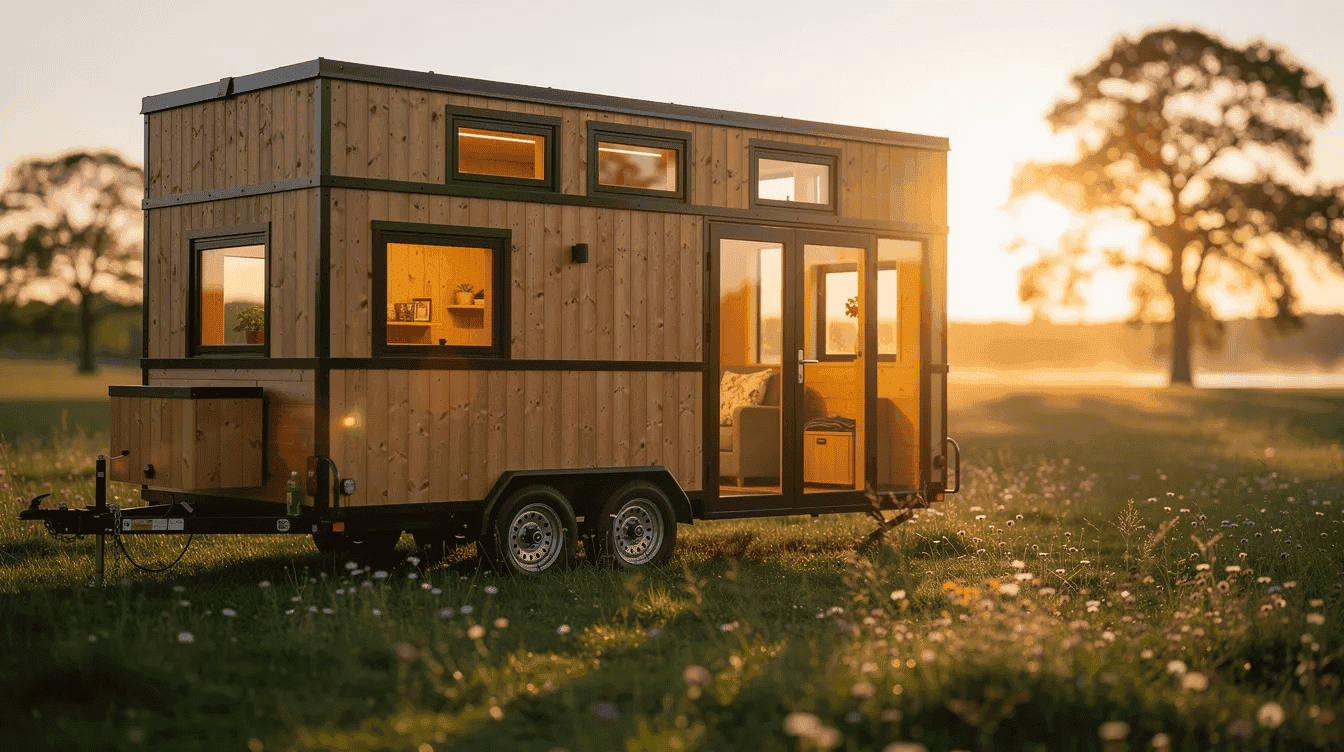
Tiny houses demand a fundamentally different approach to power generation than a traditional house. You’re working with limited floor space, thin walls that amplify every sound, minimal fuel storage, and often no connection to the electrical grid at all. A tiny house can use anywhere from 1,000 to 5,000 watts depending on the appliances you run, with average daily energy use for tiny homes ranging from 1 to 8 kWh.
That means the best generator for tiny house living isn’t simply a smaller version of what you’d buy for a suburban home. It needs to deliver enough power for your essential appliances, run quietly enough to sleep through, fit in a tight storage space, and ideally burn less fuel or none at all. Most tiny homes operate at 120V, but some electrical appliances require 240V, so understanding your specific power requirements matters before you spend a dollar.
This guide breaks down the six best generators for tiny houses across fuel types, budgets, and lifestyles, then walks you through exactly how to choose the right one.
How We Chose the Best Generators for Tiny Houses
Picking a generator for a tiny home isn’t the same as picking one for camping or emergency backup power. Here’s what we weighted most heavily:
- Power output: Inverter generators in the range of 2,000 to 4,500 watts are ideal for tiny homes. We focused on models that deliver reliable power for real-world tiny house loads, from refrigerators to coffee maker surges. Calculating running watts is necessary to determine generator needs for any tiny house.
- Fuel efficiency: Runtime at partial load matters more than peak performance. We prioritized fuel efficient models that can stretch a small tank over extended periods.
- Noise level: Inverter generators are suitable for tiny houses due to their quiet operation. We favored units under 60 dBA, since you’ll be living just feet away.
- Portability and size: Weight, dimensions, and mounting options that work in tight spaces.
- Reliability and durability: Most portable generators are rated for emergency backup with a lifespan of 1,000 to 3,000 hours. For daily off grid use, durability becomes critical, so brand reputation, warranty, and parts availability all factored in.
- Environmental impact: Emissions compliance (EPA, CARB), fuel type cleanliness, and renewable energy options.
- Value: Upfront cost balanced against fuel costs, maintenance, and lifespan.
One critical rule: generators should not be run continuously at more than 80% of their rated capacity to avoid overloads and premature wear. Common appliances have varying wattage requirements that must be considered when selecting a generator, and clean power is essential for safely running sensitive electronics like laptops and televisions.
Best 6 Generators for Tiny Houses
1. Honda EU2200i Inverter Generator
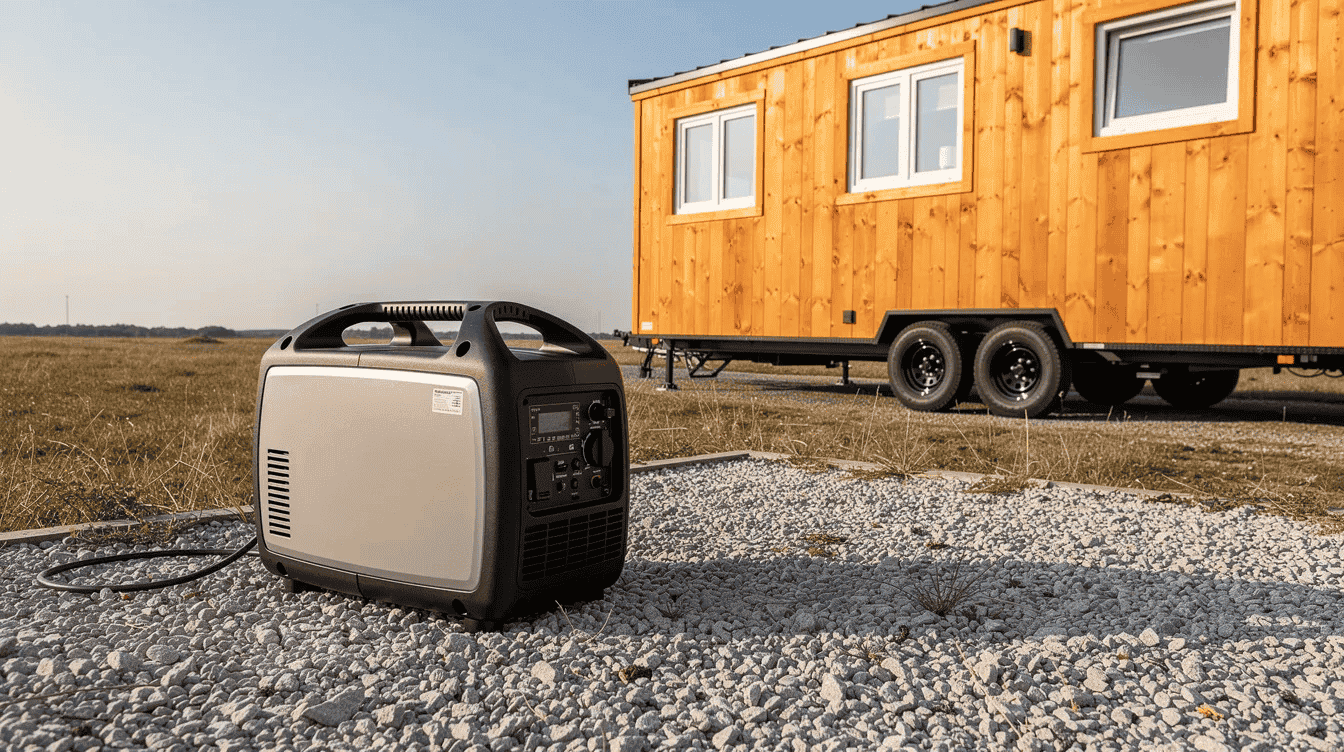
The Honda EU2200i has a power output of 2200 watts (surge) with 1,800 watts continuous from a compact 121cc engine. It weighs just 47 pounds, holds 0.95 gallons of fuel, and produces clean inverter power with low total harmonic distortion. This is the portable generator that consistently tops reliability lists for good reason.
Why It Stands Out
The Honda EU2200i generator is known for its quiet operation. At 25% load, it drops to roughly 48 decibels, quieter than a normal conversation. Combined with Honda’s Eco-Throttle system, it adjusts engine speed automatically based on load, so you’re not burning fuel you don’t need.
Best For
Tiny house owners who prioritize whisper-quiet operation and long-term reliability over raw power output. If you value sleep and low maintenance, this is your unit, particularly if it’s mounted on a purpose-built tiny house trailer foundation.
Key Strengths
- Extremely quiet operation at 48-57 decibels depending on load
- Excellent fuel efficiency with 8+ hours of runtime at quarter load. Gas generators can run for 9.6 hours on 1 gallon of fuel under optimal conditions
- Clean inverter power safe for sensitive electronics, laptops, and medical devices
- 3-year residential warranty with widely available Honda parts, and it’s built to serve tiny-house owners reliably for years
Possible Limitations
- Higher upfront cost compared to budget inverter generators
- Limited to 1,800 watts continuous power output, which may struggle with larger home appliances like a space heater or mini-split AC
- Gasoline only, with no dual fuel option
- Pull-start only on the standard model
2. EcoFlow DELTA 3 Plus Solar Generator
This portable power station packs 1,024Wh of LiFePO₄ battery capacity with 1,800W continuous AC output and 3,600W surge capability. It weighs just 27.6 pounds, accepts up to 1,000W of solar input, and operates with virtually zero noise. It’s a true solar generator built for sustainable living.
Why It Stands Out
Solar generators produce no noise or fumes, making this the only option on our list you can safely run inside your tiny cabin. With solar panels mounted on your roof, solar generators can recharge as long as there is sunlight, meaning you can generate your own electricity without ever buying fuel.
Best For
Environmentally conscious tiny house owners in sunny climates who want silent, emission-free solar power as their primary power source, a setup that can help them live off grid with more freedom.
Key Strengths
- Completely silent operation with no emissions. Solar generators produce no emissions during operation, eliminating carbon monoxide concerns entirely
- 1,024Wh battery capacity with 1,800W output and X-Boost mode supporting loads up to 2,200W; performance depends on proper sizing, matching energy consumption to overall solar system capacity
- Fast solar charging up to 1,000W input. Solar panels can generate 600Wh in 6 hours of sunlight, so a full recharge is achievable in a single day
- LiFePO₄ battery chemistry rated for 4,000+ cycles to 80% capacity
- Solar generators are portable and lightweight compared to gas generators, at just 27.6 pounds
Possible Limitations
- Dependent on weather conditions for solar charging. Extended cloudy periods require backup or AC charging
- Higher initial investment than gas generators
- Battery capacity limits how much power you can draw before needing a recharge, so heavy loads like a water heater will drain it quickly
- A solar generator can power appliances for long hours with sufficient sunlight, but overnight usage requires careful energy consumption management, and using daytime charging strategically can help extend battery life and improve efficiency
3. Champion 3400-Watt Dual Fuel Generator
This dual fuel generator delivers 3,400 starting watts on gasoline (3,100 running) and 3,060 starting watts on propane (2,790 running). It features electric start, a 30A RV outlet, and inverter technology producing less than 3% THD. At 59 dBA, it’s the loudest on our list but also the most powerful single unit.
Why It Stands Out
Dual-fuel generators can operate on both gasoline and propane, giving you flexibility that no single-fuel model can match. When you’re living off grid and gasoline isn’t always easy to find, it’s practical to keep propane on hand because gasoline degrades quickly and can create strong odors in small spaces, and the ability to switch to a 20-lb propane tank and run for up to 14.5 hours is a genuine advantage. Propane is preferred for long-term fuel storage because it does not degrade like gasoline and burns cleaner.
Best For
Tiny house owners needing more power for air conditioning, a well pump, or multiple simultaneous loads such as a fridge or occasional power tools, and who want the backup power source flexibility of two fuel types.
Key Strengths
- 3,400 watts starting power handles the brief moment when compressors and motors draw heavy startup surges
- Dual fuel operation with gasoline or propane. Propane generators burn cleaner than gasoline generators, reducing your carbon footprint
- Electric start with remote control capability, no pull cord wrestling
- Clean inverter power output safe for electronics, with ac outlets and USB a ports
Possible Limitations
- Louder operation than smaller inverter models at 59 dBA. Propane generators are much quieter than gas generators, so running on propane helps, though performance can drop in very cold temperature conditions
- Heavier weight at 95.9 pounds limits portability, though wheels and handles help
- Gas generators require fuel, increasing operational costs over solar alternatives
- More maintenance required: oil changes, spark plugs, fuel filters
4. WEN 56203i Super Quiet Inverter Generator
A budget-friendly gasoline inverter generator with a 79cc engine, 2,000W surge, and 1,700W continuous output. It features THD under 1.2%, a fuel shut-off system for storage, and weighs just 39 pounds. This small generator punches above its price class.
Why It Stands Out
The WEN 56203i delivers inverter technology benefits, including clean power and quiet operation, at an affordable price point under $500. Inverter generators are quieter than open-frame generators, making them better suited for close living quarters, and the WEN proves you don’t need a premium brand to get that benefit.
Best For
The WEN is a great fit for budget-conscious tiny house owners who need basic reliable power for household essentials without breaking the bank. It’s especially useful where tiny house kitchen appliances must be compact and efficient. Also excellent as a backup power source alongside a battery system in tiny house interiors that maximize every square foot.
Key Strengths
- Quiet 51 decibel operation at quarter load, suitable for nighttime use
- Clean inverter power for sensitive electronics with THD under 1.2%, among the lowest in its class
- Affordable price point under $500
- Fuel shut-off feature runs the carburetor dry before storage, preventing stale fuel problems
- Inverter generators have lower emissions than traditional generators
Possible Limitations
- Lower 1,700 watts maximum output, which means it won’t handle heavy loads. Gas generators can provide up to 1,600 watts of power on smaller units, and this slightly exceeds that
- Shorter 2-year warranty period than premium brands like Honda or Yamaha
- Small fuel tank requires more frequent refueling during heavy power usage
A 1,000-watt solar generator powers basic appliances, so if your energy needs are minimal, consider whether a portable solar generator might serve you better than a gas unit at this wattage level.
5. Goal Zero Yeti 1500X Portable Power Station
This lithium-ion NMC power station offers 1,516Wh of battery storage, a 2,000W continuous inverter (3,500W surge), and multiple output ports including AC, USB-C PD, USB-A, and 12V. It supports solar input up to 600W and weighs 45.6 pounds. It’s a serious energy storage solution for off grid tiny house living.
Why It Stands Out
The Goal Zero Yeti 1500X combines the largest battery capacity on our list with a powerful 2,000W inverter in a single unit. Solar generators can recharge themselves as long as there is sunlight, and the Yeti supports multiple charging methods including solar, AC, and car charging for maximum flexibility. Its solar panels generate electricity, while the unit’s batteries store that power for later use, especially after sunset.
Best For
Serious off grid tiny house owners needing multi-day portable power and stored energy for extended periods without access to the electric grid. Ideal for those who pair solar with battery storage in one of the best tiny house designs for modern living.
Key Strengths
- 1,516Wh lithium battery with 2,000W inverter can run a refrigerator for approximately 21 hours
- Multiple charging methods including solar, AC, and 12V, providing a versatile power solution
- Nearly silent operation with no engine noise; fans activate infrequently
- Solar energy reduces reliance on fossil fuels, making this a genuine renewable energy source
Possible Limitations
- Heavy weight at 45.6 pounds for a portable power station
- Premium pricing for the storage capacity
- NMC battery chemistry offers approximately 500 cycles to 80%, fewer than LiFePO₄ alternatives
- AC charging with the included charger takes 14+ hours. Faster chargers cost extra
- Limited runtime under heavy sustained loads like electric heating
6. Yamaha EF2000iSv2 Inverter Generator
A premium 79cc gasoline inverter generator delivering 1,600W continuous and 2,000W surge. It features a fuel shut-off petcock, CARB/EPA certification, and excellent build quality. At 44 pounds and roughly 19 × 11 × 18 inches, it fits neatly into tight tiny house storage compartments.
Why It Stands Out
The Yamaha EF2000iSv2 operates at a noise level of 51.5 decibels at quarter load, making it one of the quietest gas generators available. Its Smart Throttle technology automatically adjusts engine speed based on load, maximizing runtime and minimizing fuel waste.
Best For
Tiny house owners wanting premium reliability, quiet operation, and the ability to expand with parallel capability for doubled power output when needed; starting with one unit can also make sense if you expect future power needs to grow, especially in more elegant tiny homes that redefine modern living.
Key Strengths
- Smart Throttle technology for optimal fuel efficiency, using less fuel at partial loads
- The Yamaha EF2000iSv2 operates at just 51.5 decibels at a quarter load, comparable to a quiet conversation
- Parallel capability lets you connect two units for up to 3,200W continuous, providing enough power for larger loads, and adding a second later may be worth it if your needs grow
- CARB/EPA certified with a 3-year warranty
- Built-in fuel shut-off petcock prevents stale fuel issues during storage
Possible Limitations
- Higher price point than comparable generators like the WEN 56203i
- Limited to 1,600 watts continuous output as a single unit
- Noise increases to approximately 61 dBA at rated load
- Gasoline only, no propane option
Quick Comparison of the Best Generators for Tiny Houses
Generator | Best For | Continuous Power | Noise (dBA) | Weight | Fuel Type |
|---|---|---|---|---|---|
Honda EU2200i | Reliable quiet operation | 1,800W | 48-57 | 47 lb | Gasoline |
EcoFlow DELTA 3 Plus | Silent solar-powered operation | 1,800W | <30-40 | 27.6 lb | Solar/Battery (LiFePO₄) |
Champion 3400 Dual Fuel | High power needs & fuel flexibility | 3,100W (gas) / 2,790W (propane) | ~59 | 95.9 lb | Gasoline + Propane |
WEN 56203i | Budget-conscious buyers | 1,700W | ~51 | 39 lb | Gasoline |
Goal Zero Yeti 1500X | Extended off-grid power storage | 2,000W | Near silent | 45.6 lb | Solar/Battery (NMC) |
Yamaha EF2000iSv2 | Premium features & parallel capability | 1,600W | 51.5-61 | 44 lb | Gasoline |
If you need a 5,000-watt generator that can power almost all appliances in a larger tiny home setup, consider models like the Jackery Solar Generator 5000 Plus with its 5,040Wh capacity, or the Generac GP3000i which delivers 3,000 watts of power output as a mid-range alternative. The Jackery Solar Generator HomePower 3600 Plus can also power essentials for 1-2 days on a single charge.
How to Choose the Right Generator for Your Tiny House
Choose Based on Power Requirements
Start by listing every electrical appliance you plan to run and its wattage requirements, using the same process you would when planning tiny house electrical wiring basics. Here’s a typical tiny house load calculation:
Appliance | Running Watts | Starting Watts |
|---|---|---|
Energy-efficient refrigerator | 100-1200W, depending on size and type | 600-800W |
LED lighting (full house) | 100W | 100W |
Microwave | 1,000W | 1,500W |
Laptop + router | 100W | 100W |
Mini-split AC (13,000 BTU) | 1,200-1,500W | 2,500W |
Coffee maker | 800-1,200W | 1,200W |
Add up your running watts for the total count of devices you’d use simultaneously. That’s your baseline. Then identify the highest starting watt appliance, since motor-driven devices like a well pump or refrigerator compressor can draw 2-3× their running wattage on startup. Choosing essential energy-efficient appliances for a tiny house kitchen also helps keep overall demand lower. | ||
Size your generator with at least 20% headroom above your peak calculated load. If your total power usage comes to 2,400W continuous with a 3,000W startup surge, a 3,000-3,500W generator gives you comfortable margin. A light-power generator in the 2,000-2,500W range can typically handle LED lights, phone chargers, and a small fridge. Don’t forget that how much power you actually need depends on whether you’ll run a space heater, water heater, or air conditioning, as these dramatically shift your wattage requirements. |
Choose Based on Fuel Type, Efficiency, and Off Grid Needs
Each fuel type brings different trade-offs for tiny house living, and understanding how you’ll hook up a tiny house to utilities — whether grid-tied, hybrid, or fully off grid — should guide which generator and fuel source makes the most sense:
- Gasoline: Highest energy density and widest availability, but degrades over time, poses fire risk, and produces emissions. Generators can contribute to air pollution through emissions, so coordinate your choice with tiny home electric and plumbing system design to keep everything safe and code-compliant.
- Propane: Propane generators are quieter and cleaner than gas generators, with fuel that stores indefinitely. Slightly lower power output per unit, but cleaner burning and easier to store. Some propane generators can also run on natural gas with conversion kits.
- Dual fuel: Maximum flexibility. Switch between gasoline and propane depending on what’s available, freeing up resources for other off-grid systems like a tiny house rainwater collection setup.
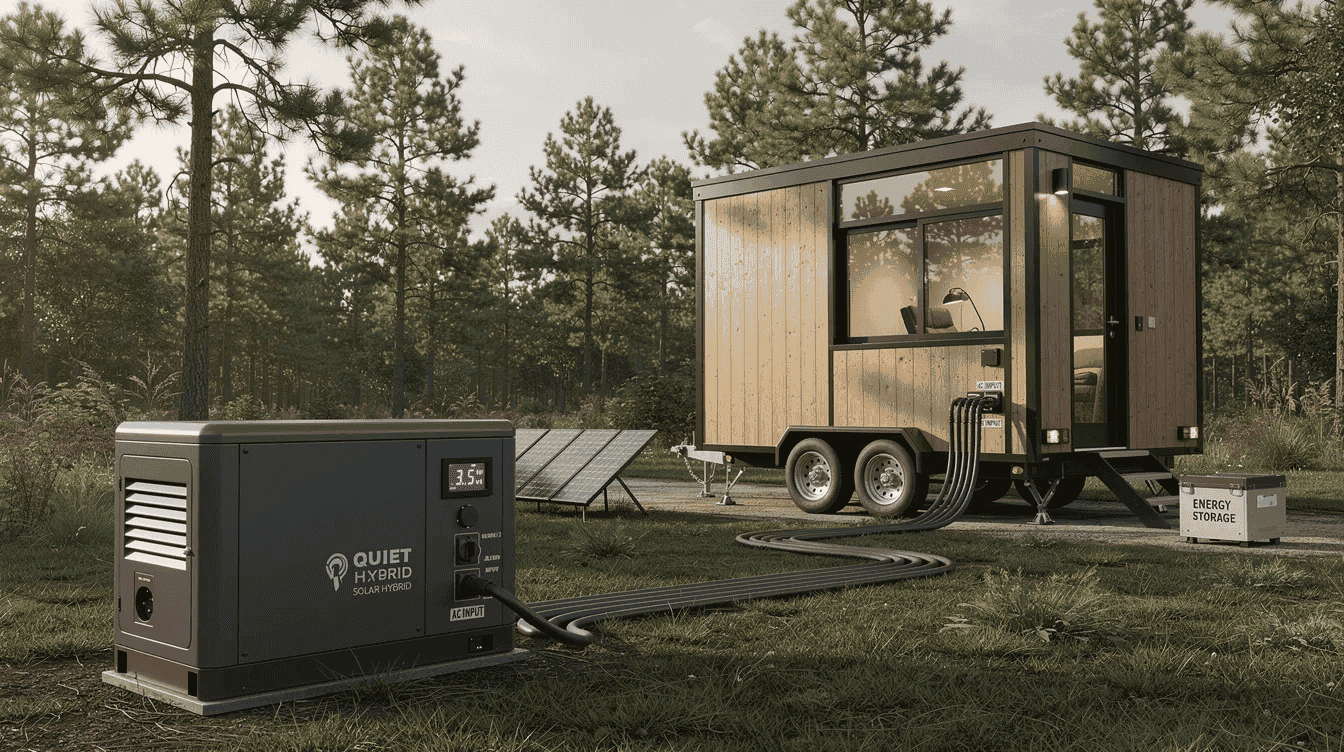
- Solar + battery: Zero emissions, zero fuel cost, renewable energy at its purest. The trade-off is dependence on sunlight and higher upfront cost, and many tiny-house systems start with roughly 4-12 solar panels in the 300-400W range. A dedicated tiny house battery bank and solar setup ensures your generator integrates smoothly with stored energy. Consider how much solar power your location receives before committing fully.
For long-term off grid living, many tiny house owners find that portable solar generators paired with a small gas backup provide electricity for the widest range of scenarios, especially when combined with other self-sufficient tiny home systems like rainwater and composting setups. Solar power lets you convert sunlight into your own electricity during the day, while a generator covers extended cloudy periods or heavy loads, especially when combined with well-sized solar panels for a tiny house. Energy Star appliances consume less energy than standard models. Choosing efficient appliances can save money by reducing the size and cost of the solar setup.
Choose Based on Noise and Living Comfort
Noise matters more in tiny houses than almost any other living arrangement. You’re sleeping, working, and relaxing within a few hours of running your generator, and thin walls provide minimal sound insulation.
Here’s a quick noise reference:
- Under 50 dBA: Quiet library level. Battery power stations and portable solar generators fall here
- 50-60 dBA: Normal conversation. Most inverter generators operate at 50-60 decibels in this range
- 65-85 dBA: Traditional generators can be louder, ranging from 65 to 85 decibels. This is lawnmower territory and unacceptable for close-quarters living
LED bulbs use about 75% less energy than traditional bulbs, which helps keep generator size and runtime demands down.
Generators with built-in mufflers can reduce noise levels significantly. Beyond the unit itself, placement matters: every doubling of distance from the generator reduces perceived noise by approximately 6 dB. Point the exhaust away from your living space, keep it well away from doors, windows, vents, and other openings to reduce carbon monoxide risk, use weather protection enclosures, and place the generator on vibration-dampening pads.
Safety features like carbon monoxide shutoff sensors are common in quality portable generators and are non-negotiable for tiny house use. Carbon monoxide risks require outdoor operation of traditional generators, always, without exception. Never run a gas or propane unit inside, in a garage, or in any enclosed space. Use extension cords rated for your generator’s amperage to maintain safe distance for peace of mind when using backup power close to a tiny house.
Which Generator Is Best for You?
Your ideal power solution depends on where you fall across three axes: power needs, budget, and environmental impact, and the road comes down to how you balance them as you move toward a self-contained tiny home for off-grid living. Exploring futuristic tiny homes with smart, efficient design can clarify which features and systems matter most before you commit to a power setup.
- Choose the Honda EU2200i if you prioritize proven reliability and quiet operation. It’s the gold standard small generator for tiny house owners who want a set-it-and-forget-it gasoline solution with minimal noise.
- Choose the EcoFlow DELTA 3 Plus if you want silent, eco-friendly solar power as your primary energy source. It’s the best choice for reducing your carbon footprint and embracing renewable energy with zero operational emissions, especially when paired with a tiny smart home packed with efficient tech.
- Choose the Champion 3400-Watt if you need high power output and fuel flexibility. When your tiny home runs air conditioning or multiple heavy loads, this dual fuel generator has the raw capacity to handle it, giving you a cleaner power option when running on propane.
- Choose the WEN 56203i if you want inverter benefits on a tight budget. It delivers clean, quiet portable power for basic energy needs at the lowest price point on this list.
- Choose the Goal Zero Yeti 1500X if you need maximum battery storage capacity for multi-day off grid living. Paired with solar panels, it provides a complete battery system that serves as both primary power and a backup power source during a power outage in a setup that may also rely on composting toilets for tiny houses.
- Choose the Yamaha EF2000iSv2 if you want premium features and expandability. The parallel capability means you can start with one unit and double your output later, scaling with your energy needs.
For many tiny house owners, the smartest approach is combining two of these: a portable power station for silent everyday use and a small generator for heavy loads or cloudy stretches. This hybrid setup maximizes energy efficiency while keeping noise to a minimum.
Final Thoughts
The best generator for tiny house living is the one that matches your specific power needs, budget, and lifestyle, and for people who want to live simply, the tiny house movement has been growing for over two decades. There’s no universal answer because a solar-powered tiny cabin in Arizona has fundamentally different requirements than an off grid tiny home in the Pacific Northwest.
What remains constant: proper sizing prevents both underpowered frustration and overspending. Space-saving choices such as vertical storage, multi-purpose furniture, and Murphy beds can also affect what equipment and storage capacity your setup can realistically accommodate. Always calculate your actual power requirements rather than guessing, and leave headroom for a few hours of peak demand. Factor in your fuel storage limitations, noise tolerance, and whether you want to provide electricity from renewable or fossil sources.
Hybrid systems combining generators with solar or battery storage often work best for daily off grid living. They give you the resilience of fuel-based power generation with the silence and sustainability of stored energy from solar, which is a major benefit for tiny house cabin retreats used as cozy getaways or for Swedish-inspired tiny houses focused on comfort and sustainability. As battery technology improves and costs drop, smart daytime use around the sun can help in maintaining battery performance, and the balance is shifting toward cleaner, quieter portable ones every year.
Investing in a quality power source pays off when you’re relying on it every single day. Many owners choose tiny homes for the freedom to live with less, use every inch well, and keep the right mind for daily off-grid adjustments, while features such as composting toilets reduce utility dependence because they do not require water or sewer hookups. Your tiny house is your home. The generator you choose determines whether it feels like one.