


Quick answer: The best noise insulation tiny house ideas combine four principles—mass, decoupling, damping, and sealing. Use dense materials like mineral wool and Mass Loaded Vinyl, decouple walls with resilient channels or sound clips, seal every gap with acoustic caulk, and upgrade to double or triple-pane windows for a quieter, cozier tiny home.
Let me tell you something I learned the hard way: tiny homes are amazing until your neighbor fires up their lawnmower at 7 a.m. and it sounds like it’s happening inside your living room. When you live in a few hundred square feet, there’s nowhere to hide from noise. No spare bedroom to escape to, no long hallway to muffle the racket—just you, your beautiful little space, and every single sound the world throws at it.
That’s the trade-off nobody warns you about when you fall in love with tiny living. The lightweight construction that makes these homes mobile and affordable also makes them, well, a bit of a sound megaphone. But here’s the good news: you don’t have to choose between minimalist living and a peaceful night’s sleep.
These noise insulation tiny house ideas will help you turn your cozy space into a genuine sanctuary. I’ve gathered the science, the materials, and the practical tricks so you can stop wincing at every passing truck. Let’s make your tiny home as quiet as it is charming.
- Why Is Noise Such a Big Deal in Tiny Homes?
- The Four Golden Rules of Noise Insulation
- What Are the Best Noise Insulation Materials for Tiny House Walls?
- How Do You Soundproof Tiny House Floors and Ceilings?
- How Can You Stop Noise Coming Through Windows and Doors?
- Structural Tricks for Serious Sound Blocking
- How Do You Quiet Noisy Appliances and Systems?
- How Much Does It Cost to Soundproof a Tiny House?
- Beyond Insulation: Easy Ways to Soften Sound
- Your Quiet Tiny Home Awaits
- Frequently Asked Questions
Why Is Noise Such a Big Deal in Tiny Homes?
Before we start slapping insulation on every surface, it helps to understand what we’re actually fighting. Sound is sneaky, and tiny homes give it plenty of ways to sneak in.
What are the two types of noise you need to block?
There are two main troublemakers here:
- Airborne noise: This is sound that travels through the air—think voices, music, barking dogs, and traffic. It slips through gaps, thin walls, and windows.
- Impact noise: This is sound created by physical contact, like footsteps on the floor above, rain hammering your metal roof, or a slamming cabinet door. It travels through the structure itself as vibration.
You’ll need different strategies for each, which is why a good plan tackles both.
How does sound actually travel through your walls?
Sound is just energy moving in waves. When those waves hit a wall, they make the material vibrate, and that vibration passes through to the other side, where it becomes sound again. The denser and more disconnected your materials are, the harder it is for that energy to make the journey.
This is measured using something called the Sound Transmission Class, or STC rating. According to Acoustical Surfaces, an STC of 45 is the baseline where real soundproofing and privacy begin, while anything 50 or above is considered genuinely effective. For reference, a standard interior wall might only hit an STC of 33—which explains why you can hear, ahem, everything.
Why are tiny homes so tricky to soundproof?
Tiny houses come with their own special challenges. They’re built light to stay mobile, so they skip the heavy mass that naturally blocks sound in a regular house. Wall cavities are shallow, leaving little room for thick insulation. And because everything is packed so close together, your noisy fridge might be three feet from your pillow. Fun!
The Four Golden Rules of Noise Insulation
Every soundproofing trick comes back to four core principles. Master these, and you’ll understand exactly why each material and technique works.
- Mass: Heavy, dense materials are harder for sound to push through. More mass equals less noise.
- Decoupling: Separating two sides of a wall so vibrations can’t travel directly across the gap. Think of it as putting a tiny “moat” between surfaces.
- Damping: Converting sound energy into a tiny amount of heat using special compounds, stopping vibrations in their tracks.
- Sealing: Sound leaks through the smallest gaps, just like water. Blocking every crack is non-negotiable.
Keep these four in your back pocket. Everything below is really just a creative way to apply one or more of them.
What Are the Best Noise Insulation Materials for Tiny House Walls?
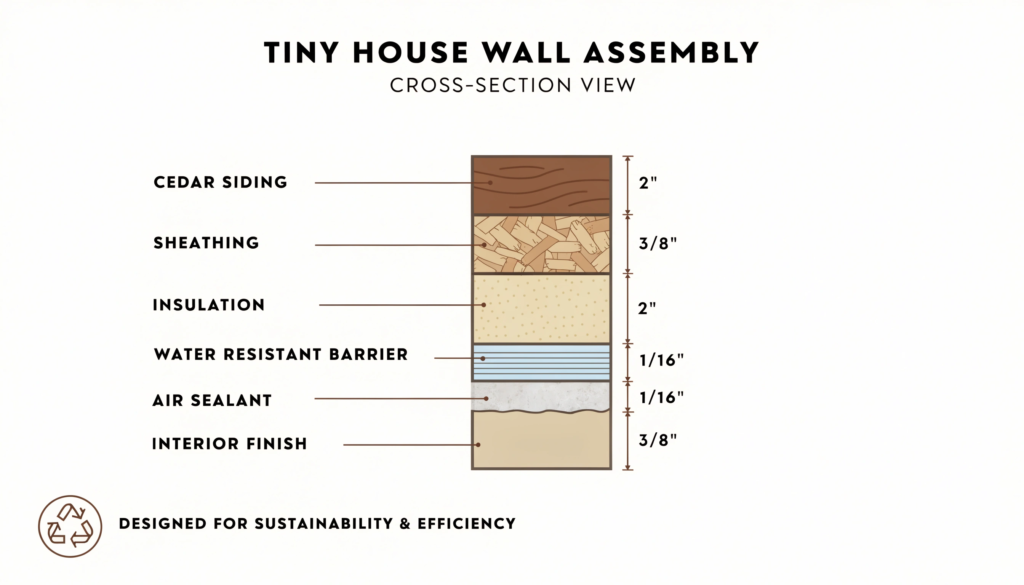
Your walls are the front line in the war on noise. Here’s what actually works inside those shallow cavities.
Mineral wool and Rockwool
If I had to pick one MVP, it would be mineral wool (often sold under the brand Rockwool). According to Acoustical Surfaces, mineral wool outperforms fiberglass for soundproofing thanks to its greater density and higher resulting STC rating. It’s also fire-resistant and water-repellent, which is reassuring in a small space. Pack it snugly into your wall cavities for excellent sound absorption and solid R-value insulation at the same time. Two birds, one eco-friendly stone.
Acoustic drywall (QuietRock)
Regular drywall is cheap, but it lets a lot through. Acoustic drywall like QuietRock is engineered with damping layers built right in. The QuietRock 530 panel, for example, delivers STC ratings between 52 and 74 depending on the assembly—a massive jump from standard drywall. It costs more, but a single layer can replace multiple layers of regular board, which saves precious wall thickness in a tiny home.
Mass Loaded Vinyl (MLV)
Mass Loaded Vinyl is a thin, heavy sheet you sandwich into walls to add mass without adding bulk. According to Buy Insulation Products, a 1/8-inch MLV barrier weighing one pound per square foot carries an STC rating of around 27 all on its own—performing nearly as well as a full 2×4 wall with drywall. For tiny homes where every inch counts, that density-to-thickness ratio is gold.
Cellulose insulation
For the eco-conscious crowd (which is most of us tiny dwellers, let’s be honest), cellulose insulation is a fantastic option. Made largely from recycled paper, it can achieve STC ratings as high as 70 depending on the wall assembly, according to the Cellulose Insulation Manufacturers Association. Greenfiber notes that a wall with an STC of 60 sounds half as loud as one rated 50. Sustainable and quiet—what’s not to love?
How Do You Soundproof Tiny House Floors and Ceilings?

Walls get all the attention, but impact noise loves your floors and roof. Don’t skip these.
Floor underlayments and subfloor strategies
Underlayments sit between your subfloor and finished floor to absorb impact noise—those footsteps and dropped spoons. Cork is a star here; according to WECORK, cork underlayment delivers strong Impact Insulation Class (IIC) ratings across different setups. Rubber and felt underlayments work well too. For serious results, layer multiple subfloor materials or add resilient clips to decouple the floor from the frame.
Spray foam, acoustic panels, and ceiling treatments
A word of caution on spray foam: it’s brilliant for thermal insulation and air sealing, but it’s not a soundproofing hero. The Journal of Light Construction actually advises against relying on either open-cell or closed-cell spray foam for sound control on its own. Open-cell foam offers some sound absorption, but for real noise blocking, pair it with mass. For interior comfort, acoustic panels and tiles on the ceiling tame echo and that drum-like effect of rain on a tiny roof.
How Can You Stop Noise Coming Through Windows and Doors?

Windows and doors are the weakest links in any wall. All that careful insulation means little if sound pours through a flimsy door.
Double and triple-pane windows
Windows are notorious sound leaks. According to Jeld-Wen, a standard dual-pane window carries an STC rating of only around 27. Upgrading to triple-pane—or windows with laminated glass and varied air gaps—bumps that number up considerably. If you’re near a road, this upgrade is worth every penny.
Solid core doors and weatherstripping
Hollow doors are basically drums waiting to be played by every noise outside. Swap them for solid core doors to add mass. Then seal the perimeter with weatherstripping and pop a draft stopper at the base—Emily Henderson’s team recommends a draft stopper on every door facing a noise source. Those little gaps around a door can leak a shocking amount of sound.
Structural Tricks for Serious Sound Blocking

If you’re still in the building or renovating phase, these techniques bake quiet right into your tiny home’s bones.
Staggered stud and double-wall construction
Staggered stud walls position studs on alternating sides of the wall plate, so each side connects to different framing. This decoupling slashes vibration transfer. Johns Manville’s testing shows staggered 2×4 stud walls hitting an STC of 59, with double stud walls performing even higher. In a tiny home, you’ll need to weigh this against the space it eats up—but it’s incredibly effective.
Resilient channels and sound clips
Resilient channels and sound isolation clips create a small gap between your drywall and the framing, decoupling the two so vibrations can’t travel through. According to Vibra-Sonic Control, sound clips outperform resilient channels with higher STC values, especially at low and high frequencies. Second Skin Audio notes that clips are pricier but much harder to install incorrectly—worth considering if you’re a DIY-er who, like me, occasionally messes things up.
Seal every gap with acoustic caulk
This is the cheapest, easiest win on the entire list. Acoustic caulk stays flexible and seals the tiny gaps around outlets, window frames, and trim where sound sneaks through. Grab a few tubes and go to town. Your wallet and your ears will thank you.
How Do You Quiet Noisy Appliances and Systems?
In a tiny home, your HVAC, plumbing, and appliances are right on top of you. A humming fridge becomes a personal nemesis fast.
- Insulated ducts: Wrapping HVAC ducts dampens the whoosh of moving air.
- Anti-vibration pads: Slip these under your fridge, washer, or any appliance that buzzes. They stop vibrations from traveling into your floor and walls.
- Low-noise fixtures: When you’re buying appliances, check the decibel ratings. A quiet range hood or low-noise fan makes a daily difference.
How Much Does It Cost to Soundproof a Tiny House?
Let’s talk money, because we’re a budget-savvy bunch. According to HomeAdvisor, soundproofing a room typically runs between $1,036 and $2,743, averaging around $1,881. The upside for tiny homes? Your square footage is small, so material costs stay lower than a full-size house.
Here’s how to spend smart:
- Prioritize the worst offenders. Tackle the wall facing the road or your noisy neighbor first.
- Get the cheap wins. Acoustic caulk, weatherstripping, and draft stoppers cost little and deliver real results.
- DIY where you can. Hanging MLV or caulking gaps is beginner-friendly. Save the pro budget for tricky window installs or structural work.
- Build it in early. Soundproofing during construction is far cheaper than retrofitting later.
Beyond Insulation: Easy Ways to Soften Sound
Sometimes the simplest fixes make the biggest difference, and they double as decor. Win-win.
- Soft furnishings: Rugs, thick curtains, upholstered furniture, and wall hangings absorb sound and kill echo. Bonus: they make your space feel cozy.
- White noise machines: When you can’t block a sound, you can mask it. A gentle hum smooths over distracting noises and helps you sleep.
- Smart layout: Place noisy appliances and your bathroom away from your sleeping nook. A little planning goes a long way.
Your Quiet Tiny Home Awaits
Here’s the thing—you don’t need to do everything on this list to feel the difference. Start with the easy, affordable steps: seal your gaps with acoustic caulk, add weatherstripping, throw down a rug, and tackle your noisiest wall with mineral wool and MLV. From there, you can layer in the bigger upgrades as your budget allows.
The beauty of these noise insulation tiny house ideas is that they stack. Each layer of mass, decoupling, damping, and sealing builds on the last, turning your tiny home into the calm, cozy retreat you dreamed of when you first downsized. Tiny living was never meant to feel like camping next to a highway.
So grab that caulk gun, channel your inner acoustic engineer, and reclaim your peace and quiet. Your tiny home—and your sanity—deserve it.
Frequently Asked Questions
What is the best soundproofing material for a tiny house?
Mineral wool (such as Rockwool) is widely considered the best all-around choice for tiny house walls because it combines high density, strong sound absorption, fire resistance, and good thermal insulation. For maximum results, pair it with Mass Loaded Vinyl for added mass and acoustic drywall like QuietRock, which can reach STC ratings of 52 to 74.
How can I reduce road noise in my tiny home?
To reduce road noise, focus on the wall facing the road first. Upgrade to triple-pane or laminated windows (standard dual-pane windows only rate around STC 27), install a solid core door with weatherstripping, add Mass Loaded Vinyl to the exterior-facing wall, and seal every gap with acoustic caulk. Heavy curtains and a white noise machine help mask any remaining sound.
Is spray foam good for sound insulation in tiny houses?
Spray foam is excellent for thermal insulation and air sealing but is not a strong soundproofing material on its own. The Journal of Light Construction advises against relying on open-cell or closed-cell spray foam for sound control. Open-cell foam offers modest sound absorption, so it works best when combined with dense, mass-adding materials.
What are resilient channels?
Resilient channels are thin metal strips installed between drywall and wall framing to create a small gap. This gap decouples the drywall from the structure, preventing sound vibrations from passing directly through. Sound isolation clips work similarly and, according to Vibra-Sonic Control, deliver even higher STC values, especially at low and high frequencies.
How much does it cost to soundproof a tiny house?
According to HomeAdvisor, soundproofing a room typically costs between $1,036 and $2,743, with an average around $1,881. Because tiny homes have less square footage, your total costs are usually lower. You can save money by prioritizing the noisiest walls, handling DIY-friendly tasks like caulking and weatherstripping yourself, and building soundproofing in during construction.