
If you have been researching whether tiny homes are allowed in Riverside County, the short answer is yes – but with important conditions. The rules depend on your property’s location, your home’s foundation type, and which jurisdiction you fall under. This guide breaks down every detail you need to turn your tiny home dream into reality in the Riverside area.
Key Takeaways
Tiny homes are allowed in Riverside County under specific ordinances and state building code provisions, but the rules are not one-size-fits-all.
- Foundation-based tiny homes are legal in many unincorporated area zones under Chapter 17.314 of the County Zoning Ordinance. Riverside County allows tiny homes under the 2022 California Building Code and Appendix AQ of the California Residential Code.
- Tiny homes on wheels are treated as recreational vehicles and generally cannot serve as permanent dwellings on standard residential lots. They are usually limited to designated RV parks, special occupancy parks, or agricultural employee housing.
- Different rules apply inside the City of Riverside versus unincorporated Riverside County. The city has a Movable Accessory Dwelling Unit (MADU) program that can allow a tiny house on wheels in a backyard as an accessory dwelling.
- In unincorporated Riverside County, tiny homes and residential shipping containers are allowed in certain zones (R-7, MU, and zones permitting single-family homes or accessory dwelling units), with a maximum of 500 square feet for a tiny home and key lot, setback, and foundation rules.
- Explore Tiny House is an educational resource – not a builder. Throughout this article, we point you toward clear next steps: checking current Riverside County Planning Department guidance, consulting a local designer, and reviewing foundation and utility requirements.
How Tiny Homes Are Regulated in Riverside County (Fast Answer)
Are tiny homes allowed in Riverside County? Yes – under Chapter 17.314 (Housing Alternatives) of the County Zoning Ordinance (Ordinance No. 348) and the 2022 California Residential Code Appendix AQ. These rules govern unincorporated Riverside County, not the City of Riverside.
- Foundation-based tiny homes up to 500 square feet (resembling a small single-family home) are allowed as primary dwellings or as an accessory dwelling unit in zones that already permit single-family or accessory dwellings, including R-7 and MU zones. The minimum lot size is 1,500 square feet, maximum height is 25 feet, and side and rear setbacks must be at least 5 feet.
- Tiny homes on wheels (THOWs) and most park model units are classified like recreational vehicles at the county level. Riverside County treats tiny homes on wheels as recreational vehicles, meaning they generally cannot be used as permanent full-time dwellings on standard residential lots. They are usually limited to designated RV parks, special occupancy parks, or agricultural employee housing sites.
- Inside the City of Riverside, movable tiny homes can sometimes be permitted as MADUs (Movable Accessory Dwelling Units) in backyards, subject to the city’s own ordinance, design certification, and hookup rules.
- Before starting any project, confirm whether your property is inside the City of Riverside or in unincorporated Riverside County, and verify your parcel’s zoning classification. Regulations for tiny homes depend on whether they are built on permanent foundations or wheels.
Riverside County vs. City of Riverside: Who Makes the Rules?
“Riverside County” and “City of Riverside” are two different governments with different ordinances for tiny homes and accessory dwelling units. This is a common point of confusion for people searching from Riverside CA.
- Unincorporated Riverside County is governed by the Board of Supervisors and the county Planning Department. Rules for tiny homes are mainly in Chapter 17.314 of the County’s Zoning Ordinance, enforced by the Building & Safety Division.
- The City of Riverside has its own municipal code, Planning Division, and a MADU program that can allow a tiny house on wheels as an accessory dwelling on residential property within city limits. City permits tiny homes in residential backyards with streamlined processes.
- Check your jurisdiction first. Pull up the Riverside County or City of Riverside online GIS/parcel viewer to confirm jurisdiction and zoning for your specific address before assuming any rules apply.
- Nearby cities like San Diego and other Riverside County cities (Temecula, Moreno Valley) each have their own local ADU and tiny home policies. Examples from San Diego’s accessory dwelling unit rules do not automatically apply in Riverside County.
Legal Tiny Home Types in Unincorporated Riverside County
Riverside County’s Ordinance No. 348, Chapter 17.314 (sections 314.010–314.070) specifically covers “tiny homes” and “residential shipping containers” for permanent housing in unincorporated county areas.
- Tiny home (per 314.020): Riverside County defines a tiny home as a detached structure designed for permanent occupancy by one household. It is site-installed, looks like a small single-family home, and is designed for year-round life with kitchen, bathroom, and sleeping areas – built to building code, not classified as an RV or mobile home. Tiny homes in Riverside County cannot exceed 500 square feet.
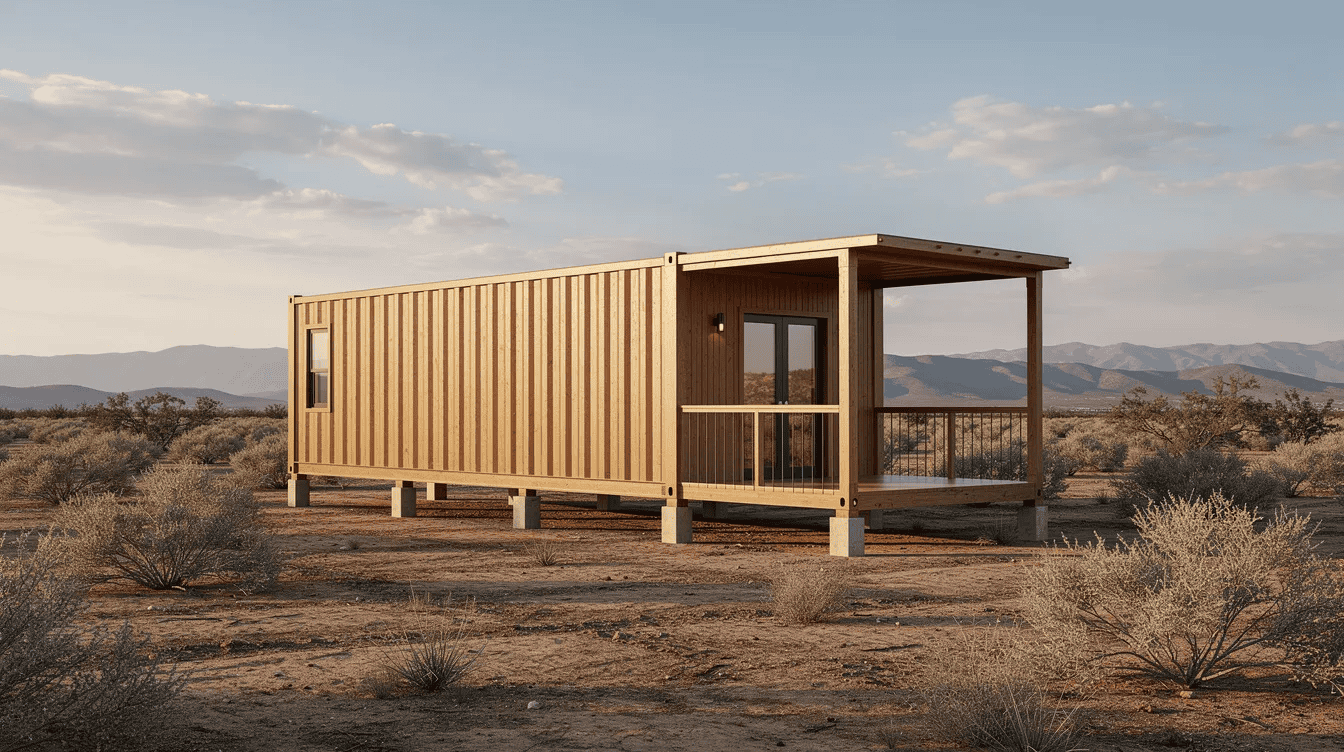
- Residential shipping container dwelling: steel ISO containers (typically 20×8 or 40×8 ft, 8.5–9.5 ft high) converted to dwellings meeting building, fire, structural, and environmental health requirements. Multiple containers can create a dwelling up to 1,200 square feet.
- Foundation required: Both types must be set on an approved foundation – concrete slab for tiny homes, and slab, pier, piling, or platform for containers per 314.050. They must connect to utilities. These are not movable RV-style units.
- Quick comparison in prose: A fixed, code-built tiny home sits on a slab foundation and is treated as a permanent dwelling (up to 500 sq.ft.). A residential shipping container home is similar but derived from steel containers (up to 1,200 sq.ft.). A tiny house on wheels or park model remains on a chassis with wheels – the county treats it as an RV, not a dwelling, and it cannot serve as a primary home on a standard residential lot.
Where Can You Put a Tiny Home in Riverside County? (Zoning & Locations)
Under section 314.030 of Chapter 17.314, location is controlled by zoning. Certain zones allow tiny homes by right in unincorporated Riverside County, but all applicable development standards must still be met.
- Allowed zones: R-7, MU (Mixed Use), and any zone that already permits single-family residences or accessory dwellings (including some R-A, R-R, and R-1 zones). The exact allowance depends on the zoning map for your parcel.
- Historic and overlay districts: Parcels located near historic resources or within special overlay districts may require an approved plot plan under Chapter 17.216, adding design review for aesthetics and neighborhood compatibility.
- Prohibited or limited areas: Tiny homes are prohibited in areas with water or sewage constraints, known health and safety issues (floodways, high fire-hazard zones without mitigation), or land under a development moratorium. Many areas with supply limitations will block new construction.
- Practical steps: Pull your Assessor’s Parcel Number (APN), contact the Riverside County Planning Department, and confirm that tiny homes or accessory dwelling units are allowed in your exact zone before purchasing land or beginning construction.
Permit & Approval Requirements (Planning, Building, Fire, Health)
A legal tiny home in Riverside County is permitted much like a small house. Permits are required for both permanent and wheeled tiny homes in Riverside County. You must go through land use (planning), building, fire, and environmental health review – especially in unincorporated areas with well or septic system needs.
- Planning review: Applications for tiny homes require a site design plan for compliance – showing lot lines, proposed tiny home footprint, setbacks, parking, driveways, utility connections, and compliance with Chapter 17.314 and base zoning. The permitting process follows standard county procedures.
- Building and safety: Tiny homes on permanent foundations must comply with California residential building codes, including the 2022 California Residential Code, Appendix AQ for small dwellings, structural calculations, and energy code (Title 24). Tiny homes must have a minimum ceiling height of 7 feet 6 inches and must include one room of at least 120 square feet.
- Fire department: Compliance with California Fire Code is required. In higher fire-severity zones, expect defensible space requirements, fire access roads, address visibility, and possibly sprinkler installation depending on occupancy and square footage.
- Environmental health and utilities: Detached ADUs generally require local water, sewer, and electrical connections. For lots without sewer, septic system design and percolation testing are mandatory. A tiny home must meet applicable health and safety requirements and obtain relevant permits. Well or water purveyor approvals and backflow prevention may also apply. Permit fees vary based on project scope and location.
Development Standards: Size, Height, Setbacks & Design
Chapter 17.314.070 sets specific development standards that sit on top of the base zone rules. Where the chapter is stricter, its standards control.
- Core quantitative standards: Minimum lot size of 1,500 sq.ft.; maximum height of 25 ft; minimum side and rear yard setbacks of 5 ft (tiny homes must maintain specific setbacks from property lines, typically 4 to 5 feet); front yard must match or exceed base zone requirements; standard off-street parking required per Chapter 17.188.
- Floor-area limits: Tiny homes can be up to 500 square feet in size of conditioned interior space (excluding patios, porches, garages). Permanent tiny homes can range up to 1,200 square feet under California law for residential shipping container dwellings assembled from multiple ISO containers.
- Clustering rules: Clusters of tiny homes in R-7 or MU zones must be enclosed by a 6-ft masonry wall around the project perimeter and must be compatible with the surrounding neighborhood’s density and character – even though no dedicated open space or recreation area is required.
- Aesthetic intent: Under 314.010, the county wants tiny homes to support affordability while protecting community appearance and property values. Exterior finishes, roofing, and window proportions should resemble conventional housing products in the area. This means a tiny home should blend into the neighborhood, not stand out as a novelty.
Foundations, Utilities & Park Model Considerations
Riverside County treats legal tiny homes as fixed structures. Foundation and utility details determine whether a structure is approved as a dwelling or remains an RV that cannot be lived in full time on residential land.
- Tiny home foundations: Tiny homes must be installed on a concrete slab foundation per section 314.050, with full connections to water, sewer or septic, electrical, and where required, gas – just like a small conventional house. Tiny homes on wheels need to connect permanently to utilities on a concrete pad if they are being installed as MADUs in the city.
- Container foundations: Residential shipping containers can use slab, piers, pilings, or engineered platforms, all designed to handle container point loads and meet seismic and wind requirements. More details on tiny house foundation types can help you evaluate options.
- Park models defined: Park models are classified as tiny homes in California – typically a 400 sq.ft. RV-type unit built to ANSI A119.5. In unincorporated Riverside County, these are treated as RVs. They may be allowed in designated RV parks and potentially as agricultural employee housing, but not as stand-alone permanent primary residences on standard lots unless converted to a code-compliant, foundation-based dwelling.
- Next steps for THOW owners: If you own or plan to buy a park model or tiny house on wheels, consult both the County Planning Department and Building & Safety Division about your options – permanent installation as an accessory dwelling, placement in an RV park, or use under state agricultural employee housing provisions.
Tiny Homes on Wheels, RVs & Agricultural Employee Housing
Riverside County generally classifies tiny homes on wheels, park models, and most RV-style units as vehicles rather than buildings when they remain movable. This limits permanent living use on standard residential parcels.
- County treatment of THOWs and RVs: Allowed in licensed RV parks, campgrounds, or as temporary dwellings in limited circumstances. Travel trailers and similar units are not approved as permanent primary residences on unincorporated residential lots without conversion to a code-built structure on an approved foundation. They can still be driven on public highways if registered as vehicles.
- Agricultural employee housing: Agricultural zones in Riverside County allow tiny homes for farmworkers. Under California’s Employee Housing Act, property owners can sometimes place tiny homes on wheels, park models, and RVs as legal housing for agricultural workers when the land is zoned for agriculture (A-1, A-2, or similar).
- Requirements for ag housing: State law can preempt some local zoning, but owners must still comply with building, health, and fire standards, obtain correct permits, and often provide units for five or more employees to fall under the Employee Housing Act framework.
- Rural vs. urban contrast: County agricultural housing is aimed at farmworker dwellings on large rural parcels, while the City of Riverside’s MADU approach supports backyard tiny houses on wheels in urban residential neighborhoods. The right fit depends on your land, your goals, and whether you are looking for rental income or personal use.
City of Riverside MADUs vs. County ADUs & Tiny Homes
Here is a side-by-side look at how a tiny home might work as an accessory dwelling unit in the City of Riverside versus in unincorporated Riverside County.
- City of Riverside MADU program: Incorporated Riverside has specific guidelines for Moveable Accessory Dwelling Units regarding size and placement. The city allows a certified tiny house on wheels to serve as a permitted backyard dwelling on a single-family home lot. MADUs must meet ANSI A119.5 or NFPA 1192 standards, have wheels and undercarriage hidden, and connect permanently to utilities. Moveable Accessory Dwelling Units must have active California DMV registration and safety certifications. MADUs are licensed and registered by the DMV. MADUs are permitted as permanent dwellings in Riverside and must comply with local zoning standards. MADUs can be installed on properties with single-family homes. Floor area typically ranges between 150 and 430 sq.ft.
- MADU process overview: The homeowner submits a site plan to the City of Riverside Planning Division, demonstrates that the tiny home meets the MADU ordinance (setbacks, parking, height, appearance), gets building and zoning approvals, then passes final inspection. This is a streamlined process compared to full construction.
- County ADU rules: Riverside County allows tiny homes primarily as permanent accessory dwelling units or site-built homes. Riverside County’s planning materials indicate that ADUs have separate protections under California state law. Like other California jurisdictions, the county must follow state law allowing at least one ADU on single-family residential lots (usually up to 800–1,200 sq.ft.), but county ADUs must be fixed units built to residential code. A prefab ADU can qualify if it meets code. California’s Department of Housing states that tiny homes can fall under different legal classifications depending on foundation and construction type.
- Explore Tiny House does not process permits but can help you understand whether your design concept is closer to a MADU (movable tiny home in the city) or a small ADU/tiny house on a slab in the county, so you know which officials to call first.

How Riverside County Compares to Other California Counties
Riverside County is among the California jurisdictions that have explicitly adopted tiny home provisions in their zoning code. Not all counties have gone this far, and details differ from neighboring places like San Diego County, Los Angeles County, and Orange County.
- Appendix AQ adoption: Both Riverside County and San Diego have adopted the 2022 California Residential Code Appendix AQ, sharing similar minimums – one habitable room at least 120 sq.ft., other habitable rooms at least 70 sq.ft., and minimum ceiling heights around 7 feet to 7 feet 6 inches. Check our guide to tiny house building codes by state for a broader comparison.
- Coastal county restrictions: Some coastal counties (like Sonoma or Napa) restrict tiny homes to temporary or park settings. Riverside County’s Chapter 17.314 explicitly allows permanent tiny homes and container dwellings on small lots in certain zones – a more progressive stance.
- Big variables statewide: Nearly all California counties allow some form of tiny house, accessory dwelling unit, or park model use. The differences come down to whether they allow THOWs as ADUs, whether they recognize park models outside designated RV parks, and how strict their minimum size and design rules are.
- San Diego’s strong adoption of prefab ADUs and tiny home-style accessory units illustrates broader momentum toward small-footprint housing across the state. Explore tiny house communities in California to see what is happening beyond the Riverside area.
Planning Your Tiny Home Project in Riverside County (Step-by-Step)
Here is a high-level roadmap from idea to move-in for homeowners and land buyers considering a tiny house, park model, or accessory dwelling unit in Riverside CA and surrounding unincorporated areas.
- Research first: Confirm city vs. county jurisdiction, pull zoning for the parcel, and download Riverside County Ordinance Chapter 17.314 and the 2022 California Residential Code Appendix AQ. Visit the Riverside County Planning Department website for current guidance.
- Choose your structure type: Code-built tiny home on slab foundation, container-based dwelling, accessory dwelling unit addition, or movable park model/tiny house on wheels intended for an RV park or City of Riverside MADU program. Each path has different compliance requirements, cost implications, and timelines.
- Assemble a concept package: Create a rough floor plan (under 500 sq.ft. for a tiny home under the county chapter), target location on the lot with approximate setbacks, foundation type, and anticipated utility connections. Even lofts and bedrooms should be sketched out to confirm room sizes meet Appendix AQ minimums.
- Collaborate with professionals: Contact the Riverside County or City of Riverside planning department, then consult a local architect or designer familiar with small homes and ADUs. Explore Tiny House offers inspiration galleries, cost calculators, and checklists to help you refine ideas before paying for full design drawings. A good designer can also help you generate your own power solutions and amenities planning for off-grid or grid-tied installation.
Photo & Visual Content Suggestions
This article features high-quality, HD, high-fidelity photographs and renderings to help readers visualize real-world tiny homes in Riverside County contexts – both rural and urban.
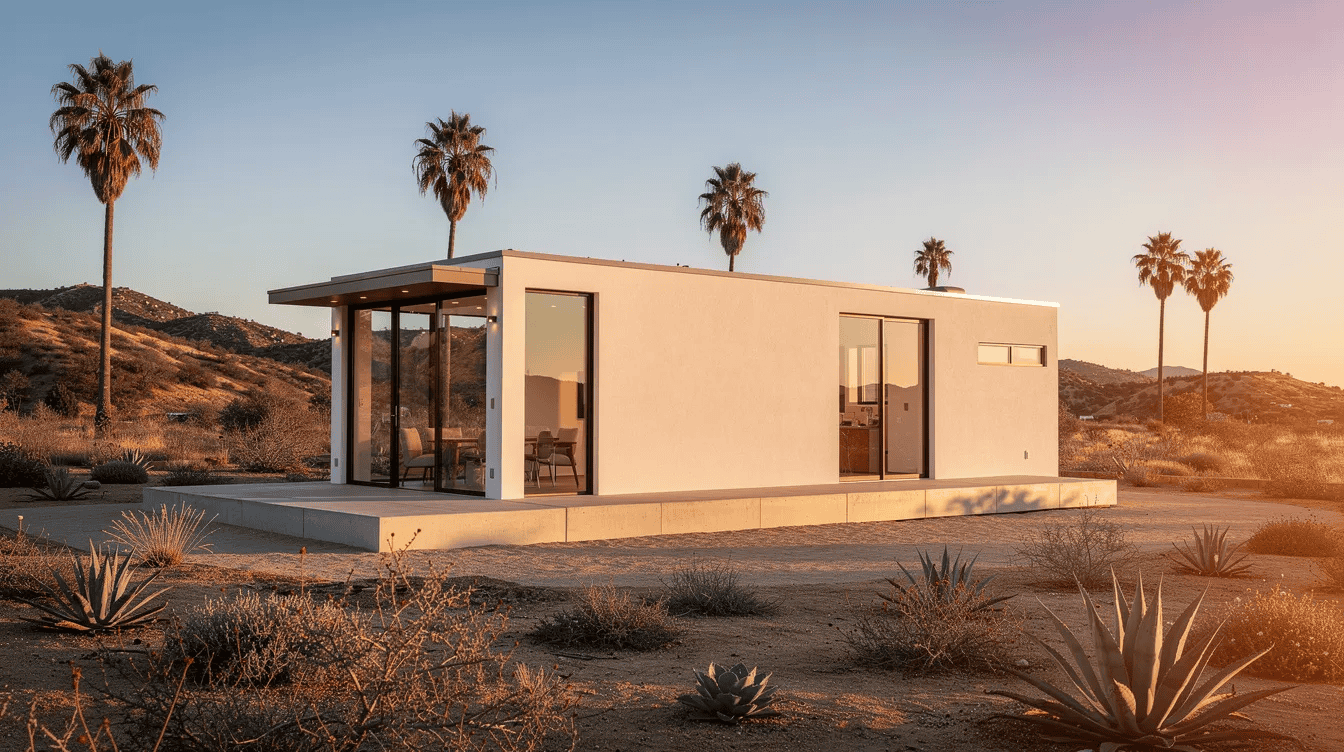
- Hero image: An HD photograph of a modern tiny home on a concrete slab in a semi-arid Riverside County landscape with palm trees and mountains, placed near the top of the article.
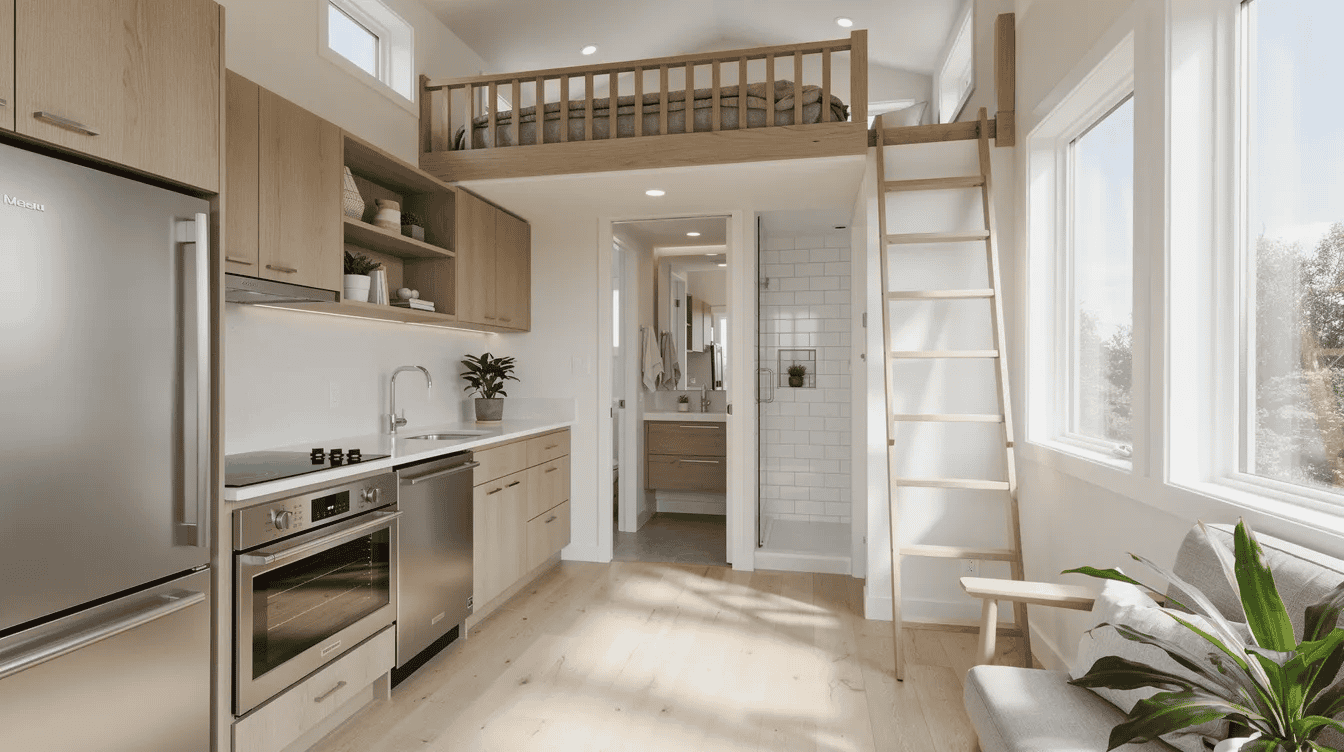
- Interior close-up: A high-fidelity image showing a 350–500 sq.ft. tiny house interior with full kitchen, sleeping loft, and compact bathroom – visually reinforcing that county-approved tiny homes support normal daily routines.
- City vs. county comparison: Side-by-side HD photos showing a backyard MADU-style tiny house in a Riverside neighborhood versus a cluster of tiny homes on an open rural lot, both in natural daylight.
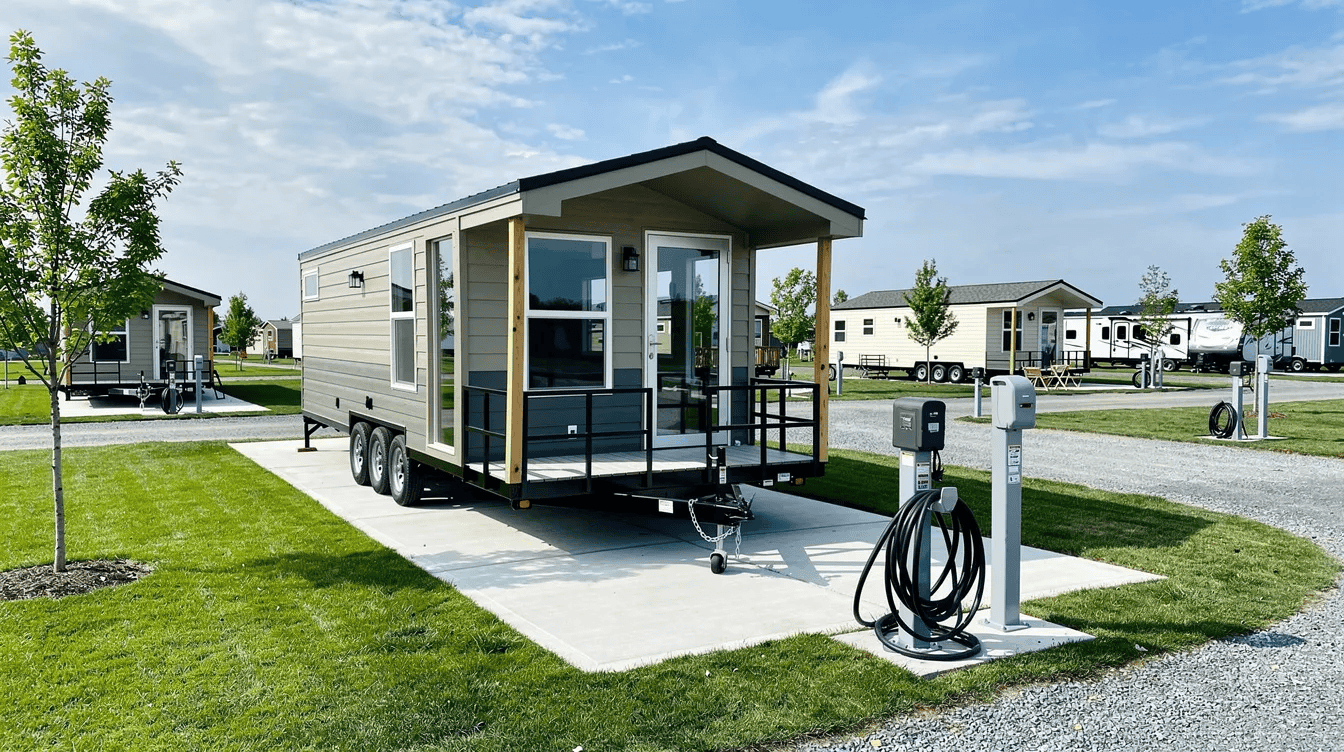
- Park model distinction: An image of a park model or tiny house on wheels in an RV park with wheels and hitch visible in one angle and utility hookups in another – helping readers distinguish movable units from permanent tiny homes on foundations.
FAQ: Tiny Homes in Riverside County
These questions address practical issues not fully covered in the main sections above.
Can I live full-time in a tiny house on wheels on my land in unincorporated Riverside County?
In most cases, no. The county treats tiny homes on wheels as recreational vehicles, so full-time use is usually limited to licensed RV or special occupancy parks and agricultural employee housing setups. Permanent living on a private residential lot generally requires a code-built unit on an approved foundation connected to utilities. Simply parking a THOW on your property does not create a legal dwelling.
Is there a minimum size for tiny homes in Riverside County?
Yes. Riverside County relies on the 2022 California Residential Code, including Appendix AQ, which requires at least one habitable room of 120 square feet and other habitable rooms of at least 70 square feet, with specific ceiling height minimums of 7 feet 6 inches. While Chapter 17.314 caps tiny home size at 500 square feet, it does not allow units smaller than the state’s minimum habitable room standards.
Can a tiny home in Riverside County count as an accessory dwelling unit (ADU)?
A small, code-compliant dwelling built on a permanent foundation can often be permitted as an accessory dwelling unit on qualifying residential lots, subject to California state ADU law and Riverside County’s ADU standards. Movable RV-type tiny homes generally do not qualify as ADUs in the county unless converted to permanent, code-built structures on approved foundations.
Do I need a special contractor to build a tiny home in Riverside County?
The county does not require a “tiny home” license specifically, but the builder must hold appropriate California contractor licensing – typically a Class B General Building contractor – and be comfortable working with the 2022 California Residential Code, Appendix AQ, and Riverside County’s Chapter 17.314. Hiring professionals with prior Riverside County or City of Riverside tiny home and ADU experience can streamline the project and reduce approval delays.
How long does it typically take to get a tiny home permitted in Riverside County?
Timelines vary with project complexity and county workload, but property owners should generally expect several weeks to a few months from initial application to building permit issuance for a straightforward single tiny home, assuming a complete submittal. More complex projects like clusters of tiny homes, container dwellings, or agricultural employee housing may take longer due to additional plot plan, environmental, and fire review. Budget for permit fees and possible revision rounds in your timeline.