
Earth Sheltered Homes in Texas: Fast Answers for Safety, Comfort, and Cost
An earth sheltered home uses surrounding soil as insulation and a structural buffer against weather. In Texas, where summer temperatures regularly exceed 100°F and tornado season brings real danger to North and Central regions, homeowners are turning to underground and earth bermed homes as energy efficient housing alternatives designed to combat extreme weather.
Well-designed earth sheltered homes in Texas can cut cooling energy costs by 50–60% while offering EF3+ tornado protection when engineered correctly. Earth sheltered homes can withstand EF3+ winds and hail, offering disaster resilience that conventional structures simply can’t match. Texas already has successful examples: underground dome homes near Buffalo, TX, a monolithic dome home in Ferris, TX, and multiple earth bermed homes across Central Texas hill country.
The main options break down into three categories: a completely underground home, an earth bermed home built into a slope, and a monolithic dome home or underground dome. This article covers types of earth sheltered dwellings, design considerations for Texas soil and climate, energy performance, costs, and real-world examples.
What Is an Earth Sheltered Home? Key Types Used in Texas
Earth sheltered construction means using earth – dirt, soil, rock – against walls, over roofs, or entirely surrounding a structure to provide insulation, temperature regulation, and protection. Underground homes are built completely below grade, relying on light wells and courtyards for daylight. Earth bermed homes are partially covered with earth on one or more sides, often looking like a traditional house from the front door.
Many Texas projects mix approaches. A monolithic dome home can be partially bermed, fully buried as an underground dome, or left exposed with earth banks added later. Monolithic domes offer flexibility in size and shape for underground homes, and they can weigh between 600 and 700 tons, making them extraordinarily stable.
Here’s how the main types compare: a completely underground house offers maximum storm protection but needs the most excavation and light planning. An earth bermed home is easier to permit and costs less to build, with bermed homes featuring grass or garden roofs for aesthetics. Exposed dome homes are the simplest to construct but sacrifice some thermal buffering. Related terms you’ll encounter from Texas builders include dome homes, green roof, and underground dome house.
Why Earth Sheltered Homes Fit the Texas Climate
Texas throws three problems at conventional homes simultaneously: extreme summer heat, severe thunderstorms with hail, and spring tornadoes concentrated in North and Central Texas. Earth sheltered design addresses all three.
Thermal mass is the key principle. Soil surrounding an earth sheltered home stays closer to 68–72°F at depth across much of Texas, and earth sheltered homes maintain a year-round temperature of 50–60 degrees. Soil helps moderate temperatures in earth sheltered homes during extreme heat, which means your air conditioning system works far less. Cooling bills can drop by 50–60% in earth sheltered homes across the Dallas–Fort Worth, Waco, and Austin regions when paired with efficient HVAC and passive solar shading. Earth sheltered homes can save over $300 monthly on cooling costs compared to conventional builds.
Storm advantages are equally compelling. Steel-reinforced concrete shells and underground construction can meet or exceed EF3 wind load ratings, and earth sheltered homes are resilient to hurricanes and tornadoes, providing superior safety. Underground homes provide immediate storm shelter during tornado warnings – families sleep peacefully during tornado season in underground homes, without scrambling for a separate safe room.
Earth sheltered homes are nearly sound-proof due to earth cover, a benefit for suburban Texas sites near highways or dense neighborhoods. They can also reduce insurance premiums due to storm damage protection. One important caveat: humidity and heavy rainfall in East Texas require more aggressive drainage and ventilation than drier regions to the west.
Types of Earth Sheltered Homes Texans Are Building Today
Texans are building earth sheltered structures using several concrete and steel systems – there’s no single “right” approach. Here’s what’s actually going into the ground.
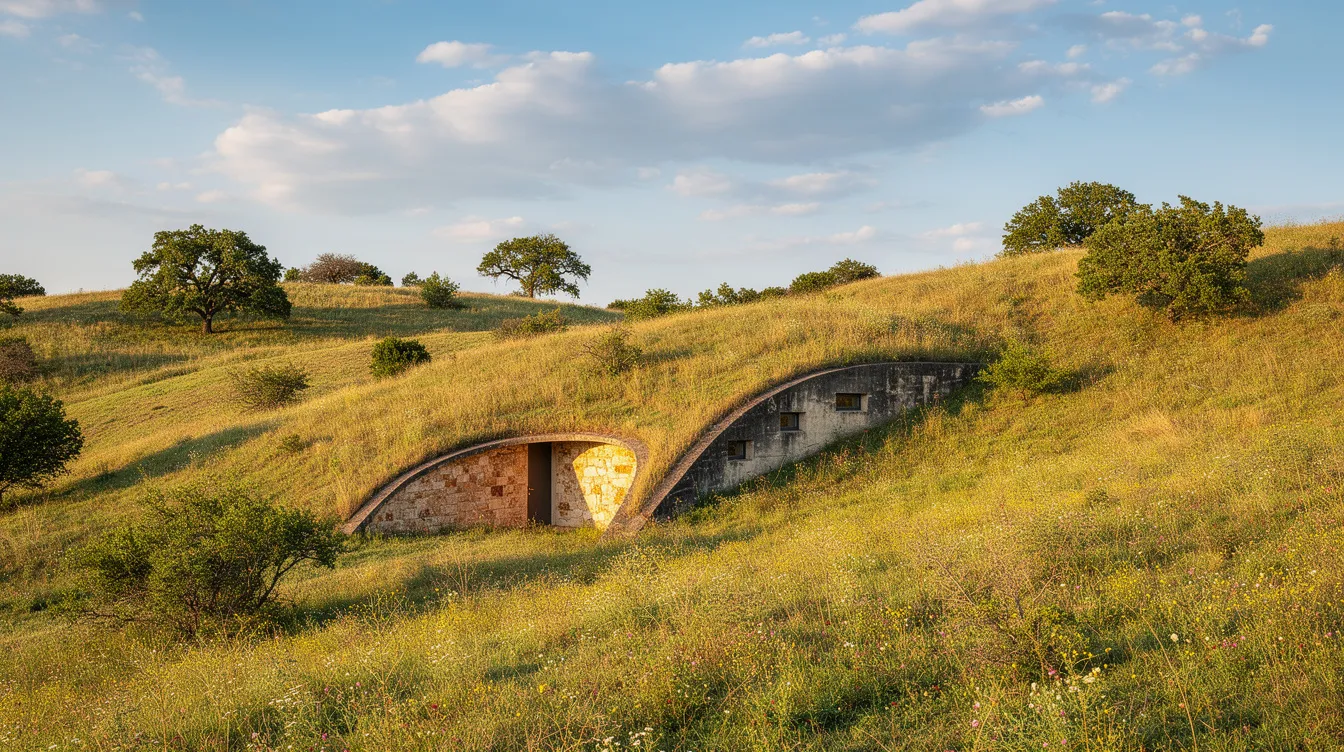
Underground homes and completely underground structures are built below grade with reinforced concrete walls and roof, organized around an open atrium, courtyard, or light well to bring in daylight and fresh air. Earth sheltered homes can be custom-designed for light and airflow. Underground homes can be completely invisible from street view, making them popular on rural land where privacy and security are priorities. Underground homes provide full protection from severe weather. Dallas Underground Homes has built multiple projects in the Dallas metro, engineering for clay soil and EF3 wind ratings.
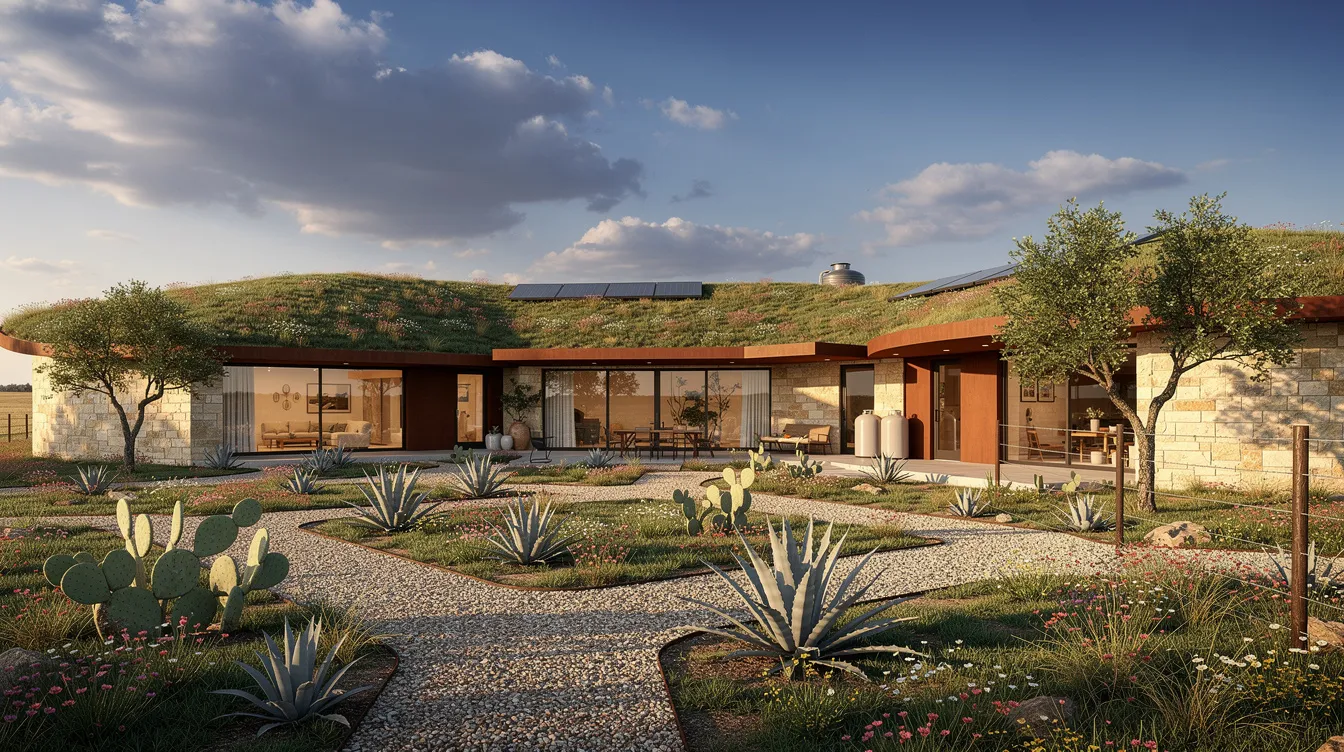
Earth bermed homes are typically built into a slope or with earth piled against one to three exterior walls. From the front, they can look like conventional ranch homes with grass or native plant roofs. Earth bermed homes can be built on any type of land, and they’re common in Hill Country and rolling parts of Central Texas. Earth sheltered homes can be integrated into the landscape, offering aesthetic and environmental benefits. Bermed designs outside Austin have demonstrated how alternative housing blends into the terrain.
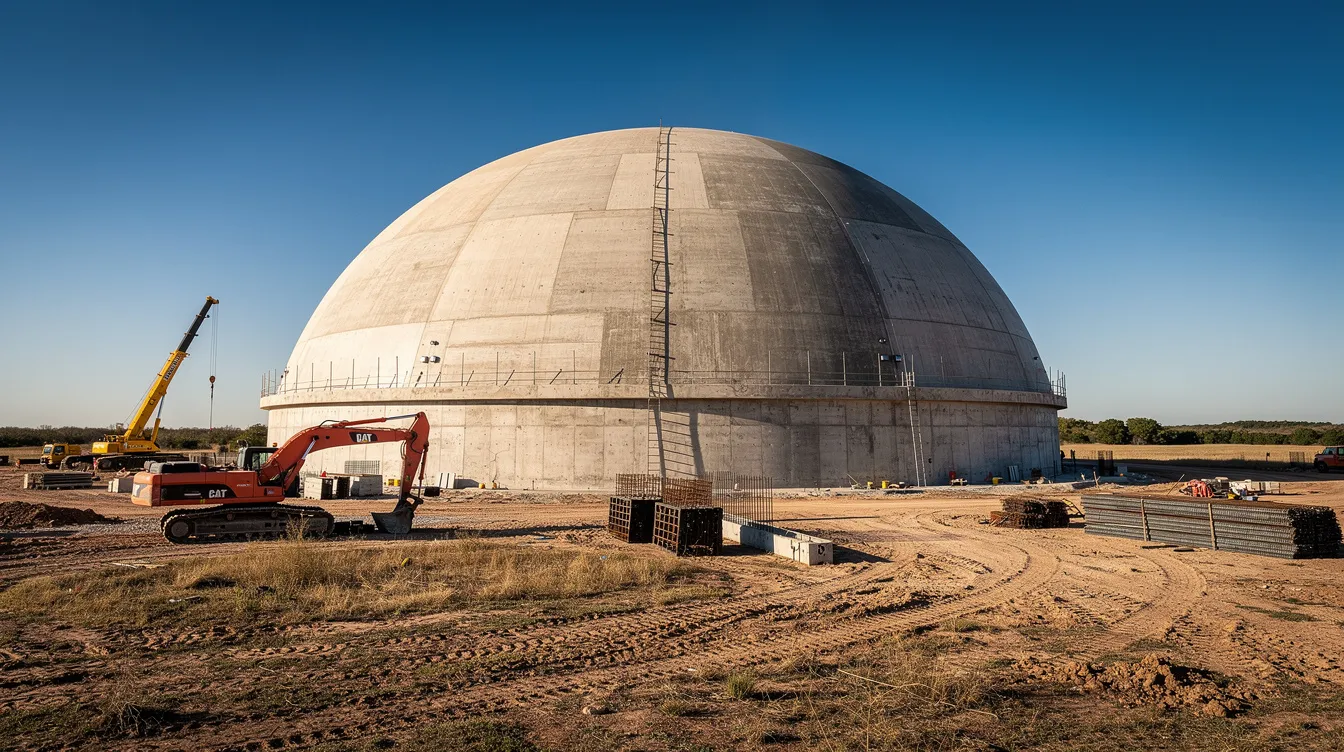
Underground dome and monolithic dome home designs use single or multiple reinforced concrete domes that are naturally strong against tornado winds due to their curved form. They can be exposed, earth bermed, or almost completely underground, and their passive solar and thermal-mass performance is similar to Earthship-style sustainable homes. The Orion dome home in Italy, Texas, built around 1999 with stemwalls and an oblate ellipsoid Airform, has proven durable through decades of Texas weather. A new 43-foot monolithic dome home near Austin was under construction in 2025 with two bedrooms and two bathrooms.
Designing Earth Sheltered Homes for Texas Soil, Drainage, and Comfort
Texas sites vary dramatically – from expansive Dallas clay to rocky Hill Country limestone – so every plan must be tailored to local soil and rainfall. Soil conditions vary widely in Texas, influencing the construction of earth sheltered homes, and site selection is important for earth sheltered homes, affecting moisture management and stability.
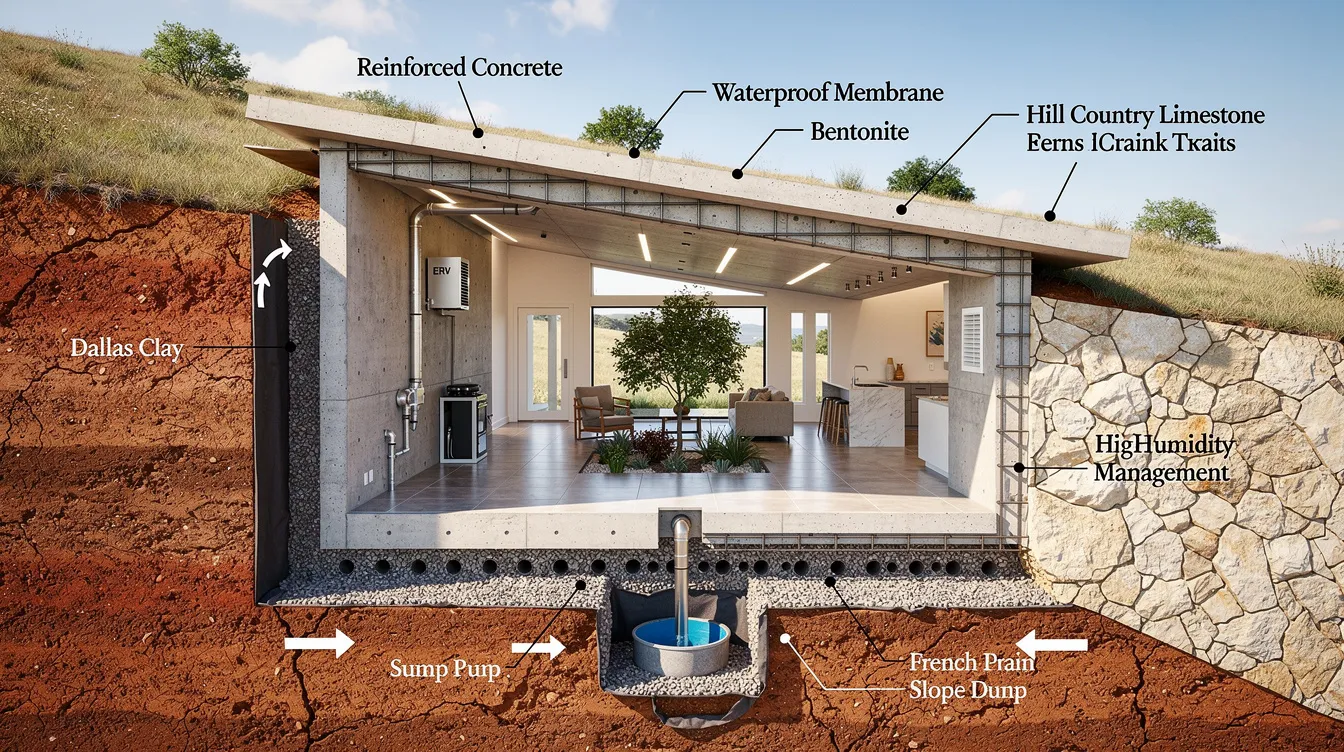
Foundation and structural engineering matter enormously. Dallas clay soil expands 6–8 inches during wet seasons, so slabs and walls must be engineered to prevent cracking. Earth sheltered homes require concrete and steel beams for support. Reinforced concrete thickness, rebar spacing, and waterproofing should be stamped by a licensed Professional Engineer (PE). Building an earth sheltered home in Texas presents challenges with humidity management that demand upfront engineering.
Drainage management is crucial to prevent flooding and moisture issues in earth sheltered homes. Proper drainage and waterproofing are necessary for earth sheltered homes due to heavy rainfall. Builders use perimeter drains, French drains, sump pumps, and sloped backfill to move water away from underground walls. High-quality waterproof membranes are critical for effective moisture control in earth sheltered homes, often combined with bentonite coatings. Moisture management systems are essential for earth sheltered homes to prevent dampness.
For ventilation, earth sheltered homes require robust dehumidification systems due to high humidity levels. Proper waterproofing and ventilation are critical in humid climates like Texas to prevent mold. Builders install energy recovery ventilators (ERVs), mechanical fresh air intakes, and ventilation portals to keep air quality high. Strategic placement of south-facing courtyards and light wells brings natural light deep into the structure, while polished concrete floors, tile, and low-VOC finishes help manage humidity and create comfortable living spaces with high ceilings.
Energy Performance, Air Conditioning Options, and Utility Savings
Energy savings are a primary motivator for earth sheltered homes in Texas, where summer electric bills can run two to three times winter bills. Earth sheltered homes require less energy for temperature control because the ground temperature remains stable, helping maintain comfortable indoor conditions. The surrounding earth buffers daily temperature swings, allowing smaller HVAC systems – in one Texas dome tour, a 2,000-square-foot dome needed only 1.5 tons of air conditioning versus the 4 tons typical for that size.
Proper insulation is necessary for energy efficiency in earth sheltered homes. Heating in winter is equally efficient – the stable ground temperature means minimal heating demand. Earth sheltered homes can reduce cooling costs by 50–60%, and passive solar design can be implemented in earth sheltered homes to enhance energy efficiency. Earth sheltered homes can utilize large south-facing windows for natural light and energy efficiency, cutting dependence on artificial lighting.
For air conditioning, Texas builders use high-efficiency heat pumps paired with ducted or ductless systems. Geothermal ground-source heat pumps leverage stable underground temperatures for even greater efficiency. Some owner-builders also integrate solar panels and battery backup for rural sites with frequent grid outages. A builder in Garland who started with earth sheltered homes in the 1980s is now constructing net-zero homes using solar and passive strategies. Earth sheltered homes can be built for the same cost as conventional homes when accounting for reduced mechanical system sizing and long-term energy savings.
Real Texas Case Studies: Underground Dome and Earth Bermed Homes
Real projects across Texas demonstrate how earth sheltered designs work in practice, not just theory. These aren’t crazy experiments – they’re homes where people live, work, and raise families.
Near Buffalo, Texas, a completely underground monolithic dome home spans about 3,000 square feet on roughly 40 acres. The property features a deck overlooking a pond and a hidden, concealed entrance that makes the entire house invisible from the road. Inside are three bedrooms, two bathrooms, extra bonus rooms with an office, and whimsical interior art by Houston artist James Perez. The owner installed backup systems including an on-site well, a generator capable of powering the home for around two weeks, and separate storage and two workshops buildings on the property. This underground home proves that living below ground doesn’t mean sacrificing comfort or style – it means gaining protection and sustainability.
In Ferris, Texas, a monolithic dome home was built into the side of a hill with a rock retaining wall and earth sheltered exterior. The interior stays cool, light, and comfortable even in summer without excessive air conditioning. The owner uses a mix of solar panels, a wood-burning fireplace for winter heating, and planned wind-assisted air conditioning. The garage and entrance face the road while the dome structure disappears into the hillside behind it.
Other Texas examples include earth bermed homes near Austin and experimental rural underground homes in Central and North Texas designed for both storm safety and privacy, much like emerging tiny house communities near Austin that emphasize efficient, compact living. The department of building inspection in several Texas cities is becoming more familiar with these structures as interest grows.
Costs, Financing, and Resale Considerations in Texas
Earth sheltered homes – especially custom underground and dome homes – typically carry higher upfront construction costs than basic stick-built houses. Initial construction costs for earth sheltered homes may be higher than conventional houses due to specialized techniques. Excavation and specialized engineering increase upfront construction costs by 10–20%, driven by extra concrete, steel reinforcement, waterproofing, and engineering fees. Permits in locations where officials have limited experience with underground homes or dome homes can add time and cost.
Financing can be a challenge. Some mainstream lenders and any bank may be cautious with unconventional custom designs. Using standard materials – reinforced concrete, code-compliant insulation, standard mechanical systems – helps. Explore local credit unions, Farm Credit lenders, or construction-to-permanent loans familiar with rural Texas property builds. Homeowners who realize they need a contractor experienced in these structures will save significant headaches.
On the resale side, unique underground or dome homes may appraise based on cost approach rather than direct comps. However, growing interest in energy efficient, storm-resistant homes since record Texas heat waves and recent tornado seasons may strengthen future demand. A sale of an earth sheltered home increasingly attracts niche buyers who value protection, low maintenance, and lifetime energy savings. Dallas-area builders suggest the premium can recover within 8–12 years through reduced energy costs alone.
Is an Earth Sheltered Home Right for Your Texas Property?
Earth sheltered homes in Texas offer storm protection, lower energy costs, and privacy – but they require careful site selection, engineering, and financing.
Property traits that work well include:
- Sloped or hillside land suitable for earth bermed homes
- Rural acreage where privacy, noise control, and off-grid potential in a self-contained home matter
- Locations in tornado alleys of North and Central Texas where an integrated storm shelter surrounded by earth is a priority
Potential challenges include high water table or flood-prone locations near the Gulf Coast, and very tight urban lots where excavation and windows for light access are harder. Don’t forget to account for the perimeter drainage infrastructure early in your plan.
To get started, commission a feasibility review with soil testing and drainage analysis. Visit existing Texas earth sheltered or dome homes to experience the living spaces – don’t just look at floor plans with bedrooms and bathrooms on paper. Work with designers, builders, and engineers experienced in underground home and earth bermed home construction, not just standard contractors installing foundation slabs for traditional homes.
As Texas grapples with hotter summers and more severe storms, interest in underground dome and earth sheltered home solutions and tiny homes across Texas is likely to keep growing. These aren’t just ideas for someday – they’re sustainable structures being built right now across the state.