
TL;DR: Compact insulation for tiny homes means high-performance materials that deliver more R-value in less thickness, so you keep valuable interior space while still meeting your climate needs. Closed-cell spray foam leads for performance at R-5.6 to R-8 per inch, with rigid foam boards and mineral wool as strong alternatives and fiberglass batts as a lower-cost option. Always match your insulation choice to your climate zone’s R-value requirements.
If you’re planning a tiny house build, upgrading an existing unit, or comparing efficient, budget-conscious options for small-space living, insulation is one of the most important choices you’ll make. Tiny homes have limited wall depth, higher surface-area exposure, and, in many cases, weight limits on wheels, so insulation affects comfort, energy use, moisture control, and even overall livability more than it does in many full-size homes.
This guide breaks down the main insulation types used in tiny homes, including spray foam, rigid foam board, mineral wool, fiberglass, and natural options like sheep’s wool. You’ll also learn how R-value and climate zones affect your decision, where different materials work best in walls, floors, and roofs, and how to choose the right compact insulation for your build type, budget, and long-term performance goals.
What Makes Insulation and Energy Efficiency So Important in a Tiny Home?
In a full-sized house, a small air leak here or a thin wall there might barely register on your energy bill. In a tiny home, those same gaps hit much harder. The ratio of exterior surface area to interior living space is far higher, which means heat escapes—or enters—more quickly.
According to the U.S. Department of Energy, proper insulation can reduce heating and cooling costs by approximately 30%. For tiny home owners who are already watching their budget closely, that’s a significant saving year after year.
Beyond energy costs, good insulation also:
- Prevents moisture buildup, which leads to mold and structural damage
- Reduces noise, especially useful for homes on wheels parked near roads
- Improves air quality by blocking outside pollutants and allergens
- Adds structural rigidity, particularly with closed-cell spray foam
Whether your tiny home sits on a foundation or rolls down the highway, insulation is what keeps it livable in every season.
Best Insulation for Tiny Homes: Top Options Compared
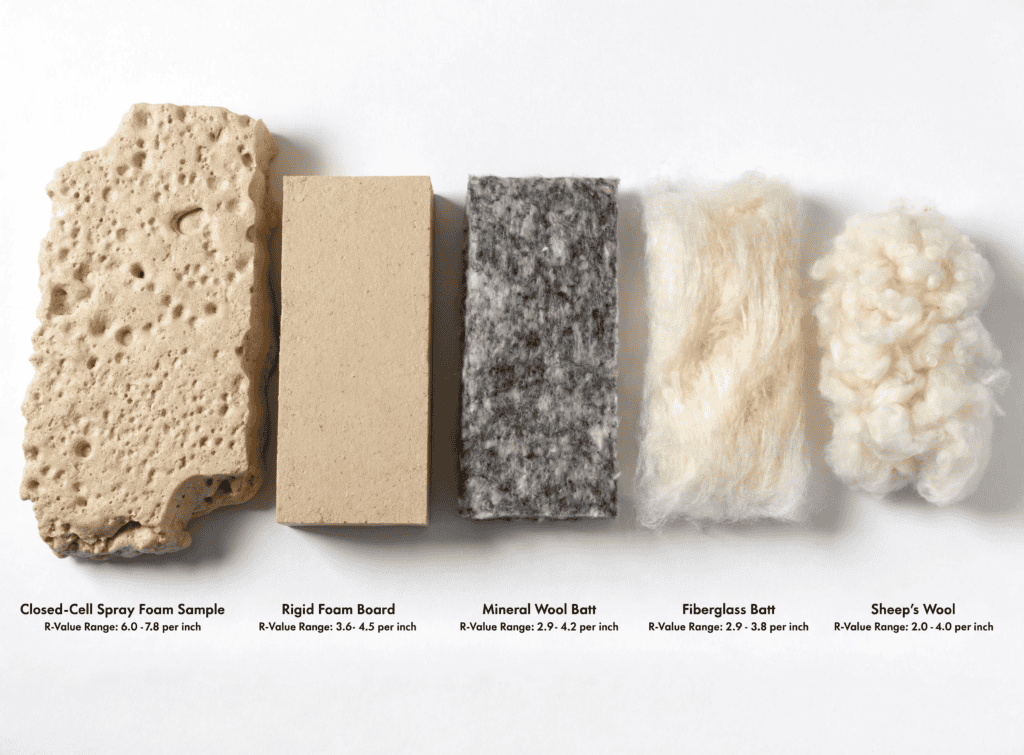
There’s no single “right” answer here—each material has trade-offs worth knowing before you spend a dime.
Closed-Cell Spray Foam
R-value per inch: R-5.6 to R-8
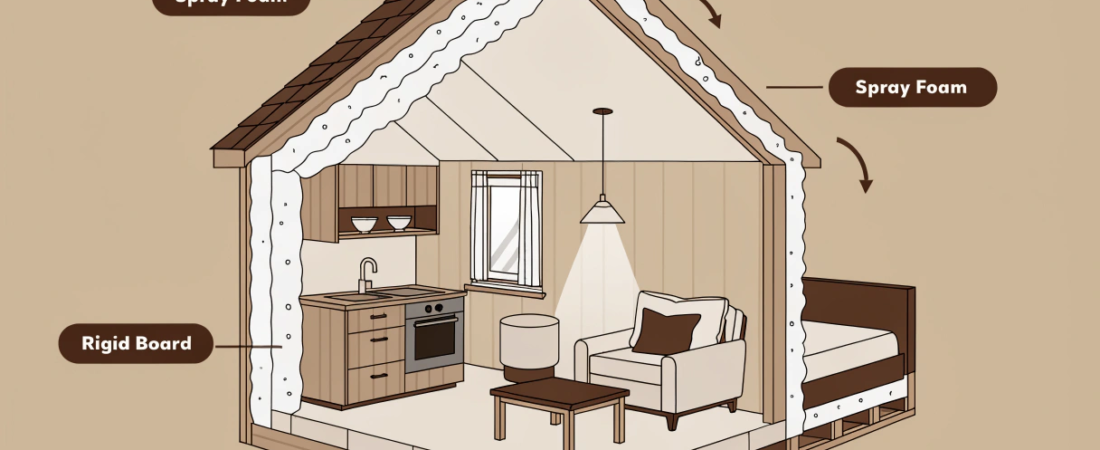
Closed-cell spray foam is the top performer on this list. Applied as a liquid, it expands and cures into a rigid, continuous layer that seals air leaks, blocks moisture, and strengthens your walls or roof assembly all at once.
For tiny homes with shallow wall cavities, that high R-value per inch is a game-changer. You get serious thermal protection without eating up precious interior space.
Pros:
- Highest R-value per inch of any common insulation material
- Acts as both an air barrier and a vapor barrier
- Adds structural strength to walls and roofs
- Moisture-resistant—ideal for tiny homes on wheels exposed to weather
Cons:
- Most expensive option ($0.90–$1.00 per board foot, per HomeGuide)
- Requires professional installation due to specialized equipment
- Difficult to remove or modify after curing
- Contains chemicals that require proper ventilation during application
Best for: Cold climates, tiny homes on wheels, and builds where wall space is limited.
Rigid Foam Board Insulation
R-value per inch: R-3.8 to R-6.5
Rigid foam boards come in three main types—EPS (expanded polystyrene), XPS (extruded polystyrene), and polyisocyanurate (polyiso). Each offers a different balance of cost, moisture resistance, and thermal performance.
These boards are especially effective under trailer floors, where they resist moisture and compress well without losing R-value. They’re lightweight, easy to cut, and manageable as a DIY project.
Pros:
- Lightweight—great for homes on wheels where weight limits matter
- Easy to install with basic tools
- Moisture-resistant (especially XPS)
- Good for floors and continuous insulation on exterior walls
Cons:
- Joints and edges need careful sealing to avoid air leaks
- Lower R-value per inch than closed-cell spray foam
- Some types degrade over time with UV exposure
Cost: $0.25–$0.75 per sq ft (material only, per HomeGuide)
Best for: Floor insulation, exterior wall sheathing, and weight-sensitive builds.
Mineral Wool / Rockwool
R-value per inch: R-3.2 to R-4.1
Mineral wool (also called rockwool) is made by spinning molten stone and steel slag into dense fibers. It comes as batts or rigid boards that press neatly into wall cavities, roofs, and floors.
What sets mineral wool apart from fiberglass is its density. The fibers hold their shape over time, making it a durable option that maintains performance in demanding conditions, while also resisting fire and shedding water without absorbing it. It’s also one of the best sound-blocking insulation materials available—a real perk if you live near traffic or camp in busy areas.
Pros:
- Fire-resistant—naturally non-combustible
- Water-repellent without losing thermal performance
- Excellent sound absorption
- Maintains shape over time—no sagging or compression
Cons:
- Heavier than fiberglass (consider weight limits on wheeled homes)
- More expensive than fiberglass batts
- Can irritate skin during installation (wear protective gear)
Cost: $1.00–$2.50 per sq ft (per HomeGuide)
Best for: Tiny homes needing fire resistance, sound insulation, or long-term stability in wall cavities.
Fiberglass Batts
R-value per inch: R-2.9 to R-3.8
Fiberglass batts are the most familiar insulation material on the market. Pre-cut panels drop into standard stud bays, making installation fast and straightforward. For anyone working with a tight construction budget, fiberglass is often the starting point.
That said, fiberglass comes with real limitations in a tiny home. Its lower R-value per inch means you need thicker walls to hit the same thermal targets. It also allows air to pass through if not paired with a proper vapor barrier, and gaps or compression can slash its effectiveness significantly—so it’s worth understanding fiberglass batts as a budget insulation choice in more detail before you commit.
Pros:
- Most affordable upfront cost ($0.30–$1.30 per sq ft, per HomeGuide)
- Easy DIY installation—no special tools required
- Widely available at any home improvement store
Cons:
- Lowest R-value per inch of all options listed
- Poor moisture resistance—can trap condensation and promote mold
- Performance drops quickly if compressed or installed with gaps
- Requires a separate vapor barrier
Best for: Budget-conscious builds in mild climates, or areas where wall depth isn’t a constraint.
Sheep’s Wool Insulation
R-value per inch: R-3.0 to R-4.0
Sheep’s wool is a natural, renewable insulation material that’s been used in construction for centuries. Treated with boric acid to reduce flammability and deter pests, it handles moisture better than most people expect—absorbing and releasing humidity without losing its insulating properties.
For eco-conscious tiny home owners, sheep’s wool ticks the sustainability box without sacrificing performance. It also adds acoustic comfort, which is a welcome bonus in small living spaces.
Pros:
- Renewable and biodegradable—minimal environmental impact
- Naturally manages moisture without mold risk when properly installed
- Good sound absorption
- Chemical-free option compared to synthetic materials
Cons:
- More expensive and harder to source than fiberglass or mineral wool
- Can attract pests if not properly treated
- Performance varies by product quality and installation
Best for: Eco-focused builds, mild to moderate climates, and owners prioritizing sustainability.
R-Value Explained: What Do You Actually Need?
R-value measures how well a material resists heat transfer. The higher the number, the better the insulation. But “higher is always better” oversimplifies it—what you actually need depends on your climate zone and which part of your home you’re insulating.
For a deeper breakdown of tiny home R-value targets by zone, check out this guide on tiny house insulation R-value.
The U.S. Department of Energy divides the country into 8 climate zones, each with specific minimum recommendations:
Area | Mild Climates (Zones 1–2) | Moderate (Zones 3–4) | Cold (Zones 5–8) |
|---|---|---|---|
Attic/Ceiling | R-30 to R-49 | R-49 to R-60 | R-60 |
Walls | R-13 | R-20 | R-20 + R-5 CI |
Floor | R-13 | R-19 | R-30 to R-38 |
Source: U.S. Department of Energy, energy.gov/energysaver/insulation |
For tiny homes on wheels that move between climate zones, it’s smart to insulate for the coldest region you plan to visit, especially if you’re intentionally designing a winter-ready tiny home for colder climates.
Best Insulation for Tiny Homes Based on Climate
Your climate zone isn’t just a number—it directly shapes which material makes sense for your build.
Warm and Hot Climates (Zones 1–3)
Heat gain is the bigger concern here. Reflective insulation or rigid foam boards work well to reduce solar heat. Closed-cell spray foam also performs well, as it blocks humidity from the warm outdoor air entering cooler wall cavities.
Mixed and Moderate Climates (Zones 4–5)
A combination approach works best here. Closed-cell spray foam in wall cavities paired with rigid foam board on the exterior reduces thermal bridging and handles both heating and cooling loads.
Cold and Very Cold Climates (Zones 6–8)
If you’re still in the planning phase, high-mass wall systems like ICF tiny house construction can combine exceptional insulation with durability in these harsher zones. Maximum R-value is the priority. Closed-cell spray foam is the strongest performer. Mineral wool is a solid secondary option for walls and roofs—its density and moisture resistance hold up well through freeze-thaw cycles.
Tiny Homes on Wheels (Multiple Zones)
Because every inch of framing matters, it also pays to understand how tiny house wall thickness affects insulation and space when you’re dialing in your build specs. Weight is a real constraint. Closed-cell spray foam and rigid foam boards offer the best R-value per pound. Avoid heavy materials like dense-packed cellulose or thick mineral wool batts if your trailer has strict weight limits.
Walls, Floors, Roof, and Sealing Air Leaks: Where Does Insulation Matter Most?
Every surface in a tiny home loses heat differently. Here’s how to prioritize:
Roof and Ceiling
Insulating ceilings prevents major heat loss in small cabins and tiny homes, since heat rises and the roof is where the most energy escapes. Target R-30 as a minimum for the ceiling, with R-60 in colder zones. Closed-cell spray foam works particularly well here—applied directly to the underside of the roof deck, it seals the assembly completely as part of a broader waterproofing and moisture-management strategy for tiny homes.
Walls
Wall cavities in tiny homes are often just 2×4 framing, giving you around 3.5 inches of depth to work with. Advanced materials can preserve flexible design options without compromising energy efficiency. Aerogel is one example with exceptionally high insulating value per thickness. That’s why R-value per inch matters so much. Closed-cell spray foam can deliver R-21+ in that space alone. Fiberglass batts in the same cavity max out around R-13.
Floor
For homes on a trailer, the floor is exposed to wind, cold air, and road moisture from below. Rigid foam boards between floor joists are a practical choice—they’re moisture-resistant, lightweight, and easy to work with. Seal all seams with spray foam to eliminate air gaps.
Windows and Doors
These are the weak points of any thermal envelope. Use double or triple-pane windows, apply caulk or foam sealant around frames, and add weatherstripping to doors. Thermal curtains add an extra layer at night and help with cooling a tiny house in summer when sun and heat gain are at their peak.
DIY vs. Professional Installation: Which Route Is Right for You?
DIY-Friendly Options:
- Fiberglass batts
- Rigid foam boards
- Sheep’s wool batts
- Mineral wool batts
These materials can all be cut and installed with basic hand tools. No special equipment, no certification required. The savings on labor can be significant, especially on a tight build budget—but remember that insulation ties directly into electrical runs and plumbing chases, so planning tiny home electrical and plumbing systems alongside your insulation layout prevents headaches later.
Hire a Professional For:
- Closed-cell spray foam
- Open-cell spray foam
Spray foam requires specialized two-component equipment, precise mixing ratios, and proper protective gear. An uneven application leaves cold spots and voids that undermine the entire insulation system. The cost of professional installation is worth it for this material, just as it often is for mini split heating and cooling systems for tiny houses that need correct sizing and setup to perform well.
Quick rule of thumb: If you’re handy and patient, batts and boards are very manageable as a DIY project. If you’re choosing spray foam, budget for a professional.
Tips for Picking the Right Insulation
Before you buy anything, run through this short checklist:
- Know your climate zone — Check the DOE’s zone map and match your R-value targets accordingly
- Measure your wall, floor, and ceiling depth — This determines how much R-value you can physically fit
- Check your trailer weight limits — If your home is on wheels, every pound counts
- Seal air leaks first — Even the best insulation underperforms if air is bypassing it through gaps around windows, doors, and electrical penetrations
- Think long-term — Cheaper upfront materials often mean higher energy bills. Closing the gap with high-performance insulation adds roughly $2,000 to a typical tiny home build but can cut monthly energy costs by up to 30% (per HomeGuide data), especially when paired with well-sized solar panels for a tiny house that take advantage of those efficiency gains
- Consider vapor management — In cold climates, moisture migrating through walls is a serious problem. Closed-cell spray foam acts as its own vapor barrier. Other materials need a separate barrier
The Bottom Line on Tiny Home Insulation

Good insulation isn’t just about comfort—it’s one of the smartest investments you can make in a tiny home. The right choice keeps your space livable year-round, protects the structure from moisture damage, and lowers your energy costs for years to come.
Closed-cell spray foam leads on performance. Rigid foam boards and mineral wool offer strong alternatives with easier DIY installation. Fiberglass works if budget is the primary concern and your climate is mild. Sheep’s wool suits eco-focused builds well. Whatever direction you go, match your choice to your climate zone, your wall depth, and your build type—and you’ll be set up for the best insulation for tiny homes that your situation allows.
Frequently Asked Questions
What is the best insulation for a tiny house on wheels?
Closed-cell spray foam is the top choice for tiny houses on wheels. It offers the highest R-value per inch (R-5.6 to R-8), acts as a vapor and air barrier, and adds structural rigidity to the walls and roof—all of which matter when a home is moving and exposed to changing weather conditions.
How do I know what R-value I need for my tiny home?
R-value requirements depend on your climate zone and the area you’re insulating. The U.S. Department of Energy provides zone-specific targets: most tiny homes need at least R-13 to R-21 for walls, R-30 for ceilings, and R-19 or more for floors. Colder zones (5–8) require higher values across all areas.
Can I insulate a tiny home myself, or do I need a contractor?
Most insulation materials—including fiberglass batts, rigid foam boards, and mineral wool—are DIY-friendly and require only basic hand tools. Spray foam, however, needs specialized equipment and should be handled by a licensed professional to ensure correct application and coverage.
What is thermal bridging and why does it matter in a tiny home?
Thermal bridging happens when heat bypasses insulation through conductive materials like metal trailer frames or wooden studs. In a tiny home, this has an outsized effect because of the smaller surface area. Adding a layer of continuous insulation (CI) on the exterior of walls helps reduce thermal bridging significantly.
How does insulation affect a tiny home’s weight capacity on a trailer?
Heavy materials like dense-packed cellulose or thick mineral wool batts add meaningful weight to a trailer build. Closed-cell spray foam and rigid foam boards offer excellent R-value at a fraction of the weight, making them better suited for homes that need to stay within a trailer’s gross vehicle weight rating (GVWR).
Is spray foam insulation eco-friendly?
Closed-cell spray foam has a higher global warming potential (GWP) due to the blowing agents used during manufacturing. Some newer low-GWP formulations are available. If sustainability is a top priority, sheep’s wool or cellulose insulation are the most eco-friendly options, as both use natural or recycled materials with minimal environmental impact.
How much does it cost to insulate a tiny home?
Costs vary by material and surface area. Fiberglass batts run $0.30–$1.30 per sq ft, rigid foam boards $0.25–$0.75 per sq ft, mineral wool $1.00–$2.50 per sq ft, and closed-cell spray foam $0.90–$1.00 per board foot. Upgrading from standard to high-performance insulation typically adds around $2,000 to the total build cost, according to HomeGuide data, and similar thinking applies when budgeting for compact, efficient water heaters for tiny houses that match your overall energy strategy.